


Lebanon–Israel Talks: A ‘Political Declaration’ and Return to UN Resolution 1701?

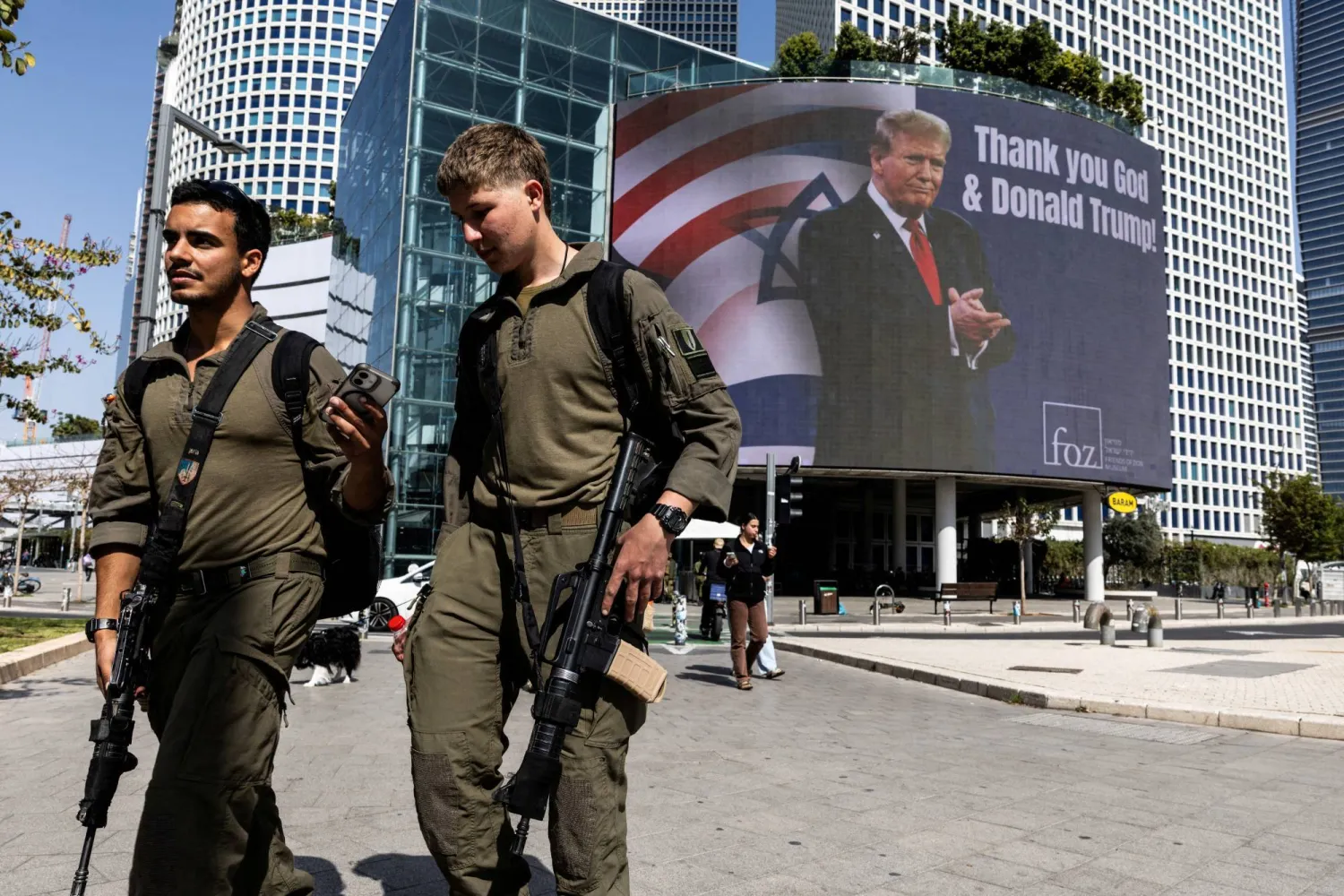
Two Israeli soldiers walk past a large billboard in central Tel Aviv reading “Thank you God and Donald Trump” (Reuters). 
TT

Lebanon–Israel Talks: A ‘Political Declaration’ and Return to UN Resolution 1701?

Two Israeli soldiers walk past a large billboard in central Tel Aviv reading “Thank you God and Donald Trump” (Reuters). 

Hopes for imminent negotiations between Lebanon and Israel have been tempered after Israeli Foreign Minister Gideon Saar said Sunday that no talks are expected in the coming days, despite reports suggesting discussions could begin this week on a French-backed plan to end the conflict.

France’s Foreign Ministry also said there was no French initiative currently on the table, casting further doubt on speculation about a diplomatic breakthrough.

Reports in Tel Aviv had suggested negotiations might begin Wednesday around a proposal centered on a political declaration that could serve as the basis for a non-aggression agreement between the two countries and possibly pave the way for a broader peace arrangement.

But Saar said Israel has no intention of entering direct negotiations with Lebanon to end the war that began earlier this month.

Political sources in Tel Aviv described his comments as a familiar Israeli tactic aimed at maintaining pressure on Hezbollah and the Lebanese government while keeping the diplomatic track ambiguous. According to these sources, Israel is unlikely to enter negotiations unless Hezbollah halts its attacks.

A Lebanese official told Agence France-Presse on Saturday that “negotiations are on the table and preparations are under way to form a delegation,” but stressed that Lebanon needs an Israeli commitment to a ceasefire before talks can begin.

Israel’s Channel 12 reported that Prime Minister Benjamin Netanyahu has tasked former strategic affairs minister Ron Dermer with handling the Lebanese file and managing any potential negotiations with the United States and Lebanon.

A source in Tel Aviv also said the US administration had asked Jared Kushner, the president’s son-in-law, to oversee the negotiations.

Meanwhile, United Nations Secretary-General António Guterres, speaking in Beirut, said diplomatic channels remain open to end the conflict between Israel and Hezbollah.

‘Positive Contribution’

Political sources in Tel Aviv said Washington had urged Israel to help create conditions for negotiations by reducing strikes in Lebanon and avoiding civilian infrastructure.

That request, however, reportedly lost momentum after the bombing of the Zahrani Bridge over the Litani River. According to the sources, Washington’s main red lines for Israel are avoiding strikes on Beirut–Rafic Hariri International Airport and the city’s seaport.

Channel 12 reported that the proposed negotiations would focus on a political declaration in which Lebanon would recognize Israel while Israel would affirm Lebanon’s territorial integrity.

The process would begin with a ceasefire followed by a gradual Israeli withdrawal from Lebanese territory.

Sources familiar with the proposal said the plan — reportedly drafted by France — includes what would be an unprecedented step: Lebanese recognition of Israel. Negotiations supported by the United States and France would aim to reach the political declaration within a month.

Paris or Cyprus?

Talks would initially take place at the level of senior diplomats before moving to higher-level political negotiations. France reportedly wants to host the discussions in Paris, while Israel prefers Cyprus.

The proposed declaration would reaffirm Israel’s commitment to Lebanon’s sovereignty and territorial integrity. Both sides would also recommit to UN Security Council Resolution 1701, which ended the 2006 war, as well as the 2024 ceasefire agreement.

Lebanon would pledge to prevent attacks on Israel from its territory and move ahead with plans to disarm Hezbollah and end its military activity. The Lebanese Army would redeploy south of the Litani River, while Israel would withdraw within a month from areas captured since the start of the current conflict.

Monitoring of ceasefire violations would be carried out through a US-led mechanism. UNIFIL would verify Hezbollah’s disarmament south of the Litani, while an international coalition authorized by the UN Security Council would oversee broader disarmament across Lebanon.

Under the French proposal, Lebanon would declare its readiness to negotiate a permanent non-aggression agreement with Israel within two months, formally ending the state of war between the two countries.

Israel would then withdraw from five positions in southern Lebanon that its forces have held since November 2024. The final stage would involve demarcating permanent borders between Israel and Lebanon — and between Lebanon and Syria — by the end of 2026.



Strike Kills at Least Four Iraqi Fighters Near Syria Border

Members of the Iraqi border forces patrol along a concrete wall on the Iraqi-Syrian border, in the town of al-Baghuz in the Al-Qaim district of western Iraq, on January 21, 2026. (AFP)
TT

Strike Kills at Least Four Iraqi Fighters Near Syria Border

Members of the Iraqi border forces patrol along a concrete wall on the Iraqi-Syrian border, in the town of al-Baghuz in the Al-Qaim district of western Iraq, on January 21, 2026. (AFP)

A strike on Monday near Iraq's western border with Syria killed at least four fighters from a former coalition, two security officials said.

The fighters from the Popular Mobilization Forces (PMF), now part of Iraq's regular army -- "were killed and three others were wounded" in the late afternoon attack on a checkpoint at the entrance to the city of al-Qaim, a local security official said, AFP reported.

An official with the PMF, which includes pro-Iranian groups, put the toll higher, at six dead, blaming the United States for the strike.

He said the checkpoint, which also housed army and police personnel, was targeted again when ambulances arrived to help victims.

Iraq has recently regained a sense of stability following years of conflict, and was unwillingly drawn into the current Middle East war after having long been a proxy battleground between the US and Iran.

Since the start of the Middle East war on February 28, bases belonging to PMF have been hit several times, with strikes mostly targeting Tehran-backed armed groups.

These groups are also united under a loose alliance called the Islamic Resistance in Iraq, which has claimed attacks against US bases in Iraq.


Israel Says Lebanese Displaced Won’t Return Until Its Own Citizens Are Safe

Israeli soldiers gather on the Israeli side of the border with Lebanon, amid escalation between Hezbollah and Israel, and amid the US-Israeli conflict with Iran, in northern Israel, March 16, 2026. REUTERS/Shir Torem
TT

Israel Says Lebanese Displaced Won’t Return Until Its Own Citizens Are Safe

Israeli soldiers gather on the Israeli side of the border with Lebanon, amid escalation between Hezbollah and Israel, and amid the US-Israeli conflict with Iran, in northern Israel, March 16, 2026. REUTERS/Shir Torem

Israel on Monday warned that displaced Lebanese driven from their homes by its military campaign would not be able to return until the safety of Israelis living near the border was ensured, as Israeli troops pushed into new parts of southern Lebanon. 

In a briefing, Israeli military spokesperson Lieutenant Colonel Nadav Shoshani told reporters that soldiers were now conducting ground operations in "new locations", describing the latest offensive as "limited and targeted". 

The extended operation began days after Defense Minister Israel Katz said the military had been ordered to expand its campaign. He later warned that the country could face territorial losses and damage to its infrastructure unless Hezbollah was disarmed. 

Israel's military, which has occupied five positions in southern Lebanon since a November 2024 ceasefire with Hezbollah, sent additional forces into the country ‌after Hezbollah fired ‌a salvo of rockets on March 2, dragging Lebanon into an expanding regional war. 

Hezbollah ⁠said its attack was in retaliation for the killing of Iran's supreme leader on February 28, the first day of the US-Israeli war with Iran. Israel has responded with an intensive bombing campaign on Lebanon. 

COMPARISON WITH GAZA 

The military has framed the ground offensive, launched after March 2, as a defensive effort to protect northern Israel from Hezbollah attacks, which it says have averaged at least 100 rockets and drones a day and have reached as far as central Israel. 

More than 880 people in Lebanon have been killed, according to Lebanon's health ministry, and more than 800,000 have been driven from their homes, many from the ⁠south as well as from areas near the capital, Beirut. 

On Monday, Katz linked the ‌return of displaced Lebanese residents to the safety of Israelis living near ‌the border. 

"Hundreds of thousands of Shiite residents of southern Lebanon who have evacuated or are evacuating their homes in southern Lebanon and ‌Beirut will not return to areas south of the Litani line until the safety of northern residents is ensured," he ‌said in a statement.  

He said the military had been instructed to destroy "terrorist infrastructure" in villages in southern Lebanon near the border with Israel, drawing a comparison to operations in cities in the Gaza Strip that were largely destroyed by Israeli forces.  

Katz also suggested that Hezbollah’s leader, Sheikh Naim Qassem, could face a fate similar to that of his predecessor, and to Iran's supreme leader, both of ‌whom were killed in Israeli strikes.  

Qassem said last week threats against his life were “worthless.” 

ISRAELI TROOPS ADVANCE WEST  

Over the weekend, Israeli troops encircled the key southern Lebanese town ⁠of Khiam and were advancing ⁠west toward the Litani River, a move that could leave large swathes of southern Lebanon under Israeli control, Lebanese security sources told Reuters. 

Israeli troops battled Hezbollah fighters in southern Lebanon throughout the day on Monday, and advanced towards Bint Jbeil, a Lebanese village and Hezbollah stronghold located about 4 km from the border with Israel, the sources said. 

Two Israeli officials said on Sunday that Israel and Lebanon were expected to hold talks in the coming days aimed at securing a durable ceasefire which would see Hezbollah disarmed. 

A Lebanese source familiar with the matter said it didn't seem talks with Israel would be taking place soon, though they would happen eventually. 

Israel's Ambassador to the United Nations Danny Danon told reporters that a "few players were trying to mediate and host talks", adding: "I believe the next step will be talks but first we have to degrade the capability of Hezbollah." 

Under the November 2024 ceasefire, Hezbollah was to pull back from southern Lebanon as the Lebanese military took over. 

Israel said Lebanon never upheld its part of the deal, continuing near-daily air strikes against what it said were Hezbollah positions and weapons.  


Iraq Hopes to Ship Oil to Türkiye by Pipeline as War Cuts off Exports

Technicians working at the Majnoon oil field in Basra, Iraq. (Reuters)
TT

Iraq Hopes to Ship Oil to Türkiye by Pipeline as War Cuts off Exports

Technicians working at the Majnoon oil field in Basra, Iraq. (Reuters)

Iraq is hoping to ship up to 250,000 barrels of oil per day to a port in Türkiye via a rehabilitated pipeline, its oil minister said, after the US-Israeli war on Iran cut off its main export route.

The amount would be just a fraction of the roughly 3.5 million barrels per day (bpd) that Iraq exported before the conflict, mostly through its southern Basra port and the Strait of Hormuz, where traffic has been severely disrupted by the war.

Authorities want to restore an old pipeline -- out of service for years -- that links the northern Kirkuk oil fields to the Turkish port of Ceyhan, where the oil could be shipped onwards to international buyers.

Oil Minister Hayan Abdel Ghani said late Sunday that the pipeline's rehabilitation is "complete, but there is a 100-kilometer section that needs to be inspected".

Teams will "conduct a hydrostatic test, which is the final phase of the pipeline's rehabilitation", hopefully "within a week", Ghani added, citing an export target of roughly 250,000 bpd.

The pipeline was damaged by the ISIS group in 2014.

Its use, however, requires "contact with the Turkish side and an agreement on logistical and technical issues", said oil expert Assem Jihad.

Initially, Baghdad wanted to send exports to the Ceyhan port via another pipeline that runs through Kurdistan.

But "so far, no agreement has been reached", Ghani said, as relations between the autonomous Iraqi Kurdistan and the federal government in Baghdad have deteriorated.

He acknowledged that "Iraqi oil exports were halted two or three days after the start of the war".

The country is also considering the possibility of transporting 200,000 bpd by tanker trucks, primarily via Jordan and Syria.

Iraq derives more than 90 percent of its revenue from oil.

Experts have warned that without this income, the state -- Iraq's largest employer -- will be unable to pay civil servants' salaries and risks a foreign currency shortage to finance imports or stabilise its exchange rate.