


Israel Doubles Troops in Hezbollah Fight, Searches Homes in South Lebanon

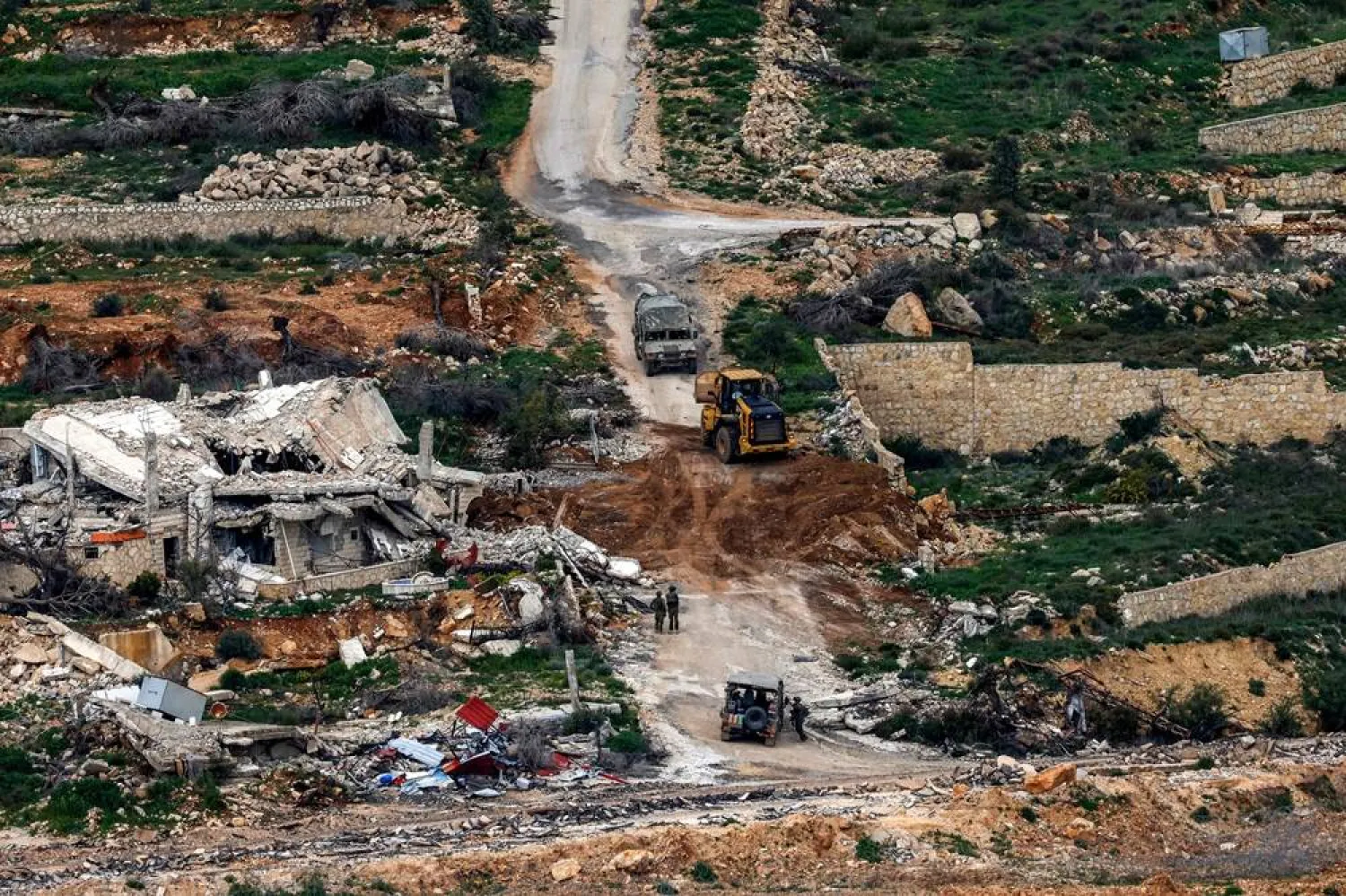
Israeli soldiers and a bulldozer conduct an operation in a southern Lebanese village along the border, as seen from a position in the Upper Galilee in northern Israel on March 18, 2026. (AFP)
TT

Israel Doubles Troops in Hezbollah Fight, Searches Homes in South Lebanon

Israeli soldiers and a bulldozer conduct an operation in a southern Lebanese village along the border, as seen from a position in the Upper Galilee in northern Israel on March 18, 2026. (AFP)

Israel has more than doubled the number of troops along its border with Lebanon since March 1 and they are searching homes in southern Lebanese villages that the military has ordered evacuated, a senior Israeli commander said on Wednesday.

As Israeli warplanes pound Beirut in operations against Hezbollah that have become the deadliest spillover of the US-Israeli war on Iran, heavy smoke could be seen rising from villages in southern Lebanon as troops fired artillery across the border.

Hundreds of thousands of Lebanese have fled southern Lebanon since Israel ordered people to clear the area south of the Litani River, viewed by Israel as a stronghold of Iran-backed Hezbollah. The group has been firing rockets toward Israel since joining the war in support of Iran on March 2.

'DEFENSIVE POSITIONS' INSIDE LEBANON

"The plan is to make sure that Hezbollah does not have military infrastructure," said the commander, whose name was withheld by the Israeli military on security grounds.

Speaking to Reuters in Eilon, an ‌Israeli town four kilometers ‌from the border, the commander, who is responsible for infantry warfare in Lebanon, declined to ‌say ⁠how many troops Israel ⁠had now deployed in the area.

Describing the military's fortifications inside Lebanon as "defensive positions", he said troops were searching "the villages to see if Hezbollah hid weapons or communications centers".

Asked if that included searching houses that residents had fled following Israeli orders, the commander said: "In some of the cases they hid their weapons in houses. We have no choice but to make sure that house is not a military installation."

Hezbollah has publicly denied using civilian infrastructure to store weapons. It accuses Israel of destroying homes to prevent Lebanese from returning, something Israel denies. Many villages in southern Lebanon have been completely destroyed.

Two Israeli soldiers have been killed since the start of operations ⁠in southern Lebanon, the Israeli military says.

At least 968 people in Lebanon have been ‌killed since the start of Israel's attacks, Lebanese authorities say.

Hezbollah has not provided ‌regular updates on deaths among its fighters. On Monday, a Hezbollah official told Reuters that at least 46 had been killed so far.

LEBANESE ‌VILLAGE OF KHIYAM AN INITIAL TARGET

The Israeli military is advancing slowly through southern Lebanon, aiming to completely clear the ‌town of Khiam as a first step before advancing toward the Litani River, according to a Lebanese security source and a foreign official tracking developments on the ground.

In response to a question on whether Israel intended to establish positions up to the Litani, the commander said it was not his decision. If troops receive orders, he added, they are "prepared to do all kinds of operations".

The Israeli military did not ‌immediately comment on its operations in Khiam, five kilometers inside the Lebanese border from the Israeli town of Metula.

Along the border near Metula, Reuters saw several Israeli military fortifications dug ⁠into hillsides, filled with rows ⁠of tanks, armed personnel carriers, and bulldozers.

Smoke rose from Khiam throughout the day on Wednesday, and many of the buildings on the southern side of the town had been reduced to rubble. A neighboring town remains in ruins from Israel's attacks in 2024.

'EVERY FIVE MINUTES YOU CAN HEAR THE BOMBS'

Israel's northern border area with Lebanon is known as the Upper Galilee, its rolling hills offering vantages into southern Lebanese villages now occupied and bombarded by Israeli troops.

Near Metula, Israeli Apache helicopters and jets were making near-constant sorties on Tuesday and Wednesday, with the sounds of rocket fire from Lebanon interspersed with the booms of Israeli artillery fire.

For residents of Israel's far north, the current war with Hezbollah has seen less rocket fire than during a year of fighting that ended in 2024.

Hezbollah's ability to launch missiles has largely been degraded, but it still retains capacity to strike areas deep inside Israel, Israeli officials say.

Ofer Moskovitz, 60, who works at an avocado farm in the area, and said being so close to the border meant he had little time to run to a bomb shelter when sirens signaled incoming Hezbollah fire.

Near his farm, the military dug out a muddy fortification from where troops fired artillery across the border.

"Every five minutes you can hear the bombs," he said.


Israeli Military Publishes Map of South Lebanon Territory Under Its Control

 Israeli military vehicles drive in southern Lebanon, near the Israel-Lebanon border, amid a 10-day ceasefire between Lebanon and Israel, as seen from Israel, April 19, 2026. (Reuters)
Israeli military vehicles drive in southern Lebanon, near the Israel-Lebanon border, amid a 10-day ceasefire between Lebanon and Israel, as seen from Israel, April 19, 2026. (Reuters)
TT

Israeli Military Publishes Map of South Lebanon Territory Under Its Control

 Israeli military vehicles drive in southern Lebanon, near the Israel-Lebanon border, amid a 10-day ceasefire between Lebanon and Israel, as seen from Israel, April 19, 2026. (Reuters)
Israeli military vehicles drive in southern Lebanon, near the Israel-Lebanon border, amid a 10-day ceasefire between Lebanon and Israel, as seen from Israel, April 19, 2026. (Reuters)

The Israeli military published ‌for the first time a map of its new deployment line inside Lebanon on Sunday, bringing dozens of mostly abandoned Lebanese villages under its control, days after a ceasefire with Hezbollah took effect.

There was no immediate comment from Lebanese officials or from Iran-backed Hezbollah.

Israel and Lebanon agreed on Thursday to a US-backed ceasefire in fighting between Israel and Hezbollah. The deal, which followed the first direct talks in decades between Israel and Lebanon on April 14, is meant to enable broader US-Iran negotiations but with Israeli forces maintaining positions deep inside southern Lebanon.

Stretching east to west, the deployment line on the ‌map runs 5-10 km ‌deep from the border into Lebanese territory, where Israel ‌has ⁠said that it ⁠plans to create a so-called buffer zone. Israeli forces have destroyed Lebanese villages in the area, saying their aim is to protect northern Israeli towns from Hezbollah attacks.

It has created buffer zones in Syria and in Gaza, where it controls more than half the enclave.

"Five divisions, alongside Israeli Navy forces, are operating simultaneously south of the forward defense line in southern Lebanon in ⁠order to dismantle Hezbollah terror infrastructure sites and to ‌prevent direct threats to communities in northern ‌Israel," the military said in a statement accompanying the map.

Asked whether people who fled ‌the Israeli strikes would be allowed to return to their homes, ‌the Israeli military declined to comment.

Lebanese civilians have been able to access some of the villages that fall on or beyond the Israeli-set line, but Israeli forces still prevent people from accessing most of those south of the line, a Lebanese security ‌source said.

Israeli Defense Minister Israel Katz said on Sunday that homes on the border exploited by Hezbollah would ⁠be demolished and ⁠that "any structure threatening our soldiers and any road suspected of (being planted with) explosives must be immediately destroyed".

Lebanon was dragged into the war on March 2, when Hezbollah opened fire in support of Tehran, prompting an Israeli offensive that has killed more than 2,100 people, including 177 children, and forced more than 1.2 million to flee, Lebanese authorities say.

Hezbollah has not disclosed its casualty figures. At least 400 of its fighters had been killed by the end of March, according to sources close to the group.

Hezbollah has fired hundreds of rockets and drones at Israel. Its attacks killed two civilians in Israel while 15 Israeli soldiers have died in Lebanon since March 2, Israel says.


Israel Re-Establishes Evacuated West Bank Settlement

Israeli Defense Minister Israel Katz, (3rd-L), Yossi Dagan, Head of the Shomron Regional Council (4th-L), and Israel's far-right Finance Minister Bezalel Smotrich (4th-R) stand for the national anthem as they attend the resettlement ceremony of Sa-Nur, south of Jenin, in the Israeli-occupied West Bank on April 19, 2026. (AFP)
TT

Israel Re-Establishes Evacuated West Bank Settlement

Israeli Defense Minister Israel Katz, (3rd-L), Yossi Dagan, Head of the Shomron Regional Council (4th-L), and Israel's far-right Finance Minister Bezalel Smotrich (4th-R) stand for the national anthem as they attend the resettlement ceremony of Sa-Nur, south of Jenin, in the Israeli-occupied West Bank on April 19, 2026. (AFP)

Israeli ministers on Sunday officially reopened Sa-Nur, a settlement in the occupied West Bank that was evacuated 20 years ago, marking the occasion with defiant declarations against Palestinian statehood and calls to resettle Gaza.

Several cabinet members and lawmakers attended the ceremony near a cluster of white prefabricated homes arranged in rows on a hilltop.

Excluding east Jerusalem, more than 500,000 Israelis now live in the West Bank in settlements that are illegal under international law, among some three million Palestinians.

"On this exciting day, we celebrate a historic correction to the criminal expulsion from Northern Samaria," Finance Minister Bezalel Smotrich said, using the Israeli biblical term for part of the West Bank.

Sa-Nur's settlers were evicted in 2005 as part of Israel's so-called disengagement policy that also saw the country withdraw troops and settlers from the Gaza Strip.

The policy promoted by then-prime minister Ariel Sharon was framed as a security measure intended to reduce Israel's civilian and military footprint in densely populated Palestinian areas.

Israel's current government, considered one of the most right-wing in the country's history, approved the reconstruction of all four northern West Bank settlements evacuated in 2005.

Authorities have approved 126 housing units in Sa-Nur alone.

"We are cancelling the shame of the disengagement, burying the idea of a Palestinian state and returning to the settlement of Sa-Nur," Smotrich said.

Smotrich, a far-right minister in the ruling coalition and a settler himself, also called for the resettlement of the Gaza Strip as a "security belt" for the State of Israel.

Israeli media reported that 16 families had moved into the re-established settlement in recent days, adding that the new residents included Yossi Dagan, head of the northern West Bank Settlements Council.

Dagan was among those evacuated from Sa-Nur in 2005.

"For me, this is both a national and a personal closing of a circle," Dagan said after cutting the ribbon at the ceremony.

"No more uprootings, no more retreats. We have returned to stay."

Israel has occupied the West Bank since 1967 and since then settlement expansion has been a policy under successive Israeli governments.

But it has accelerated significantly under the current coalition government of Prime Minister Benjamin Netanyahu.

More than 100 settlements have been approved since the government came to power in 2022, according to activists and authorities.


France’s Macron to Meet with Lebanon’s PM in Paris on Tuesday

16 February 2026, Lebanon, Beirut: Lebanese Prime Minister Nawaf Salam is pictured during a meeting at the Prime Minister's office. (dpa)
TT

France’s Macron to Meet with Lebanon’s PM in Paris on Tuesday

16 February 2026, Lebanon, Beirut: Lebanese Prime Minister Nawaf Salam is pictured during a meeting at the Prime Minister's office. (dpa)

French President Emmanuel Macron will on Tuesday meet with Lebanese Prime Minister Nawaf Salam in Paris, his office announced, amidst a fragile 10-day truce between Israel and Iran-backed Hezbollah.

The visit highlights Macron's commitment to seeing "full and complete respect for the ceasefire in Lebanon" as well as France's support for Lebanon's "territorial integrity", the president's office said on Sunday.

Israel and Lebanon on Thursday agreed to a 10-day ceasefire to give time to negotiate an end to six weeks of fighting between Israel and the group.

The visit was announced a day after France blamed Hezbollah for an ambush on UN peacekeepers which left one French soldier dead and three others wounded.

Macron is to urge Lebanese authorities to "shed full light on the incident" and "identify and prosecute those responsible without delay," his office added.

An initial assessment by the United Nations Interim Force in Lebanon (UNIFIL) found the attack was carried out by Hezbollah, according to UN Secretary-General Antonio Guterres.

"UNIFIL soldiers, who are carrying out their missions in difficult conditions and supporting the delivery of humanitarian aid to southern Lebanon, must under no circumstances be targeted," the Elysee said.

Hezbollah -- which strongly opposes to the planned Lebanon-Israel talks -- denied involvement in the attack that killed the French peacekeeper.

The fighting in Lebanon has seen UNIFIL positions repeatedly targeted by Israeli and Hezbollah forces.
