


Iraqi Factions: Tehran’s Arm in an Open War of Attrition

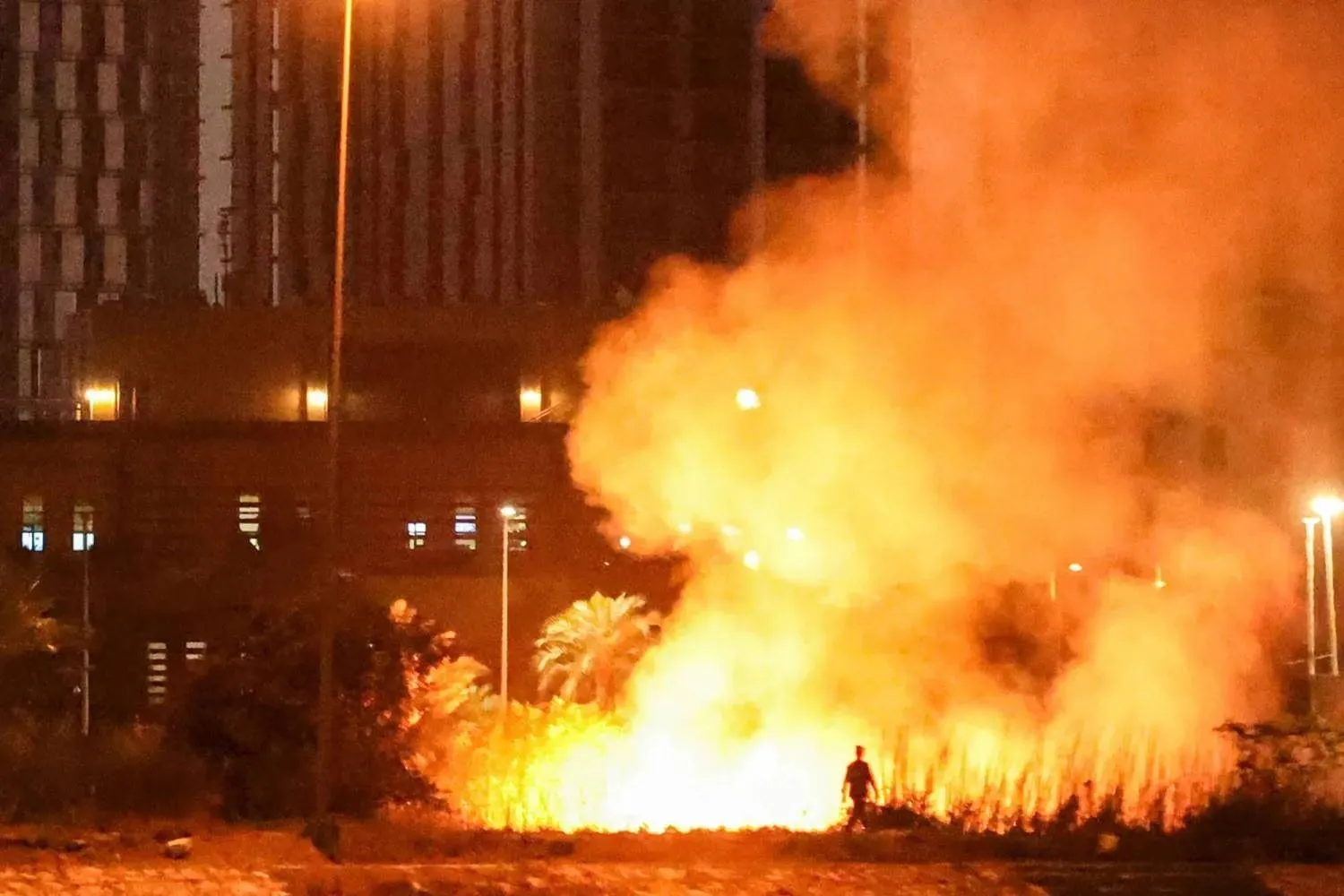
A burning fire outside the perimeter of the United States Embassy in the fortified Green Zone in Baghdad on March 17, 2026. 
TT

Iraqi Factions: Tehran’s Arm in an Open War of Attrition

A burning fire outside the perimeter of the United States Embassy in the fortified Green Zone in Baghdad on March 17, 2026. 

Since the outbreak of conflict in the Middle East, Iraqi factions aligned with Tehran have placed US interests squarely in their sights, repeatedly targeting bases hosting international forces, diplomatic missions and key oil infrastructure.

Designated as terrorist organizations by Washington, these groups had issued early warnings that the confrontation would evolve into a prolonged “war of attrition.”

Interlocking Axes

In a statement underscoring domestic production, Harakat al-Nujaba said the manufacture of drones and missiles within the so-called Axis of Resistance had become “as commonplace as making sweets in Iraqi homes.”

The factions operate under a loose umbrella known as the Islamic Resistance in Iraq, which regularly claims drone and rocket attacks against what it describes as hostile targets inside Iraq and across the region.

They form a core part of Iran’s Axis of Resistance, alongside Hezbollah in Lebanon, Hamas in Gaza and the Houthis in Yemen. Iraqi factions also pledged full support for Iran following the Israeli–US strike on Feb. 28.

Military and Political Landscape

Several actors shape the current landscape. Kataib Hezbollah is widely seen as the spearhead of attacks on US interests and has lost several commanders in past strikes. It has also developed a political role by backing a parliamentary bloc with six seats.

Kataib Sayyid al-Shuhada, led by Abu Alaa al-Walaei, is represented within the Coordination Framework, the ruling Shiite alliance with a parliamentary majority. Harakat al-Nujaba, by contrast, rejects political participation, favoring a purely military approach.

Asaib Ahl al-Haq has so far avoided direct involvement in the current fighting, focusing instead on political influence through its 27-seat bloc. It is widely seen as gradually distancing itself from its armed role.

Strategy of Attrition

Attacks have extended beyond the US Embassy in Baghdad and its airport facilities to include oil fields operated by foreign companies and sites in the Kurdistan Region, which hosts a major US consulate and military forces. The impact has also spread beyond Iraq, with Kuwait previously summoning the Iraqi ambassador after strikes hit its territory.

Lahib Higel of the International Crisis Group said the factions’ involvement reflects an “existential battle” for Iran, describing them as a last line of defense. Despite their use of drones and short-range missiles, she said Tehran continues to withhold heavier weapons compared with those supplied to Hezbollah or the Houthis. The ultimate aim, she added, is to expel US forces from Iraq.

Wave of Assassinations

The United States and Israel have responded with precision strikes. Early in the conflict, airstrikes targeted Kataib Hezbollah strongholds in Jurf al-Sakhr, south of Baghdad, as well as sites linked to the Popular Mobilization Forces.

According to Agence France-Presse, at least 43 fighters from these groups have been killed since the start of operations. The escalation peaked last Saturday when a missile struck a house in central Baghdad, killing three Kataib Hezbollah members, including a senior commander, and wounding the group’s leader, Abu Hussein al-Hamidawi.

An Iraqi security official said the wave of assassinations that began during the Gaza war in 2023 has now moved openly into Iraq, signaling a new phase of intensified confrontation.



Lebanese Army Warns Hezbollah Supporters against Undermining Civil Peace

Hezbollah supporters demonstrate in Beirut to protest the Lebanese authorities’ decision to engage in direct negotiations with Israel, on April 10, 2026. (Photo by FADEL itani / AFP)
TT

Lebanese Army Warns Hezbollah Supporters against Undermining Civil Peace

Hezbollah supporters demonstrate in Beirut to protest the Lebanese authorities’ decision to engage in direct negotiations with Israel, on April 10, 2026. (Photo by FADEL itani / AFP)

The Lebanese army warned supporters of Hezbollah against actions that could undermine civil peace, as protests in Beirut over government policy entered a second day, raising tensions in the capital.

Demonstrations involving hundreds of Hezbollah and Amal Movement supporters have taken place in central Beirut, including near government headquarters in Riad al-Solh Square, with protesters blocking roads and moving through areas such as Hamra, Raouche, Sakiet al-Janzir and the so-called Ring Bridge. The protests are aimed at pressuring the government over its decision to launch direct negotiations with Israel and to restrict weapons to state control in Beirut.

Prime Minister Nawaf Salam postponed a planned trip to the United States following the unrest.

“In light of the current domestic situation, and in order to fully carry out my duty to safeguard the security and unity of the Lebanese people, I have decided to postpone my trip to the United Nations and the United States to continue the government’s work from Beirut,” Salam said in a post on X.

The Lebanese army said in a statement it respects the right to peaceful expression but warned strongly against any actions that could endanger stability or civil peace.

“Any movement that could threaten stability, civil peace or lead to attacks on public or private property will not be tolerated,” the army said, adding it would act decisively to prevent any disruption to internal stability.

Protesters raised party flags and slogans rejecting what they described as “concessions and normalization with Israel,” insisting that “the resistance’s weapons are what liberate the land.”

Security coordination

Amid fears of escalation, President Joseph Aoun convened a security meeting at Baabda Palace attended by Defense Minister Maj. Gen. Michel Menassa and Interior Minister Ahmad al-Hajjar to review measures aimed at maintaining stability.

Salam also chaired a meeting at the Grand Serail with the defense and interior ministers, Lebanese Armed Forces Commander Gen. Rodolphe Haykal and Internal Security Forces chief Maj. Gen. Raed Abdallah to discuss the implementation of cabinet decisions to maintain security in Beirut.

The army and Internal Security Forces deployed heavily across central Beirut, including elite units, and set up checkpoints at key entry points including Hamra and Spears. Patrols were also conducted near displacement centers and in mixed sectarian neighborhoods.

Al-Hajjar said peaceful protest is permitted under the law but stressed that security forces have taken all necessary measures to protect state institutions and ensure the safety of Beirut and its residents. He called for “responsibility, awareness and national unity at this delicate stage.”

Ahead of a second rally on Saturday afternoon near the Grand Serail, security forces expanded their deployment across Beirut.

A security source said there would be “no tolerance for any attempt to undermine security or threaten civil peace,” describing stability as a “red line” and warning that any destabilization would be met with a firm response.


Palestinians Say Israeli Settlers Kill Man in Raid on Village

A damaged car in the Wadi Al-Lubban Al-Shamali area, south of Nablus, 06 April 2026. Israeli settlers burned a house, two tents, and three vehicles, and assaulted Palestinians in the town of Al-Lubban Ash-Sharqiya earlier in the day. (EPA)
TT

Palestinians Say Israeli Settlers Kill Man in Raid on Village

A damaged car in the Wadi Al-Lubban Al-Shamali area, south of Nablus, 06 April 2026. Israeli settlers burned a house, two tents, and three vehicles, and assaulted Palestinians in the town of Al-Lubban Ash-Sharqiya earlier in the day. (EPA)

The Palestinian health ministry said Israeli settlers shot dead a Palestinian man in the West Bank on Saturday, in the latest deadly attack on the occupied territory.

Ali Majed Hamadneh, 23, died after settlers opened fire during a raid on the village of Deir Jarir, northeast of Ramallah, the ministry said.

"He was brought to the Palestine Medical Complex in a critical condition" and later succumbed to his wounds, the ministry said on Telegram.

Palestinian official news agency Wafa also reported the incident.

"Armed colonists, under the protection of Israeli forces, attacked Deir Jarir from its western entrance and opened fire toward residents in the area," Wafa reported.

There was no immediate response from the Israeli police or military.

Violence in the West Bank, which Israel has occupied since 1967, has risen sharply since the October 7, 2023 Hamas attack on Israel triggered the Gaza war.

There has also been a spike in deadly attacks by Israeli settlers in the West Bank since the start of the Iran war on February 28, Palestinian authorities and the United Nations have said.

Prior to Saturday's attack, at least six Palestinians were killed since then in settler attacks, according to an AFP tally based on Palestinian health ministry figures.

Settler assaults on Palestinians have persisted for years, often to the indifference of mainstream Israeli society.

But the recent surge has prompted criticism from influential rabbis, settler leaders, and even Israel's military chief Lieutenant General Eyal Zamir, who called the attacks "morally and ethically unacceptable".


Iraqi Parliament Elects Nizar Amedi as Country’s New President

 The entrance of the Iraqi parliament building during a parliamentary session in Baghdad, Iraq, April 11, 2026. (Reuters)
The entrance of the Iraqi parliament building during a parliamentary session in Baghdad, Iraq, April 11, 2026. (Reuters)
TT

Iraqi Parliament Elects Nizar Amedi as Country’s New President

 The entrance of the Iraqi parliament building during a parliamentary session in Baghdad, Iraq, April 11, 2026. (Reuters)
The entrance of the Iraqi parliament building during a parliamentary session in Baghdad, Iraq, April 11, 2026. (Reuters)

The Iraqi parliament on Saturday elected Kurdish politician Nizar Amedi as the country's new president, a largely ceremonial role, following a parliamentary election last November.

Amedi, 58, is a former environment minister and has headed the political office of the Patriotic Union of Kurdistan (PUK) in Baghdad since 2024.

Iraq is now ‌due to ‌choose a prime minister, ‌a closely-watched ⁠and sensitive pick.

US ⁠President Donald Trump threatened in January to withdraw Washington's support for Iraq, a major oil producer, if former Prime Minister Nouri al-Maliki was designated to form a cabinet.

The pro-Iran Coordination Framework coalition that holds a parliamentary majority has ‌nominated Iran-backed Maliki, alarming Washington, which along ‌with Israel waged a six-week war with ‌Iran until a ceasefire was announced on Tuesday.

Senior US and Iranian officials were meeting in Islamabad on Saturday in ‌the highest-level talks between Washington and Tehran in half a century ⁠in ⁠an effort to end the war.

In Iraq, which has long trodden a tightrope between Iran and the US, its closest allies, the prime minister wields significant power.

Under Iraq's sectarian power-sharing system, the prime minister must be a Shiite, the parliamentary speaker a Sunni, and the president a Kurd.