


Israeli Provocations Aim to Draw Damascus into Regional Escalation

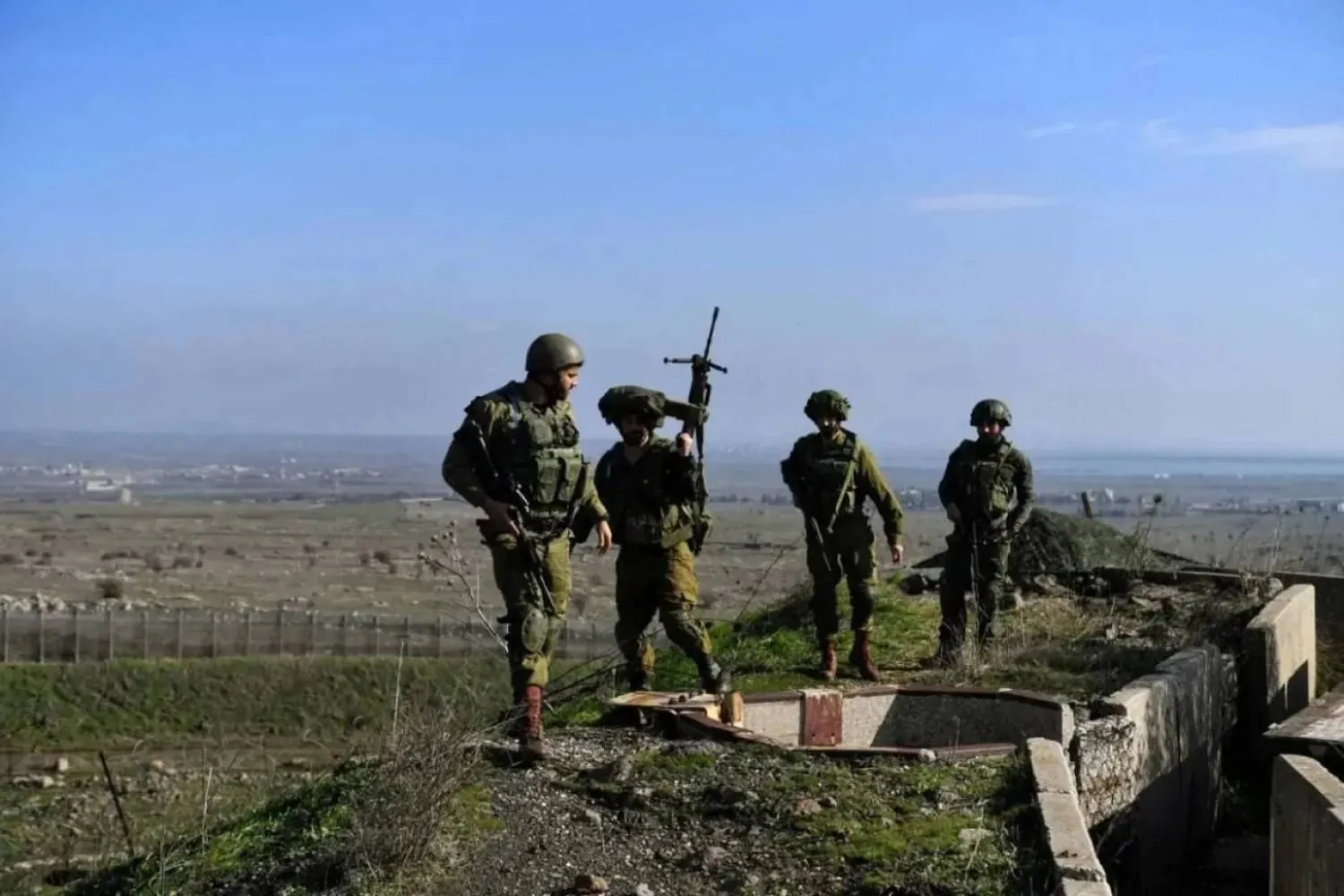
Israeli soldiers operate in the occupied Golan Heights near the Syrian border, Dec. 28, 2023 (Reuters)
TT

Israeli Provocations Aim to Draw Damascus into Regional Escalation

Israeli soldiers operate in the occupied Golan Heights near the Syrian border, Dec. 28, 2023 (Reuters)

Damascus is treading carefully to avoid being pulled into the region’s escalating tensions, but Syrian-Israeli friction has resurfaced after Israel struck Syrian army sites and military infrastructure, claiming it was acting to “protect Druze citizens in Sweida.”

The attacks drew condemnations from Saudi Arabia and other Arab and Muslim states.

Sources close to the Syrian Defense Ministry told Asharq Al-Awsat that Israel is seeking to provoke Syria and drag it into war by stoking tensions in Sweida, which has seen a string of recent security incidents.

Syrian authorities said they had foiled an attempt to smuggle weapons and ammunition intended for hostile acts.

Israel carried out a series of strikes on Friday targeting Syrian army positions and infrastructure in southern Syria.

Syria TV, citing local sources, said one strike hit the former Transport Battalion site, now used as the finance headquarters of the 40th Division, opposite Brigade 12 in the city. The attack caused material damage.

Israeli Defense Minister Israel Katz threatened to hit Syria with greater force if necessary, saying he and Prime Minister Benjamin Netanyahu had instructed the military to strike Syrian government sites.

The Israeli military said it struck Syrian army weapons depots overnight and would not allow harm to come to the Druze in Syria, adding it would continue to act to protect them.

Syria’s Foreign Ministry condemned the strikes, calling them a new aggression based on flimsy pretexts and fabricated justifications, and a continuation of Israel’s escalation policy.

Saudi Arabia, in a Foreign Ministry statement, condemned “the blatant Israeli attack” on military infrastructure in southern Syria as a “flagrant violation of international law,” and urged the international community to act.

Egypt, Jordan, Qatar, Kuwait and the Gulf Cooperation Council also condemned the raids, stressing Syria’s sovereignty and calling for an end to such attacks.

Türkiye described the strikes as a “dangerous escalation” that must be stopped, urging adherence to the 1974 disengagement agreement, which established a ceasefire and separation of forces in the Golan under UN supervision.

The Arab League said the attack fits within “Israeli plans to destabilize Syria” and undermine regional peace and security.

Arab League Secretary-General Ahmed Aboul Gheit said the strikes were not only a “blatant violation” of Syria’s sovereignty but also aimed at dragging the region into broader confrontation.

He urged the UN Security Council to act to halt repeated attacks on Syrian territory and ensure respect for international law.

Unrest in Sweida

Sources close to the Syrian Defense Ministry said Israel is working to widen the regional war and pull Syria into it, pointing to what they described as a parallel disinformation campaign about an Israeli ground advance and false reports of rockets launched from Syrian territory toward the occupied Golan.

They said Syria remains intent on avoiding conflict unless required to ward off a greater danger, and that any such move would come under Arab and international political cover.

President Ahmed al-Sharaa said after Eid al-Fitr prayers on Friday that “what is happening now is a major event, rare in history,” adding that Syria is acting with precision to avoid being drawn into conflict.

Sweida province has seen mounting security tensions in recent days. Local media said Syrian internal security forces foiled an infiltration attempt by members of the National Guard in western Sweida, triggering clashes that killed four and led to the arrest of seven others.

The National Guard, formed in Sweida in August 2025, is a coalition of local armed factions under Sheikh Hikmat al-Hijri, opposed to the Syrian authorities that overthrew Bashar al-Assad.

In a statement on Friday, Syria’s Interior Ministry said special units carried out a “precise security operation” in Sweida, thwarting an attempt to smuggle weapons and ammunition for “hostile acts” by outlaw groups on the Bosra al-Sham-Bakka road.

The ministry said the operation followed the detection of infiltrators near internal security checkpoints and suspicious movements of hostile vehicles, as part of a “criminal plot” to undermine stability.

Clashes killed four members of the group, two were arrested, and weapons and ammunition were seized. The ministry said the operation is part of ongoing efforts to pursue “outlaw gangs” and reinforce security across the province.



WHO: Strike on Sudan Hospital killed at Least 64 People

Women Muslim worshippers gather for the early morning prayers for Eid al-Fitr, marking the end of the holy month of Ramadan, at a stadium in Sudan's eastern Red Sea port city of Port Sudan on March 20, 2026. (Photo by Ibrahim ISHAQ / AFP)
TT

WHO: Strike on Sudan Hospital killed at Least 64 People

Women Muslim worshippers gather for the early morning prayers for Eid al-Fitr, marking the end of the holy month of Ramadan, at a stadium in Sudan's eastern Red Sea port city of Port Sudan on March 20, 2026. (Photo by Ibrahim ISHAQ / AFP)

At least 64 people were killed, including at least 13 children, in a strike on a hospital in Sudan's western Darfur region last week, the World Health Organization said Saturday.

The strike on the Al Daein Teaching Hospital in East Darfur on Friday also injured at least 89 people and rendered the hospital non-functional, Tedros Ghebreyesus, the head of the WHO, said on X.

Sudan slid into chaos in April 2023 when a power struggle between the military and the rival Rapid Support Forces exploded into war throughout the country.

The RSF has blamed the military for the strike on the hospital.

The army has denied the attack, but two military officials said the strike was targeting a nearby police station, The Associated Press reported. They spoke on the condition of anonymity as they were not allowed to discuss the matter openly.

The devastating war has killed more than 40,000 people, according to UN figures, but aid groups say that is an undercount and the true number could be many times higher.

The WHO has said that over 2,000 people have been killed in attacks on medical facilities since the start of the war.

“Enough blood has been spilled. Enough suffering has been inflicted. The time has come to de-escalate the conflict in Sudan,” said Ghebreyesus.


Damaged Russian Tanker to Be Towed to Libya

A series of explosions rocked the Arctic Metagaz on March 3. Miguela XUEREB / Newsbook Malta/AFP
TT

Damaged Russian Tanker to Be Towed to Libya

A series of explosions rocked the Arctic Metagaz on March 3. Miguela XUEREB / Newsbook Malta/AFP

A damaged Russian gas tanker that was abandoned in the Mediterranean will be towed to a Libyan port, according to a state-owned oil company in the north African country.

The Arctic Metagaz was ferrying about 700 tons of fuel and a consignment of liquified natural gas (LNG) from Russia to Egypt when it was hit by a series of explosions on March 3. Russia accused Ukraine of trying to blow it up.

The 30 crew members were rescued, leaving the LNG-laden carrier to drift between Malta and Libya for nearly three weeks.

Libya's National Oil Corporation (NOC) announced on Saturday that it would collaborate with Italian group Eni to fetch the wrecked vessel.

"Managing this environmental threat is fully achievable," NOC said in a statement. "It will be towed safely to one of the Libyan ports following coordination with the relevant authorities."

The company said it had already taken action to "reduce the risk of pollution".

AFP footage taken from a plane earlier this month showed the carrier listing to one side, parts of it blackened and seriously damaged by fire, with two holes on either side in the middle of the hull.

According to Italy's Civil Protection Department, the carrier is located in international waters, but within the Libyan search and rescue zone.

It said that towing the wreck would be a "complex operation" due to the "large breach along its side".

The WWF environmental group warned that any spill could cause long-lasting pollution in the area, among the most biodiverse in the Mediterranean basin.

The ship faced US and European Union sanctions as a suspected part of Russia's "shadow fleet" of vessels carrying Russian oil and gas in contravention of international sanctions.


War Deepens Lebanon’s Economic Collapse

A displaced young girl who fled with her family Israeli airstrikes in southern Lebanon, eats an apple at a playground school that turned into a shelter in Beirut, Saturday, March 21, 2026. (AP Photo/Hussein Malla)
TT

War Deepens Lebanon’s Economic Collapse

A displaced young girl who fled with her family Israeli airstrikes in southern Lebanon, eats an apple at a playground school that turned into a shelter in Beirut, Saturday, March 21, 2026. (AP Photo/Hussein Malla)

Lebanon’s economy barely catches its breath before another crisis hits, tightening the squeeze and deepening its fragility.

The current war has wiped out efforts to revive it, as the country still reels from the 2019 financial collapse, the coronavirus pandemic, the Beirut port blast, and the 2023-2024 war.

After successive governments failed to resolve its structural crisis, the latest military escalation has further weakened the economy and stalled reform efforts, despite the current government's attempts to lay out recovery plans and legislation.

Since the first week of the war, some businesses have halved employees’ working hours to cut wages, while others have shut down entirely, aside from those destroyed in Beirut’s southern suburbs and the south.

The impact has been immediate, with many workers still earning less than half their pre-2019 salaries.

Losses of $100 million a day

Nicolas Chammas, secretary-general of the Lebanese Economic Organizations and head of the Beirut Traders Association, described the war’s impact as “huge,” compounded by years of strain since 2019.

“In 2025, economic growth reached 5%, but that followed a 7% contraction in 2024,” Chammas told Asharq Al-Awsat. “We had already started this year on a negative footing, and the current war has worsened conditions.”

According to the World Bank, the 2024 war cost $14 billion, or about $225 million a day.

“Using that as a benchmark, the current war is costing roughly $100 million a day,” he said, citing damage to infrastructure, reduced economic activity, and the cost of sheltering and assisting displaced people.

Chammas said tourism and travel were among the hardest-hit sectors, with travel down by more than 80%.

“Hotel occupancy is now below 10%, and declines are also severe in car rentals, furnished apartments, and resorts,” he said. “The industrial and commercial sectors are also affected, with the latter down around 50%.”

If the war continues, he warned, growth could flip into a contraction of up to 10%.

Structural contraction

Economist Jassem Ajaka said the war has shifted the downturn from “monetary” to “structural.”

“Under full dollarization, the shock no longer shows in a currency collapse, but in paralyzed economic activity and higher operating costs,” he told Asharq Al-Awsat.

He put total losses from the previous and current wars at about $15 billion, direct and indirect, based on World Bank estimates and updated research for 2026.

With Brent crude above $115, production and dollarized service costs have risen by more than 40%, eroding companies' profit margins, he said.

The agricultural sector has been the hardest hit geopolitically, with losses of about $2.5 billion due to destroyed land and disrupted supply chains. Tourism revenues have fallen 74% compared with the 2024 season, depriving the economy of a key source of foreign currency.

Ajaka said recent Banque du Liban data showed external assets holding at about $12.07 billion, supported by liquid foreign securities.

But he warned that a prolonged war and high oil prices would gradually drain those assets to cover fuel and essential imports, threatening this “artificial stability” in the second half of the year if reserves fall below safe levels.

Latest figures

Ajaka said 30% of small and medium-sized businesses had shut down permanently by the first quarter of 2026, unable to cover dollarized operating costs amid weak demand.

Those still operating have shifted to “emergency cash flow management,” with some paying half salaries or flat dollar wages worth no more than 40% of previous levels.

Unemployment has surged to between 46% and 48%, driven not only by business closures but also by the inability of productive sectors to absorb labor costs amid rising global energy and input prices.
