Attack on Iraqi Intelligence HQ Ends Opportunities for Dialogue between Govt, Armed Factions

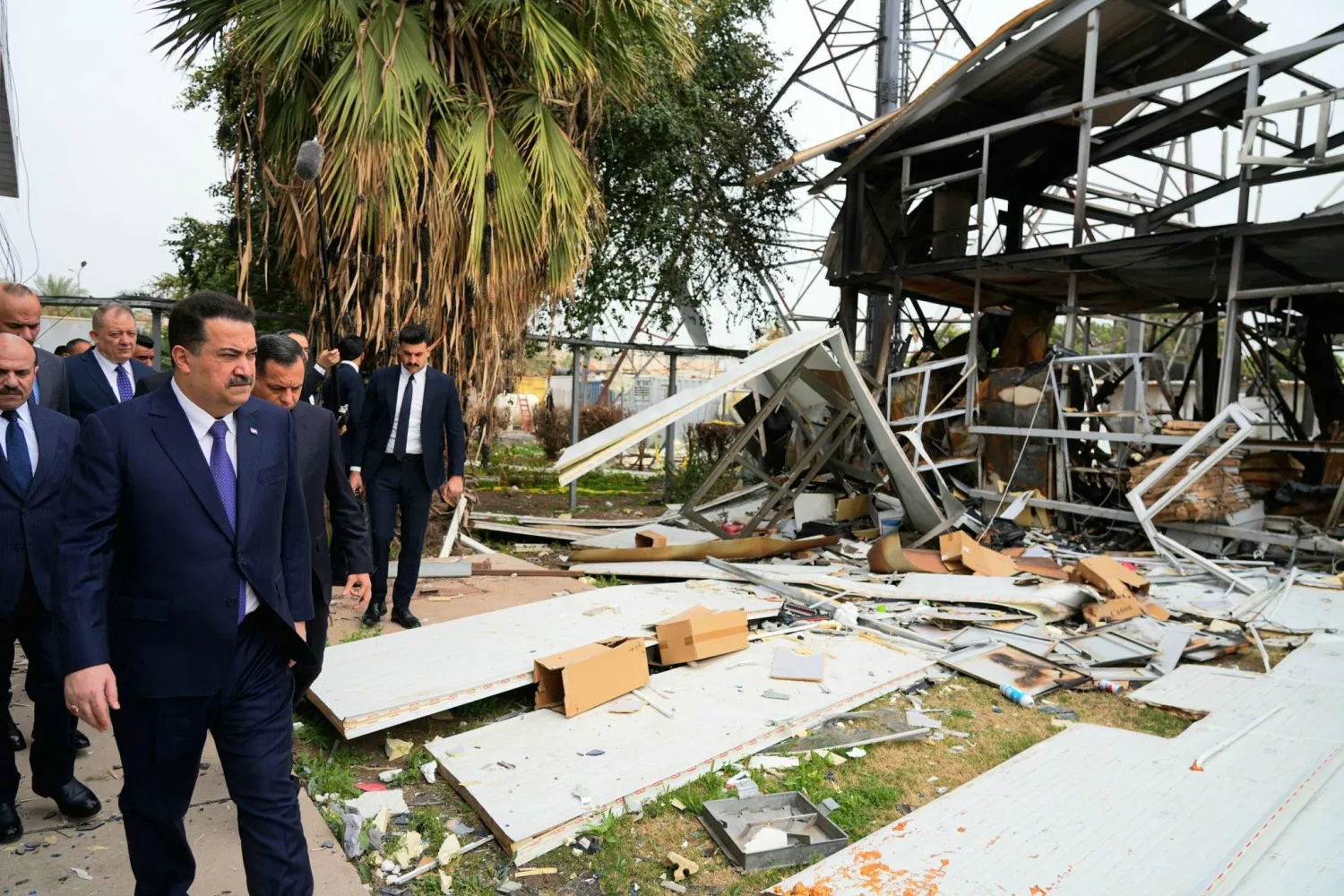
Iraqi Prime Minister Mohammed Shia al-Sudani visits the intelligence HQ in Baghdad on Sunday after Saturday's attack. (Iraqi Prime Minister’s Office)
TT

Attack on Iraqi Intelligence HQ Ends Opportunities for Dialogue between Govt, Armed Factions

Iraqi Prime Minister Mohammed Shia al-Sudani visits the intelligence HQ in Baghdad on Sunday after Saturday's attack. (Iraqi Prime Minister’s Office)

Iraqi Prime Minister Mohammed Shia al-Sudani slammed on Sunday the attack by a “cowardly” armed faction against an intelligence headquarters in Baghdad.

His position effectively puts an end to opportunities to hold dialogue between his government and the factions to stop their attacks on various US interests in Iraq and Kurdistan in solidarity with Iran in its war with Washington and Tel Aviv.

One officer was killed and other intelligence personnel were wounded in Saturday’s drone attack.

Sudani called on the political forces to take a “clear and frank” stance against the attacks on state institutions, a reference to some members of the pro-Iran Shiite Coordination Framework that have yet to make their position clear about the attacks.

The factions continue to target the US embassy in Baghdad and have struck a diplomatic logistics support base affiliated with the embassy at Baghdad airport and the US consulate in the Kurdistan Region capital Erbil.

Sudani visited the intelligence headquarters on Sunday, urging the concerned agencies to investigate the “heinous terrorist” attack.

He called on them to not hesitate in exposing the truth and bringing the perpetrators to justice.

“The perpetrators are a cowardly group that have violated Iraqi blood and state institutions. Whoever dares to do so does not represent Iraq. There can be no justification for this crime,” he added.

“The government is acting wisely and responsibly, but it will not stand idly as the country’s higher interests are violated,” he went on to say.

Sudani called on the political forces to “assume their responsibilities and issue clear and frank statements against the violations that are gambling with the future of the country.”

“Some party gave itself the right to control decisions of war and peace. We declare that this decision is the state’s alone. It alone sets and protects Iraq’s interests,” he stressed.

The national intelligence agency said outlaws had carried out Saturday's “terrorist” attack.

Sudani also denied reports that he had tasked national security advisor Qasim al-Araji to hold dialogue with the armed factions to make them stop attacks on US interests and residential neighborhoods in Baghdad.


Lebanese Army Restores Road, Bridge Damaged by Israeli Strikes

Displaced people cross a destroyed bridge which was hit few days ago in an Israeli airstrike, as they return to their villages on the second day of a ceasefire between Hezbollah and Israel in Qasmiyeh, near Tyre city, southern Lebanon, Saturday, April 18, 2026. (AP)
TT

Lebanese Army Restores Road, Bridge Damaged by Israeli Strikes

Displaced people cross a destroyed bridge which was hit few days ago in an Israeli airstrike, as they return to their villages on the second day of a ceasefire between Hezbollah and Israel in Qasmiyeh, near Tyre city, southern Lebanon, Saturday, April 18, 2026. (AP)

Lebanon's military said Sunday it had reopened a road and bridge damaged by Israeli strikes in the country's south, as a 10-day truce holds between Hezbollah and Israel.

In a statement, the military said it "fully reopened" a road linking the city of Nabatieh with the Khardali area, and had "partially reopened the Burj Rahal-Tyre bridge".

"Work is also underway to rehabilitate the Tayr Falsay-Tyre bridge... following damage caused by the Israeli aggression," the army added.

Israeli strikes on bridges that cross Lebanon's Litani river, which flows around 30 kilometers (20 miles) north of Israel, have largely cut off the area south of the waterway from the rest of Lebanon, according to the army.

On Friday a ceasefire between Israel and Lebanon took effect after the first direct talks between the two sides in decades, bringing a pause to weeks of fighting between Israel and Hezbollah that has killed nearly 2,300 people and displaced more than a million.

Since the truce began, Lebanon's military and local authorities have been working to reopen roads that were blocked due to Israeli strikes.

The vital Qasmiyeh bridge was also reopened on Friday morning, allowing countless people displaced from southern Lebanon by the fighting to return to the area and check on their property.

However, many residents have remained hesitant to venture back with the longevity of the truce uncertain.

On Saturday, an AFP correspondent in the southern city of Sidon saw heavy traffic heading to Beirut as displaced southerners returned to temporary homes and shelters in the capital after briefly visiting southern areas.

Earlier that day, Hezbollah official Mahmud Qamati warned that "Israeli treachery is expected at any time, and this is a temporary truce".

"Take a breath, relax a little, but do not abandon the places you have taken refuge in until we are completely reassured about your return," he said.

The Israeli military has carried out strikes and demolitions in southern Lebanon despite the truce.

It also said Saturday that it had established a "yellow line", similar to one in the Palestinian territory of Gaza that separates Israeli forces from areas held by the Hamas group.


Israeli Army Says Soldier Killed in Southern Lebanon

 18 April 2026, Lebanon, ---: A general view of the heavily damaged area in southern Lebanon following Israeli strikes. (dpa)
18 April 2026, Lebanon, ---: A general view of the heavily damaged area in southern Lebanon following Israeli strikes. (dpa)
TT

Israeli Army Says Soldier Killed in Southern Lebanon

 18 April 2026, Lebanon, ---: A general view of the heavily damaged area in southern Lebanon following Israeli strikes. (dpa)
18 April 2026, Lebanon, ---: A general view of the heavily damaged area in southern Lebanon following Israeli strikes. (dpa)

Israel's military said on Sunday that a soldier died during combat in southern Lebanon, where a temporary ceasefire had come into effect this week.

"Lidor Porat, aged 31, from Ashdod, a soldier in the 7106th Battalion, 769th Regional Brigade, fell during combat in southern Lebanon," the Israeli military said in a statement, without providing further details.

The total Israeli army death toll in the six-week war between Israel and Hezbollah was now 15, according to an AFP tally based on military figures.

It was the second death announced by Israel of a soldier in southern Lebanon since the start of a ten-day truce announced by the United States began on Friday -- part of wider efforts to bring a permanent end to the Middle East war.

The latest round of fighting in Lebanon -- one of the fronts in the regional war -- had begun on March 2 when Tehran-backed Hezbollah launched rocket attacks on Israel to avenge the death of its supreme leader in the opening wave of Israeli-US strikes on Iran.

Israel then responded with a strikes it said targeted Hezbollah in Beirut and the southern parts of the country where it had also launched a ground operation.


Israel Intensifies Ceasefire Violations, Destroying and Burning Occupied Lebanese Villages

Residents walk on the rubble of destroyed houses on the second day of a ceasefire between Hezbollah and Israel in Jibchit village, south Lebanon, Saturday, April 18, 2026.(AP Photo/Mohammed Zaatari)
TT

Israel Intensifies Ceasefire Violations, Destroying and Burning Occupied Lebanese Villages

Residents walk on the rubble of destroyed houses on the second day of a ceasefire between Hezbollah and Israel in Jibchit village, south Lebanon, Saturday, April 18, 2026.(AP Photo/Mohammed Zaatari)

Israeli violations of the US-brokered ceasefire on the Lebanon front continue, as military operations and airstrikes persist against targets Israel claims are affiliated with Hezbollah. This has forced residents who had returned to some southern villages to leave again immediately, fearing a rapid return to fighting.

The yellow line

These violations coincide with the Israeli army’s announcement of the creation of a “yellow line” in southern Lebanon, similar to the one in Gaza, effectively preventing residents from returning to 55 Lebanese towns located within this line.

On Saturday, the Israeli army said it had established a separating “yellow line” in southern Lebanon, similar to the line dividing its forces from areas controlled by Hamas in Gaza. It stated that it had targeted suspected militants who approached its forces along this line.

The army said that over the past 24 hours, its forces operating south of the yellow line had identified individuals it described as militants who violated the ceasefire and approached from the north of the line in what it called a direct threat. This marked the first reference to the line since the ceasefire took effect.

It added that its forces struck those individuals in several areas of southern Lebanon immediately after detecting them, in order to eliminate the threat, stressing that it is authorized to act against threats despite the ceasefire.

In this context, military and security expert Brig. Gen. Fadi Daoud told Asharq Al-Awsat that the Israeli security line is unofficial but effectively constitutes a dangerous point of friction. He said it is known in the field as the Israeli technical line along the Lebanon-Israel border. It is not an internationally recognized boundary but a security measure imposed by Israel that extends beyond the Blue Line and is used to impose facts on the ground, and could quickly trigger clashes.

An unstable situation

Amid the developments imposed by the recent war, it has become difficult to quantify Israeli violations, as UNIFIL forces are unable to enter towns under full Israeli control. A security source told Asharq Al-Awsat that violations are not limited to artillery shelling, drone strikes, or clashes with Hezbollah fighters, but also include the deliberate booby-trapping and complete demolition of homes under the pretext of destroying the group’s infrastructure.

The source described the situation in the south as unstable, warning of concerns about a return to a cycle of fighting. The source added that the Lebanese side had been monitoring developments through the mechanism committee, but the committee is currently not in place, leaving no mechanism to address new Israeli attacks.

On the ground, one person was killed in the town of Kounine and others were wounded by a suspicious object believed to be a cluster munition left over from Israeli bombardment, just hours after the ceasefire came into effect. Artillery shelling continues to be heard in several villages in the central sector, while Israeli forces fired bursts of gunfire toward the town of Aitaroun.

Field reports indicate that the town of Khiam continues to come under artillery fire. Israeli forces have also carried out demolitions in Khiam, Qantara, Shamaa, Bint Jbeil, and Bayyada. Explosions and sweeping fire were also reported in the vicinity of Bint Jbeil.

Two tracks of operations in the south

The ceasefire terms, which took effect at midnight between Thursday and Friday, have imposed a new and more difficult reality compared with the cessation of hostilities agreement reached between Lebanon and Israel on November 27, 2024.

Daoud said Israeli operations south of the Litani River are proceeding along two parallel tracks aimed at establishing a new reality on the ground. The first track involves efforts by the Israeli army to entrench its presence in villages it has taken control of, alongside continuing a policy of widespread destruction similar to what it previously carried out in Gaza.

He said the Israeli army is focusing on demolishing buildings in villages it controls in the first and second defensive lines, uprooting trees including olive trees, and setting forests on fire to turn them into completely scorched areas. He added that Israel is also clearing the rubble of destroyed homes and transporting it for recycling, indicating an intention to fundamentally alter the nature of the area.

The battle for Bint Jbeil

The second track centers, according to Daoud, on the battle for Bint Jbeil. He said the battle has two main dimensions: a symbolic one, as Hezbollah has called the city the “capital of the resistance,” and a strategic one due to its geographic location near the border, allowing whoever controls it to influence both northern Israel and southern Lebanon.

The importance of Bint Jbeil is not limited to symbolism but extends to its surroundings. Daoud said controlling the city effectively means controlling surrounding roads and towns, as it provides a tactical advantage that allows fire control over the northeastern and western sectors of the area. He added that operations inside Bint Jbeil will continue regardless of the ceasefire.

He also suggested that if a US green light is given, Israel may continue operations under what is described as “low-intensity warfare” or guerrilla-style operations, aimed at completing control over remaining Hezbollah positions in the city.

Daoud stressed that Israel’s less visible operations reflect a scorched-earth policy, turning occupied towns south of the Litani into fully devastated areas, mirroring the operational pattern seen in Gaza.