
Hezbollah Escalates its Rhetoric, Threatens Lebanese Govt

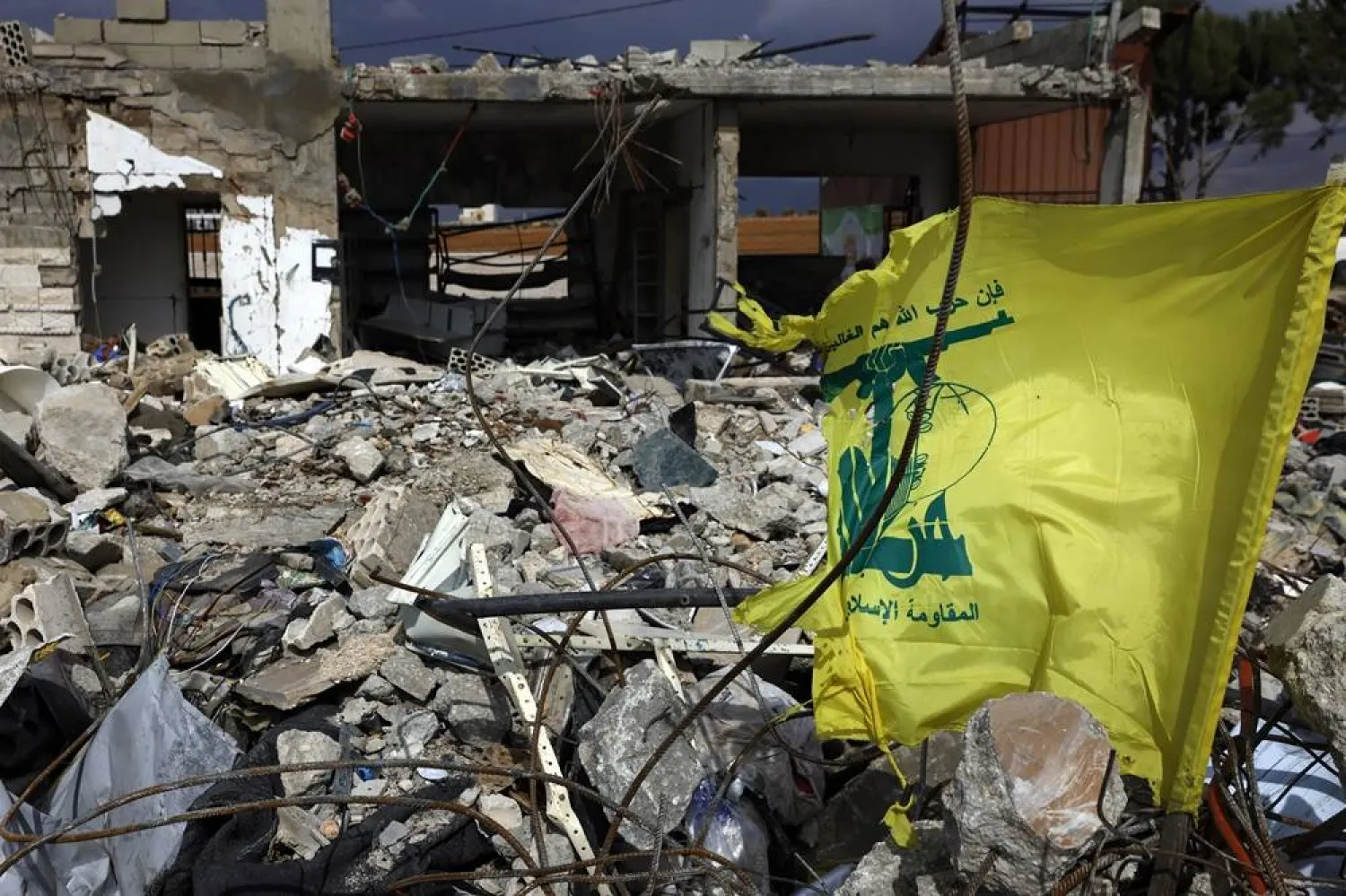
23 March 2026, Lebanon, Chaat: A Hezbollah flag is seen fixed to the debris after an Israeli airstrike that targeted a residential home in Chaat. (dpa)
TT

Hezbollah Escalates its Rhetoric, Threatens Lebanese Govt

23 March 2026, Lebanon, Chaat: A Hezbollah flag is seen fixed to the debris after an Israeli airstrike that targeted a residential home in Chaat. (dpa)

Leading Hezbollah officials decided to escalate their rhetoric against the Lebanese government, threatening to take new political approaches after the war, even as its fighters battle Israeli troops on the ground.

The Iran-backed party has decided to effectively open a new battle in Lebanon, this time against the government and the political authority.

Mahmoud Qamati, deputy head of Hezbollah's political council, said last week: “A confrontation with the political authority is inevitable after the war.”

“Hezbollah is capable of turning the country and government upside down. The party’s patience has limits, and the traitors will pay for their betrayal,” he declared.

The government has slammed Hezbollah for dragging Lebanon to a new war with Israel and banned the group’s military operations. It has also expressed readiness for Lebanon to engage with negotiations with Israel to end the war.

Hezbollah political council member Wafiq Safa echoed Qamati’s remarks, saying the party will force the government to retract its decision to ban its military operations, “regardless of the way it will do so.”

At the moment, the party will not topple the government in the streets, but it has a “new agenda” that it will implement after the war, including street action, he said.

Hezbollah opponents dismissed the threats, saying the party was resorting to such rhetoric to rally its supporters after witnessing their displacement from the war, as well as the destruction of their homes and the mounting death toll.

Change MP Mark Daou told Asharq Al-Awsat: “Hezbollah is in the heart of the battle. It will try to escalate its positions to rally its supporters given their humanitarian plight and the party’s own failure in offering the displaced any real assistance.”

The Hezbollah leadership instructed its officials to “stir debates that are fodder for the media that would portray the party as coming under attack and so as the garner the public’s support,” he explained.

“Hezbollah is suffering from successive setbacks. The decisions taken by the government since 2024 until now are mounting against it,” he remarked.

“The party’s weapons are no longer legal and its allies have distanced themselves from it,” he added. It has also lost its ally, the Syrian regime, and its main backer Iran is under attack by the US and Israel.

“Hezbollah therefore has to protect itself by resorting to stoking sectarian tensions inside Lebanon,” Daou noted.

As for the post-war phase, that is up to the state to manage, such as reconstruction, protecting the people and addressing the affairs of the displaced, said the MP.

“The state will decide what will happen after the war. The Lebanese army also has a major responsibility to secure the situation in Lebanon and stop Hezbollah’s military operations so that the state can have control over decisions of war and peace,” he remarked.

Jad Al-Akhaoui, a Shiite opponent to Hezbollah and head of the Lebanese Democratic Coalition, said the party’s escalating rhetoric against the government “reflects changes in its political and military environment.”

“The blows it has suffered on various levels forced it to stoke tensions to compensate for its relative losses on the ground,” he told Asharq Al-Awsat.

He noted that there have been rising calls within the Shiite community, which is the party’s main support base, demanding that the state impose monopoly over arms and that Hezbollah be held responsible for dragging Lebanon to war.

Hezbollah has reacted to these calls by adopting a sharper rhetoric in an attempt to intimidate its internal opponents and prevent a new political movement that works against it from emerging, he explained.

On Safa’s statements, Al-Akhaoui said Hezbollah is sensing that there will be official or international efforts to curb the party’s activities after the war.

“So, it is acting preemptively by drawing red lines as if to say that any decision about his weapons will be confronted, perhaps through means that go beyond traditional politics,” he remarked.

Al-Akhaoui ruled out that Hezbollah would succeed in having full control over post-war Lebanon as it did before the conflict. “It will still hold major sway and have the ability to obstruct or impose conditions, but not have total control,” he added.


Sadr Says Armed Wing to Join Iraqi Gov’t

An Iraqi man walks past a poster of Moqtada al-Sadr wearing Saraya al-Salam military uniform on a street in Baghdad (AFP)
TT

Sadr Says Armed Wing to Join Iraqi Gov’t

An Iraqi man walks past a poster of Moqtada al-Sadr wearing Saraya al-Salam military uniform on a street in Baghdad (AFP)

Shiite cleric Moqtada al-Sadr, leader of the Sadrist movement, said on Wednesday he had decided to sever his movement’s ties with its armed wing, Saraya al-Salam, and place its members under the authority of the state, in a move that comes amid political and government efforts to restrict weapons to the state and regulate the work of armed factions in Iraq.

Sadr had previously announced that he was dissolving his armed wing, but his latest position coincides with the arrival of a government working under regional and international pressure to disarm armed factions.

Observers said Sadr’s latest decision carries weight because it hands his Saraya al-Salam fighters over to the authority of the new prime minister, Ali al-Zaidi.

“It has become necessary for us to announce the complete separation of Saraya al-Salam from the movement and their full integration into the state and the general authority responsible for military formations, provided that the civilian bodies attached to Saraya al-Salam are transformed into Al-Bunyan al-Marsous, with no offices, weapons, uniforms, titles or anything else,” Sadr said in a statement.

“In the end, I can only thank the military formations of Saraya al-Salam for all their jihad, and may God forgive them,” he added.

Saraya al-Salam is part of the Popular Mobilization Forces through brigades 313, 314, and 315. It carries out security duties across several areas, most notably in Samarra.

Sadr called on “the remaining factions in the Popular Mobilization Forces to separate themselves from partisan and sectarian orders” and urged them to hand over their weapons to the state, saying he had offered such advice years earlier.

Government welcomes move

In a swift response, Iraqi Prime Minister Ali al-Zaidi welcomed the move, describing it as “an important path toward strengthening internal stability and consolidating the principle of restricting weapons to the state.”

Zaidi said in a statement that the current phase “requires unifying efforts and placing the higher national interest first.” He called on all armed factions to work under the umbrella of the state and its official institutions, stressing that the state “is the only authority authorized to carry weapons and enforce the law.”

Sadr’s announcement comes as the Iraqi government seeks to implement a program to restrict weapons to the state, a pledge included in the current government’s ministerial program, alongside discussions within the Coordination Framework over mechanisms to regulate and hand over weapons.

Sources said some factions had shown relative “flexibility” on the issue compared with their previous, more hardline positions, while others still reject including what they call “resistance weapons” in any disarmament measures.

It is widely rumored that five armed factions have agreed to place their weapons under government institutions, without clear details on how the possible process would be carried out, while Harakat al-Nujaba and Kataib Hezbollah have refused to comply with disarmament requests.

Nazim al-Saidi, head of the executive council of Harakat al-Nujaba, said earlier this month that measures to restrict weapons target “uncontrolled” arms that cause “chaos,” not “resistance weapons.”

Former lawmaker Sajjad Salem questioned whether the decision could be implemented, saying Sadr had previously announced the separation of Saraya al-Salam from the movement, “but the decision was not carried out.”

Salem said armed factions rely on weapons to secure their political and financial influence, adding that the Sadrist movement “has an exceptional ability to organize and mobilize with almost no resources,” a reference to the difficulty other factions may face in giving up their weapons.

Former Prime Minister Mustafa al-Kadhimi also commented on the move, saying the decision “stems from a high level of concern for the supreme national interest, and from a deep awareness of the need to push toward strengthening the path of the state and its institutions.” He described it as “a position worthy of praise and welcome.”

The leader of Asaib Ahl al-Haq also paved the way for the handover of his weapons. On Wednesday, he stressed that his political project supports “the state, sovereignty and stability, not a project of chaos,” as he put it.

Qais al-Khazali said in press remarks that “the current phase requires moving toward consolidating state institutions and strengthening their role in confronting internal and external challenges.”

Disarmament plan

Asharq Al-Awsat reported on May 9, 2026, that an Iraqi committee, including Prime Minister-designate Ali al-Zaidi, outgoing Prime Minister Mohammed Shia al-Sudani, and Hadi al-Amiri was working to complete an “executive project” to disarm armed factions before presenting it to Washington, amid mounting US pressure to keep militias away from the new government and state institutions.

The committee had presented militia leaders with “ideas on how to disarm,” but some meetings “did not pass calmly,” according to people familiar with the matter.

The plan includes removing heavy and medium weapons and restructuring the Popular Mobilization Forces, in parallel with expected changes in sensitive security agencies, which could include the intelligence service.

But political sources questioned the government’s ability to implement the project, saying it may be intended to “buy time.” In contrast, prominent factions, including Kataib Hezbollah and Harakat al-Nujaba, have said they reject handing over their weapons “whatever the cost.”


Yemen Transport Minister Says Two Arabian Sea Ports Planned

A view of Aden International Airport earlier this year (Reuters)
TT

Yemen Transport Minister Says Two Arabian Sea Ports Planned

A view of Aden International Airport earlier this year (Reuters)

The Yemeni government is betting that rebuilding the transport sector can help revive an economy battered by more than a decade of war that has left airports, ports and roads badly damaged.

Yemeni Transport Minister Mohsen al-Amri told Asharq Al-Awsat that rebuilding the sector “requires resources, capabilities, investments and effective partnerships with donors, international institutions and the private sector.”

Al-Amri said the ministry was working under “a phased vision” to expand airport capacity and reconnect Yemeni governorates with the region and the wider world. It is also seeking to develop two ports on the Arabian Sea “to improve logistics services, support maritime trade and connect coastal areas to regional and international trade routes,” he said.

The Houthi group, meanwhile, has limited itself to estimating the sector’s losses without acknowledging responsibility.

Al-Amri said the damage since the start of the war had been extensive across air, sea and land transport.

“We cannot determine any figures in this regard at the present time, and there is no doubt that rebuilding Yemen’s transport sector requires resources, capabilities and investments with the private sector,” he said.

The minister praised Saudi Arabia’s continued support across several fields, including transport, saying its impact was reflected in improved services.

The Houthi group issued a report several days ago, presented at an event attended by some of its leaders, putting cumulative war damage and losses across transport sectors at $23.2 billion.

It claimed it could restore the operational readiness of damaged facilities in areas under its control within weeks, but did not set out a strategy.

Reconnecting Yemen

Recent moves by Yemen’s Transport Ministry point to a broader government push to rehabilitate airports and ports and increase the capacity of air and sea gateways. The government says the plan aims to turn Yemen into a hub linking international trade corridors, drawing on its strategic location.

Al-Amri said the ministry was pursuing a phased plan to turn several local airports into international airports, including Al-Ghaydah in the eastern governorate of Al-Mahra, Ataq in the central governorate of Shabwa and Mokha in the southwestern governorate of Taiz.

The plan also includes upgrading Seiyun airport in the east and Socotra airport in the south, with the aim of “linking Yemeni governorates to the regional and international spheres.”

The government is also seeking to revive maritime transport through new port projects, led by Qarma port on Socotra island in the Indian Ocean and Brom port in the eastern governorate of Hadramout.

Al-Amri described the two ports as “strategic projects” that would ease pressure on main ports, improve logistics, stimulate maritime trade and connect coastal areas to regional and international trade routes.

He said the ministry sets transport project priorities based on population density, economic importance, development and service impact, and the ability to facilitate the movement of people, trade and aid. Project readiness and financing prospects are also considered, he said, along with the goal of balancing development among governorates and directing resources by priority.

In recent weeks, the Transport Ministry has stepped up foreign outreach through talks and cooperation agreements with the European Union, the International Civil Aviation Organization, Morocco and Egypt. The aim is to secure technical and professional support to develop airports and ports, train personnel and modernize air navigation systems.

Al-Amri said the government does not see transport development as a services project alone, but as part of a wider plan to restore state institutions and strengthen their economic role.

Houthi denial

The Yemeni government expects its plans to help move Yemen from a country exhausted by war into a hub linking international trade corridors, using its position on the Red Sea, the Gulf of Aden and the Arabian Sea. It also expects the plans to cut transport and insurance costs, stimulate trade, attract private investment and support economic recovery.

By contrast, the Houthi group’s claims and loss estimates expose the depth of deterioration in one of the most vital sectors under its control, whether from its use of facilities and installations as military bases and barracks, or from attacks linked to escalation in the Red Sea and against Israel.

According to the group’s figures, losses at the ports of Hodeidah, Al-Salif and Ras Isa on Yemen’s western coast exceeded $8.7 billion. Airport losses topped $2 billion, with major airports knocked out of service, Sanaa International Airport damaged, thousands of kilometers of roads destroyed and more than 100 bridges wrecked.

The group has avoided acknowledging responsibility for destroying these facilities and damaging the sector, particularly after it detained four Yemenia Airways aircraft at Sanaa airport. The planes were destroyed by Israeli airstrikes last May in response to Houthi missile attacks.

The gap between government development plans and Houthi loss figures shows that transport has become one of the central arenas for rebuilding the Yemeni state. Reopening airports and ports is not just about improving services. It is about restoring key tools of economic sovereignty, easing the movement of trade and aid, and reconnecting Yemen’s regions with one another and with regional and international markets.


Israel Tests Nabatieh Defenses, Seeks to Isolate the City in South Lebanon

Smoke rises from Beaufort Castle following strikes, as seen from Marjayoun, southern Lebanon, May 27, 2026. REUTERS/Stringer
TT

Israel Tests Nabatieh Defenses, Seeks to Isolate the City in South Lebanon

Smoke rises from Beaufort Castle following strikes, as seen from Marjayoun, southern Lebanon, May 27, 2026. REUTERS/Stringer

The Israeli army made on Wednesday further incursions around the southern Lebanese city of Nabatieh beyond the Israeli-declared "yellow line” while increasing airstrikes up to 20 kilometers from the border and forcing the full evacuation of towns around the city.

The advance followed Israeli threats to expand beyond the yellow line and coincided with what Israel’s Channel 14 described as the widespread, systematic destruction of more than 10,000 buildings in southern Lebanese border villages, about 70% of the structures Israel plans to demolish in the area.

“We are expanding our operations in Lebanon to deepen the scale of the damage we are inflicting on Hezbollah,” Israeli army Chief of Staff Eyal Zamir said on Wednesday.

Hayat Al-Aqleh embraces her 18-month-old son Ali at Jabal Amel Hospital in the southern port city of Tyre, Lebanon, Wednesday, May 27, 2026, after he underwent head surgery for injuries sustained in an Israeli airstrike a day earlier in the village of Charnay near Tyre. (AP Photo/Mohammad Zaatari)

New push north of the river

Israeli forces entered eastern Zawtar, a town on the northern bank of the Litani, advancing on its outskirts as they sought to reach the strategic Beaufort Castle east of Nabatieh.

The castle overlooks, from the east, Lebanese towns under Israeli occupation, as well as northern Israeli settlements less than 10 kilometers away. Israel has placed the castle and the towns of Zawtar, Arnoun and Yohmor al-Shaqif within the yellow line, although they lie north of the Litani.

Local sources in southern Lebanon told Asharq Al-Awsat that Israeli forces sent unmanned vehicles deep into an area near Mayfadoun to probe defenses and reconnaissance capabilities.

They said the move pointed to attempts to push toward the hills south of Nabatieh, especially Mayfadoun and Shawkin, to isolate the city, which was placed under a full evacuation warning on Wednesday for a second day in a row.

The sources said airstrikes intensified on Beaufort Castle and nearby Yohmor, Kfar Tebnit and Arnoun, areas overlooking Nabatieh from the east.

The Israeli army gave no details on the fighting.

In a statement sent in response to a question from Agence France Presse and attributed to a military official, the army said it was operating in a targeted manner beyond the forward defense line to eliminate direct threats to the citizens of the State of Israel and to soldiers ... in accordance with directives from the political leadership.

Specific details regarding the locations of soldiers cannot be provided, the official said.

Clashes at point-blank range

In a statement Wednesday, Hezbollah said its fighters "clashed with the enemy forces at point-blank range" with light and medium weapons in the town of Zawtar al-Sharqiyah.

Since dawn on Tuesday, Hezbollah had said it targeted Israeli forces trying to enter the town with rocket-propelled grenades and explosive drones. It later said its fighters fired rockets and drones at Israeli forces on the town’s outskirts and near its entrance by the riverbed.

Al-Manar, Hezbollah’s television channel, said Israeli forces were moving along three axes on the outskirts of Zawtar al-Sharqiyah from the Hamra side. It said clashes were underway at three points, but denied that Israeli forces had advanced toward Mayfadoun or the inner neighborhoods of Zawtar al-Sharqiyah.

The town’s position north of the Litani gives it strategic significance due to its proximity to Nabatieh, southern Lebanon’s largest city. Israel accuses Hezbollah of violating the ceasefire.

Zawtar al-Sharqiyah lies next to the yellow line that the Israeli army drew last month in southern Lebanon. The line runs around 10 kilometers deep inside Lebanese territory and where residents have been warned not to return.

The advance into the town coincided with an Israeli army statement on Tuesday saying it was “operating in a targeted manner beyond the forward defense line to eliminate direct threats to the citizens of the State of Israel and to soldiers.”

Emptying Nabatieh’s surroundings

As it tries to advance, Israel is also working to isolate Nabatieh and its surroundings by expanding the fire-enforced buffer zone to nearly 20 kilometers from the border.

Field sources in southern Lebanon told Asharq Al-Awsat that the line of fire had been cleared to Doueir, where no one can now enter, including ambulances, which need permission from the so-called mechanism - an internationally brokered monitoring committee established to oversee the ceasefire - to access the town.

Civil defense members search for victims in the rubble of a residential building hit the previous day by an Israeli strike near the southern town of Burj al-Shamali, on the outskirts of Tyre, on May 27, 2026.(Photo by KAWNAT HAJU / AFP)

The sources said the evacuation sweep covered Doueir, Harouf, Jebchit, Zebdine, Toul, Kfar Jouz, Deir al-Zahrani, Habboush, Kfar Roummane, Mayfadoun and Shawkin. It also included towns north of the river, southwest of Nabatieh, overlooking the Litani’s bank.

The developments came hours after evacuation warnings on Tuesday covered about 50 Lebanese villages and towns, including all towns in the districts of Bint Jbeil, Marjayoun and Tyre, as well as a large part of the Nabatieh district.

The Israeli army carried out about 150 airstrikes on Tuesday, killing 31 people and wounding 40, according to Lebanon’s Health Ministry. The ministry said 14 people were killed in Burj al-Shamali near Tyre.

On Wednesday, the bombing expanded into the Zahrani district, hitting Tafahta, as well as large parts of villages around Nabatieh. Lebanon’s official National News Agency said a strike near Nabih Berri Governmental Hospital caused “major damage to hospital wards.”