


Israel Expands Warnings to Hezbollah-linked Money Changers

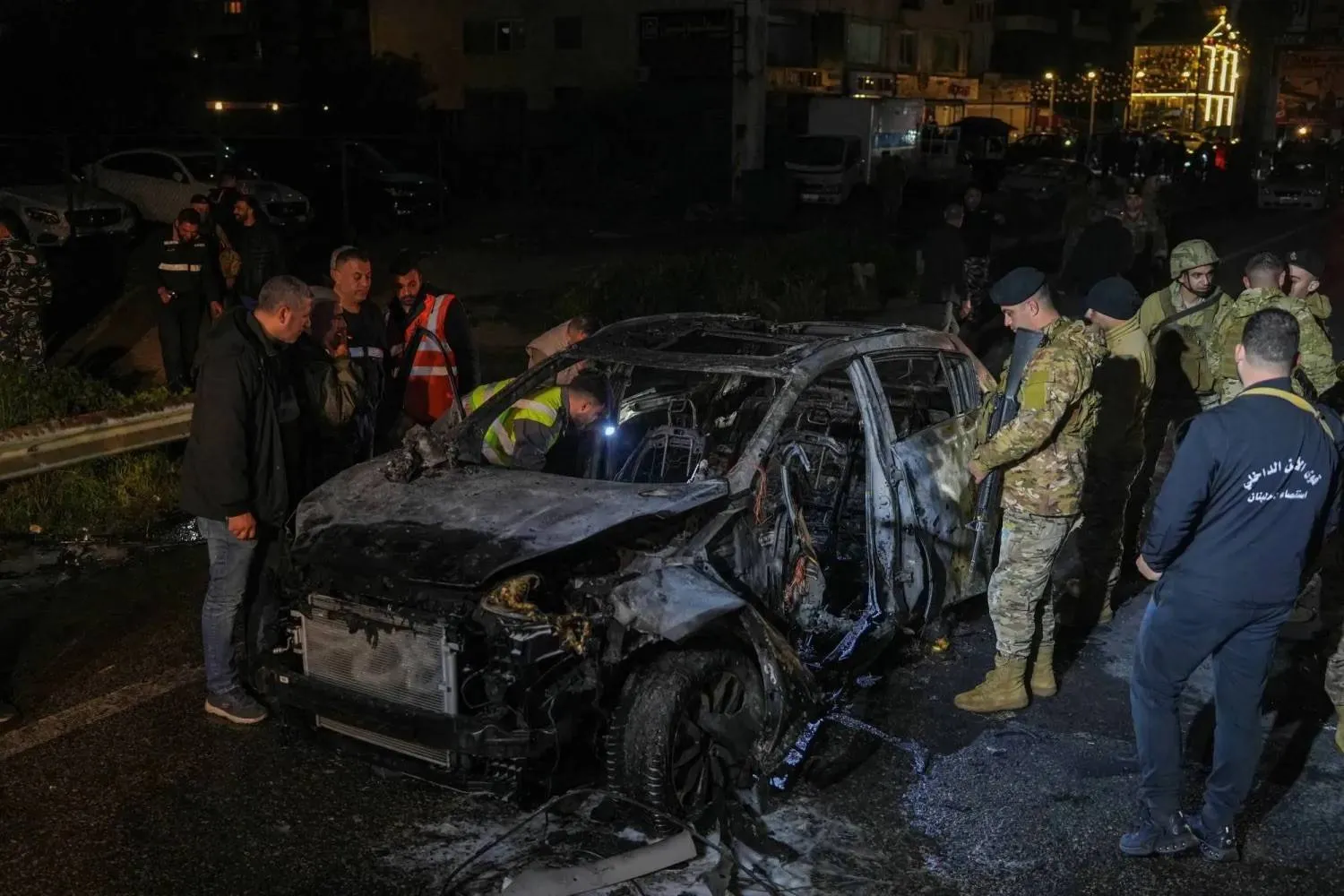
Lebanese security personnel at the site of an Israeli strike targeting senior military commander Youssef Hashem in the Jnah area on the outskirts of Beirut (Reuters). 
TT

Israel Expands Warnings to Hezbollah-linked Money Changers

Lebanese security personnel at the site of an Israeli strike targeting senior military commander Youssef Hashem in the Jnah area on the outskirts of Beirut (Reuters). 

The Israeli army said it has killed a senior Hezbollah commander, Youssef Ismail Hashem, in a naval strike, as it widened its warnings in Lebanon to include individuals it accuses of handling the group’s finances.

The military described Hashem as Hezbollah’s “southern front commander”, adding he had more than 40 years of experience and was one of Hezbollah’s “major pillars”.

A security source told AFP that Hashem, also known as Sayyed al-Sadeq, was responsible for Hezbollah’s military and security file in Iraq and was killed in a strike on the Jnah area of Beirut. Lebanon’s health ministry said the attack killed seven people.

The source noted that Hashem “was in a meeting with other party members inside a tent near several vehicles” at the time of the attack.

A source close to Hezbollah confirmed the killing, describing him as “the most senior official targeted since the start of the war”. Hezbollah also announced the death of one of its members, Mohammad Baqer al-Nabulsi, who was killed in the same strike.

US sanctions

Hashem has been under US sanctions since 2018 for working for or on behalf of Hezbollah, according to the US Treasury.

The Treasury noted that he oversaw Hezbollah’s operational activities in Iraq and was responsible for protecting the group’s interests there.

It added that he managed relations with armed groups in Iraq, including coordinating the deployment of fighters to Syria.

Senior figure

Hashem is the most senior military figure killed since the start of the war, succeeding Ali Karaki, who was assassinated in an Israeli strike that targeted former Hezbollah secretary-general Hassan Nasrallah in Beirut’s southern suburbs on Sept. 27, 2024.

Israel had previously targeted lower-ranking commanders, including Hassan Salameh, head of Hezbollah’s “Nasr Unit”, who was killed on March 10.

According to Israeli media, Hezbollah’s southern front is divided into three sectors — the Nasr, Aziz and Badr units — which operate independently, with Hashem overseeing all three.

Warnings broadened

Israel has expanded its warnings in Lebanon to include “money changers working in the service of Hezbollah”.

Israeli army spokesman Avichay Adraee said in a post on X that the military had targeted Hezbollah funding sources during the war, including the Al-Qard al-Hassan association and fuel networks.

“Another source that has been targeted is the network of money changers, which constitutes the main and most important financial source for this terrorist organization,” he added.

He named Mohammad Noureddine and Hussein Ibrahim as key money changers working for Hezbollah.

Addressing them directly, he said: “Due to your involvement in financing Hezbollah, the IDF warns you that continuing to fund Hezbollah puts you at risk.”

He also urged Lebanese citizens to avoid “any contact with Hezbollah money changers” and to “stay away from them” for their own safety.

Security zone plans

The intensified strikes come as Israeli Defense Minister Israel Katz said that “at the end of the operation, the Israeli army will establish a security zone inside Lebanon along a defensive line against anti-tank missiles”.

He added that Israel would maintain security control over the area up to the Litani River, about 30 kilometers from the border.

Lebanese Defense Minister Michel Menassa condemned the remarks, saying they “no longer constitute mere threats, but reflect a clear intention to impose a new occupation of Lebanese territory”.


UN Resumes Operations in Sudanese Capital after 3 Years of War

Officials are seen at the reopening ceremony in Khartoum. (Asharq Al-Awsat)
TT

UN Resumes Operations in Sudanese Capital after 3 Years of War

Officials are seen at the reopening ceremony in Khartoum. (Asharq Al-Awsat)

The United Nations announced on Thursday that it was officially resuming operations in the Sudanese capital Khartoum after three years of war.

UN Resident Coordinator and Humanitarian and Development Coordinator in Sudan Denise Brown said the move was significant and allows UN agencies to reach all areas that were previously inaccessible.

Speaking at a press conference at the UN mission in central Khartoum, she added that the organization will continue its support to the state and individuals to end the war and reconstruct Sudan.

The UN quit Khartoum for Port Sudan shortly after the eruption of the war between the army and Rapid Support Forces in April 2023.

Sudanese Foreign Minister Mohi El-Din Salem said the UN’s return to Khartoum was an important message to internal partners that “we are working side by side to restore peace and stability in Sudan.”

“As we have reclaimed Khartoum from the rebel RSF, we will reclaim the regions of Darfur and Kordofan,” he told a press conference.

“We will work with the UN through the initiative proposed by Prime Minister Kamil Idris to the Security Council in December to end the war and restore peace and stability in Sudan,” he stressed.

Moreover, he said that Sudan was “open to all initiatives to reach sustainable peace,” while also rejecting any truce that allows the RSF to return to the Sudanese scene.

Sudan and the UN will work together to restore stability through intra-Sudanese dialogue, declared the FM. “Only the Sudanese people will decide the fate of their country.”


IOM Warns of 'Alarming' Risk of Long-term Mass Displacement in Lebanon

The rubble of a destroyed building, seen from inside a heavily damaged building, after an Israeli strike, amid escalating hostilities between Israel and Hezbollah, as the US-Israeli conflict with Iran continues, in Tyre, Lebanon, April 2, 2026. REUTERS/Yara Nardi
TT

IOM Warns of 'Alarming' Risk of Long-term Mass Displacement in Lebanon

The rubble of a destroyed building, seen from inside a heavily damaged building, after an Israeli strike, amid escalating hostilities between Israel and Hezbollah, as the US-Israeli conflict with Iran continues, in Tyre, Lebanon, April 2, 2026. REUTERS/Yara Nardi

International Organization for Migration chief Amy Pope told AFP on Thursday in Beirut that the prospects for prolonged mass displacement in Lebanon, where Israel and Hezbollah are at war, were "very alarming".

"I think those prospects are very alarming because you look right now at the level of destruction that's happening and... the further destruction that has been threatened," she said when asked about the possibility of prolonged mass displacement.

"There are parts of the south that are being completely flattened... even if the war ends tomorrow, that destruction remains and there needs to be a rebuilding," she said, noting that reconstruction would require funding, resources and peace.

"Unless we start to see those things come into place, that means that people will be displaced now for who knows how long," she added.

Lebanon says more than one million people have been displaced since the country was drawn into the Middle East war last month when the Tehran-backed Hezbollah launched rockets at Israel to avenge the US-Israeli attack that killed Iran's supreme leader Ali Khamenei.

Israel has responded with massive strikes across Lebanon and a ground invasion, and has issued sweeping evacuation warnings for swathes of south Lebanon and Beirut's densely populated southern suburbs.

Authorities say more than 136,000 people are staying in collective shelters including schools and stadiums, while some people are sleeping on the streets.

Israeli Defense Minister Israel Katz has said his country's military would occupy a swathe of southern Lebanon even after the war ends, and that the return of hundreds of thousands of displaced Lebanese would be "completely prevented" until northern Israel's security was ensured.

- 'Shocking' -

Pope said the current displacement crisis was "far more severe" than during the previous hostilities between Hezbollah and Israel which a 2024 ceasefire sought to end.

She noted the high number of displaced people, shelters struggling to cope and the fact that some people had been unable to return home after being displaced during the previous round of fighting.

People outside Lebanon "absolutely do not understand the scale" of the displacement crisis, which is "coming at a time where resources for humanitarian response are more limited than ever", she said.

The UN has launched a flash humanitarian appeal for more than $300 million for Lebanon, including an IOM appeal for around $19 million, Pope said, "but very, very little of that has now come in".

"We're seeing some of the most basic life-saving support really be needed," she said, including shelter and blankets.

Pope also said a strike this week on Beirut's Jnah district damaged the IOM premises nearby, shattering windows and rendering the agency's health clinic for migrants "basically unusable".

Authorities said the strike killed seven people, while Israel said it killed a senior Hezbollah commander.

Israel has also carried out several strikes on locations near where displaced people have been sheltering or on hotels or apartments reportedly rented by displaced people.

Pope said such strikes were "shocking".

"If people can't find safety, they move. And if they can't find safety at home, they move across borders," she warned.


Arab League Urges Action to Force Israel to Repeal Prisoner Execution Law

Meeting at Palestine’s request, the Arab League Council, at the level of permanent representatives, convened an extraordinary session in Cairo on Thursday. (Arab League)
TT

Arab League Urges Action to Force Israel to Repeal Prisoner Execution Law

Meeting at Palestine’s request, the Arab League Council, at the level of permanent representatives, convened an extraordinary session in Cairo on Thursday. (Arab League)

The Arab League strongly condemned on Thursday the Israeli Knesset’s approval of a law allowing the execution of Palestinian prisoners.

It urged the international community, particularly the United Nations Security Council and the United Nations Human Rights Council, to act urgently to compel Israel to repeal it.

Meeting at Palestine’s request, the Arab League Council, at the level of permanent representatives, convened an extraordinary session in Cairo, chaired by Bahrain, to address what it described as a “racist and invalid” law, and to discuss Arab and international steps to confront systematic Israeli violations in Jerusalem.

A 21-point resolution adopted at the meeting said limiting the death penalty to Palestinian prisoners amounted to “entrenching an apartheid system imposed by Israel,” holding “Israel, the illegal occupying power, fully responsible for the legal and humanitarian consequences.”

The Arab League called for listing Israel’s National Security Minister Itamar Ben-Gvir and members of his party, along with Finance Minister Bezalel Smotrich and their party members, on “international, regional, and national terrorism lists,” and welcomed condemnations of the law by several countries and the European Union.

It urged states party to the Fourth Geneva Convention to annul the law, and called on the International Criminal Court to open an urgent investigation and prosecute Israeli officials responsible for its approval, describing it as a “war crime.”

The Arab League also called for activating a legal monitoring unit to document any implementation of the law for use before international courts, and urged Arab parliamentary bodies to work toward suspending the Knesset’s membership in the Inter-Parliamentary Union.

Foreign ministers from Saudi Arabia, Türkiye, Egypt, Indonesia, Jordan, Pakistan, Qatar, and the United Arab Emirates also condemned the law, warning it entrenches an apartheid system and promotes rhetoric denying the Palestinian people’s inalienable rights and presence in occupied territory.

Regarding Jerusalem, the Arab League condemned what it described as unprecedented Israeli measures to close Al-Aqsa Mosque, calling it a “flagrant violation of international law” and an unprecedented provocation to Muslims worldwide, as well as an assault on freedom of worship. It also condemned measures targeting the Christian presence in the city.

The Arab League denounced Israeli efforts to dismantle the United Nations Relief and Works Agency for Palestine Refugees in the Near East and shut its offices and schools in Jerusalem, calling it an attempt to erase the refugee issue from final status talks.

It called for coordinated Arab, Islamic, and international action, political, diplomatic, economic, and legal, to protect Jerusalem and its holy sites, urging the international community, including the UN Security Council, to take a firm stance obliging Israel to halt its violations.

The Arab League reiterated its rejection of any move to alter Jerusalem’s legal status, including relocating diplomatic missions, and warned Argentina against moving its embassy to the city, saying such a move would damage Arab-Argentine relations.

Arab League Assistant Secretary-General for Palestine Affairs Faed Mustafa told the Cairo meeting that developments in Jerusalem and measures targeting Palestinian prisoners are “two facets of one policy,” urging a shift from condemnation to concrete action and impact.

Former Egyptian assistant foreign minister Mohamed Hegazy told Asharq Al-Awsat the meeting was a necessary step toward unifying the Arab stance and moving beyond political condemnation.

He called for a serious international debate on sanctions against Israel if violations continue.
