


US Stops Israel’s Plan to Drag Syria to War on Hezbollah

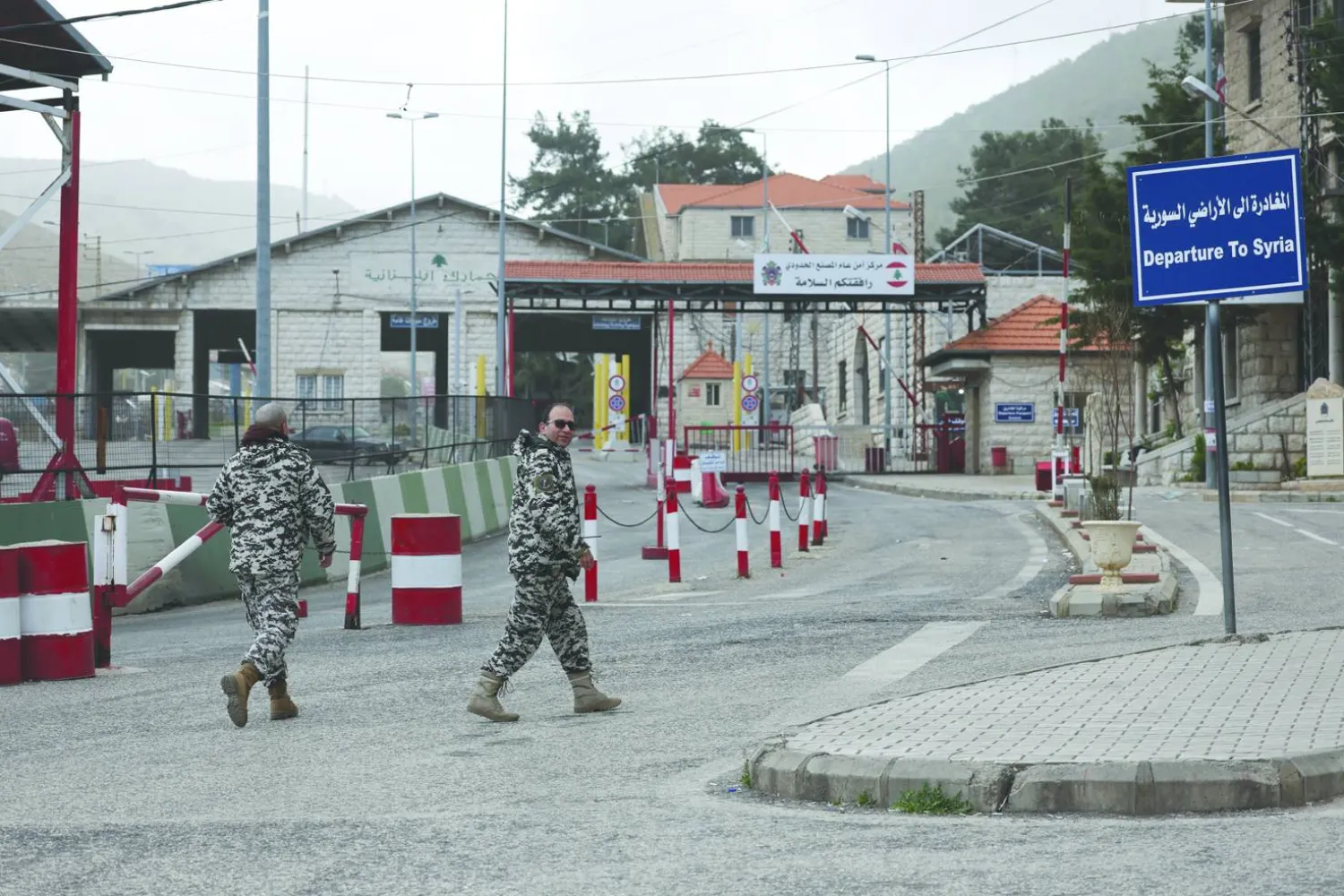
Lebanese General Security members stand guard at the Masnaa border crossing with Syria in the Bekaa Valley, eastern Lebanon, 05 April 2026, following an Israeli warning to target the M30 highway between Lebanon and Syria. (EPA)
TT

US Stops Israel’s Plan to Drag Syria to War on Hezbollah

Lebanese General Security members stand guard at the Masnaa border crossing with Syria in the Bekaa Valley, eastern Lebanon, 05 April 2026, following an Israeli warning to target the M30 highway between Lebanon and Syria. (EPA)

Political sources in Tel Aviv revealed that Washington stopped Israel from striking the Masnaa border crossing between Lebanon and Syria, as well as a plan to drag Damascus into the war against Hezbollah.

Israel radio said that the American administration stopped Israel from bombing the crossing shortly after Tel Aviv had threatened to attack it over the weekend.

Israel had bombed an area close to the crossing, claiming Hezbollah was using it for “military” purposes.

Israel radio reported that the US had asked Tel Aviv to refrain from attacking the crossing for “political reasons” and to leave the issue to Syrian security officials who are working on behalf of Syrian President Ahmed al-Sharaa.

It quoted an informed source as saying that the Damascus government had told the Americans that it was working against Hezbollah and that it had thwarted in recent days attempts to smuggle weapons from Syria to Lebanon.

Other sources revealed that Israel wants Syria to become involved in the war against Hezbollah, despite the previous past experience when Israel allowed the Syrian army to enter Lebanon 1976 under the pretext of restoring peace when the country was in civil war. The military intervention led to years of Syrian hegemony over Lebanon, straining relations between Beirut and Damascus.

The sources told Israel’s Maariv that Israel is convinced that Lebanon has failed in confronting Hezbollah and American and western powers have lost faith in the Lebanese state. So, Israel has turned to the new Syrian authorities to “handle security responsibilities in Lebanon,” they said.

The US believes that the Lebanese government has not met the least of its commitments in disarming Hezbollah, while the army is incapable - or unwilling - to really confront the Iran-backed party, the sources continued.

Washington believes that it has no real partner in Lebanon and that no state and military authority has the power to disarm Hezbollah, they added.

Observers believe that the only two parties capable of and willing to fight Hezbollah are Israel and the new Syrian authorities led by Sharaa.

Israeli sources said Tel Aviv and Damascus have this common goal even if they are not allied with each other. The Syrian authorities view Hezbollah as an enemy, making it a convenient partner in achieving interests in Lebanon.

Tel Aviv believes that it can eventually reach understandings with Damascus whereby the Israeli military can control southern Lebanon and Syrian army controls the north and they can both work against Hezbollah.

“This appears to be the least of evils amid the current impasse,” said the observers.

Tel Aviv is trying to convince Washington of its position, explaining that it would not be waging war against the Lebanese state or imposing hegemony over it. Rather, it would be acting to remove the Hezbollah threat and impose a new reality in Lebanon.

Israel wants the US to relay these messages to Syria.

Former US Secretary of State Henry Kissinger had in the 1970s held indirect talks between late Syrian President Hafez al-Assad's regime and Israel on Damascus sending troops to Lebanon with the aim to break the alliance between Lebanese leftists and the PLO.

The regime sent its forces in 1976, but over the years it became obvious that Assad sought to impose Syrian hegemony over Lebanon. In the ensuing years, he acted against Israeli invasions of Lebanon in 1978 and 1982.

The current Israeli government is hoping to avoid similar failures in Lebanon by reaching understandings with the current Syrian authorities.



Israel Military Says Completed Forward Deployment in South Lebanon

An Israeli Air Force F-15D Eagle fighter aircraft flies over the area of Marjeyoun in southern Lebanon on April 7, 2026. (AFP)
TT

Israel Military Says Completed Forward Deployment in South Lebanon

An Israeli Air Force F-15D Eagle fighter aircraft flies over the area of Marjeyoun in southern Lebanon on April 7, 2026. (AFP)

The Israeli military said on Tuesday it had completed the deployment of ground troops along a "defense line" in southern Lebanon, where it is fighting Iran-backed Hezbollah.

The military has not given any geographical details on the furthest point to which its soldiers have advanced into Lebanese territory.

Israeli media reported that the military did not intend at this stage to push troops deeper than around 20 kilometers (12 miles) north of the Israel-Lebanon border.

"At this stage, soldiers have completed their deployment along the anti-tank missile defense line and continue to operate in the area in order to strengthen the forward defensive posture and remove threats to the residents and communities of northern Israel," a military statement said.

Defense minister Israel Katz has said on several occasions in recent weeks that Israel intends to establish a "security zone" in southern Lebanon extending to the Litani river, which flows as much as 30 kilometers from the Israel-Lebanon border, in order to prevent rocket, drone or missile fire at northern Israeli communities.

The Israeli daily Yediot Aharonot reported that the military was expected to present to the government "an operational plan for controlling the first line of (Lebanese) villages as a deep security zone up to the anti-tank line".

Israeli newspaper Haaretz, citing military sources, reported that the military was "preparing to boost its forces in southern Lebanon, but there are currently no plans to advance deeper into the country".

"The sources said the forces have reached what has been defined as the 'front line' outlined in the approved operational plans," Haaretz reported, adding that "this line includes southern villages located roughly 10 kilometers from the Litani River, an area under Israeli military control".

Haaretz reported that the current deployment was aimed at preventing anti-tank missile fire on northern Israeli communities.

These anti-tank missiles have an estimated range of around 10 kilometers.


Fighter from Iraq's PMF Killed in Strike near Syria Border

Archive: Popular Mobilization Forces (PMF) fighters ride in a tank near the Iraqi-Syrian border in al-Qaim, Iraq. Iraq November 26, 2018. REUTERS/Alaa al-Marjani
TT

Fighter from Iraq's PMF Killed in Strike near Syria Border

Archive: Popular Mobilization Forces (PMF) fighters ride in a tank near the Iraqi-Syrian border in al-Qaim, Iraq. Iraq November 26, 2018. REUTERS/Alaa al-Marjani

A strike killed a fighter from the former paramilitary coalition Hashed al-Shaabi, or Popular Mobilization Forces, in Iraq near the border with Syria on Tuesday, the alliance said, blaming the United States and Israel.

"At 4 am (0100 GMT) this morning the 45th Brigade... was subjected to a treacherous Zionist-American aggression in the Qaim district of Anbar province," the alliance said.

The strike resulted in "the martyrdom of one of the fighters of the 45th Brigade", which belongs to the US-blacklisted, pro-Iran group Kataeb Hezbollah.


WHO Suspends Gaza Operations After Contract Worker Killed

 Palestinians inspect the damage after a person was hit by an Israeli strike while riding a bicycle, according to medics, in Gaza City, April 6, 2026. (Reuters)
Palestinians inspect the damage after a person was hit by an Israeli strike while riding a bicycle, according to medics, in Gaza City, April 6, 2026. (Reuters)
TT

WHO Suspends Gaza Operations After Contract Worker Killed

 Palestinians inspect the damage after a person was hit by an Israeli strike while riding a bicycle, according to medics, in Gaza City, April 6, 2026. (Reuters)
Palestinians inspect the damage after a person was hit by an Israeli strike while riding a bicycle, according to medics, in Gaza City, April 6, 2026. (Reuters)

The World Health Organization announced it was suspending evacuations from Gaza after a worker contracted to help them was killed on Monday.

"@WHO is devastated to confirm that a person contracted to provide services to the Organization in Gaza was killed today during a security incident," the agency's chief Tedros Adhanom Ghebreyesus posted on X.

Two staff members were present at the incident but were not injured, he added.

"Following the incident, WHO suspended today's medical evacuation of patients from Gaza via Rafah to Egypt. Medical evacuations will remain suspended until further notice."

The United Nations health agency did not give details of what had happened, but Tedros said "the relevant authorities" were investigating.

"We call for the protection of civilians and humanitarian workers," he added in his post.

Israel and Hamas have accused each other of violating the ceasefire that came into force on October 10 in the Gaza Strip, after two years of devastating war.