
Israel Military Says Completed Forward Deployment in South Lebanon

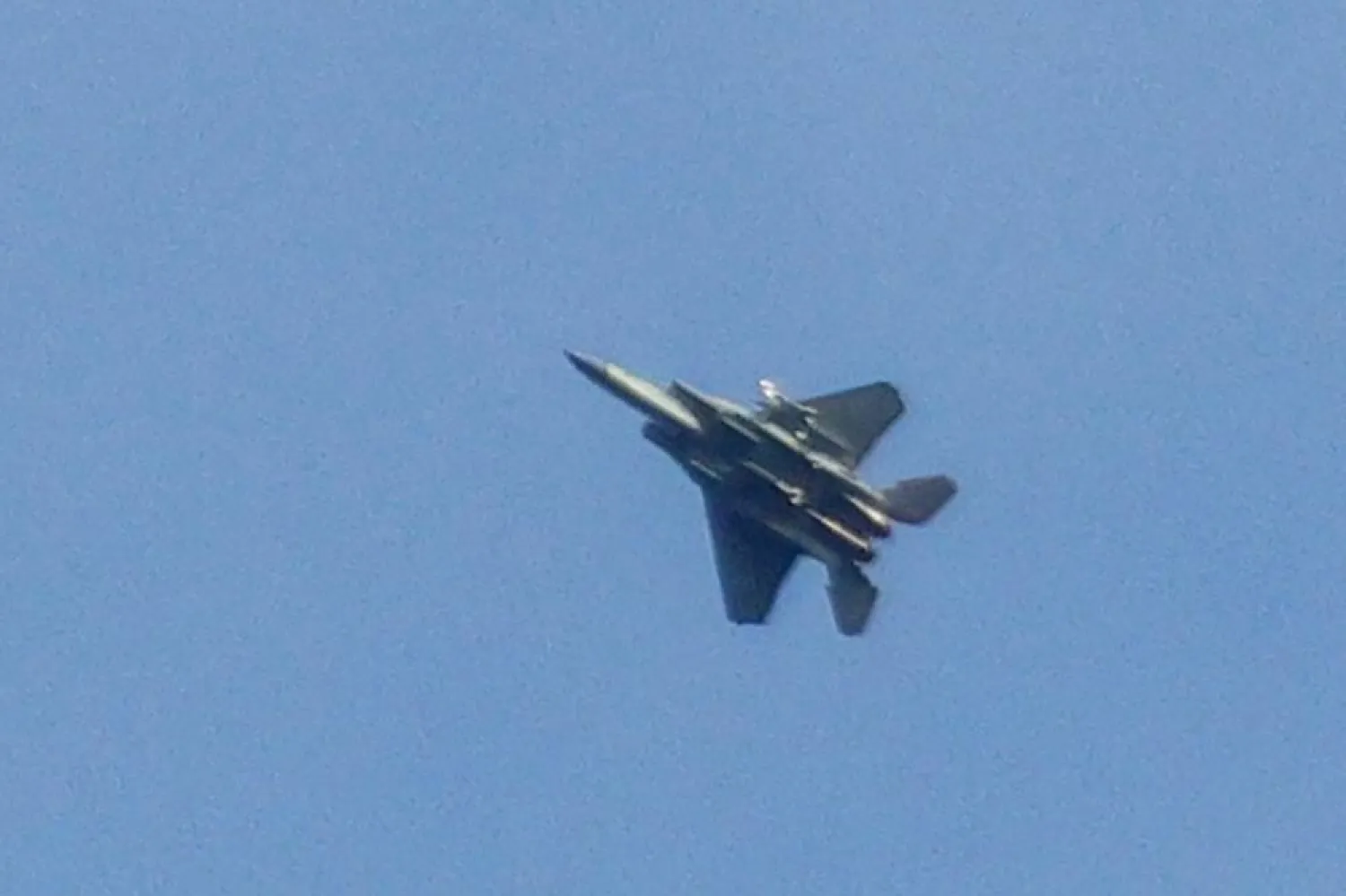
An Israeli Air Force F-15D Eagle fighter aircraft flies over the area of Marjeyoun in southern Lebanon on April 7, 2026. (AFP)
TT

Israel Military Says Completed Forward Deployment in South Lebanon

An Israeli Air Force F-15D Eagle fighter aircraft flies over the area of Marjeyoun in southern Lebanon on April 7, 2026. (AFP)

The Israeli military said on Tuesday it had completed the deployment of ground troops along a "defense line" in southern Lebanon, where it is fighting Iran-backed Hezbollah.

The military has not given any geographical details on the furthest point to which its soldiers have advanced into Lebanese territory.

Israeli media reported that the military did not intend at this stage to push troops deeper than around 20 kilometers (12 miles) north of the Israel-Lebanon border.

"At this stage, soldiers have completed their deployment along the anti-tank missile defense line and continue to operate in the area in order to strengthen the forward defensive posture and remove threats to the residents and communities of northern Israel," a military statement said.

Defense minister Israel Katz has said on several occasions in recent weeks that Israel intends to establish a "security zone" in southern Lebanon extending to the Litani river, which flows as much as 30 kilometers from the Israel-Lebanon border, in order to prevent rocket, drone or missile fire at northern Israeli communities.

The Israeli daily Yediot Aharonot reported that the military was expected to present to the government "an operational plan for controlling the first line of (Lebanese) villages as a deep security zone up to the anti-tank line".

Israeli newspaper Haaretz, citing military sources, reported that the military was "preparing to boost its forces in southern Lebanon, but there are currently no plans to advance deeper into the country".

"The sources said the forces have reached what has been defined as the 'front line' outlined in the approved operational plans," Haaretz reported, adding that "this line includes southern villages located roughly 10 kilometers from the Litani River, an area under Israeli military control".

Haaretz reported that the current deployment was aimed at preventing anti-tank missile fire on northern Israeli communities.

These anti-tank missiles have an estimated range of around 10 kilometers.


Who Is Iraq’s PM-Designate Al-Zaidi?


Iraq PM-designate Ali al-Zaidi (INA)
TT

Who Is Iraq’s PM-Designate Al-Zaidi?


Iraq PM-designate Ali al-Zaidi (INA)

Despite his close ties to Shiite party leaders in Baghdad and his extensive financial investments, premiership nominee Ali Faleh Kazem al-Zaidi remains largely unknown to most Iraqis outside political circles.

Informed sources say al-Zaidi has multiple financial partnerships with political and business figures both inside and outside the government.

Those familiar with his affairs describe him as “a young man who joined the ranks of the wealthy over the past decade,” noting that he spends generously on social aid and assistance.

Born in Baghdad in 1986, Al-Zaidi holds a law degree and is not known for seeking public attention.

This is despite the fact that he owns Dijlah TV, which he acquired from Jamal and Mohammed al-Karboli, two brothers who are leaders of a Sunni party that competed in elections between 2010 and 2014.

If al-Zaidi succeeds in forming a government, he would become the youngest prime minister to hold the post since 2004.

The Coordination Framework surprised most Iraqis by naming him its candidate for prime minister, even though his name had not appeared among those circulated during the roughly five-month political crisis and government-formation talks.

Financial activities

Asharq Al-Awsat has learned that al-Zaidi is the owner and chairman of Al-Janoob Islamic Bank for investment and finance, a publicly listed company on the Iraq Stock Exchange established in 2016 and operating in the banking sector.

He later stepped down as chairman, handing the role to one of his brothers, after the US State Department placed the bank on its sanctions list in February 2024 for money laundering, prompting the Central Bank of Iraq to block its access to US dollars, according to informed sources.

Al-Zaidi also owns Al-Oweis Group, which, according to its website, includes 15 companies operating across food trade, agricultural and livestock production, contracting, printing, security services, electronics and oil, though it does not disclose its owner or founding date.

Property registration data indicates the company was established in 2007, later dissolved and converted into a private joint stock company with capital of 99 billion Iraqi dinars, about $75 million. An oil services company was also established in 2018 with a capital of 2 billion dinars.

The Iraq Stock Exchange website lists 2016 as the founding year of Al-Janoob Islamic Bank alongside a financial transfer company with capital of 250 billion dinars, about $191 million, meaning the bank’s total capital is less than the cost of a single “food basket.”

The company’s website says its total investments amount to $500 million and that it is responsible for contracts to supply the Trade Ministry’s food basket, as well as contracts with the Defense Ministry to provide food for 300,000 soldiers daily.

It also opened a private university last year named Al-Shaab.

Sources close to al-Zaidi say he holds further investments in education and media, including Al-Shaab University, Ishtar Medical Institute and Dijlah TV.

Sources say the Trade Ministry contracted Al-Oweis, owned by al-Zaidi, to supply food basket items to around 40 million Iraqis, a program inherited from Saddam Hussein’s government under the oil-for-food agreement during the 1990s sanctions period.

Citizens often complain about poor food quality and delivery delays.

However, the sources say the program has been scaled down in recent years to cover 18 million people, citing the exclusion of higher-income groups.

Group of companies

According to additional data, company registration records show that al-Zaidi owns 15 companies registered in his name, with an initial capital exceeding 282 billion Iraqi dinars.

These companies operate across key sectors including general contracting and construction, real estate and tourism investment, oil, gas and electricity, food and glass industries, agricultural and livestock production, as well as higher education, medical and financial services.

Among the most prominent is Al-Oweis, which holds contracts to feed the Iraqi army and import food basket items, alongside Al-Shaab University.

Through Al-Oweis Trading, General Contracting, Food Supply and Food Industries Ltd., al-Zaidi implements multiple projects, including feeding the Iraqi army.

The company signed a partnership contract with the State Company for Foodstuff Trading to supply both dry and fresh rations, covering 41 items for a total of 300,000 personnel.

Another project is the food basket program, under which Al-Oweis signed a partnership contract with the State Company for Foodstuff Trading to supply seven food items to support around 40 million people.


Tunisia President Sacks Energy Minister Ahead of Renewable Energy Projects Vote

Tunisian ‌President Kais Saied. (AFP)
TT

Tunisia President Sacks Energy Minister Ahead of Renewable Energy Projects Vote

Tunisian ‌President Kais Saied. (AFP)

Tunisia’s ‌President Kais Saied dismissed Energy Minister Fatma Thabet on Tuesday, amid growing controversy over renewable energy projects set to be voted on in parliament.

Saied said he had appointed Housing and Infrastructure Minister Salah Eddine ‌Zouari to ‌temporarily oversee the ministry. ‌No ⁠detailed explanation was ⁠provided for the decision.

The move comes as Saied's government seeks to pass draft laws on renewable energy, which ⁠will be put to ‌a ‌vote in parliament later on Tuesday.

The ‌projects have a planned ‌capacity of 600 megawatts, with 500 million euros ($585 million) as total investment.

The projects are ‌part of Tunisia’s efforts to expand clean energy ⁠production. ⁠Some lawmakers and political parties oppose the projects, describing them as a form of "energy colonization."

They have criticized the exclusion of the state electricity company (STEG) from the contracts, which they say were awarded exclusively to foreign firms.


Israeli Strikes on Gaza Kill Five, Including 9-Year-Old Boy, Medics Say

 Mourners react during the funeral of Palestinian child Adel Al-Najjar, who was killed today in an Israeli strike, according to medics, at Nasser Hospital in Khan Younis, in the southern Gaza Strip, April 28, 2026. (Reuters)
Mourners react during the funeral of Palestinian child Adel Al-Najjar, who was killed today in an Israeli strike, according to medics, at Nasser Hospital in Khan Younis, in the southern Gaza Strip, April 28, 2026. (Reuters)
TT

Israeli Strikes on Gaza Kill Five, Including 9-Year-Old Boy, Medics Say

 Mourners react during the funeral of Palestinian child Adel Al-Najjar, who was killed today in an Israeli strike, according to medics, at Nasser Hospital in Khan Younis, in the southern Gaza Strip, April 28, 2026. (Reuters)
Mourners react during the funeral of Palestinian child Adel Al-Najjar, who was killed today in an Israeli strike, according to medics, at Nasser Hospital in Khan Younis, in the southern Gaza Strip, April 28, 2026. (Reuters)

Israeli strikes killed five Palestinians, including a 9-year-old boy, in the Gaza Strip on Tuesday, health officials said.

Medics said an Israeli drone killed the child, Adel Al-Najjar, in eastern Khan Younis in the south of the enclave, while an Israeli airstrike targeted a vehicle in Gaza City, killing four people.

The Israeli military did not ‌immediately comment on ‌either incident.

At Nasser Hospital’s morgue, relatives arrived ‌to ⁠bid farewell to Najjar's ⁠small, white-shrouded body.

Women cried next to the body, which lay on a medical stretcher on the floor, and men held a special prayer before carrying him to the cemetery for burial.

The boy was collecting cardboard that the family uses for cooking, relatives said. There has been no electricity in ⁠Gaza since the war began in October 2023, ‌and Palestinians have complained of Israeli ‌restrictions on the entry of cooking gas.

"We don't have gas. ‌We collect cardboard to bake, they want to eat; they ‌want to drink," said one of the boy's relatives, Sabreen Al-Najjar.

Violence in Gaza has persisted despite an October 2025 ceasefire, with Israel conducting almost daily attacks on Palestinians.

At least 800 Palestinians have been ‌killed since the ceasefire took effect, according to local medics, while Israel says gunmen attacks have ⁠killed four ⁠of its soldiers over the same period.

“Isn’t it shameful what is happening to us? Isn’t it shameful that we bury our children every day, right in front of us? Isn’t it shameful? I swear to God, our hearts are breaking for these children,” another relative, Suhaib Al-Najjar, said at the morgue.

Israel and Hamas have blamed each other for ceasefire violations.

More than 72,500 Palestinians have been killed since the Gaza war began in October 2023, according to Gaza health authorities.

Hamas’ October 7, 2023, attacks on Israel killed 1,200 people, according to Israeli tallies.