


Egypt Banks on Domestic Defense Manufacturing to Curb Military Spending

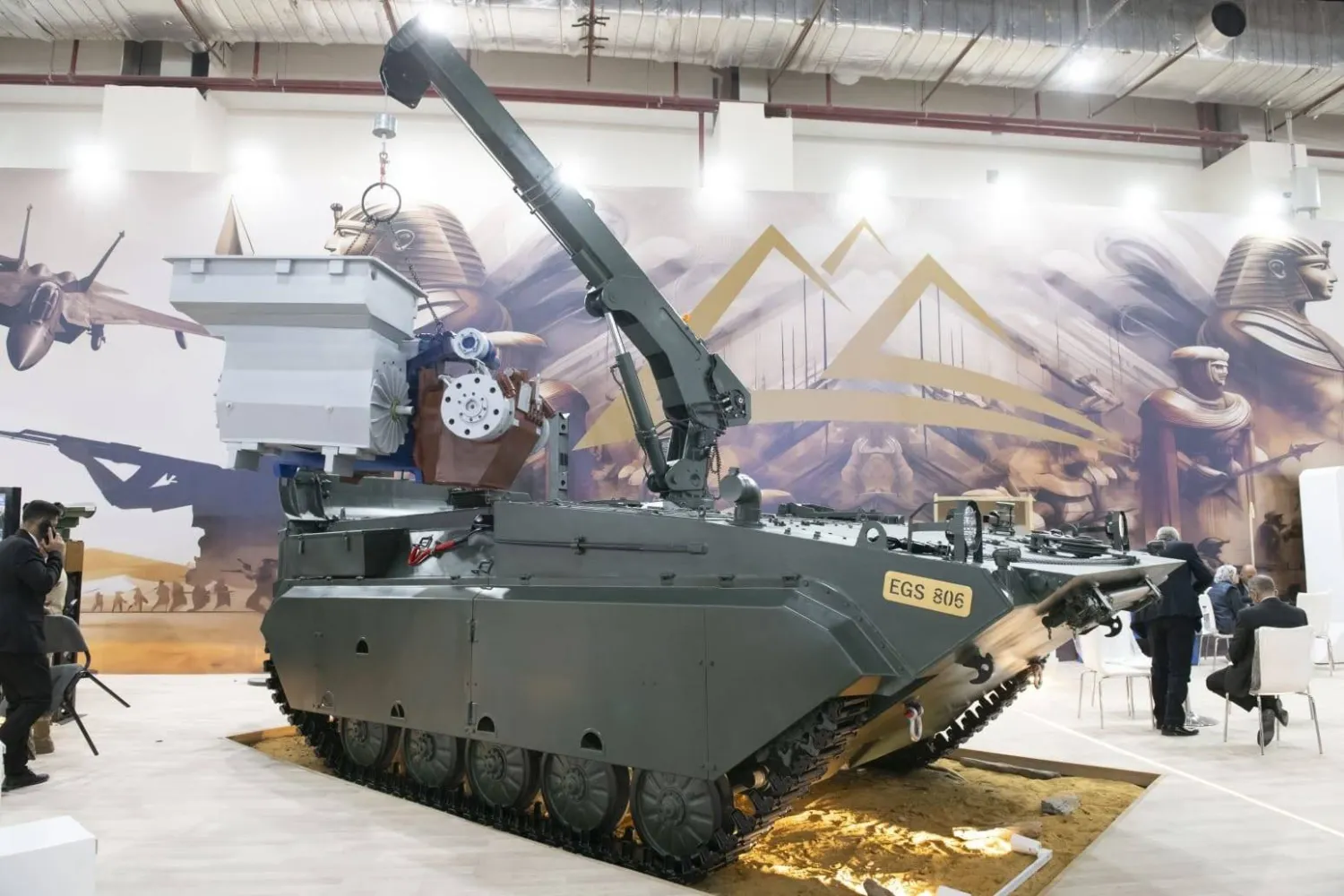
A military vehicle manufactured in Egypt. (Egyptian Ministry of Military Production)
TT

Egypt Banks on Domestic Defense Manufacturing to Curb Military Spending

A military vehicle manufactured in Egypt. (Egyptian Ministry of Military Production)

Egypt is increasingly relying on domestic defense manufacturing to curb military spending, expanding local production of armored vehicles, drones and air defense systems while continuing to diversify its foreign arms suppliers and pursue joint-production partnerships with other countries.

The strategy comes as the country posted the lowest military spending among Arab states last year, with defense expenditure accounting for 0.61% of gross domestic product, according to figures released by the Stockholm International Peace Research Institute (SIPRI).

Military experts told Asharq Al-Awsat that local arms production helps ease pressure on foreign-currency reserves required for imports while ensuring a more secure supply chain. They explained that modern warfare is characterized by the heavy consumption of weapons and ammunition, making uninterrupted access to military supplies a strategic necessity.

Egypt’s armed forces have pursued a comprehensive modernization program in recent years, including diversifying sources of weaponry and forging partnerships with major defense-producing countries, according to Egypt’s State Information Service.

The government is also pushing to expand reliance on locally manufactured defense products.

Minister of State for Military Production Salah Mostafa Gomblat said the current phase focuses on localizing advanced industrial technologies to improve production efficiency and enhance the competitiveness of Egyptian-made products.

He added that the strategy includes forging new partnerships with the private sector to reduce import costs and support the national economy.

According to SIPRI, Egypt recorded the lowest military spending among Arab countries in 2025 even as global military expenditure rose 2.9% from the previous year to $2.887 trillion. Algeria recorded the highest military-spending among Arab countries, at 8.83% of GDP.

Egypt has recently showcased a range of domestically produced defense systems, including armored vehicles, drones and air defense platforms displayed at the EDEX 2025 defense exhibition held in Cairo last December.

Among the systems highlighted were the Raad 300, a multiple-caliber guided rocket launcher capable of striking targets at ranges of up to 300 kilometers, and the Jabbar 150 unmanned aerial vehicle, which Egyptian officials describe as possessing advanced offensive capabilities.

The unveiling of the Jabbar 150 attracted attention in Israel. In a report published on June 8, Israeli website Natziv.net said Israeli security agencies were monitoring advances in Egyptian military technology and assessing their strategic implications.

Major General Nasr Salem, a military analyst, noted that Egypt’s drive to deepen domestic weapons production is intended both to secure military supply lines and reduce the cost of importing arms.

“Part of Egypt’s strategy to diversify its sources of armaments is based on localizing military industries,” Salem told Asharq Al-Awsat.

He stressed that the prolonged nature of modern conflicts requires armies to maintain a continuous flow of weapons and ammunition, adding that some military estimates suggest the cost of a single day of combat can equal a year’s defense procurement budget for some armed forces.

“For that reason, the best option for countries is to manufacture their own weapons,” he said.

Salem cautioned, however, that building a domestic defense industry is itself costly and requires access to advanced technologies capable of competing with foreign systems.

He added that local production offers another advantage: the ability to design weapons tailored to a country’s operational environment and the needs of its armed forces.

Major General Samir Ragab said expanding local defense production also helps reduce pressure on foreign-currency resources.

“No country in the world can achieve complete self-sufficiency in armaments,” Ragab told Asharq Al-Awsat, noting that certain categories of advanced weapons will continue to be imported from countries with more sophisticated defense-industrial capabilities.

Nevertheless, he said, a strong domestic defense-industrial base enhances the Egyptian military’s capabilities and provides Cairo with greater flexibility to develop weapons systems suited to its own requirements.



Lebanon Reports Israeli Strikes in South after Evacuation Warning

 Smoke billows from southern Lebanon following an Israeli strike, as seen from Marjeyoun, Lebanon, June 12, 2026. (Reuters)
Smoke billows from southern Lebanon following an Israeli strike, as seen from Marjeyoun, Lebanon, June 12, 2026. (Reuters)
TT

Lebanon Reports Israeli Strikes in South after Evacuation Warning

 Smoke billows from southern Lebanon following an Israeli strike, as seen from Marjeyoun, Lebanon, June 12, 2026. (Reuters)
Smoke billows from southern Lebanon following an Israeli strike, as seen from Marjeyoun, Lebanon, June 12, 2026. (Reuters)

Lebanon reported Israeli strikes on the country's south on Saturday shortly after the Israeli army issued an evacuation warning for 20 locations including the city of Nabatieh ahead of raids there, said AFP.

The state-run National News Agency (NNA) said Israeli airstrikes hit several areas covered by the warning, including the villages of Rihan and Sujud, located not far from Nabatieh. 

The Israeli army warning urged residents to "evacuate your homes immediately and move to the north of the Zahrani River", around 45 kilometers (28 miles) from the southern border with Israel. 

The Israeli army last month declared all areas south of the river "combat zones", and has since been striking the area. 

The NNA late Friday reported explosions and artillery shelling near the Ali Taher hills overlooking Nabatieh. 

On Friday Hezbollah, which has kept up attacks on Israeli troops who have invaded south Lebanon, said its fighters had confronted Israeli forces advancing towards the town of Majdal Zoun. 

Israel and Hezbollah have been at war since early March when the Iran-backed group drew Lebanon into the Middle East conflict with rocket fire at Israel to avenge the killing of Iran's supreme leader in US-Israeli strikes. 

Israel launched a massive campaign of airstrikes and a ground invasion, killing more than 3,700 people in Lebanon, authorities say. 

Neither Israel nor Hezbollah have respected an April ceasefire, and a conditional truce deal announced this month after the fourth round of direct Lebanese-Israeli negotiations in Washington has also failed to halt the fighting. 

Hezbollah has rejected the direct talks and the conditional agreement, which requires it to cease attacks but makes no mention of Israel doing so or withdrawing troops from Lebanon. 

Iran insists that Lebanon must be part of any agreement to end the wider Middle East war, and a senior US official said Friday that a peace deal with Iran "includes Lebanon". 

But Lebanon's leaders have accused Tehran of treating Lebanon as a "bargaining chip". 

Hezbollah lawmaker Ali Fayyad on Saturday urged Lebanon to take advantage of any deal to end the Iran war that includes the country. 

"We want the Lebanese state to negotiate for itself, and nobody is suggesting forfeiting this role," Fayyad said, "however, the state must abandon the policy of being crushed in the face of the Israelis and submission to the Americans." 

Lebanese President Joseph Aoun said in a statement on X on Saturday that Lebanon faces "a fateful test". 

"Either its people unite around a sovereign state that monopolizes weapons, upholds the law and protects citizens irrespective of their affiliation or position, or it remains hostage to the logic of militias," the statement said. 


Sharaa: Syria Seeks to Stop Lebanon War, Not Join It

Syrian President Ahmed al-Sharaa (SANA)
TT

Sharaa: Syria Seeks to Stop Lebanon War, Not Join It

Syrian President Ahmed al-Sharaa (SANA)

Syrian President Ahmed al-Sharaa has moved to quell renewed speculation that Syria could become involved in the war in Lebanon, saying reports that Damascus intends to intervene militarily are “mere rumors.”

Sharaa said Syria’s position at this stage was based on “seeking to stop the war in Lebanon, not becoming involved in it.”

His remarks came during a meeting with a delegation from the Damascus countryside. He said demarcating the Syrian-Lebanese border was “not currently a priority” given more urgent files, foremost among them the case of about 1.4 million displaced Syrians in Lebanon and efforts to find a suitable mechanism to ensure their return.

US President Donald Trump had recently reaffirmed Washington’s goal of delivering a strong blow to Hezbollah. According to him, Israel has done what is necessary in the south, but there is still much left to eliminate Hezbollah. He then hinted at possibly having to ask Syria’s involvement.

Trump’s remarks prompted a wave of interpretations, amid reports of a possible visit by Sharaa to Washington. The Syrian presidency denied those reports.

Sources in Damascus told Asharq Al-Awsat that the US remarks were “a form of reshuffling the cards” and fell within “the framework of negotiating statements and sending messages to Iran.”

The sources said, “So far, there has been no official US request to Damascus related to any form of Syrian military intervention in Lebanon.” They said Tom Barrack, Trump’s envoy to Syria and Iraq and Washington’s ambassador in Ankara, had previously asked Damascus “to take a clear, explicit and serious position against Hezbollah.”

The sources said Damascus believes it already has such a position, reflected in border control, cutting smuggling routes and high-level coordination with the Lebanese government.

They added that “entering the quagmire of war and sending military forces unilaterally is completely ruled out,” and that it was “very, very early” to discuss the possibility of Syrian forces entering Lebanon in support of the Lebanese army.

Brigadier General Hassan Abdul Ghani, commander of the Border Guard Forces in the Syrian Arab Army, met last Thursday with a Lebanese army delegation headed by liaison official Brigadier General Michel Boutros, in the presence of several officers.

The talks focused on issues of mutual concern, mainly “enhancing cooperation and coordination between the two sides in border control and combating smuggling activities, in a way that contributes to strengthening border security between the two countries.”

At the same time, Syria’s Interior Ministry said “Lebanon is a sovereign state and not a backyard, as the former regime viewed it,” stressing that “coordination with Lebanon is the basic pillar for any assistance Syria provides to Lebanon.”

Sharaa had expressed Syria’s readiness to provide Lebanon with whatever support and assistance it can, within available capabilities and circumstances, when he received former Lebanese Prime Minister Najib Mikati in Damascus on the ninth of this month.

Media reports said Sharaa told Mikati that “Lebanon’s stability and security constitute a direct Syrian interest,” and that Damascus was keen to build the best relations with the Lebanese state on the basis of mutual respect, good neighborliness and non-interference in internal affairs.

The meeting between Sharaa and Mikati, which lasted for hours, discussed the state of bilateral relations between Damascus and Beirut and prospects for developing them in the next stage, along with several economic and investment files of mutual interest, in light of the transformations taking place in the region.


Palestinian, Israeli Civil Society Groups Meet in France as Two-State Hopes Dim

European Union foreign policy chief Kaja Kallas speaks during a conference with Palestinian and Israeli civil society groups supporting a two-state solution in Paris, France, 12 June 2026. (EPA)
TT

Palestinian, Israeli Civil Society Groups Meet in France as Two-State Hopes Dim

European Union foreign policy chief Kaja Kallas speaks during a conference with Palestinian and Israeli civil society groups supporting a two-state solution in Paris, France, 12 June 2026. (EPA)

Palestinian and Israeli civil society groups delivered an appeal in France on Friday to urge the international community not to abandon a two-state solution, as Paris seeks to keep the issue alive amid the Middle East war.

The meeting brought together foreign ministers and senior officials from dozens of countries alongside civil society groups. It marks one year since the UN-backed New York Declaration, which set out a roadmap toward Palestinian statehood and prompted around a dozen countries, including France, Britain and Canada, to recognize ‌a Palestinian state.

"We ‌could find every reason in the world to give up. ‌But ⁠you are here! Your ⁠testimonies alone are grounds for hope and action," France's Foreign Minister Jean-Noel Barrot told 250 civil society representatives from both sides.

"France refuses to let the side of war prevail over the side of peace."

The gathering ended with an eight-point “Call for Action” urging a permanent ceasefire, a halt to settlements, Gaza reconstruction, governance reforms and stronger international backing for civil society.

It will be delivered to the G7 leaders who meet in the French Alps from Monday.

"The region continues to fracture. Gaza is devastated, Israel remains ⁠under threat. Settler terrorism, settlement expansion, and de facto annexation and ‌threats to the Palestinian Authority continue to undermine the viability ‌of a future Palestinian state," according to the action plan.

"Israelis and Palestinians alike remain trapped in fear, insecurity, ‌and trauma. We return because, as the G7 convenes in Evian, this conflict risks once ‌again being set aside. The window for a solution remains open; but it is narrowing."

ANGER IN WEST OVER SETTLER VIOLENCE

The conference comes amid escalating violence by Israeli settlers in the occupied West Bank and underscores anger in many Western countries toward Israeli Prime Minister Benjamin Netanyahu’s government, which has expanded settlements.

Diplomats say ‌that expansion is aimed at undermining prospects for a Palestinian state.

A key concern is Israel’s plan to build a settlement east of Jerusalem, ⁠known as the E1 ⁠project, which would bisect the West Bank and cut it off from East Jerusalem, fragmenting territory Palestinians seek for an independent state.

"The two-state solution remains the only viable path to bringing lasting peace to the Middle East," European Union foreign policy chief Kaja Kallas said. "The situation in the West Bank is equally alarming. Illegal Israeli settlements continue to expand at an unprecedented pace, and settler violence is increasing without sufficient accountability."

Britain, Canada, France and Norway announced new coordinated sanctions on Tuesday against Israeli networks involved in financing, enabling and carrying out violence in the Israeli-occupied West Bank.

Israel and the United States declined to attend the meeting in Paris.

"The ambassador was invited but will not attend the conference, as it has nothing to do with promoting peace," the Israeli embassy said in a statement.

"France cannot act as a mediator between Israel and the Palestinians. Regarding the two-state solution, the ambassador recalls that the Palestinians have rejected proposals to establish a Palestinian state on five occasions."