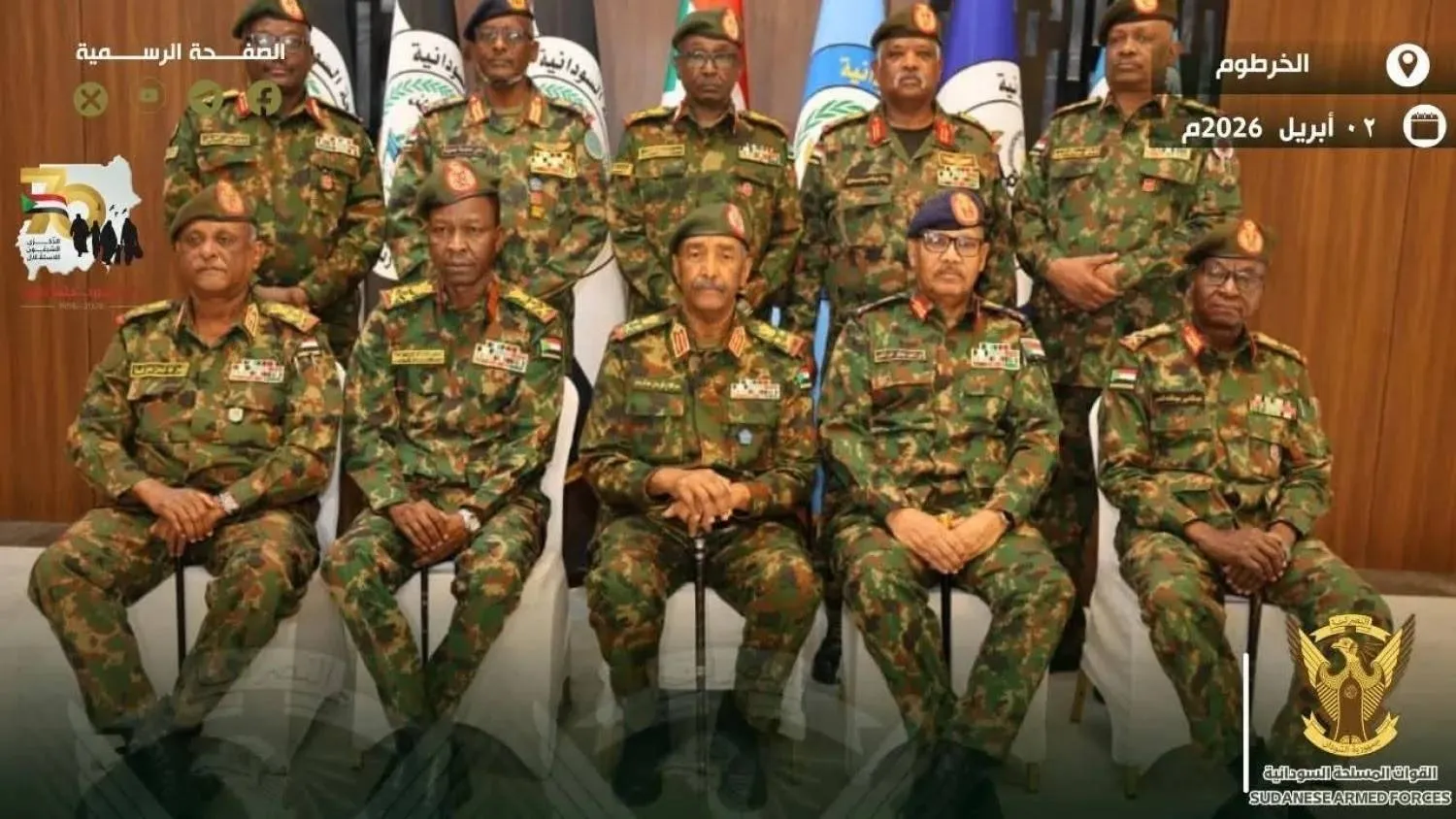

Decisions by Sudan’s transitional Sovereign Council chief and army commander, Abdel Fattah al-Burhan, to dismiss several senior military leaders and reassign them to other top positions have fueled speculation that the moves are “not isolated” from imminent changes within the army-led governing authorities.
Al-Burhan issued a decree removing his deputy in army command, Shams al-Din Kabbashi, as well as his assistants Yasser al-Atta and Ibrahim Jaber. He followed it with another decision on the same day appointing Kabbashi, Jaber and Lt. Gen. Mirghani Idris as assistants to the army commander-in-chief.
Al-Burhan had begun the reshuffle last Thursday by appointing Sovereign Council member Lt. Gen. Yasser al-Atta as chief of staff, along with deputies drawn from senior officers across military divisions.
In this context, al-Burhan said the creation of new posts — assistants to the commander-in-chief — aims to “develop and rehabilitate military industries and enhance the capabilities of the armed forces.” He added that “leadership succession is a deeply rooted military tradition to ensure generational continuity and inject new blood to improve military performance.”
Al-Burhan denied “any regional criteria in the appointments.” He said al-Atta’s selection “was based on his field competence and his role in breaking the siege of the General Command and boosting morale,” describing him as “one of the pillars of the armed forces in resolving the Battle of Dignity and achieving victories.”
For his part, the newly appointed chief of staff, al-Atta, described the changes affecting the armed forces leadership as “routine annual measures in line with military hierarchy,” adding that he would work to develop the “joint forces” and “support forces” with the aim of integrating them into army units.
The reshuffle - the most significant within army leadership since the outbreak of war in April 2023 - is widely seen as an indication of a broader restructuring possibly involving changes to or the dissolution of the Sovereign Council, the country’s highest sovereign authority.
Under the latest decisions, al-Burhan appointed Kabbashi as assistant for construction and strategic planning affairs, Lt. Gen. Ibrahim Jaber as assistant for international relations and military cooperation, and Lt. Gen. Mirghani Idris Suleiman Idris as assistant for military industries.
For his part, crisis management and negotiation expert Maj. Gen. Amin Ismail Majzoub of the Strategic Studies and Research Center told Asharq Al-Awsat that changes to the army’s general command “are a routine procedure carried out every two years, though extensions may occur under exceptional circumstances,” referring to the ongoing war in the country.
Meanwhile, retired Sudanese army Maj. Gen. Kamal Ismail said the timing is “not appropriate” for reassignments and transfers among senior ranks, suggesting the latest reshuffle “may be the result of failure to achieve victory in the battlefield, necessitating a change in the general staff leadership to devise new plans for resilience and military progress.”