


Lebanon Rejects Iran Negotiating on Its Behalf

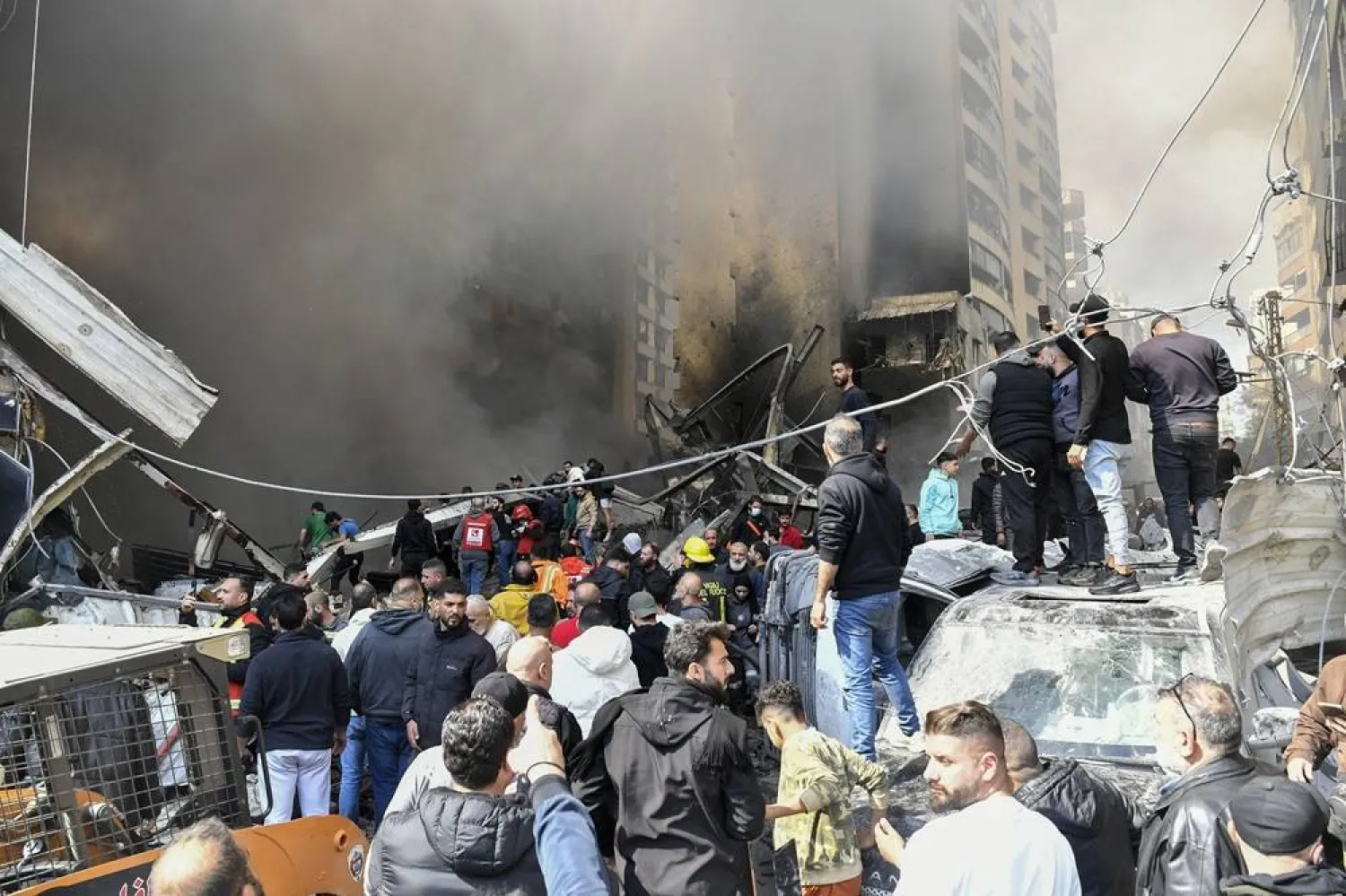
People gather at the scene of an Israeli airstrike in the Corniche al-Mazraa neighborhood of Beirut, Lebanon 08 April 2026. (EPA)
TT

Lebanon Rejects Iran Negotiating on Its Behalf

People gather at the scene of an Israeli airstrike in the Corniche al-Mazraa neighborhood of Beirut, Lebanon 08 April 2026. (EPA)

Lebanon was left outside contacts that produced a US-Iran ceasefire deal, despite reports it would be included and moves by Iran and Hezbollah suggesting otherwise.

Hezbollah halted its military operations before the deal was announced early on Wednesday, while Lebanese officials scrambled to contact countries involved in the issue to clarify the situation.

Prime Minister Nawaf Salam told Asharq Al-Awsat that Lebanon would not accept anyone negotiating on its behalf.

President Joseph Aoun welcomed the US-Iran announcement of a 15-day ceasefire and praised efforts by all parties that helped secure the agreement, particularly Pakistan, Egypt, and Türkiye.

He said he hoped it would mark a first step toward a final, comprehensive deal that addresses the drivers of conflict in the region, safeguarding the sovereignty of all states.

Aoun said violence was not an effective means to resolve disputes and that governments should work to ensure a free and dignified life for their people, not push them toward futile and needless death.

He added that the Lebanese state would continue efforts to ensure any regional calm extends to Lebanon on a firm and lasting basis.

Aoun affirmed that the efforts are in line with principles agreed upon by the Lebanese: full sovereignty over all territory, liberation from any occupation, and the exclusive right to wage war, maintain peace, and use legitimate force, resting with constitutional institutions alone.

Responsibility for any negotiations to secure Lebanon’s national interest lies solely with the Lebanese state, he said.

Berri: Lebanon included

Parliament Speaker Nabih Berri told Asharq Al-Awsat that Lebanon was covered by the ceasefire agreement with Iran, but said Israel had not complied with it across Lebanon so far, in breach of the deal.

Berri said the agreement clearly included Lebanon and that this was what should be implemented. He said he had contacted the Pakistani side to inform it of Tel Aviv’s failure to abide by the ceasefire and asked it to engage the United States to pressure Israel.

He said he remained in contact with several parties involved and had received assurances that Lebanon was part of the agreement, though he did not rule out that Israel could seek to “undermine this agreement as the party most harmed by it.”

Salam: The state alone negotiates

In his first comment on the ceasefire and the debate over whether Lebanon was included, Salam said: “No one negotiates over Lebanon except the Lebanese state.”

He declined to elaborate on ongoing contacts to secure a ceasefire in Lebanon, saying only that the state was carrying out its duties and mobilizing all its capabilities to pull the country out of a crisis imposed on it.

“With the announcement of an agreement between the US and Iran, through appreciated Pakistani efforts, we are intensifying our contacts and our political and diplomatic efforts to secure a ceasefire in Lebanon,” said Salam.

“I also stress that no one negotiates in the name of Lebanon except the Lebanese state, through its constitutional institutions, in a way that safeguards its sovereignty and the interests of its people,” he added.

Foreign Ministry: One voice

For its part, Lebanon’s Foreign Ministry welcomed the announcement of the two-week ceasefire between Iran and the US as a step toward de-escalation and regional stability, but stressed that no party has the right to negotiate on the country’s behalf.

“Lebanon unequivocally affirms that it speaks with one voice — its own — and that no party has the right to negotiate on its behalf except the Lebanese state,” the ministry said in a statement.

“Any such action constitutes a direct violation of its sovereignty and national decision-making,” it added, noting that Lebanon has previously announced its readiness for direct negotiations with Israel, with civilian participation and under international auspices.

The ministry reiterated that Lebanon’s sovereignty is indivisible and not negotiable, and that its national choices, security, and political future are determined exclusively by its constitutional institutions, free from any external interference.



Lebanon Central Bank Says New Audit to Scrutinize Transactions for Graft

A view shows Lebanon's Central Bank building in Beirut, Lebanon August 25, 2023. (Reuters)
TT

Lebanon Central Bank Says New Audit to Scrutinize Transactions for Graft

A view shows Lebanon's Central Bank building in Beirut, Lebanon August 25, 2023. (Reuters)

Lebanon's central bank said Wednesday that an outside firm had begun a forensic audit into past transactions linked to its foreign assets, scrutinizing them for evidence of graft in the wake of the country's economic collapse.

The move is part of measures the institution has taken to improve oversight, steps that have also resulted in the arrest of the body's former governor, Riad Salameh.

A forensic audit has also been a key demand of the international community and the International Monetary Fund as Lebanon seeks bailout funds after the economic crash, which began in 2019.

The central bank said Wednesday that on August 17, the New York-based Alvarez & Marsal began the forensic audit of "selected transactions", covering the period from October 2019 to the end of 2023.

The audit includes "transactions related to the central bank's foreign assets, including subsidy programs for essential goods and materials" as well as other transfers, it said.

In May, the central bank had said that the audit aimed to verify that payments and transfers "were executed pursuant to proper authorizations and approvals", and that funds "were used for their intended purposes, without any violation, misuse, or misappropriation".

In 2020, Alvarez & Marsal had launched an audit of the central bank but later halted work after the body failed to hand over necessary data.

The firm resumed that audit the following year, and its preliminary report in 2023 painted a damning picture of the institution under long-serving former governor Salameh.

Salameh, who headed the bank from 1993 to July 2023, is widely viewed as a key culprit in the country's dramatic economic crash and is accused of having amassed a fortune during his time in the job.

He has faced numerous accusations including embezzlement and tax evasion in probes in Lebanon and abroad but has consistently denied any wrongdoing, insisting he is being made a "scapegoat" for the economic collapse.

He was arrested in September 2024 and charged with offenses including the alleged embezzlement of $44 million from the central bank, but was released a year later after posting record bail of more than $14 million.

He was placed in custody again in July over accusations including embezzlement and illegal enrichment after a complaint lodged by the new central bank authorities.


Israel Ready to Remove Gaza Population if US Gives Approval, Says Minister

An Israeli military vehicle maneuvers in Gaza, as seen from the Israeli side of the border, September 1, 2026. (Reuters)
TT

Israel Ready to Remove Gaza Population if US Gives Approval, Says Minister

An Israeli military vehicle maneuvers in Gaza, as seen from the Israeli side of the border, September 1, 2026. (Reuters)

Israel has plans ready to remove Palestinians from the Gaza Strip but is waiting for the United States to figure out where to take them, the defense minister said Wednesday.

"There is no real solution for Gaza in the end without this migration," Defense Minister Israel Katz told a conference hosted by Israeli news site Ynet and newspaper Yedioth Ahronoth.

The Israeli government "is organized and prepared to get them out -- by sea, by air, by every way possible", he said.

The US embassy referred requests for comment to the State Department in Washington.

US President Donald Trump, at the start of his second term, stunned much of the world by calling for all two million Palestinians to leave the Gaza Strip.

Trump spoke of developing the Mediterranean territory, devastated by Israeli bombardment since the October 7, 2023 attack by Hamas, into a luxury resort destination.

Trump walked back the idea following strong pushback including from Egypt, the only country other than Israel to border Gaza.

The proposal was also condemned by Palestinians themselves, for whom any effort to force them off their land would recall the "Nakba", or catastrophe -- their mass displacement during Israel's creation in 1948.

Announcing a Gaza war ceasefire in October, Trump laid out 20 points for the territory that included no forced displacement.

Katz, known for his outspoken remarks, said that Trump had only "frozen" the idea as he looks for countries to take in Palestinians.

"The plan hasn't been cancelled; it is being discussed all the time, even now, and I think there is no other solution for everyone's good," he said.

"But for it to happen, we need the US. When will we get their approval? Whenever it becomes clear that Hamas is not meeting its obligations" under the ceasefire, he said.

Katz, without citing his source, said 80 percent of people in Gaza wanted to leave but that Hamas was preventing them.

Forced displacement of civilians in occupied territory is considered a war crime under the Geneva Conventions.

The International Criminal Court has issued arrest warrants for Prime Minister Benjamin Netanyahu and Katz's predecessor Yoav Gallant over alleged war crimes, which both Israel and the United States deny.

Israeli attacks have already internally displaced the vast majority of Gaza's people following the unprecedented Hamas attack, which killed 1,221 people, according to official Israeli figures.

Israel's offensive has since claimed 73,470 lives in Gaza, with more than 1,330 since the ceasefire, according to the Gaza health ministry, which operates under Hamas.


Netanyahu Says ‘We Are Not Retreating’ During Gaza Visit

Prime Minister Benjamin Netanyahu in Gaza on Wednesday. (Netanyahu on X)
TT

Netanyahu Says ‘We Are Not Retreating’ During Gaza Visit

Prime Minister Benjamin Netanyahu in Gaza on Wednesday. (Netanyahu on X)

Prime Minister Benjamin Netanyahu on Wednesday visited Israeli forces in the Gaza Strip, where he vowed not to pull back troops despite a recent push by mediators to advance a US-backed ceasefire plan calling for their withdrawal.

It was the first time Netanyahu has visited the war-shattered territory since the ceasefire between Israel and Hamas came into effect in October 2025.

"We control the area. We are not retreating. We are staying on this line," Netanyahu said near the so-called Yellow Line, which demarcates the areas under Hamas and Israeli military control.

"We control 60 percent of the Strip, and we are not stopping, because we are eliminating the terrorists who threaten us, day in and day out."

Israel has kept striking the Gaza Strip and its forces have made further inroads despite the US-brokered ceasefire, insisting it must eliminate threats from Hamas, which led the unprecedented October 7, 2023 attack against Israel.

International appeals to move to the next stages of the US-led peace plan have not stopped Israel targeting Palestinians it says are militants.

Netanyahu, facing tight elections in October, last month rejected a proposal for advancing to the next stage of the plan after Hamas said it had agreed to hand over its weapons.

The Israeli premier has vowed no military pullout until the Palestinian movement is "genuinely" disarmed.

On Tuesday, Israel said its forces and a Palestinian anti-Hamas militia captured the head of Hamas's internal security apparatus during a ground operation in Gaza City that Palestinian health officials said killed four people.

Hamas's Interior Ministry identified the man as Muein al-Arabid, and said he was an "officer in the internal security service", but did not mention whether he was its chief.

"We are doing everything to reach our goal -- disarming Hamas and demilitarizing Gaza. Gaza will no longer pose a threat to Israel," Netanyahu said Wednesday, adding that "there is still work left to complete -- and we will complete it".

Israel's defense minister on Wednesday said the country had plans to remove Palestinians from the Gaza Strip but was waiting for the United States to figure out where to take them.

"There is no real solution for Gaza in the end without this migration," Defense Minister Israel Katz told a conference hosted by Israeli news site Ynet and newspaper Yedioth Ahronoth.

The Israeli government "is organized and prepared to get them out -- by sea, by air, by every way possible", he said.

Similar suggestions in the past that Gazans could be displaced from the territory entirely have drawn international outrage, as well as condemnation from Palestinians themselves.

Announcing the Gaza war ceasefire in October, Trump laid out 20 points for the territory that included no forced displacement.

Forced displacement of civilians in occupied territory is considered a war crime under the Geneva Conventions.

Israeli operations in Gaza have killed at least 1,334 people since the ceasefire came into effect, according to the Palestinian territory's health ministry, which also operates under Hamas authority and whose figures are considered reliable by the United Nations.

The Israeli army has reported five deaths in its ranks over the same period, as well as the death of one civilian contractor.