

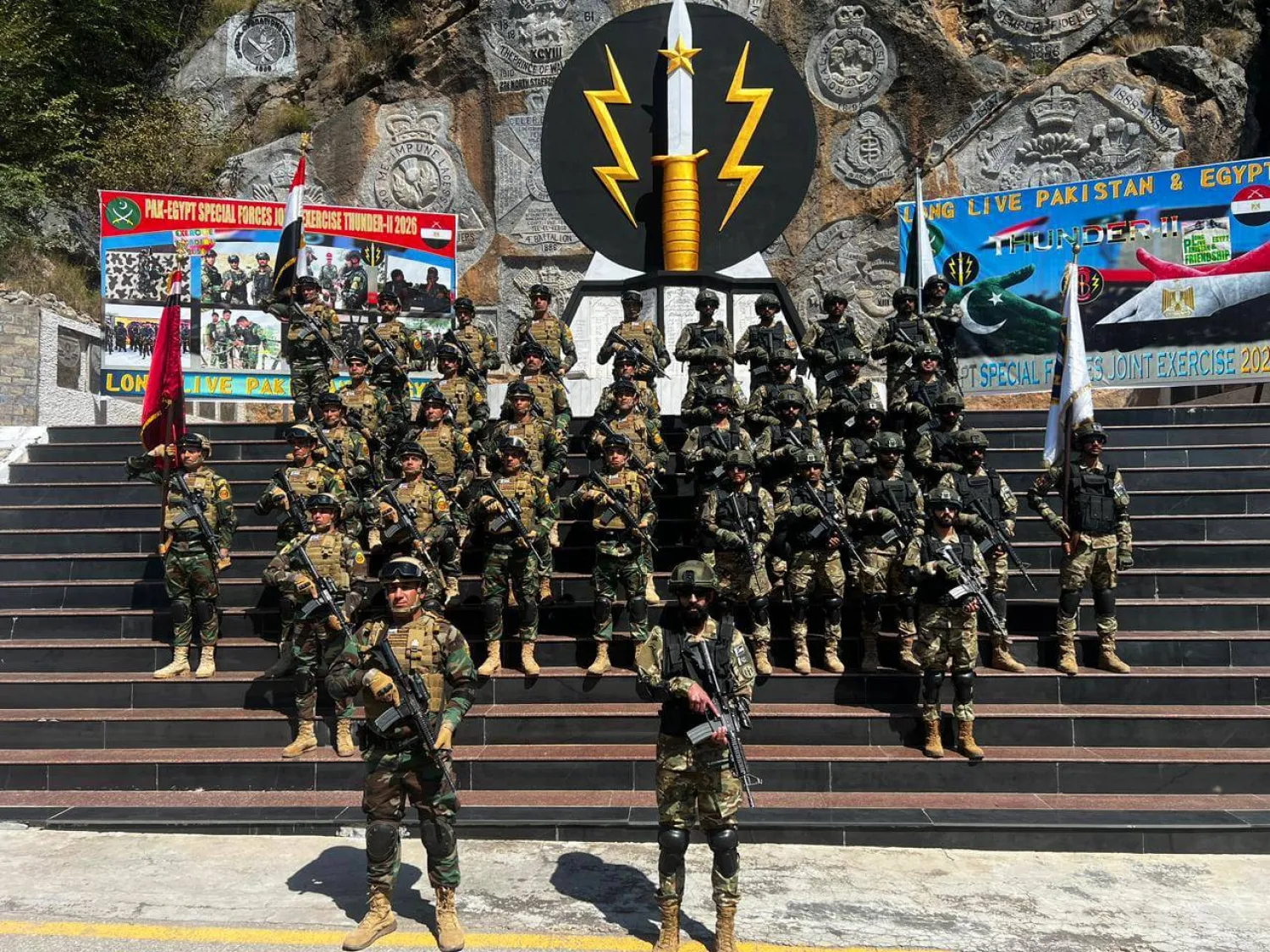

Egypt-Pakistan Military Drill Underscores Closer Ties

Launch of the joint Egyptian-Pakistani “Raad 2” exercise in Pakistan on Thursday (Egyptian military spokesman)
TT

Egypt-Pakistan Military Drill Underscores Closer Ties

Launch of the joint Egyptian-Pakistani “Raad 2” exercise in Pakistan on Thursday (Egyptian military spokesman)

A joint military exercise between Egypt and Pakistan has underscored growing ties between the two countries, which became increasingly evident during the recent Iran war.

The joint drill, dubbed “Raad 2,” began Thursday with the participation of Egyptian paratroopers and Pakistani special forces and is set to run for several days at special forces training grounds in Pakistan.

Egypt’s military spokesman said the exercise includes a range of joint training activities focused on special operations and counterterrorism, aimed at exchanging tactical expertise, aligning operational concepts and enhancing coordination and combat readiness among participating units.

Pakistan, Egypt and Türkiye emerged as key mediators in the Iran war, which began on Feb. 28.

Egyptian President Abdel Fattah al-Sisi on Wednesday welcomed the ceasefire announced this week between the US and Iran and urged all parties to engage seriously in talks “to achieve lasting peace and peaceful coexistence among the peoples of the region and the world.”

Cairo also reiterated its support for initiatives aimed at achieving peace and security, stressing its continued efforts with Pakistan and Türkiye to work with regional and international partners to enhance stability.

Pakistan, which maintains good relations with both the administration of US President Donald Trump and neighboring Iran, played a mediating role between Washington and Tehran.

Pakistani Prime Minister Shehbaz Sharif said Wednesday in a post on X that China, Saudi Arabia, Türkiye, Egypt and Qatar had all provided support to help secure a ceasefire and give diplomacy a chance.

A four-way meeting involving Saudi Arabia, Egypt, Türkiye and Pakistan held in Islamabad in late March discussed ways to enhance coordination in response to rapid developments and escalating military tensions in the region.

Participants also exchanged assessments of the severe economic repercussions of the escalation, including its impact on international shipping, supply chains, food security and energy security amid rising oil prices.

Rakha Ahmed Hassan, a member of the Egyptian Council for Foreign Affairs and a former assistant foreign minister, said Egyptian-Pakistani cooperation dates back many years and includes joint exercises and exchanges of expertise.

He told Asharq Al-Awsat the drill aims to strengthen ties and benefit from evolving military experience, particularly in light of new weapons and technologies introduced in both countries.

He added the exercise is not directly linked to the Iran war but comes within the broader context of addressing various challenges. “The training is military support and is not directed against anyone,” he stated.

In recent days, Egyptian Foreign Minister Badr Abdelatty held daily contacts with his Pakistani counterpart, Ishaq Dar, and Turkish Foreign Minister Hakan Fidan to discuss efforts to launch direct negotiations between the US and Iran and to promote diplomacy over military escalation.

Hassan said Egypt, Pakistan and Türkiye played a significant role in reaching a truce, noting that the three countries helped bridge differences between the sides thanks to their strong relations with all parties and their interest in ending a war that caused heavy damage to all sides, including the US and Israel.


Lebanon Says Israeli Attack Killed 13 State Security Personnel in Nabatieh

Flames and smoke engulf part of the site of an Israeli airstrike that targeted the Lebanese State Security Center, in the Southern Lebanese city of Nabatieh on April 10 2026. (AFP)
TT

Lebanon Says Israeli Attack Killed 13 State Security Personnel in Nabatieh

Flames and smoke engulf part of the site of an Israeli airstrike that targeted the Lebanese State Security Center, in the Southern Lebanese city of Nabatieh on April 10 2026. (AFP)

Lebanon's President Joseph Aoun said on Friday that 13 state security ‌personnel ‌were killed ‌in an ⁠Israeli strike on ⁠a governmental building in the southern city ⁠of ‌Nabatieh.

In a ‌statement, Aoun ‌condemned ‌continued Israeli attacks and said targeting ‌state institutions would not ⁠deter ⁠Lebanon from defending its sovereignty.

Naim Qassem, head of Iran-backed armed group Hezbollah, called on the Lebanese state to stop giving "free concessions" to Israel, with the two governments due to begin negotiations next week to end the war that has left nearly 1,900 people in Lebanon dead.

The government banned Hezbollah's military activities at the beginning of the latest war with Israel in March and is moving towards bilateral negotiations with Israel despite the opposition of Hezbollah, which is represented in the cabinet and parliament.

The state-run National News Agency (NNA) said "enemy warplanes launched a series of heavy strikes" on Nabatiyeh, including one in the vicinity of the government complex hitting the State Security office.

An AFP photographer saw extensive damage at the site, where a fire was still raging.

- Diplomatic scramble -

As the government prepared for talks with Israel in Washington, outside the auspices of the US-Iran talks in Islamabad, Qassem called on officials "to stop offering free concessions" and described Israel's military campaign as a failure.

"The Israeli enemy has failed on the battlefield... It has been unable to carry out the ground invasion it repeatedly announced," he said, adding that "the resistance will continue until the last breath".

More than 300 people, mostly civilians according to a Lebanese military source, were killed in a wave of simultaneous Israeli strikes on Lebanon on Wednesday despite the announcement hours earlier of a truce between the United States and Iran, with Israel and the US saying it did not apply to Lebanon.

Iran has insisted on including Lebanon in its ceasefire negotiations with the US.

- Quiet in Beirut -

On Thursday afternoon, the Israeli military issued a warning of incoming strikes for large, densely populated areas of southern Beirut, but had not carried out the threat as of Friday, with a Western diplomat telling AFP Friday that European and Arab states are pressuring Israel to stop targeting Beirut.

The Western diplomat, who asked to remain anonymous in order to discuss sensitive matters, said on Friday that "there is ongoing diplomatic pressure from European states, Gulf states and Egypt on Israel to prevent renewed Israeli airstrikes on Beirut after 'Black Wednesday'".

Thursday's Israeli warning included areas home to major hospitals and the road to the country's only international airport.

Public Works and Transport Minister Fayez Rasamny said, in a statement carried by the state-run National News Agency (NNA) on Thursday, that he had "received assurances" from foreign diplomats that the airport and the road leading to it would be spared.

Meanwhile, Mohammad Zaatari, director of the country's largest public medical facility, Rafic Hariri Hospital, told AFP: "We have received assurances, including from the International Committee of the Red Cross that the hospital would not be targeted."

The World Health Organization on Thursday called on Israel to cancel its evacuation warning for the Jnah district of Beirut because around 450 patients were in the Rafic Hariri and Al-Zahraa hospitals in the district, including 40 in intensive care.

The Israeli military said on Friday it had "dismantled" more than 4,300 Hezbollah sites in Lebanon and killed "more than 1,400" Hezbollah fighters.

Hezbollah, for its part, claimed several rocket launches on northern Israel, as well as attacks on Israeli troops advancing in the border area.

Hezbollah also said it targeted a naval base in the southern Israeli city of Ashdod on Friday, far from the border, with missiles.


Israel’s Zamir: Lebanon is the Main Combat Arena

First responders gather at the site of an Israeli airstrike in the village of Habbouch, southern Lebanon on April 10, 2026. (Photo by Abbas FAKIH / AFP)
TT

Israel’s Zamir: Lebanon is the Main Combat Arena

First responders gather at the site of an Israeli airstrike in the village of Habbouch, southern Lebanon on April 10, 2026. (Photo by Abbas FAKIH / AFP)

The head of Israel’s military, Lt. Gen. Eyal Zamir, has said that the “main combat arena is in Lebanon.”

The mission is to keep weakening Hezbollah, Zamir said.

He was speaking on Thursday to Israeli troops inside Lebanon, on the outskirts of the town of Bint Jbeil.

“Our main combat arena is here in Lebanon,” he stated.

Zamir said the army’s mission is to “continue deepening the damage and to continue weakening Hezbollah.”

He added that the objective is to remove the direct threat to residents of northern Israel.

Israeli Prime Minister Benjamin Netanyahu has offered a potential boost to ceasefire efforts in the region when saying he had approved direct talks with Lebanon.

The announcement came after Israel’s pounding of Beirut Wednesday killed more than 300 people. The negotiations are expected next week in Washington.


Macron Meets Pope Leo to Talk Lebanon, Middle East War

 French President Emmanuel Macron and his wife Brigitte Macron are welcomed as they arrive at the San Damaso courtyard to meet Pope Leo XIV at the Vatican, April 10, 2026. (Reuters)
French President Emmanuel Macron and his wife Brigitte Macron are welcomed as they arrive at the San Damaso courtyard to meet Pope Leo XIV at the Vatican, April 10, 2026. (Reuters)
TT

Macron Meets Pope Leo to Talk Lebanon, Middle East War

 French President Emmanuel Macron and his wife Brigitte Macron are welcomed as they arrive at the San Damaso courtyard to meet Pope Leo XIV at the Vatican, April 10, 2026. (Reuters)
French President Emmanuel Macron and his wife Brigitte Macron are welcomed as they arrive at the San Damaso courtyard to meet Pope Leo XIV at the Vatican, April 10, 2026. (Reuters)

French President Emmanuel Macron arrived Friday at the Vatican for his first meeting with Pope Leo XIV, a private audience expected to be dominated by the Iran war.

The French leader, who arrived with his wife Brigitte after flying to Rome on Thursday, will meet the US pontiff and the Vatican's secretary of state, Pietro Parolin.

Macron and the leader of the world's 1.4 billion Catholics were due above all to discuss "the resolution of the crisis in the Middle East", a spokesman for Macron's office told reporters.

They are particularly focused on Lebanon, where deadly Israeli strikes threatened this week's temporary truce between the US and Iran.

Leo XIV visited Lebanon late last year as part of his first trip abroad, which also included Türkiye, and has repeatedly prayed for the victims of conflict there.

Macron has also made numerous appeals for Lebanon to be included in the ceasefire.

He discussed the conflict on Thursday evening with representatives of the Catholic community of Sant'Egidio, an informal diplomatic channel of the Holy See that is very active on Middle Eastern and humanitarian issues.

"Macron is a man of peace," and "can do a lot" to "support" the Lebanese authorities, the community's founder, Andrea Riccardi, told reporters, adding that Lebanon "must not be left alone".

In recent days, both Macron and the Chicago-born pontiff have spoken out against US President Donald Trump over the war, which began with Israel-US attacks on Iran.

Leo condemned as "unacceptable" threats to civilian targets -- while not citing Trump by name -- while Macron said there was "too much talk, and it's all over the place".

Both welcomed the truce and have urged a diplomatic solution to the war, which has expanded across the Middle East and roiled the global economy.

The US government on Thursday denied a report that the Vatican's US envoy was summoned in January for a "bitter" dressing down over a speech by the pope condemning "diplomacy based on force", in remarks widely viewed as aimed at the Trump administration.

Macron is expected to invite Leo, a more reserved character than his predecessor, to visit France soon.

Friday's meeting at the Vatican comes three days before the pope's visit to the former French colony of Algeria, the first ever by a pontiff.