


Israel Adopts Phased Approach to Lebanon Negotiations

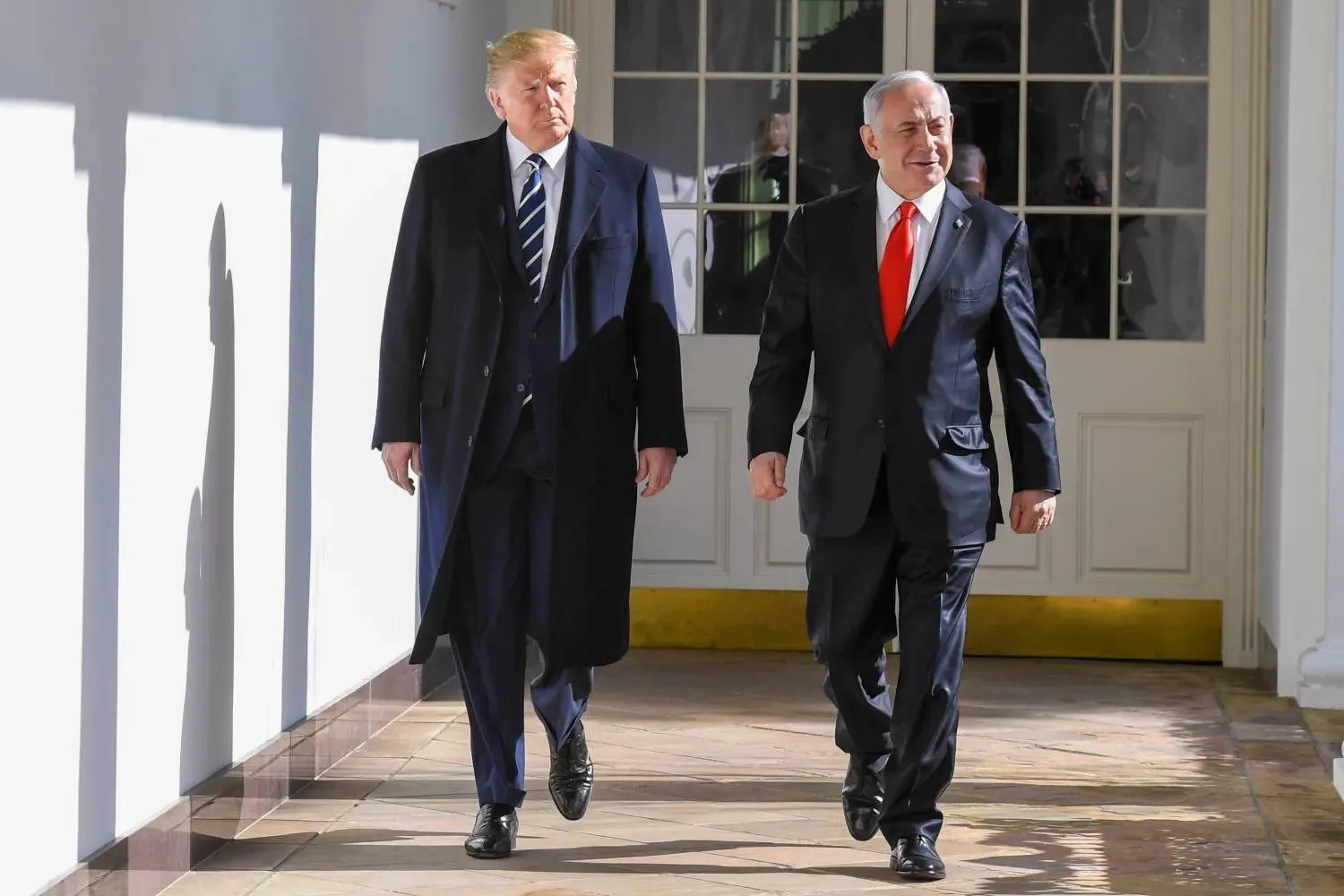
US President Donald Trump and Israeli Prime Minister Benjamin Netanyahu at the White House (file photo, dpa)
TT

Israel Adopts Phased Approach to Lebanon Negotiations

US President Donald Trump and Israeli Prime Minister Benjamin Netanyahu at the White House (file photo, dpa)

Israeli Prime Minister Benjamin Netanyahu had opted for a gradual approach in negotiations with Lebanon, sources close to Netanyahu said on Friday.

This means that Israel will start with technical and procedural issues before moving to major files, depending on the trajectory of US-Iran talks that began in Pakistan.

The sources cited by Maariv said Netanyahu chose a relatively junior official to handle the file, Israel’s ambassador to Washington, Yechiel Leiter, after initially planning to appoint his close adviser, Ron Dermer.

They said Dermer disagreed with Netanyahu’s approach. He argued Israel should agree to a ceasefire on the Lebanese front to allow the Islamabad talks to proceed without disruption.

In discussions with US envoy Steve Witkoff, he concluded that the continued war with Lebanon was undermining negotiations with Iran and could give Tehran grounds to trigger a crisis that prolongs the talks.

That would in turn harm President Donald Trump, who faces mounting domestic pressure to prevent a return to war.

Dermer, who manages US-Israeli dialogue, believes Trump’s opponents are exploiting the war politically, accusing him of being pulled behind Netanyahu and his personal and partisan interests at the expense of US interests, damaging Israel’s standing in the US.

The Israeli military, however, opposes ending the war with Lebanon and insists negotiations proceed under fire. The stance reflects a public perception that operations have not met their objectives, alongside anger over continued shelling from Lebanon. The fire has expanded into southern Israel and, while causing limited physical damage, has spread panic and reinforced calls to press on.

A poll published Friday showed 79% of Israelis oppose halting the war before Hezbollah is dismantled and disarmed.

Netanyahu has aligned himself with the military, leaving Dermer in a difficult position as both seek a formula that would satisfy Washington.

Katz said Hezbollah is “pleading for a ceasefire, and its Iranian patrons are also applying pressure and issuing threats, out of serious concern that Israel will crush Hezbollah.”

Boaz Bismuth, head of the Knesset’s Foreign Affairs and Defense Committee, said the war could resume in the “coming days,” describing the current ceasefire as a temporary arrangement.

Seeking to reassure the public, especially in the north where rocket fire is heaviest, Katz said the “massive and unprecedented attack on Lebanon” had dealt Hezbollah a severe blow, leaving it “stunned and confused” due to the depth and scale of the strikes.

He said the “separation of fronts” agreement, led by Netanyahu, was a key achievement that allows Israel to act forcefully against Hezbollah under an organized plan, with forces ready to escalate if Iran opens fire.

Katz said the plan rests on four lines: the border line, including the destruction of homes in Lebanese border villages, a defense line inside Lebanon expanded from five to 15 points, an anti-tank defense line secured through ongoing ground operations, and the Litani line, which Israeli forces aim to control to prevent infiltration and block residents from returning south.

He added the military would also launch a powerful air campaign, modeled on operations against Iran, targeting operatives and rocket launch sites in the Litani area and across Lebanon outside it.

Israeli military chief Eyal Zamir approved additional plans to expand the war and ground operations in Lebanon after touring and assessing the situation near Bint Jbeil on Thursday.

“Our main combat arena is here in Lebanon. The objective defined for you is the removal of the direct threat to the residents of the north, which you are carrying out with determination,” Zamir said to troops, according to remarks published by the army.

He said the army remained at war, deepening ground operations and striking Hezbollah hard.

“This is a very powerful operation, and our forces are on the front lines and in depth,” he said. He added that strikes on Iran were also affecting Hezbollah, which he said had become isolated inside Lebanon and cut off from its “strategic artery” in Iran.

“The Lebanese government now understands more than ever the scale of the problem posed by the presence of a radical extremist terrorist organization on its territory,” he said.


Palestinians Say Israeli Settlers Kill Man in Raid on Village

A damaged car in the Wadi Al-Lubban Al-Shamali area, south of Nablus, 06 April 2026. Israeli settlers burned a house, two tents, and three vehicles, and assaulted Palestinians in the town of Al-Lubban Ash-Sharqiya earlier in the day. (EPA)
TT

Palestinians Say Israeli Settlers Kill Man in Raid on Village

A damaged car in the Wadi Al-Lubban Al-Shamali area, south of Nablus, 06 April 2026. Israeli settlers burned a house, two tents, and three vehicles, and assaulted Palestinians in the town of Al-Lubban Ash-Sharqiya earlier in the day. (EPA)

The Palestinian health ministry said Israeli settlers shot dead a Palestinian man in the West Bank on Saturday, in the latest deadly attack on the occupied territory.

Ali Majed Hamadneh, 23, died after settlers opened fire during a raid on the village of Deir Jarir, northeast of Ramallah, the ministry said.

"He was brought to the Palestine Medical Complex in a critical condition" and later succumbed to his wounds, the ministry said on Telegram.

Palestinian official news agency Wafa also reported the incident.

"Armed colonists, under the protection of Israeli forces, attacked Deir Jarir from its western entrance and opened fire toward residents in the area," Wafa reported.

There was no immediate response from the Israeli police or military.

Violence in the West Bank, which Israel has occupied since 1967, has risen sharply since the October 7, 2023 Hamas attack on Israel triggered the Gaza war.

There has also been a spike in deadly attacks by Israeli settlers in the West Bank since the start of the Iran war on February 28, Palestinian authorities and the United Nations have said.

Prior to Saturday's attack, at least six Palestinians were killed since then in settler attacks, according to an AFP tally based on Palestinian health ministry figures.

Settler assaults on Palestinians have persisted for years, often to the indifference of mainstream Israeli society.

But the recent surge has prompted criticism from influential rabbis, settler leaders, and even Israel's military chief Lieutenant General Eyal Zamir, who called the attacks "morally and ethically unacceptable".


Iraqi Parliament Elects Nizar Amedi as Country’s New President

 The entrance of the Iraqi parliament building during a parliamentary session in Baghdad, Iraq, April 11, 2026. (Reuters)
The entrance of the Iraqi parliament building during a parliamentary session in Baghdad, Iraq, April 11, 2026. (Reuters)
TT

Iraqi Parliament Elects Nizar Amedi as Country’s New President

 The entrance of the Iraqi parliament building during a parliamentary session in Baghdad, Iraq, April 11, 2026. (Reuters)
The entrance of the Iraqi parliament building during a parliamentary session in Baghdad, Iraq, April 11, 2026. (Reuters)

The Iraqi parliament on Saturday elected Kurdish politician Nizar Amedi as the country's new president, a largely ceremonial role, following a parliamentary election last November.

Amedi, 58, is a former environment minister and has headed the political office of the Patriotic Union of Kurdistan (PUK) in Baghdad since 2024.

Iraq is now ‌due to ‌choose a prime minister, ‌a closely-watched ⁠and sensitive pick.

US ⁠President Donald Trump threatened in January to withdraw Washington's support for Iraq, a major oil producer, if former Prime Minister Nouri al-Maliki was designated to form a cabinet.

The pro-Iran Coordination Framework coalition that holds a parliamentary majority has ‌nominated Iran-backed Maliki, alarming Washington, which along ‌with Israel waged a six-week war with ‌Iran until a ceasefire was announced on Tuesday.

Senior US and Iranian officials were meeting in Islamabad on Saturday in ‌the highest-level talks between Washington and Tehran in half a century ⁠in ⁠an effort to end the war.

In Iraq, which has long trodden a tightrope between Iran and the US, its closest allies, the prime minister wields significant power.

Under Iraq's sectarian power-sharing system, the prime minister must be a Shiite, the parliamentary speaker a Sunni, and the president a Kurd.


Syria Says Busts Hezbollah-Linked Cell Planning Attack on ‘Religious Figure’

This handout picture released by the official Syrian Arab News Agency (SANA) on March 8, 2025, shows Syrian forces manning a checkpoint in the coastal city of Latakia. (SANA/AFP)
TT

Syria Says Busts Hezbollah-Linked Cell Planning Attack on ‘Religious Figure’

This handout picture released by the official Syrian Arab News Agency (SANA) on March 8, 2025, shows Syrian forces manning a checkpoint in the coastal city of Latakia. (SANA/AFP)

Syria's interior ministry said Saturday that five people had been arrested over a plot to attack an unidentified religious figure in Damascus, alleging the cell was linked to the Lebanese armed group Hezbollah.

In a statement, the ministry said security forces observed a woman as she attempted to "plant an explosive device in front of the house of a religious figure" near a church in Damascus's Bab Touma area.

Security forces intervened and dismantled the device, arresting all five members of the cell, the statement said.

"Preliminary investigations revealed the cell's link to Lebanon's Hezbollah, and that its members received specialized military training abroad," the statement added.

Since March 2, Hezbollah has been battling Israel after drawing Lebanon into the Middle East war with rocket fire at Israel in support of its backer Iran.

The group played a key role in Syria's civil war, fighting alongside the forces of now ousted leader Bashar al-Assad.

Under Assad, Syria was part of Iran's "axis of resistance" against Israel and enabled the transfer of weapons and money from Iran to Hezbollah.

Syria's new authorities have rejected Iranian influence and are hostile to the Lebanese group and its sponsor.

In February, Syria said it had dismantled a cell responsible for recent attacks targeting Damascus's Mazzeh district, saying the weapons came from Hezbollah, which denied any involvement.
