


Lebanon Between 2026 War and Negotiation Talks Next Week

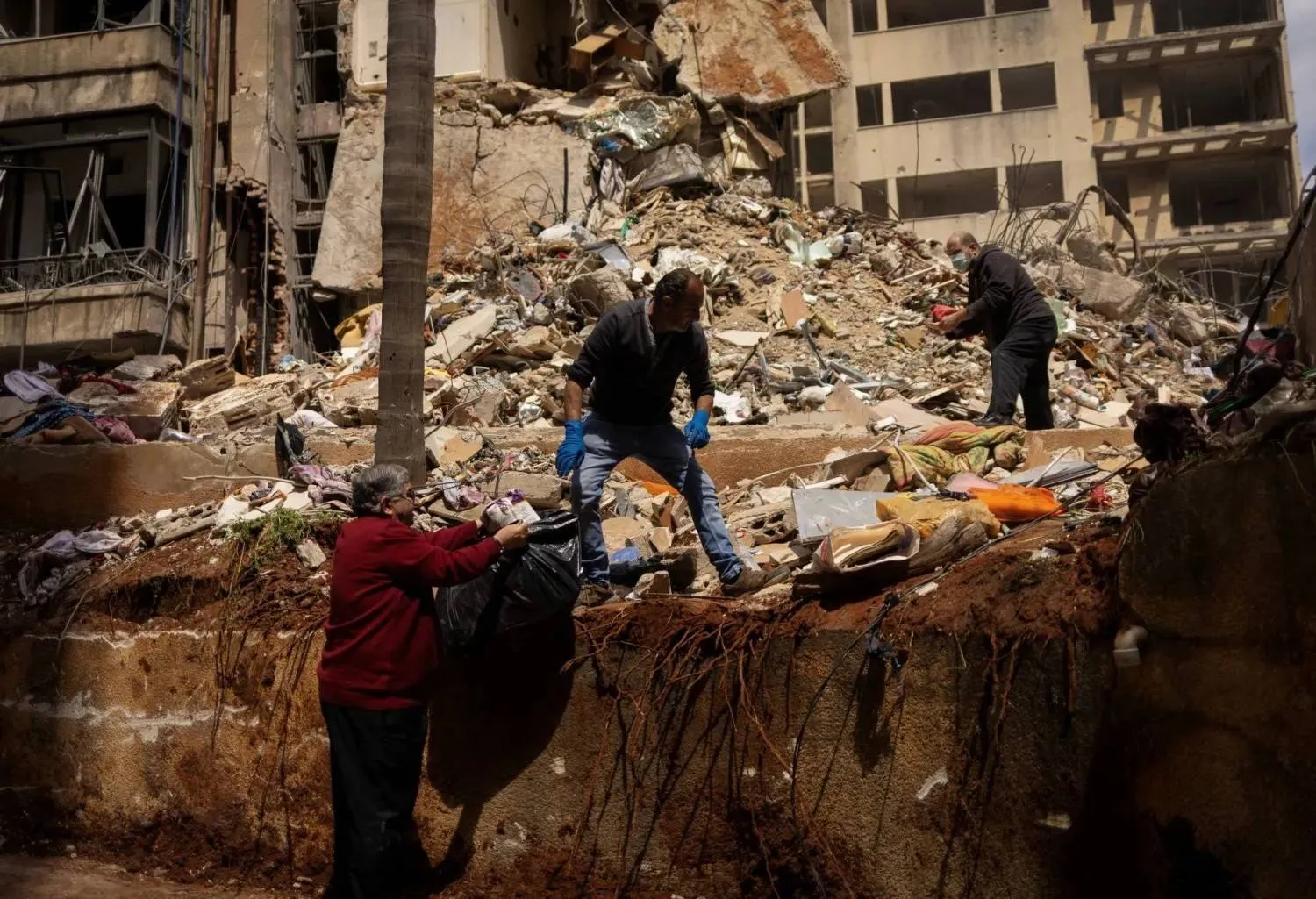
Residents search for belongings in the rubble of a building hit by an Israeli strike in the Ain el-Mreisseh area of Beirut (Reuters)
TT

Lebanon Between 2026 War and Negotiation Talks Next Week

Residents search for belongings in the rubble of a building hit by an Israeli strike in the Ain el-Mreisseh area of Beirut (Reuters)

Lebanon, under sustained Israeli air strikes and an open war, is entering a pivotal week as it prepares for preliminary meetings expected next week that could open a new negotiating track to secure a ceasefire, stabilize the border, and regulate the south.

The move brings Lebanese-Israeli negotiations back into focus, not as a precedent, but as a continuation of a path shaped by wars and facts on the ground.

The key shift lies in the form. Most past negotiations were indirect, conducted through the United Nations, international mediators, or technical committees. Lebanon has seen only one formal round of direct negotiations at this level, the May 17, 1983, agreement. That makes the 2026 track, in form, the closest parallel, though it differs sharply in context, conditions, and aims.

From armistice to border demarcation: indirect track

Negotiations between Lebanon and Israel began with the 1949 Armistice Agreement, signed in Naqoura after the 1948 war and the Lebanese army’s participation in the al-Malikiyyah battle.

It established a ceasefire, adopted the armistice line based on international borders, and set up a joint committee under UN supervision.

Since then, all frameworks, except the 1983 deal, have stayed within indirect or technical formats.

In April 1996, Israel’s “Grapes of Wrath” operation and the Qana massacre led to the April Understanding, which barred targeting civilians. It set up a monitoring committee including Lebanon, Israel, the US, France, and Syria, helping curb escalation until Israel’s withdrawal from the south in 2000.

After the 2006 war, United Nations Security Council Resolution 1701 set the international framework for the southern border, including a halt to hostilities, deployment of the Lebanese army south of the Litani River, expansion of UNIFIL, and restricting weapons in the area to the state.

In 2022, US-mediated indirect talks on maritime borders ended with the adoption of Line 23 and recognition of Lebanon’s right to develop the Qana field, seen as a model for technical, non-political negotiation.

In November 2024, border escalation produced a fragile ceasefire that included partial Israeli withdrawal from some points, expanded Lebanese army deployment south of the Litani, and a halt to hostilities. Repeated violations and weak implementation exposed its limits, prompting calls for a stricter mechanism.

“Mechanism”: toward direct engagement

In 2025, the term “mechanism” emerged as a practical framework to anchor a ceasefire. The proposal centers on a five-party committee including Lebanon, Israel, the US, France, and the United Nations, backed by technical and field monitoring.

Lebanon insists the Lebanese army alone must implement any arrangements on its territory, rejecting any Israeli operational role on the ground.

This marks the core shift. Unlike previous talks, which were indirect or technical, the 2026 meetings are set to be direct or semi-direct, making them the second such test after May 17.

Second time since 1983

Former MP Fares Soaid said Lebanon is entering “the second instance of formal direct negotiations with Israel,” after the first, which followed the 1982 invasion, when President Amine Gemayel pursued talks to secure Israeli withdrawal and reach an understanding.

He said 1983 unfolded under vastly different conditions. “The obstacles were enormous. The Cold War shaped the scene, and the Soviet Union, led by Yuri Andropov, opposed any track that could pull Lebanon fully into the US camp,” he said.

Arab capitals, led by Damascus under Hafez al-Assad, were not supportive, and Lebanese public opinion, especially among Muslims, was not ready, he added.

Although the May 17 agreement won majority backing in parliament, Damascus, aligned with the Soviet camp, mobilized local forces, leading to the February 6 uprising and the collapse of the deal, effectively besieging Gemayel in Baabda, Soaid said.

He said 2026 presents a different landscape. “There is no Soviet veto, the international climate is more positive, and Arab and Islamic positions are more open to negotiations,” he said.

“There is no objection from Damascus and no real internal opposition. The negotiating delegation is expected to be formed in line with the constitution and presidential powers,” he added, saying the chances of success are far higher than in 1983.

Negotiation is not normalization

A Lebanese parliamentary source said conflating negotiation with normalization has no legal or political basis, stressing that talks do not amount to diplomatic recognition or normal relations.

Lebanon has repeatedly negotiated, from the armistice to the April Understanding and the maritime demarcation, without changing its legal or political stance toward Israel, the source said.

“Negotiation is a political decision governed by international law and the Vienna and Geneva conventions,” the source said, adding that legal doctrine does not treat negotiation as recognition.

Lebanon has used multiple formats, from separate rooms to technical committees, all confined to specific files tied to security, borders, and sovereignty.

“The issue is not the form, but the substance,” the source said. “If the goal is to stabilize borders, stop violations, and restore sovereignty, that falls within the core duties of the Lebanese state.”

In Gaza, Fiberglass Homes Aim to Offer More ‘Dignity’ for Displaced

Boys (C) play with a ball amid tents at a makeshift camp for displaced Palestinians in Khan Younis, in the southern Gaza Strip on April 10, 2026. (AFP)
TT

In Gaza, Fiberglass Homes Aim to Offer More ‘Dignity’ for Displaced

Boys (C) play with a ball amid tents at a makeshift camp for displaced Palestinians in Khan Younis, in the southern Gaza Strip on April 10, 2026. (AFP)

In southern Gaza, aid workers are meticulously assembling fiberglass homes meant to shelter thousands of Palestinians still displaced six months after a ceasefire started between Israel and Hamas.

Nearly two million people in Gaza are living in makeshift shelters, and the humanitarian situation remains dire, according to aid agencies.

The fiberglass units are designed to offer a modicum of relief -- homes with slightly more comfort than a tent vulnerable to the coastal winds that hit Gaza.

Alessandro Markic, head of the United Nations Development Program office in Gaza, initiated the plan. He said families "are facing extremely difficult conditions".

Roughly 4,000 units are planned in the al-Mohararat area, west of Khan Younis.

Workers assemble walls, install small windows, and lay roofs for families who try to settle in with rugs and cushions inside.

"These are very basic and temporary solutions, while we continue to plan for recovery and reconstruction," Markic said. The homes, he added, "provide more dignity, privacy, and protection during the winter."

Some Gazans were visibly relieved to have an alternative to the tents where most displaced people continue to live.

Nasma Sharab has moved into one unit with her sons, and affirmed it was "better" than a tent.

The fiberglass homes "don't constantly blow away in the wind," she said.

But, she added, "it's a temporary solution while we wait for reconstruction to begin and for people to be able to go back to their homes."

Among those who remain in a tent is Ali Abu Nahl, in Beit Lahia in northern Gaza, after being displaced to the center and south of the territory with his children and grandchildren.

His house was destroyed during the devastating conflict that erupted with the Hamas attacks on Israel in October 2023.

"It's been half a year since the bombing stopped, but in Gaza, the war doesn't end when the strikes stop," he said.


Pressure Mounts on Hamas as It Weighs Response on Disarmament

Family members and friends mourn outside the Nasser Hospital, the day after a Palestinian was killed in an Israeli strike in Khan Yunis, in the southern Gaza Strip on April 10, 2026. (AFP)
TT

Pressure Mounts on Hamas as It Weighs Response on Disarmament

Family members and friends mourn outside the Nasser Hospital, the day after a Palestinian was killed in an Israeli strike in Khan Yunis, in the southern Gaza Strip on April 10, 2026. (AFP)

Diplomatic momentum is building around a Gaza ceasefire, as Hamas and other Palestinian factions prepare their final response to a “Board of Peace” plan on the movement’s disarmament and the second phase of the deal.

Talks were set to begin in Cairo on Friday and Saturday, with more meetings possible, bringing together Palestinian factions, Egyptian officials, and the Board of Peace’s high representative, Nickolay Mladenov.

Mladenov has held several rounds of talks in Egypt with officials and European representatives, following a second meeting last week with a Hamas delegation.

Sources from Hamas and other factions told Asharq Al-Awsat the group will present a unified Palestinian position, outlining its vision and proposed amendments to the plan submitted more than two weeks ago.

The response will stop short of outright acceptance or rejection, the sources said. Instead, Hamas will propose clear amendments and push for deeper negotiations to prevent Israel from using the process as a pretext to resume the war.

The group also aims to convince mediators, the United States, and the Board of Peace to broaden the talks beyond weapons, to include key provisions from both the first and second phases.

In its latest meeting with Mladenov, Hamas stressed that Israel must fully implement the first phase before any move to the second.

A Hamas source said the group would show flexibility with mediators to reach solutions that prevent renewed fighting, accusing the hardline government of Benjamin Netanyahu of seeking a return to war.

Resetting the terms

Hamas and other factions want a new negotiating framework that reflects Palestinian demands, rather than accepting imposed terms without binding commitments on Israel, another source said.

Details of the response remain undisclosed. But earlier discussions suggested handing over a limited number of vehicles mounted with “Dushka” machine guns, which Israel classifies as heavy weapons. At a later stage, factions could retain light arms under a mechanism overseen by mediators as part of a long-term truce.

Factions say they no longer possess what Israel defines as heavy weapons, such as rockets. Their remaining capabilities, they say, are limited to small numbers of anti-armor projectiles, explosive devices, light weapons such as Kalashnikov rifles, and some vehicle-mounted Dushka guns.

Pressure or coordination

Hamas sources acknowledge the group will face significant pressure in the coming talks, but say key mediators in Egypt, Türkiye, and Qatar understand its demands, even as they urge it to scale back proposed amendments.

A senior Hamas delegation has held meetings in Egypt and Türkiye, including with Turkish President Recep Tayyip Erdogan and intelligence chief Ibrahim Kalin, both of whom played key roles in the initial ceasefire negotiations.

Hamas said the meetings were part of consultations on Gaza and proposed amendments, denying that it was coming under pressure from Ankara.

The Board of Peace plan calls for full consolidation of all weapons, including light, heavy, tribal, and personal arms. Israel backs the plan. Hamas rejects it in its current form, citing security threats to its leaders and rejecting any link between disarmament and reconstruction of Gaza.

On the Israeli side, Yedioth Ahronoth reported that Israel is awaiting Hamas’s response. If it is negative, the decision would fall to Netanyahu’s government, which may move to enforce disarmament by force.

Israeli sources told the paper all options remain open, but with focus on the northern front with Lebanon, a return to fighting in Gaza in the coming days appears unlikely.


Türkiye, Syria Advance Strategic Partnership to Support Reconstruction

Turkish Foreign Minister Hakan Fidan (R) and Syrian Foreign Minister Asaad al-Shaibani shake hands during a joint press conference after their meeting in Ankara, Türkiye, 09 April 2026. (EPA)
TT

Türkiye, Syria Advance Strategic Partnership to Support Reconstruction

Turkish Foreign Minister Hakan Fidan (R) and Syrian Foreign Minister Asaad al-Shaibani shake hands during a joint press conference after their meeting in Ankara, Türkiye, 09 April 2026. (EPA)

Türkiye and Syria are moving to forge a broad strategic partnership spanning all areas of cooperation, backing reconstruction and efforts to restore stability after 14 years of war.

A flurry of meetings in recent days has aimed to accelerate coordination between the neighbors across multiple sectors.

Turkish Foreign Minister Hakan Fidan said shielding Syria from spillover from the regional crisis, including tensions involving Iran, the US, and Israel, is essential.

He said protecting gains toward sustainable stability in Syria remains a top priority for Ankara.

Speaking alongside Syrian Foreign Minister Asaad al-Shaibani in Ankara, Fidan said Türkiye would stand by Syria’s efforts.

Ankara is closely tracking the integration of the Syrian Democratic Forces into state institutions and wants the process completed without disruption to safeguard Syria and its neighbors, he added.

Lasting peace in the Middle East will remain out of reach unless Israel stops its expansionist ambitions. He described Israel’s actions in Lebanon as “genocide,” warning that stability cannot be achieved under continued escalation.

Shaibani said Syria and Türkiye have entered a new phase defined by a “strategic partnership,” anchored in the “Four Seas Project,” aimed at turning them into a key energy corridor linking the Gulf, the Caspian Sea, and the Mediterranean and Black seas.

He said talks covered energy, trade, and infrastructure, as well as tighter security coordination to control borders and counter threats to national security.

Shaibani said Damascus is pressing ahead with a comprehensive agreement with the Syrian Democratic Forces, with work underway to integrate them into the Syrian army and restore state control over border crossings, oil and gas fields, and civilian institutions.

Both ministers welcomed a temporary US-Iran truce and called for concrete steps to bolster regional stability.

Shaibani said Syria has endured more than 14 years of Iranian interference and militia activity, leaving one million dead, 15 million displaced or forced to flee, and 4 million homes destroyed.

He said Syria supports Arab countries hit by what he called unjustified Iranian attacks and backs efforts to ensure state control in Lebanon and Iraq, rather than armed groups operating outside official authority.

Shaibani said Syria seeks a strategic and economic partnership with Lebanon and supports a ceasefire and the Lebanese government's efforts to resolve issues through national means.

He also called for US and international backing to implement the 1974 disengagement agreement, urging Israeli forces to withdraw from Syrian territory and allow reconstruction to proceed.

After talks with Fidan, Shaibani met the US envoy to Syria and the ambassador to Türkiye, Tom Barrack, to discuss regional and international developments.

Earlier, a Turkish-Syrian investment forum in Istanbul brought together Turkish Trade Minister Omer Bolat and Syrian Economy Minister Mohammad Nidal al-Shaar to boost cooperation in transport, energy, investment, trade, and customs.

Bolat said transit trade through Syria to the Middle East and the Gulf is set to resume after a decade-long halt, with operations expected to begin next week following eased visa procedures for Turkish truck drivers via Saudi Arabia.

He said bilateral trade reached $3.7 billion last year, up 40%.

Separately Turkish Transport Minister Abdulkadir Uraloglu signed a trilateral transport deal in Amman with Jordan’s Nidal Qatamin and Syria’s Yarub Badr to deepen regional integration and develop transport infrastructure amid disruptions linked to the Iran conflict.

Uraloglu said the deal will ease truck movement, expand rail transport, boost port activity, and expand market access, adding that a Turkish technical delegation will visit Saudi Arabia next week as part of a broader plan to link the Arabian Peninsula with Central Asia and Europe.
