


Masoud Barzani’s Party Rejects Result of Iraqi Presidential Vote

Iraqi Parliament (X)
TT

Masoud Barzani’s Party Rejects Result of Iraqi Presidential Vote

Iraqi Parliament (X)

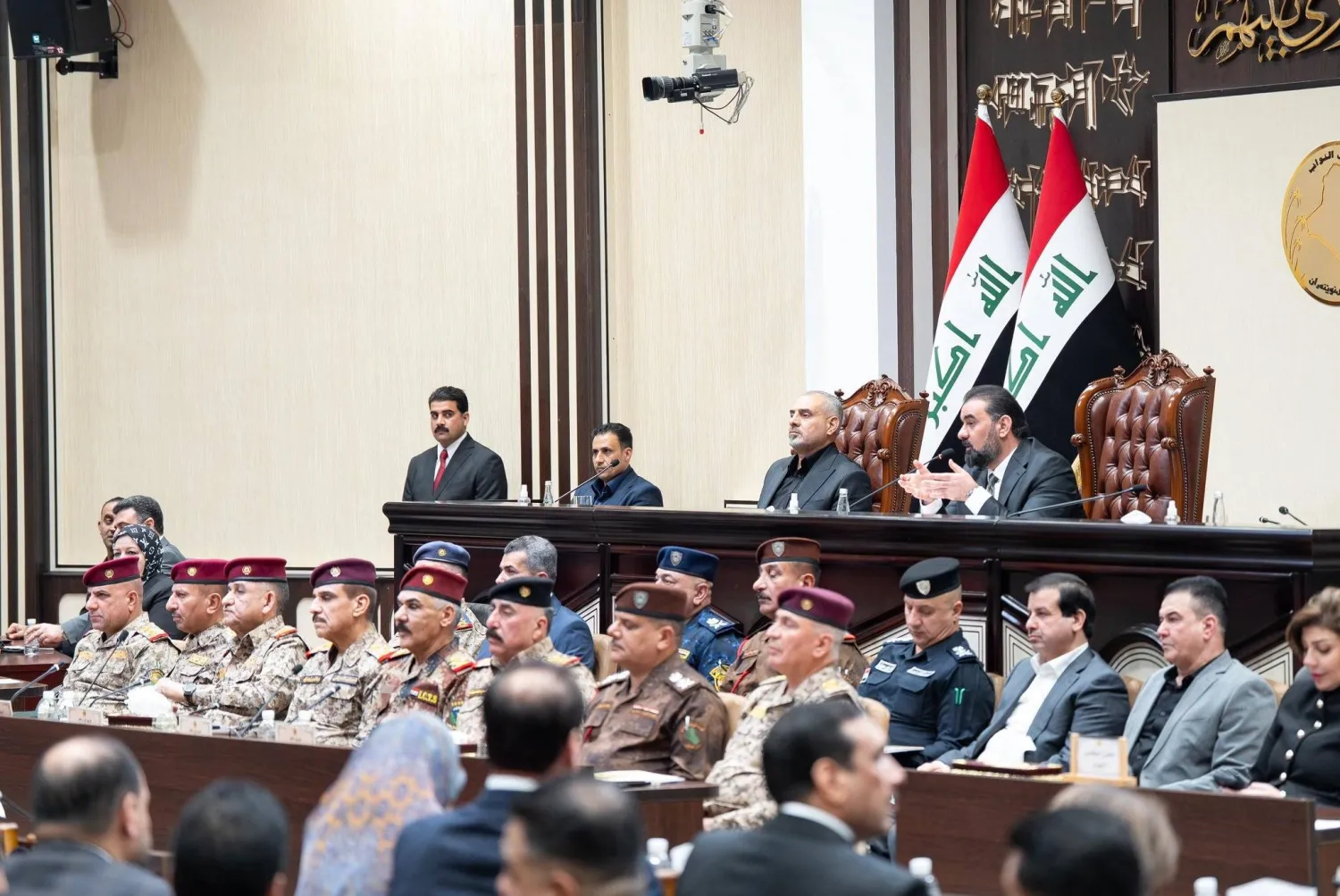
The Kurdistan Democratic Party (KDP), led by Masoud Barzani, has rejected the election of Nizar Amidi as Iraq’s president, worsening political tensions in the Kurdistan Region and across the country.

The party has instructed its representatives in the federal government and parliament to return to the region for consultations.

Kurdish sources close to the KDP allege that armed factions represented in parliament helped secure quorum for the vote. Electing a president requires a two-thirds majority, meaning at least 220 of 329 lawmakers must be present.

On Saturday, parliament elected Amidi, the candidate of the Patriotic Union of Kurdistan (PUK), after more than four months of deadlock driven by disputes between the two main Kurdish parties over the post, as well as broader disagreements over forming a new Kurdistan Regional Government.

The session was boycotted by the KDP and the State of Law Coalition, headed by former prime minister Nouri al-Maliki, underscoring widening divisions among Kurdish and Shiite factions within the Coordination Framework.

In a statement issued after the vote, the KDP said it would not recognize Amidi’s presidency and accused parliament of violating its own rules.

“The election process was conducted in a manner inconsistent with the council’s internal regulations,” the party said, arguing that the session agenda was set without proper adherence to procedure.

The KDP also objected to the selection of the candidate itself, saying the presidency is a national Kurdish entitlement rather than the prerogative of a single party. It accused the PUK of unilaterally nominating Amidi and securing backing from other Iraqi factions.

“We do not consider a person chosen in this way to represent the Kurdish majority,” the statement said.

The party added that its lawmakers and officials would return to the Kurdistan Region to “assess the situation and hold consultations,” without clarifying next steps or whether the move could further delay the formation of a regional government.

Days earlier, Barzani had warned against proceeding with the presidential vote before Shiite factions agreed on a candidate for prime minister. Writing on X, he said moving ahead on one constitutional post while leaving another unresolved was “unacceptable,” and called for a synchronized process ensuring participation by all parties.

Independent Kurdish journalist Saman Noah described the KDP’s response as unprecedented and likely to deepen an already severe political crisis in the Kurdistan Region.

“The current trajectory is unprecedented and will further complicate conditions in a region facing major structural challenges,” Noah wrote on Facebook, citing the failure to form a government for more than 18 months, a parliament effectively suspended for years, and worsening economic conditions.

He said recurring disputes over the presidency — often marked by party interests overriding broader Kurdish priorities — have significantly weakened Kurdish political leverage in Baghdad.

Questions have also emerged over whether the parliamentary session met quorum requirements.

Writer and researcher Kifah Mahmoud said the vote may have violated legal standards, citing lawmakers including Ikhlas al-Dulaimi who claimed fewer than 180 members were present.

“If accurate, that would fall well short of the required 220,” Mahmoud said, describing the session as a “serious breach” that risks further undermining trust in Iraq’s political process.


Lebanese, Int’l Contacts Contain South Lebanon Security Slide

A giant portrait of Lebanese President Joseph Aoun hangs at the northern entrance to Sidon, as cars carrying displaced people from southern Lebanon head toward Beirut. (EPA)
TT

Lebanese, Int’l Contacts Contain South Lebanon Security Slide

A giant portrait of Lebanese President Joseph Aoun hangs at the northern entrance to Sidon, as cars carrying displaced people from southern Lebanon head toward Beirut. (EPA)

Lebanese and regional contacts contained a sharp deterioration in Lebanon’s security situation after a major military escalation between Israel and Hezbollah, and threats by Tel Aviv to escalate further.

Lebanese sources said Israel was seeking to undermine the ceasefire agreement, pressure Lebanese negotiators ahead of a fifth round of talks with Lebanon in Washington, and secure gains on the ground.

Reuters quoted a US official as saying Israel and Hezbollah had agreed to a ceasefire starting at 4 p.m. local time, after a major escalation that killed 47 Lebanese, including children and civilians, and four Israeli soldiers in clashes with Hezbollah in southern Lebanon. The Israeli air force carried out more than 150 strikes in southern and eastern Lebanon.

“Hezbollah and Israel agreed to a ceasefire,” the US official said, adding that US and Qatari negotiators reached the agreement with help from Iran.

“We understand that after the exchange of fire earlier today, Israel and Hezbollah are now in a ceasefire,” the official said.

Israel and Hezbollah both said they were ready to respect the ceasefire and respond to violations.

Lebanese and international contacts

The security deterioration triggered a flurry of regional, international and local contacts.

Official sources told Asharq Al-Awsat that Lebanese President Joseph Aoun “began a series of international contacts in the morning with influential countries to lower the escalation, prevent further deterioration and ensure commitment to the ceasefire.”

The contacts focused mainly on the United States and Qatar.

Aoun also condemned “the continuing Israeli escalation.”

“What we are witnessing today in the south and the Bekaa, with the expansion of Israeli attacks and further killing and destruction, is a dangerous and condemnable escalation, especially as it has affected dozens of innocent people, including women and children,” Aoun said.

He said the escalation “effectively targets all ongoing efforts to consolidate the ceasefire and end the war, especially after the latest developments between the US and Iran.”

“But this will not prevent work to achieve a comprehensive ceasefire as quickly as possible. This is what I instructed the Lebanese negotiating delegation to pursue in the next round in Washington,” he said.

“There can be no leniency on this issue because a comprehensive ceasefire is the entry point for discussing other issues, most importantly the Israeli withdrawal, the deployment of the army and the return of prisoners.”

On the international level, Hezbollah parliamentary bloc member MP Hassan Fadlallah said Iran had informed the group that negotiations with the United States could not continue without the implementation of a comprehensive ceasefire.

Fadlallah urged the Lebanese government to reject any direct negotiations with Israel while Israeli attacks on Lebanon continue. He said Washington was responsible for ensuring Israel stops its attacks and implements the terms of the agreement.

Geographic expansion and pressure on Lebanon

The sudden deterioration appeared to signal an Israeli attempt to bypass the agreement that took effect last Monday.

Sources in the Shi’ite duo told Asharq Al-Awsat that Israel was “pressuring to strike the agreement directly and target it.” They said Tel Aviv was also trying to pressure the Lebanese negotiator before the fifth round of direct negotiations with Israel opens in Washington next Tuesday. The talks are due to run for three days.

The sources said Israel was trying to “seize additional cards with which to pressure Lebanon.”

They cited “an Israeli desire for geographic expansion after its failure to achieve a major expansion during 110 days of war.” The area where Israel made significant advances in the first weeks of the war, they said, was the same area Hezbollah evacuated and where it committed to restricting weapons to the Lebanese state.

But attempts to expand beyond that area “met fierce resistance that slowed the push,” the sources said.

The source said a fourth reason was “an internal crisis linked to the rising far-right mood in Israel,” adding that “military failure is driving it to target civilians in Lebanon.”

Ceasefire before any arrangements

Lebanese observers say Israel’s failure to abide by the ceasefire agreement is not driven only by Prime Minister Benjamin Netanyahu’s sense of being “sidelined” after the agreement was signed.

They say Israel is also trying to reach an agreement with the Lebanese state in exchange for withdrawal from occupied territory, and to begin disarming Hezbollah in exchange for halting the escalation.

Hezbollah rejects this. The group is relying on US-Iranian understandings and continues to criticize the Lebanese state’s negotiating track.

Still, Lebanese authorities are proceeding with the sessions scheduled to begin Tuesday.

Lebanese ministerial sources told Asharq Al-Awsat that the instructions to the negotiating delegation are clear: demand a full and comprehensive ceasefire before discussing any other arrangements.

The sources said Beirut “is holding to its demands.”

Singling out Lebanon

Hezbollah, however, rejects the direct negotiating track.

Sources following Hezbollah’s escalation against the track said the group “believes there is an overlap of interests between Tel Aviv and the state within the framework of the track on which the state is relying to achieve withdrawal and a ceasefire.”

The sources said Hezbollah believes the direct negotiating track rests on the view that Israel is uncomfortable with US performance in the agreement with Iran, while Lebanon is uncomfortable with Iran’s performance.

They said Hezbollah had “sensed that Lebanon was being singled out” through the US statement issued after the first negotiating session. This, they said, was reinforced in the declaration of intent paper in the fourth round, which appeared to show bias toward Israel in the negotiations.

Hezbollah MP Hussein Hajj Hassan said: “The authorities agreed to a joint statement with the Americans and Israelis containing language to the effect that Hezbollah is a common enemy of Israel, America and Lebanon. This was stated by US Secretary of State Marco Rubio, while the Lebanese delegation did not utter a word. No Lebanese official in power objected to this language. Therefore, what is required from them is a position clarifying whether they agree with this language or not.”

He called on Lebanese officials “to bridge the gap they created with the resistance and its public, and to bridge the gap they created with the Islamic Republic of Iran, for Lebanon’s interest and not for Iran’s interest.”


US, Domestic Pressures Seen Behind Baghdad Dismissals

 Iraqi Prime Minister Ali al-Zaidi meets US envoy Tom Barrack in Baghdad, June 16, 2026. Iraqi government media/Handout
Iraqi Prime Minister Ali al-Zaidi meets US envoy Tom Barrack in Baghdad, June 16, 2026. Iraqi government media/Handout
TT

US, Domestic Pressures Seen Behind Baghdad Dismissals

 Iraqi Prime Minister Ali al-Zaidi meets US envoy Tom Barrack in Baghdad, June 16, 2026. Iraqi government media/Handout
Iraqi Prime Minister Ali al-Zaidi meets US envoy Tom Barrack in Baghdad, June 16, 2026. Iraqi government media/Handout

A shake-up by Iraqi Prime Minister al-Zaidi in security and economic posts has raised questions over the messages he is trying to send: is he seeking to redraw the balance of power inside the state, or responding to external demands tied to his expected visit to the United States next month?

The moves came as talks to complete the cabinet lineup were still under way, giving them added political weight. Iraqi prime ministers have often avoided sweeping decisions in sovereign institutions before fully securing their governments, wary of clashing with the political forces that have anchored the system since 2003.

The changes touched some of the state’s most sensitive institutions, including the National Security Service and the central bank.

Supporters say the move shows a push to bring in new faces and project the prime minister’s ability to act independently. Critics say some of the decisions amount to recycling familiar figures within the ruling system.

Coordination Framework reaction

What drew more attention than the reshuffle itself was the response from the main political forces, especially the Coordination Framework, which backed al-Zaidi’s rise to office.

So far, there has been no strong public objection, although the decisions affected figures long tied to centers of influence inside the state.

Yassin al-Bakri, a political science professor at Al-Nahrain University, said the steps carried several messages at once. He described them as an early show of force, a test of political reactions and an attempt to present al-Zaidi as a figure able to move from business into the management of Iraq’s complex political balances.

Al-Bakri told Asharq Al-Awsat that the prime minister had stepped into an area several predecessors had avoided by moving to reorder influential posts before completing his cabinet.

That could give him wider room to negotiate over the remaining ministries, especially the Interior Ministry, which remains contested by several political parties.

Between home and abroad

The timing of the decisions carries added weight as al-Zaidi’s expected visit to the United States approaches, along with an anticipated meeting with US President Donald Trump next month.

Observers believe the changes may be meant to reassure Washington that the new government is ready to take steps on institutional reform and strengthening state authority, especially after meetings al-Zaidi held with US officials in recent weeks.

Basil Hussein, head of the “Kloatha” center for studies, said the timing of the changes, alongside a meeting with US envoy Tom Barrack, makes it difficult to dismiss the possibility that they are linked to understandings with Washington.

But Hussein said a broader reading also suggests that al-Zaidi is trying to reshape what he called the “hard core” of the security and financial agencies, ensuring their loyalty to the prime minister’s office rather than to the political forces that brought them in.

Under this reading, the reassignment of some figures affected by the reshuffle suggests the prime minister is trying to gradually loosen existing networks of influence without directly confronting powerful forces inside the Coordination Framework. But this view is weakened by the fact that some dismissed figures were replaced by others from the same party-linked circles or their allies.

Analysts are divided over whether al-Zaidi’s decisions mark the start of a confrontation with the political class or merely a calculated maneuver within existing understandings.

On one hand, his background as a businessman and his previous ties with influential actors give him deep knowledge of the system’s power centers and weak points. That could give him more room to maneuver than some of his predecessors had.

On the other hand, the limits of that room remain tied to several factors: the outcome of his expected visit to Washington, the level of external support he may secure and the willingness of Iraqi political forces to adapt to his efforts to redistribute influence inside state institutions.

Some decisions also looked, to observers, more like political settlements than a rupture. Influential figures were moved to other posts rather than pushed out entirely, suggesting the continued need to preserve the balances that govern Iraq’s political system.

In the end, al-Zaidi’s changes look like an early test of the limits of executive power in Iraq. They carry reformist elements and messages of strength, but they have not yet amounted to a break with the forces that brought him to power.


Aoun to Rubio: Ceasefire Is Fundamental Pillar for Lebanese-US-Israeli Talks in Washington Next Week

Smoke billows from southern Lebanon following an Israeli strike, as seen from Nabatieh, southern Lebanon, June 19, 2026. (Reuters)
TT

Aoun to Rubio: Ceasefire Is Fundamental Pillar for Lebanese-US-Israeli Talks in Washington Next Week

Smoke billows from southern Lebanon following an Israeli strike, as seen from Nabatieh, southern Lebanon, June 19, 2026. (Reuters)

Lebanese President Joseph Aoun received on Friday a telephone call from US Secretary of State Marco Rubio to discuss the current situation in Lebanon and the region in light of the lates developments, reported Lebanon’s National News Agency.

Rubio stressed that the United States stands with Lebanon and is working to achieve security and stability in the country, extend the authority of the state over all its territory, and support its legitimate, security, and military institutions, especially the army.

Aoun expressed his gratitude to Rubio for "his country's support for Lebanon," stressing "the need to stop the Israeli attacks on Lebanese territory by achieving a comprehensive ceasefire.”

Lebanon considers achieving a ceasefire a “fundamental pillar for the progress of the Lebanese-US-Israeli negotiations scheduled in Washington next week to reach the goals and principles from which these negotiations were launched to restore Lebanon's security, stability, sovereignty, and territorial integrity.”

Fighting flared anew in Lebanon on Friday, with authorities reporting 47 killed in Israeli airstrikes and Israel announcing the deaths of four of its soldiers.

The violence is the worst since the sealing of a US-Iran deal to halt the wider Middle East war, which was supposed to also pause fighting between Israel and Hezbollah in Lebanon.
