
In Lebanon Shelters, Women Care for Tiny Babies, Face Pregnancy

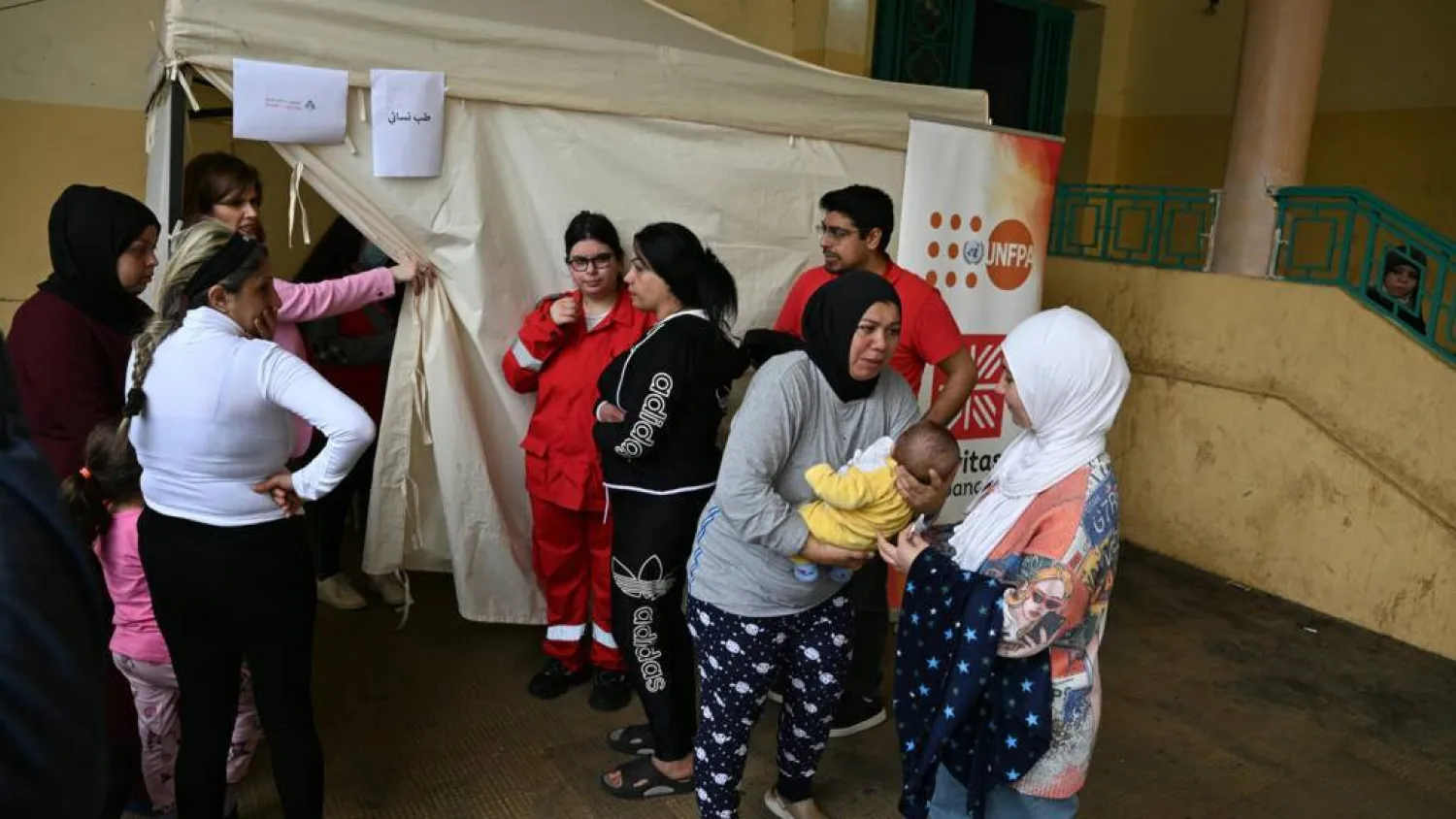
Mariam Zein (R) brings her son to a mobile health clinic run by charity Caritas Lebanon. Joseph EID / AFP
TT

In Lebanon Shelters, Women Care for Tiny Babies, Face Pregnancy

Mariam Zein (R) brings her son to a mobile health clinic run by charity Caritas Lebanon. Joseph EID / AFP

Mariam Zein cradled her 11-week-old son on a mattress on the floor where she and her family have sheltered near Beirut since the Israel-Hezbollah war upended her young family's life.

"I was really excited when I was in my ninth month of pregnancy... I never thought he'd be born and there'd be war," said Zein, 26, clutching baby Hussein.

"I haven't been able to enjoy my son -- my first child... to see him getting bigger in his own bed, in his own home."

"I was very sad, and I'm still sad," she told AFP, nappies and baby formula wedged near a photocopier, clothes hanging on an improvised line.

Zein fled with her husband, their baby and other relatives when war erupted between Israel and Hezbollah on March 2, drawing Lebanon into the Middle East conflict, said AFP.

She does not know if her home in south Lebanon is still standing.

Israel has kept up strikes despite a fragile US-Iran ceasefire, a landmark meeting this week between Israeli and Lebanese officials in Washington, and reports that leaders from both countries would talk for the first time in decades.

Lebanese authorities say the war has killed more than 2,100 people and displaced more than one million others.

Some 140,000 people are in overcrowded shelters like the center in Beirut's suburbs housing Zein's family and around 500 other people, among them five pregnant women and others with young babies.

Zein said she stopped breastfeeding because there was no privacy, and now struggles to buy baby formula, while Hussein is outgrowing his clothes.

"Whatever happens I just want my son near me," she said.

- Pregnancy -

According to the United Nations Population Fund (UNFPA), an estimated 620,000 women and girls are displaced, including some 13,500 pregnant women, of whom "1,500 are expected to give birth within the next 30 days".

The agency and other organizations have sought to support women as the authorities struggled to cope.

In a small tent containing a portable ultrasound, obstetrician and gynecologist Theresia Nassar has checked on women including Zein as part of a mobile health clinic run by charity Caritas Lebanon with support from UNFPA.

Displaced pregnant women risk missing important tests and scans, she said, and they are trying to fill the gaps.

"We're not just worried about physical health but also their mental health," she said.

"They don't know if they can go home, they don't have their medication, they're not being properly followed."

Elsewhere, at a school-turned-shelter in central Beirut, heavily pregnant Ghada Issa, 36, is due to deliver a baby girl in a few weeks.

But "this place, this environment, is not for pregnant women", said Issa, who was displaced from south Lebanon with her husband, their daughter Siham, five, and son Ali, four.

They live in a cramped tent, and she said even the basics are a problem, like having to make frequent trips to crowded, far-away communal toilets.

- Twins -

Her husband set up an improvised bed so she doesn't have to sleep on the floor.

Underneath are precious donated items like tiny socks and little blankets. A worker from charity Amel Association International brought them a "baby kit" including nappies and baby powder.

Without donations and other support, "there wouldn't be anything" for the baby, Issa said, as people playing football yelled, children squealed and washing hung on improvised lines.

The shelter's administration said some 20 pregnant women and two who had recently given birth were among more than 2,600 people staying there.

"I haven't got my head around the idea of having a baby here," Issa said.

"I'm still hoping that one day they'll tell me, let's go to the village, and I'll have the baby at home."

In a university classroom in south Lebanon's city of Sidon, Ghada Fadel, 36, cares for her tiny twin sons. Mohammed and Mehdi are just over one month old, and in blue jumpsuits and matching beanies.

The family has been there since she was eight months' pregnant, after fleeing their border village.

"After we left the house, they (Israel) bombed it. The house is gone" along with everything they had prepared for the twins, Fadel said.

"I was hoping to give birth and come home," she said sadly.

"Every mum hopes to take her kids home... no matter the circumstances."


Trump Warns Israel and Iran Not to 'Blow It' after New Strikes Threaten Emerging Ceasefire Deal

US President Donald Trump speaks to reporters aboard Air Force One on a flight back to Washington March 15, 2026. REUTERS/Kevin Lamarque/File Photo
TT

Trump Warns Israel and Iran Not to 'Blow It' after New Strikes Threaten Emerging Ceasefire Deal

US President Donald Trump speaks to reporters aboard Air Force One on a flight back to Washington March 15, 2026. REUTERS/Kevin Lamarque/File Photo

US President Donald Trump on Sunday urged no further attacks by anyone after Israel's military said it launched strikes on Hezbollah targets in Beirut's southern suburbs, potentially complicating efforts to finalize a deal to end the US-Iran war.

The Public Health Emergency Operations Center said three people, including two women, were killed, and 16 were wounded.

Trump reacted on social media and said Israeli strikes on Beirut "should not have happened" as he vowed a regional peace deal was at hand, though he did not confirm reports it would be signed during the day.

"We are very close to a Deal that will bring peace to the region, including to Lebanon, and all sides should stand down," Trump said on social media.

"This could be the beginning of a long and beautiful peace -- Let's not blow it!"

The deal in its current form is a deep disappointment to Israel's government, which has been sidelined in negotiations led by Pakistan and others. The last time Israel struck the Beirut suburbs a week ago, it set off the most serious escalation of fighting between Iran and Israel since the tenuous ceasefire took hold April 7.

Trump, who had said the deal could be signed Sunday, has pressed Israeli Prime Minister Benjamin Netanyahu to stop hitting Lebanon hard while a deal is near, but the prime minister has defied him.

Netanyahu's office said the strikes were in response to Hezbollah attacks on northern Israel. Israel’s military said Hezbollah launched three projectiles, releasing footage where an audible boom was followed by rising smoke. There was no immediate comment from the Iranian-backed Hezbollah.


Trump to Meet Sisi at G7 Summit in France

US President Donald Trump holds a meeting with Egypt's President Abdel Fattah al-Sisi during a summit on Gaza in Sharm el-Sheikh on October 13, 2025. (AFP)
TT

Trump to Meet Sisi at G7 Summit in France

US President Donald Trump holds a meeting with Egypt's President Abdel Fattah al-Sisi during a summit on Gaza in Sharm el-Sheikh on October 13, 2025. (AFP)

US President Donald Trump is set to hold talks with Egypt's President Abdel Fattah al-Sisi on the sidelines of the G7 summit in France this month, the Egyptian presidency said on Sunday.

In a statement, the presidency said Sisi is expected to hold a series of meetings with world leaders during the summit, "including a bilateral meeting with US President Donald Trump".

It added that Sisi's meetings would focus on "discussing ways to resolve international geopolitical crises and address their repercussions on trade, energy and supply chains".

The G7 summit will be one of the first major international gatherings since the United States and Israel launched a war against Iran in late February, upending the Middle East and widening transatlantic tensions.

French President Emmanuel Macron, who is hosting the summit in the city of Evian on June 15-17, said that leaders from Egypt, Saudi Arabia, Qatar and the United Arab Emirates had been invited to discuss the Middle East war, according to the French presidency.

Saudi Crown Prince Mohammed bin Salman said he would not attend the summit due to "prior commitments", the Saudi Press Agency (SPA) reported on Thursday.

The G7 brings together the leaders of Britain, Canada, France, Germany, Italy, Japan and the United States, along with invited leaders from several other countries, including Brazil and India.

Macron is due to arrive in Evian on Sunday evening, with other leaders, including Trump, expected on Monday.

Leaders are set to have a packed agenda of potentially explosive issues, including efforts to end the war in Iran and re-open the key Strait of Hormuz shipping bottleneck.


Arab League Warns of Devastating Effects of Attacking Education in Occupied Territories

Arab League headquarters in Cairo (The League's official Facebook page)
TT

Arab League Warns of Devastating Effects of Attacking Education in Occupied Territories

Arab League headquarters in Cairo (The League's official Facebook page)

Assistant Secretary-General and Head of the Palestine and Occupied Arab Territories Sector at the Arab League Ambassador Dr. Faed Mustafa stressed that targeting education in the occupied Palestinian territories, particularly in the Gaza Strip, cannot be regarded as merely a side effect of war.

He asserted that it represents part of a systematic plan aimed at erasing the Palestinian national identity and depriving future generations of their awareness, culture, and sense of belonging. He warned that what he described as educational genocide would have devastating consequences extending to generations to come, SPA reported.

He made the remarks during his speech at the opening of the 111th Session of the Committee on Educational Programs for Arab Students in Occupied Arab Territories, which kicked off today at the headquarters of the General Secretariat of the Arab League in Cairo.

Mustafa noted that Palestinian efforts to resume the educational process, particularly in the Gaza Strip, face major challenges due to the blockade, Israeli restrictions, and shortages of educational supplies. These circumstances have compelled the concerned authorities to resume classes in partially damaged schools, as well as in tents and temporary educational centers with limited resources.

He called on the international community and relevant institutions to fulfill their obligations toward rebuilding the Palestinian educational system, ensuring sustainable funding for United Nations Relief and Works Agency for Palestine Refugees in the Near East (UNRWA), and supporting psychological and educational recovery programs.

Mustafa stressed that saving Palestinian education is a national, humanitarian, and moral duty that requires concerted local, regional, and international efforts.