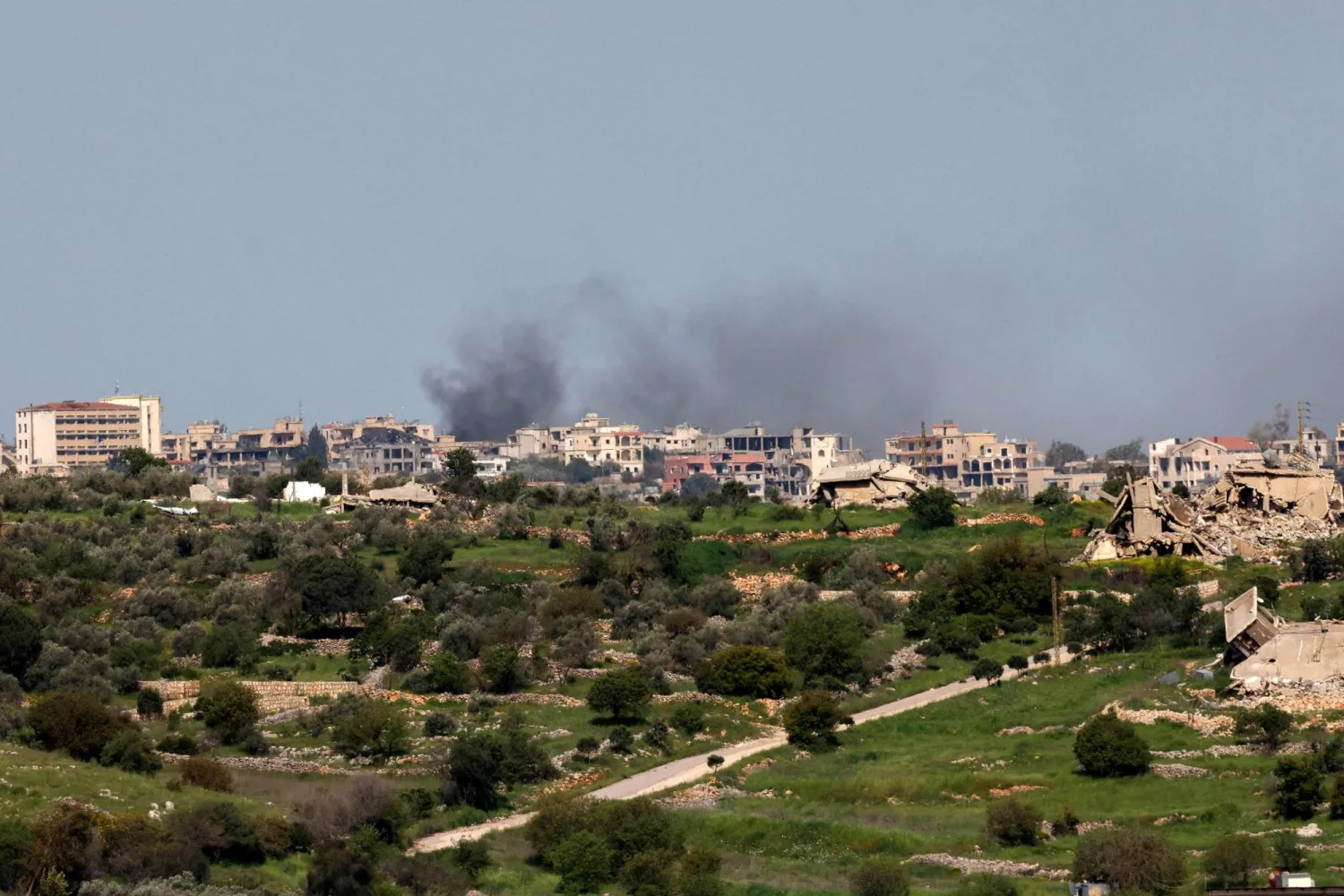
Israel has stepped up demolitions, explosions and bulldozing in the coastal town of Mansouri, south of Tyre, making it one of the hardest-hit areas in southern Lebanon in recent days.
The intensity of the destruction has raised questions over why Israel is focusing on the town — and whether it is targeting specific military installations or pursuing a broader aim:
reshaping the terrain to control Mansouri by fire without fully occupying it.
A documented tally of Israeli attacks over the past seven days shows a sharp surge in explosions inside the town. More than 75 were recorded between Sept. 3 and midday Thursday, alongside airstrikes and repeated artillery shelling.
The campaign peaked on Wednesday, with dozens of explosions in a single day. Another 12 were recorded on Thursday morning. The figures are a minimum estimate, with further explosions reported but not precisely counted.
According to available information, Israeli forces have recently adopted a method of demolishing homes and residential neighborhoods remotely. Drones drop barrels packed with powerful explosives onto rooftops before detonating them.
A similar tactic was recorded in Bani Hayyan, where a drone dropped explosives onto homes before they were blown up.
Mansouri is strategically important because it lies along the coastal route and close to several positions occupied by Israeli forces. The mounting destruction suggests Israel’s actions go beyond daily military operations, raising questions about the military reality it is seeking to impose in the town and its surroundings.
Reshaping the terrain
Retired Brig. Gen. Hassan Jouni links Israel’s focus on Mansouri to the area’s geography. But he says the presence of Hezbollah infrastructure alone does not explain the scale of the destruction.
“This is linked to Mansouri’s geography and its geographical extent,” Jouni told Asharq Al-Awsat. “The area forms a corridor that Hezbollah historically used extensively in its operations.
My assessment is that infrastructure exists there.”
“The terrain, dense woodland and a long corridor stretching from north of Tyre to the border made the area particularly useful to Hezbollah,” he said.
“It is likely to contain extensive and varied infrastructure, especially given its proximity to the border. During the fighting, reports spoke of drones and rockets being launched from this area.”
But Jouni stressed that this “does not mean every explosion carried out by Israel is targeting such infrastructure.”
“Israel is reshaping the geography and altering the terrain to create a military landscape better suited to its army,” he said.
“The natural geography is being changed to make surveillance, observation and monitoring easier for the Israeli army. What we are seeing is more an effort to reshape the geography than simply to target infrastructure in Mansouri.”
Jouni said the same logic applied to the destruction of buildings.
“Some homes stand at commanding, elevated locations that overlook the surrounding area,” he said.
“They are being destroyed because of the importance of their position — not necessarily because they contain infrastructure or ammunition, or because they belong to Hezbollah or its members. Some are destroyed solely because of where they stand.”
Jouni described Mansouri as a “pivotal target” for Israel because it “lies between Israeli army positions in the western sector and the city of Tyre.”
A shifting operational zone
Jouni said the “yellow line” should not be understood as a fixed boundary on the ground.
“The yellow line being discussed cannot be drawn as a line on the ground,” he said. “It is a series of operational zones extending in the west from the vicinity of Mansouri and Majdal Zoun, moving north toward Haddatha and then east to the vicinity of Ali al-Taher.”
“There is no yellow line like the one in Gaza, marked by signs or concrete blocks,” he added.
“Here, we are talking about a fluid, dynamic operational zone. It has been called the yellow line, but in practice, it is not fixed.”
Jouni said the limits of the Israeli army’s presence in southern Lebanon were defined not by a fixed line, but by shifting operations.
In Israeli calculations, he said, Mansouri is “a vital central target separating the city of Tyre from Israeli army positions along the southern border or in the buffer zones.”
“Israel views Mansouri strategically,” he said. “It is treating the town as a barrier village — and seeking to remove that barrier.”
Control by fire
Retired Brig. Gen. Saeed Qazah said Israel appeared to be trying to strip Mansouri of cover and control it from surrounding positions, rather than occupy it and station troops inside.
“Mansouri appears to contain many Hezbollah installations and infrastructure sites,” Qazah told Asharq Al-Awsat. “I do not know whether Hezbollah members are still able to infiltrate or move through them, but that may be one reason the Israelis are targeting the town so heavily.”
“They appear to be trying to destroy Mansouri — its infrastructure and its buildings — to leave it exposed without having to occupy it physically,” he said.
“They can control it by fire from Majdal Zoun, Bayyada and Shamaa. Once the buildings are destroyed and the area is exposed, they can detect any movement inside and respond.”
Qazah said the scale of destruction did not necessarily mean Israel was preparing to occupy the town.
“Mansouri lies on the edge of what has been declared the yellow line,” he said. “It is close to Majdal Zoun, Bayyada and Shamaa, while Majdal Zoun stands on higher ground overlooking it.”
“The Israelis enter, plant explosives and destroy infrastructure and homes to turn the area into exposed, scorched ground.”
Qazah said Israel appeared to want Mansouri cleared and exposed, allowing it to monitor the town from surrounding hills and positions.
“They would then be able to use firepower against any armed movement inside without having to station forces in the heart of the town, as long as they can control it by fire,” he said.
Qazah said Majdal Zoun lies southeast of Mansouri, while Bayyada and Shamaa lie to the south, alongside the Buyout al-Sayyad area. Their terrain and elevation, he said, allow Israel to monitor the town and its surroundings.
“Mansouri is tied to this coastal route,” Qazah said.
“It appears to contain many installations that are being entered and destroyed, while homes are also being demolished to leave the area devastated and completely exposed, allowing any potential movement inside it to be detected.
“This is particularly important because any movement from Mansouri could head toward Majdal Zoun or areas where Israeli forces are deployed.”