

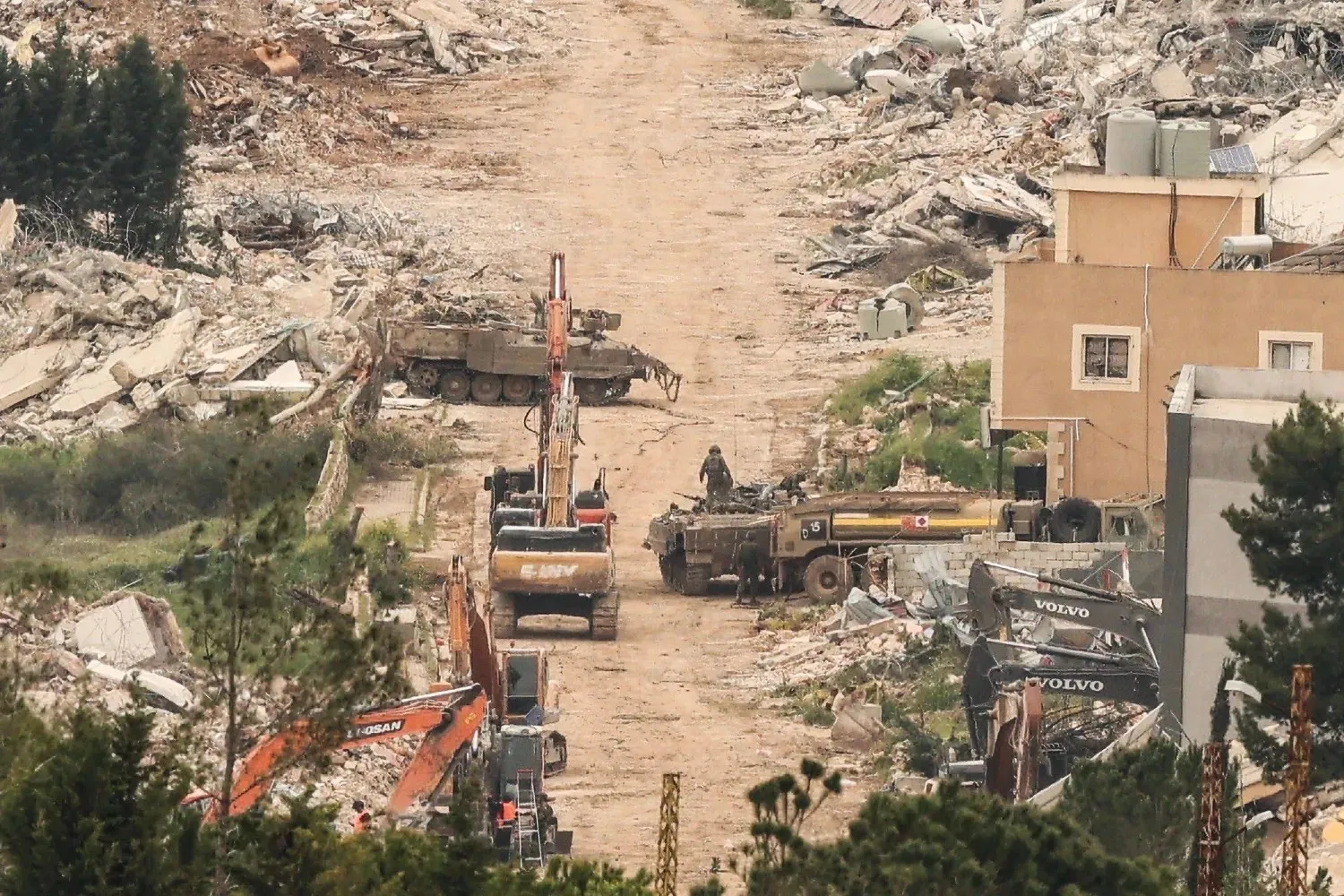

Israeli Army Brings in Demolition Contractors to Raze Dozens of Lebanese Villages

Israeli military vehicles and armored units in front of destroyed buildings in southern Lebanon on April 15. (AFP)
TT

Israeli Army Brings in Demolition Contractors to Raze Dozens of Lebanese Villages

Israeli military vehicles and armored units in front of destroyed buildings in southern Lebanon on April 15. (AFP)

The Israeli army is using the ceasefire period to accelerate large-scale destruction in areas it occupies in southern Lebanon, which have been largely emptied of residents displaced by the conflict, according to local accounts.

Working around the clock across an area estimated at more than 800 square kilometers — about 8 percent of Lebanon’s territory — Israeli forces are systematically flattening buildings.

Confronted with the scale of the task and racing against time, the military engineering corps has enlisted private sector “demolition contractors,” some with experience in Gaza, to carry out operations in dozens of villages.

Using heavy machinery, including bulldozers and D9 units, they have begun what sources describe as a coordinated clearing campaign.

The occupied zone stretches from the Litani River to the internationally recognized border and has been divided into three sectors.

The first is a “total destruction” zone running along the entire Lebanese border strip, from the expanded Shebaa Farms area and the town of Khiam in the east, through Deir Siryan, to the coastal town of Bayyada in the west. Its depth ranges from about 3 kilometers at its narrowest point near Odaisseh to as much as 10 kilometers near Khiam.

This area is referred to by the Israeli army as the “yellow belt,” in reference to a similarly named line in Gaza. Civilian presence is effectively prohibited, with entry posing a serious risk to life.

The second sector extends from the “yellow belt” to the Litani River. Israeli forces have positioned this line along hilltops and elevated terrain to maintain direct visual oversight of the river corridor, despite advanced surveillance capabilities. Armed presence is banned in this zone, and civilian presence is strongly discouraged.

The area remains highly volatile, with Israeli troops on constant alert.

Reports indicate sporadic resistance operations, as well as the presence of minefields and ambushes. Tactics developed by Hezbollah since the 2006 war are being employed here. Most Israeli casualties reported in this area — 12 killed and around 30 wounded — occurred in this sector, which has also seen fire reach as far as the Tyre region.

The third sector extends from the Litani River northward to the Zahrani River. While not officially designated as occupied, it is subject to continuous aerial and maritime surveillance.

Israel believes Hezbollah uses this area as a launching ground for operations, including short- and medium-range rocket fire. Drones are reported to operate overhead day and night. Israeli assessments indicate that more than half of the roughly 8,000 rockets and shells fired from Lebanon originated from this zone.

Israeli military doctrine since Oct. 7, 2023, calls for layered security zones along each front — Lebanon, Syria and Gaza — including a fortified area inside Israel, a no-go “security belt” inside enemy territory, and a broader demilitarized zone.

Within Israel’s far-right leadership, some officials have embraced this approach as a precursor to expanding territorial control. Finance Minister Bezalel Smotrich has called for further expansion and the establishment of Israeli military bases elsewhere in the region.

On the ground, Israeli forces appear intent on consolidating control over the “yellow belt” by erasing all structures above and below ground, from homes to schools and public buildings, a strategy critics say is aimed at preventing displaced residents south of the Litani from returning, or ensuring they find nothing left if they do.

The army also faces domestic criticism, particularly from residents of northern Israel, who say it has failed to provide adequate security despite months of fighting. Israeli officials argue that such operations could help secure longer-term calm on the northern front through a political agreement.

The Haaretz newspaper quoted a senior officer as saying the goal is “not a return to rounds of fighting, but achieving long-term security,” adding that Hezbollah has been significantly weakened compared with its position before Oct. 7, 2023.



Palestinians Say West Bank Teen Killed by Israeli Fire

An Israeli security force personnel patrols during a military raid at the Qalandia refugee camp, south of the city of Ramallah, in the Israeli-occupied West Bank, on May 6, 2026. (AFP)
TT

Palestinians Say West Bank Teen Killed by Israeli Fire

An Israeli security force personnel patrols during a military raid at the Qalandia refugee camp, south of the city of Ramallah, in the Israeli-occupied West Bank, on May 6, 2026. (AFP)

Palestinian health officials said a teenager was killed by Israeli fire in a village in the West Bank on Wednesday, the latest in a series of violent incidents shaking the Israeli-occupied territory.

The health ministry in Ramallah identified the victim as 16-year-old Yusef Ali Kaabnah, saying he was "killed by occupation bullets" near the town of Jiljilya, north of Ramallah.

The Palestinian Red Crescent said he had been shot in the chest during a raid by Israeli settlers who were accompanied by Israeli troops.

Four others were injured in the incident, it added.

The Israeli military told AFP that security forces were dispatched to the area "following reports of several Israeli civilians who entered Jiljilya after livestock had been stolen from an illegal outpost".

Troops "operated to prevent confrontation in the area and extract the livestock" and "escort all Israeli civilians out", and as they were leaving, "a violent riot developed, which included stone-throwing," the military said.

"The soldiers responded with riot dispersal means and live fire toward the primary instigators," it added.

Violence has increased in the West Bank since the start of the war in Gaza in October 2023.

According to an AFP tally based on Palestinian health ministry figures, Israeli troops or settlers have killed at least 1,071 Palestinians in the West Bank since the war began.

Official Israeli figures show at least 46 Israelis have been killed in Palestinian attacks or during Israeli military operations in the same period.


Lebanon Says Over 10,000 Homes Destroyed or Damaged Since Israel Truce

Smoke rises from the site of an Israeli airstrike that targeted the southern Lebanese village of Jarjouaa on May 13, 2026. (AFP)
TT

Lebanon Says Over 10,000 Homes Destroyed or Damaged Since Israel Truce

Smoke rises from the site of an Israeli airstrike that targeted the southern Lebanese village of Jarjouaa on May 13, 2026. (AFP)

More than 10,000 homes have been damaged or destroyed in Lebanon since a ceasefire in the war between Israel and Hezbollah, the head of the country's National Council for Scientific Research said on Wednesday.

"Since the current ceasefire... we have witnessed 5,386 housing units that were completely destroyed, and 5,246 housing units damaged," CRNS chief Chadi Abdallah told a news conference broadcast by local media.

Israel has kept up heavy airstrikes despite the April 17 ceasefire, and Israeli soldiers are operating inside an Israeli-declared "yellow line", which runs around 10 kilometers (six miles) north of the Israel-Lebanon border where troops have been carrying out broad demolition operations.


UN Food Agency Halves Syria Food Aid, Halts Bread Subsidy Over Funding Shortages

 11 May 2026, Syria, Badama: Agricultural workers hand-harvest a fresh crop of strawberries as the season begins in the highlands of western Idlib and the coastal range. (dpa)
11 May 2026, Syria, Badama: Agricultural workers hand-harvest a fresh crop of strawberries as the season begins in the highlands of western Idlib and the coastal range. (dpa)
TT

UN Food Agency Halves Syria Food Aid, Halts Bread Subsidy Over Funding Shortages

 11 May 2026, Syria, Badama: Agricultural workers hand-harvest a fresh crop of strawberries as the season begins in the highlands of western Idlib and the coastal range. (dpa)
11 May 2026, Syria, Badama: Agricultural workers hand-harvest a fresh crop of strawberries as the season begins in the highlands of western Idlib and the coastal range. (dpa)

The World Food Program said ‌on Wednesday it had halved emergency food assistance in Syria due to funding shortages, warning that millions remained vulnerable despite signs of stabilization in parts of the country.

The UN agency's biggest donor, the United States, has slashed its foreign aid under President Donald Trump, and other countries have also made or announced cuts in development and humanitarian assistance.

The WFP said in a statement the number of people receiving emergency food aid in Syria fell to 650,000 in ‌May from 1.3 million, ‌while scaling back operations in all ‌14 ⁠Syrian governorates to just ⁠seven.

Meanwhile, 7.2 million people in Syria remain acutely food insecure, including 1.6 million facing severe hunger, the WFP said. Many households were already reducing meal portions, eating less nutritious food or skipping meals altogether, it added.

“The reduction in WFP’s assistance is driven solely by funding constraints, not by a ⁠decrease in needs,” Marianne Ward, the WFP’s country ‌director in Syria, said in ‌the statement.

The WFP also halted a bread subsidy program ‌that had supported more than 300 bakeries with fortified wheat ‌flour, helping provide subsidized bread to up to four million people daily in some of Syria’s most vulnerable areas.

Syria has faced a deep economic crisis after more than a decade of conflict ‌that devastated infrastructure, displaced millions and battered livelihoods.

Although fighting has eased in many parts of ⁠the ⁠country since the ouster of former President Bashar al-Assad at the end of 2024, aid agencies say humanitarian needs remain severe.

The WFP said it requires $189 million between June and November to sustain and restore assistance inside Syria.

It said funding shortages were also affecting Syrian refugees in neighboring countries.

In Jordan, the agency halted cash-based food assistance for 135,000 Syrian refugees living in host communities, while maintaining reduced support for around 85,000 refugees in camps.

In Egypt, support for 20,000 Syrians has been reduced, while many refugee households in Lebanon remain heavily dependent on aid.