


Low Turnout as Palestinians Vote in First Elections Since Gaza War

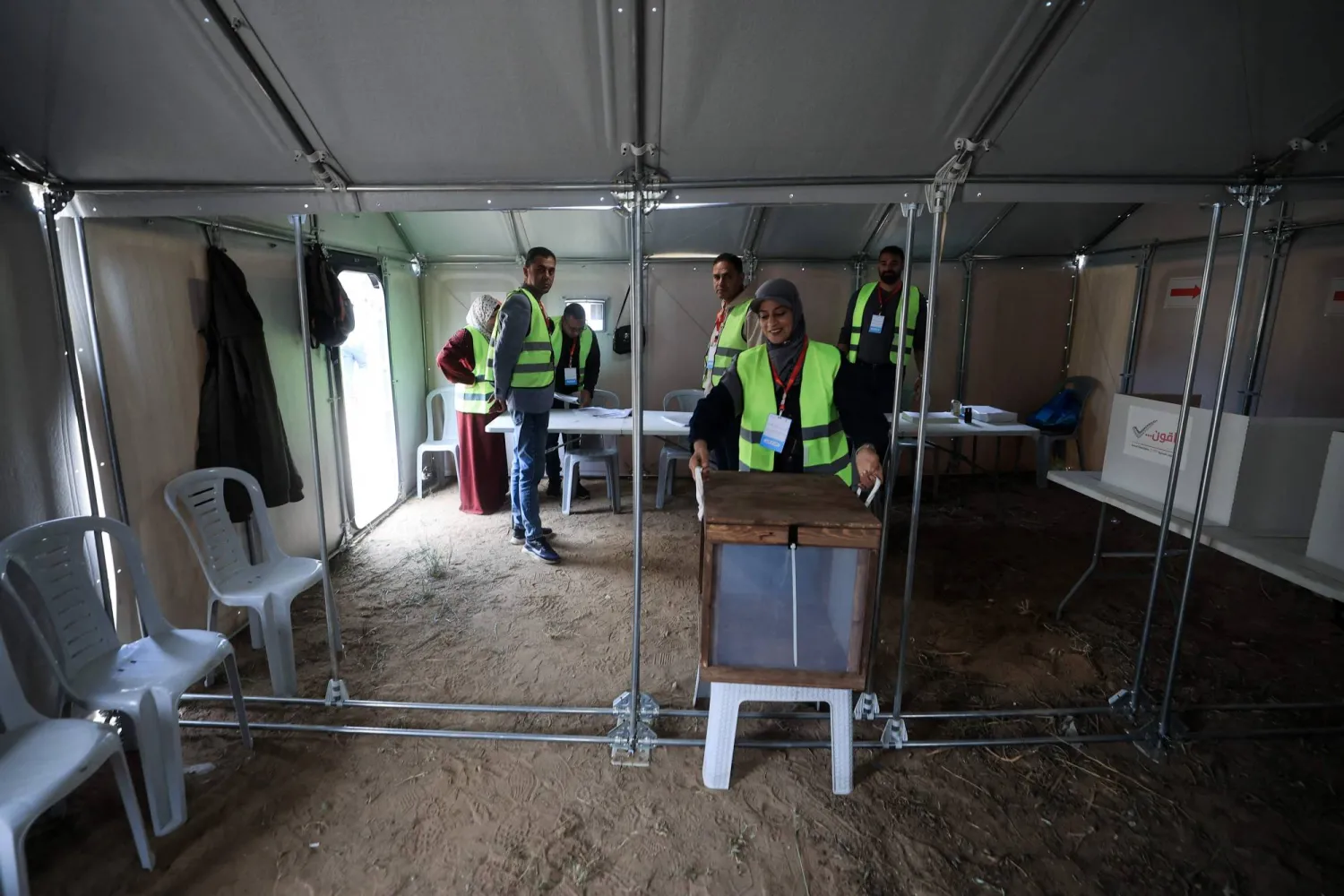
Palestinian electoral officials set up a polling station in a tent for municipal elections in Deir al-Balah, Gaza Strip, on April 25, 2026. (AFP)
TT

Low Turnout as Palestinians Vote in First Elections Since Gaza War

Palestinian electoral officials set up a polling station in a tent for municipal elections in Deir al-Balah, Gaza Strip, on April 25, 2026. (AFP)

Palestinians in the West Bank and central Gaza voted on Saturday in municipal elections, the first since the Gaza war erupted, marked by low turnout and a narrow slate of contenders. 

Nearly 1.5 million people were registered to vote in the Israeli-occupied West Bank, as well as 70,000 people in Gaza's Deir al-Balah area, according to the Ramallah-based Central Elections Commission (CEC). 

"We are very pleased to exercise democracy in spite of the many challenges we face, both locally and internationally," Palestinian president Mahmud Abbas told journalists after voting in Al-Bireh, Wafa news agency said. 

Early Saturday, a steady trickle of voters headed to polling stations in the West Bank, as foreign diplomats observed the process. 

By 5 pm (1400 GMT), turnout in the West Bank reached 40.62 percent, the CEC said. 

But participation in Deir al-Balah was significantly lower, at just 21.2 percent, by the time polls closed there at 6 pm. 

In the previous municipal elections in March 2022, turnout was 53.7 percent in West Bank cities. 

Voting in the West Bank ended at 7 pm, with a notable late surge of women voters in Jericho, an AFP journalist said. 

"We will elect someone who can improve the local community ... things like water and repairing the streets," said Manar Salman, an English teacher in the city. 

"We don't receive much support from outside, and the occupation affects us in many ways... it limits what the municipality can do." 

Some questioned the election's timing. 

"We didn't want elections at this time -- not with war in Gaza and settler attacks ongoing in the West Bank," said Ziad Hassan, a businessman from Dura Al-Qaraa village. 

"The decision was imposed on us, and so we are compelled to elect an administrative body for the village council." 

Israeli settler attacks have surged in recent months, and become a major concern. 

"The main thing is security from settlers. That's why we need new faces, young people willing to fight for our rights," said Abed Jabaieh, 68, former mayor of Ramun village. 

Most electoral lists were aligned with Abbas's secular-nationalist Fatah movement or composed of independents. 
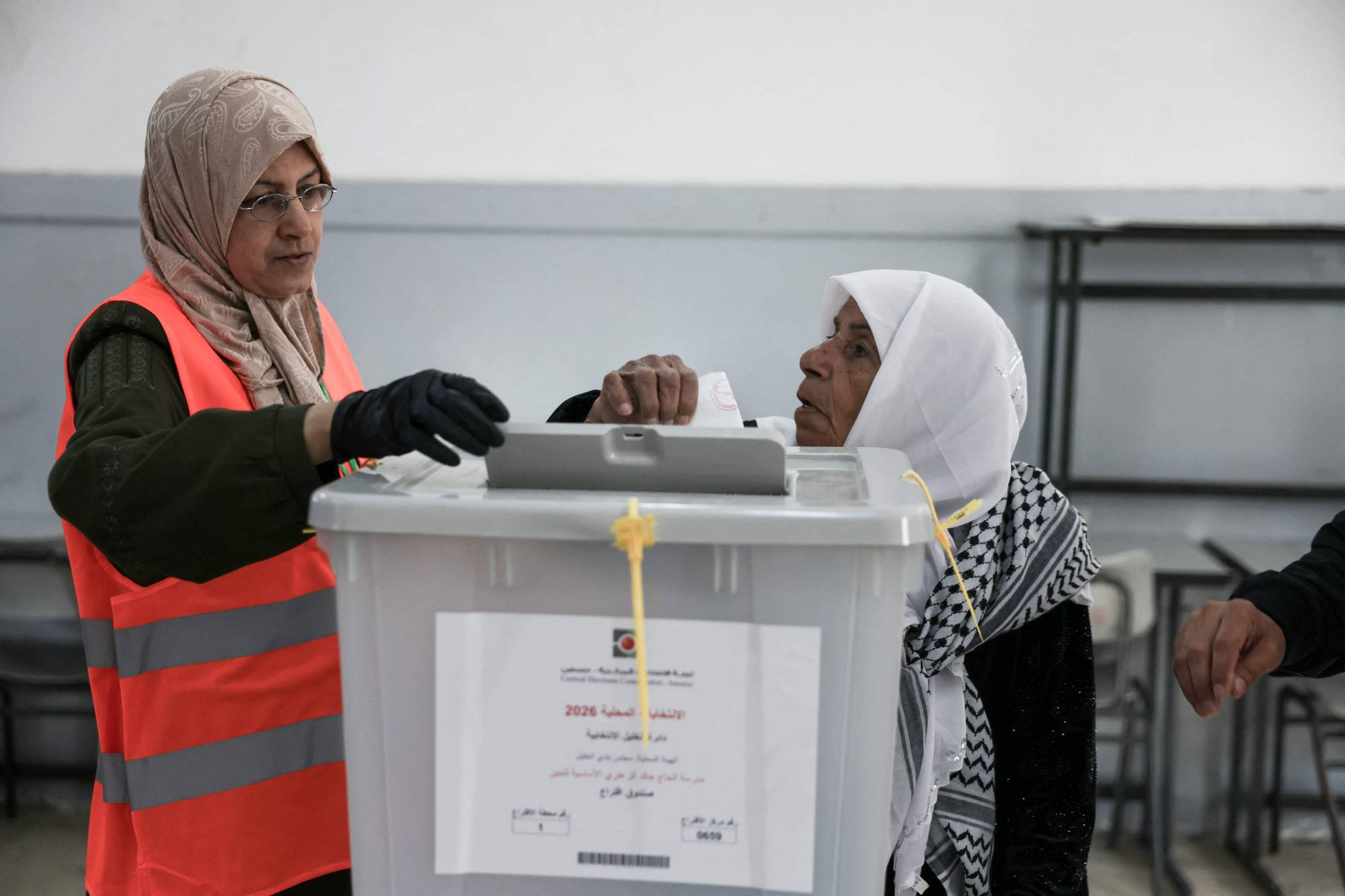
A Palestinian woman casts her ballot in a polling station during municipal elections in the Israeli-occupied West Bank city of Hebron on April 25, 2026. (AFP)

- EU hails vote - 

Hamas, Fatah's bitter rival and the ruling power in Gaza, was absent from the race. 

In many municipalities, Fatah-backed lists faced off against independents supported by smaller factions such as the Marxist-Leninist Popular Front for the Liberation of Palestine. 

Municipal councils oversee water, sanitation, and local infrastructure but do not enact legislation. 

Still, with presidential or legislative elections frozen since 2006, councils have become one of the last remaining democratic mechanisms under the Palestinian Authority. 

The PA faces widespread criticism over corruption, stagnation and declining legitimacy. 

Western and regional donors have increasingly tied financial and diplomatic support for the PA to reform, particularly in local governance. 

The European Union called the vote an "important step towards broader democratization and strengthened local governance ... in line with the ongoing reforms process". 
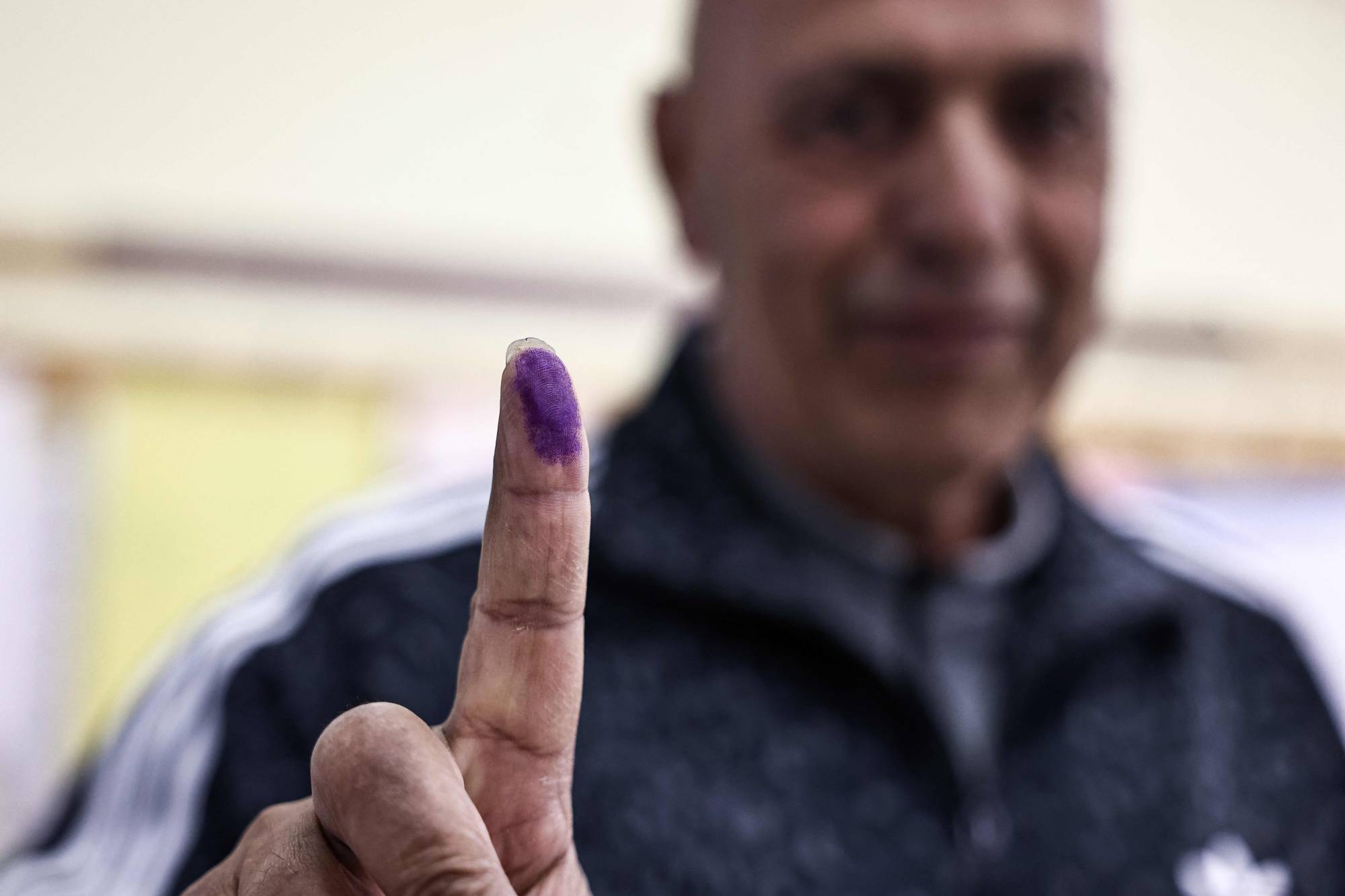
A Palestinian man shows his marked finger after casting his ballot at a polling station during municipal elections in the Israeli-occupied West Bank city of Al-Bireh on April 25, 2026. (AFP)

- 'Strong determination' - 

The polls closed earlier in Deir al-Balah to allow for counting in daylight because of the lack of electricity in the war-devastated strip, the CEC told AFP. 

Two years of war have left swathes of Gaza destroyed and more than 72,000 people dead, according to the territory's health ministry, whose figures are considered reliable by the UN. 

Public infrastructure, sanitation and health services in Gaza are all struggling to function. 

Under Hamas control since 2007, Gaza experienced its first vote since the 2006 legislative elections that the movement won. 

The PA is holding elections only in Deir al-Balah to test its "success or failure, since there are no post-war opinion polls", said Jamal al-Fadi, a political scientist at Cairo's Al-Azhar University. 

It was chosen as one of the few areas where the population has not been massively displaced. 

After voting there, Mohammed al-Hasayna, 24, said although the elections were largely symbolic, they served as a sign of people's "will to live". 

"We are an educated people with strong determination, and we deserve to have our own state," he told AFP. 

"We want the world to help us overcome the catastrophe of war. Enough wars -- it is time to work towards rebuilding Gaza." 



Israeli Strikes Kill Five People in Gaza

Mourners carry a body during the funeral of Palestinians who were killed in an Israeli strike, according to medics, in Gaza City, May 17, 2026. REUTERS/Dawoud Abu Alkas
TT

Israeli Strikes Kill Five People in Gaza

Mourners carry a body during the funeral of Palestinians who were killed in an Israeli strike, according to medics, in Gaza City, May 17, 2026. REUTERS/Dawoud Abu Alkas

Israeli strikes killed at least five Palestinians in the Gaza Strip on Sunday, health officials said, as ceasefire efforts meant to end fighting between Israel and Hamas falter.

In the weeks since halting its joint bombing with the US in Iran, Israel has stepped up its attacks in Gaza, where Hamas has been tightening its grip, even as Israeli troops remain in control of more than half the territory.

Medics said an Israeli strike killed one Palestinian near a police ⁠post and another ⁠at a tent encampment in Khan Younis in the southern Gaza Strip. The Israeli military said it killed a militant who posed an immediate threat to forces in the area.

Separately, Gaza medics said another Israeli airstrike killed at least three people at a community kitchen near Al-Aqsa Hospital in Deir Al-Balah, in the central Gaza area. The Israeli military did not immediately ⁠comment on that incident.

On Saturday, the Israeli military said that Izz al-Din al-Haddad, the head of Hamas' armed wing in Gaza, was killed in what it described as a precise strike on Gaza City on Friday.

Hamas confirmed Haddad's death but stopped short of threatening revenge.

The Israeli military said it had also killed Bahaa Baroud, a Hamas Operations Headquarters commander, in an airstrike on Saturday, accusing him of planning multiple imminent attacks against troops and Israeli civilians in recent weeks.

According to Reuters, the military said Baroud posed an immediate threat and was targeted in a precise strike, adding ⁠that measures ⁠were taken beforehand to reduce civilian harm, including the use of precision munitions and aerial surveillance.

Gaza health officials said Baroud, along with another person, was killed in the airstrike, which targeted their car in Gaza City.

Israel and Hamas remain deadlocked in indirect talks to advance US President Donald Trump's post-war plan for Gaza that is meant to end more than two years of fighting with Hamas disarming as Israeli troops withdraw from Gaza.


Israel Strikes Lebanon as Hezbollah Calls Talks 'Dead End'

Smoke rises from the site of an Israeli airstrike that targeted the southern Lebanese village of Choukine on May 17, 2026. Photo by Abbas FAKIH / AFP
TT

Israel Strikes Lebanon as Hezbollah Calls Talks 'Dead End'

Smoke rises from the site of an Israeli airstrike that targeted the southern Lebanese village of Choukine on May 17, 2026. Photo by Abbas FAKIH / AFP

Israel struck eastern and southern Lebanon on Sunday, state media reported, despite a fragile ceasefire as Hezbollah called US-brokered talks between the two countries a "dead end".

Two Israeli strikes hit the town of Sohmor in eastern Lebanon's Bekaa valley, the state-run National News Agency (NNA) said, adding that others took place across southern Lebanon.

The Israeli army later issued an evacuation warning to four villages near the southern coastal city of Sidon, dozens of kilometres from the border area, which were also subject to an evacuation warning on Saturday, AFP reported.

Israeli airstrikes hit three of the four villages following the warning, the NNA said.

Despite the ceasefire, Israel continues to strike widely in southern Lebanon and issues frequent evacuation warnings to towns and villages across the south.

Speaking at the start of a cabinet meeting on Sunday, Israeli Prime Minister Benjamin Netanyahu said Israel was "holding territory, clearing territory, protecting Israel's communities, but also fighting an enemy that is trying to outsmart us".

"We are facing the challenge of neutralizing FPV (First-Person view) drones," he said, as Hezbollah has increasingly made use of the drones to strike Israeli forces.

The latest exchanges of fire came after envoys from Israel and Lebanon held a third round of negotiations in Washington and agreed to extend the ceasefire, talks that Iran-backed Hezbollah has repeatedly denounced.

"The direct negotiations that the authorities in Lebanon have conducted with the Israeli enemy have... led them down a dead-end path that will result in nothing but one concession after another," Hezbollah lawmaker Hussein Hajj Hassan said on Sunday.

"Neither they nor anyone else will be able to carry out what the enemy wants, especially when it comes to the issue of disarming the resistance," he said, adding that authorities were creating "very big predicaments" for the country.

In a statement on Saturday, the group called the proposed establishment of a US-facilitated security track a fresh addition "to the series of free concessions" the Lebanese government "offers the enemy".

On Saturday the group also said it had struck a military target in northern Israel, having earlier announced several operations against Israeli forces in southern Lebanon.

Israel sent ground forces into southern Lebanon during the latest war and they continue to occupy territory near the border between the two countries.

Israeli attacks since the start of the war have killed more than 2,900 people in Lebanon, including more than 400 since the truce began on April 17, according to Lebanese authorities.


Palestinian President's Son Elected to Top Fatah Leadership Body

Palestinian President Mahmoud Abbas with his son Yasser in Ramallah, West Bank, on May 28, 2018 (Reuters file photo)
TT

Palestinian President's Son Elected to Top Fatah Leadership Body

Palestinian President Mahmoud Abbas with his son Yasser in Ramallah, West Bank, on May 28, 2018 (Reuters file photo)

The son of Palestinian President Mahmoud Abbas won a seat on Fatah's top decision-making body on Sunday, as initial results emerged from the Palestinian movement's first congress in years.

Yasser Abbas, 64, a businessman who spends most of his time in Canada, secured a place on the central committee after being appointed around five years ago as his father's "special representative" - a role that marked his gradual emergence on the political scene.

Jailed Fatah leader Marwan Barghouti topped the preliminary results, retaining his seat on the committee with the highest number of votes, according to figures seen by AFP.

Jibril Rajoub was reelected as the secretary-general of the committee, retaining the seat he has held since 2017.

Palestinian vice president Hussein Al-Sheikh, Fatah deputy leader Mahmoud Al-Aloul and ex-Palestinian intelligence chief Tawfiq Tirawi also held their seats on the body.

Among the newcomers was Zakaria Zubeidi, 50, a former commander of the Al-Aqsa Martyrs Brigades -- Fatah's armed wing in the Jenin refugee camp -- who was freed from Israeli prison last year under a prisoner exchange deal with Hamas.

Two women also won seats, including Ramallah governor Laila Ghannam.

The three-day congress, held simultaneously across Ramallah, Gaza, Cairo and Beirut, drew 2,507 voters -- a turnout of 94.64 percent, organisers said.

Fifty-nine candidates competed for 18 seats on the central committee, while 450 vied for 80 seats on the revolutionary council, the party's parliament.

Counting for the council was still under way.

The congress opened Thursday, with Abbas being reelected as head of the movement.
In his opening address, he vowed to pursue reforms and hold long-delayed presidential and parliamentary elections.