
Israel Defense Minister Says Hezbollah Chief ‘Playing with Fire’ That Will ‘Burn Lebanon’

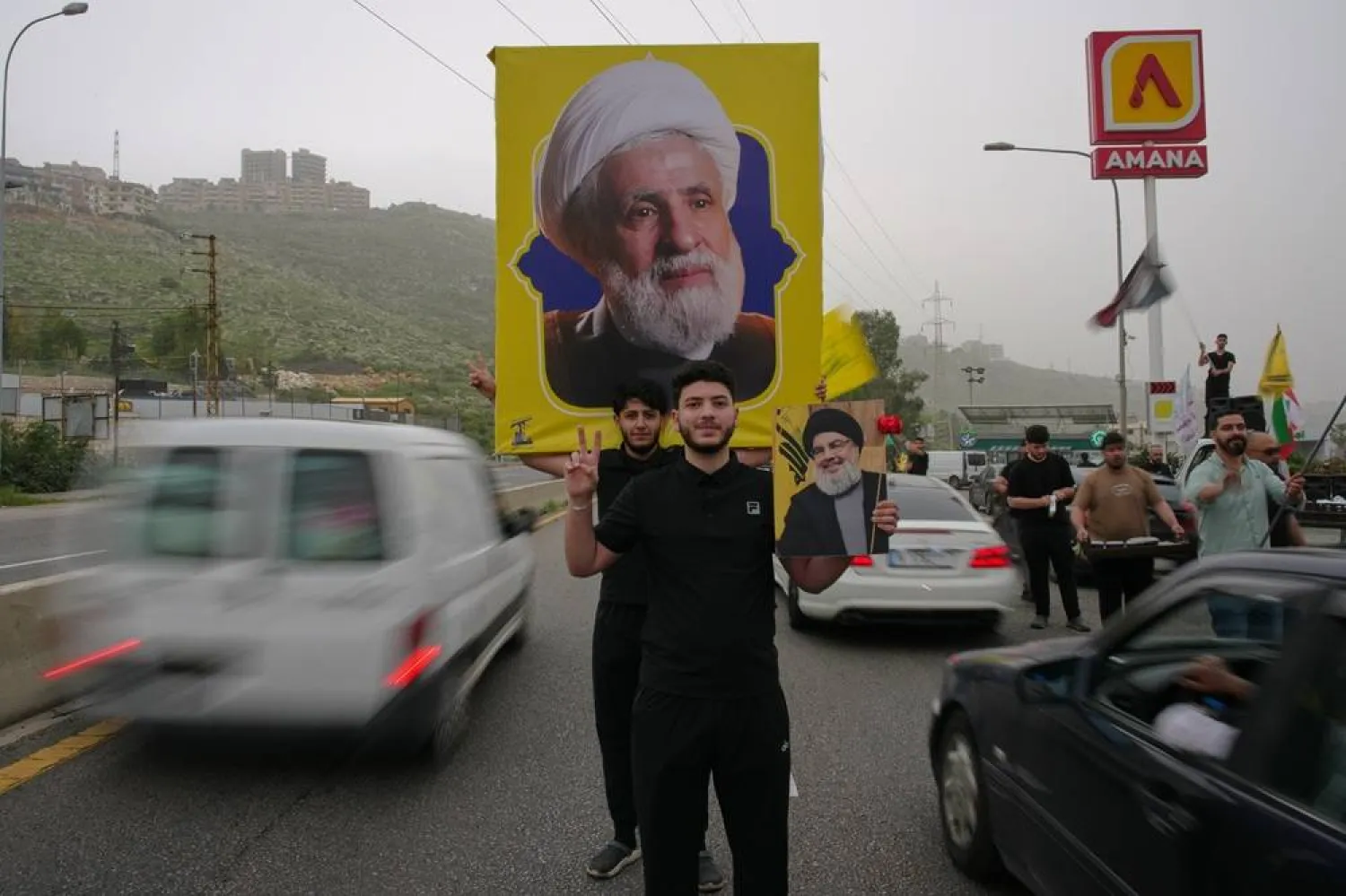
 People hold up portraits of Hezbollah leader, Naim Qassem, top, and slain Hezbollah leader Hassan Nasrallah as displaced residents drive back to their villages, in Jiyyeh, near Sidon, southern Lebanon, Friday, April 17, 2026, following a ceasefire between Israel and Hezbollah. (AP)
People hold up portraits of Hezbollah leader, Naim Qassem, top, and slain Hezbollah leader Hassan Nasrallah as displaced residents drive back to their villages, in Jiyyeh, near Sidon, southern Lebanon, Friday, April 17, 2026, following a ceasefire between Israel and Hezbollah. (AP)
TT

Israel Defense Minister Says Hezbollah Chief ‘Playing with Fire’ That Will ‘Burn Lebanon’

 People hold up portraits of Hezbollah leader, Naim Qassem, top, and slain Hezbollah leader Hassan Nasrallah as displaced residents drive back to their villages, in Jiyyeh, near Sidon, southern Lebanon, Friday, April 17, 2026, following a ceasefire between Israel and Hezbollah. (AP)
People hold up portraits of Hezbollah leader, Naim Qassem, top, and slain Hezbollah leader Hassan Nasrallah as displaced residents drive back to their villages, in Jiyyeh, near Sidon, southern Lebanon, Friday, April 17, 2026, following a ceasefire between Israel and Hezbollah. (AP)

Israeli Defense Minister Israel Katz warned Monday that Hezbollah's defiance would bring catastrophic consequences for Lebanon, after the group's leader rejected proposed direct talks between Israel and Lebanon. 

"Naim Qassem is playing with fire, and the fire will burn Hezbollah and all of Lebanon... If the Lebanese government continues to take cover under the wing of the Hezbollah terrorist organization -- fire will break out and engulf the cedars of Lebanon," Katz told UN envoy to Lebanon Jeanine Hennis-Plasschaert, according to a statement issued by his office. 

"If the Lebanese government continues to take cover under the wing of the Hezbollah terrorist organization -- fire will break out and engulf the cedars of Lebanon."

Katz said that Lebanese President Joseph Aoun was "gambling with the future of Lebanon", adding that Israel would not accept a situation in which a ceasefire in Lebanon coexists with continued attacks on Israeli forces and communities in northern Israel.

He reiterated that "the Lebanese government must ensure that Hezbollah is disarmed, first of all south of the Litani up to the Blue Line, and afterwards throughout all of Lebanon," referring to the river that cuts through southern Lebanon.

Aoun on Monday said that the direct talks with Israel were aimed at ending the conflict with Hezbollah while accusing those who drew Lebanon into war of "treason", in an implicit rebuke of the Iran-backed armed group.

Hezbollah leader Naim Qassem on Monday rejected Lebanon's planned direct negotiations with Israel, calling them a "grave sin" that will destabilize Lebanon. 

Lebanon and Israel's US ambassadors held two meetings in Washington over the past weeks, the first of their kind in decades. 

The first meeting led to a truce in the Israel-Hezbollah war, while Beirut has been preparing for direct negotiations with the aim of striking a peace deal with Israel. The two countries have officially been at war since 1948. 

"We categorically reject direct negotiations with Israel, and those in power should know that their actions will not benefit Lebanon or themselves," Qassem said in a statement, aired by the group's channel Al-Manar. 

He called on authorities to "back down from their grave sin that is putting Lebanon in a spiral of instability". 

He added that the Lebanese government "cannot continue while it is neglecting Lebanon's rights, giving up land, and confronting its resistant people". 

Lebanese authorities have repeatedly stated that the goal of the US-sponsored negotiations is to stop the war, secure Israel's withdrawal from southern Lebanon, and return displaced people to their homes after the fighting forced more than a million people to flee. 

"These direct negotiations and their outcomes are as if they do not exist for us, and they do not concern us in the slightest," Qassem said. 

"We will continue our defensive resistance for Lebanon and its people," he added. 

"No matter how much the enemy threatens, we will not back down, we will not bow down, and we will not be defeated. 

"We will not give up our weapons... and the Israeli enemy will not remain on a single inch of our occupied land." 

Hezbollah drew Lebanon into the Middle East war on March 2 by firing rockets at Israel to avenge the death of Iran's supreme leader Ali Khamenei in US-Israeli strikes. 

Since the truce went into force on April 17, Israeli strikes have killed at least 36 people, according to an AFP tally of Lebanese health ministry figures. 

Hezbollah has meanwhile claimed several attacks on Israeli troops in southern Lebanon, as well as missile and drone launches at northern Israel, saying it is responding to Israeli "violations". 

According to details of the truce released by the US State Department, which said both Lebanon and Israel agreed to it, Israel reserves the right to continue targeting Hezbollah to prevent "planned, imminent, or ongoing attacks". 

Hezbollah strongly rejects this clause, saying the text of the agreement was not presented to the cabinet, in which the group and its allies are represented. 

"Has the government decided to work alongside the Israeli enemy against its own people?" Qassem said in his speech. 

Israeli attacks on Lebanon killed more than 2,500 people since March 2, according to Lebanese authorities. 


Israel Says Deported 'All Foreign Activists' from Gaza-bound Flotilla

A Palestinian flag is pictured against a background of smoke grenades during a gathering against the interception of the Global Sumud Flotilla by the Israeli Navy off the coast of Cyprus outside the Ministry of Foreign Affairs in Athens on May 18, 2026.  (Photo by Aggelos NAKKAS / AFP)
A Palestinian flag is pictured against a background of smoke grenades during a gathering against the interception of the Global Sumud Flotilla by the Israeli Navy off the coast of Cyprus outside the Ministry of Foreign Affairs in Athens on May 18, 2026. (Photo by Aggelos NAKKAS / AFP)
TT

Israel Says Deported 'All Foreign Activists' from Gaza-bound Flotilla

A Palestinian flag is pictured against a background of smoke grenades during a gathering against the interception of the Global Sumud Flotilla by the Israeli Navy off the coast of Cyprus outside the Ministry of Foreign Affairs in Athens on May 18, 2026.  (Photo by Aggelos NAKKAS / AFP)
A Palestinian flag is pictured against a background of smoke grenades during a gathering against the interception of the Global Sumud Flotilla by the Israeli Navy off the coast of Cyprus outside the Ministry of Foreign Affairs in Athens on May 18, 2026. (Photo by Aggelos NAKKAS / AFP)

Israel said it had deported on Thursday all the foreign activists seized by Israeli forces from a Gaza-bound flotilla, following global outcry over their treatment in custody.

"All foreign activists from the PR flotilla have been deported from Israel. Israel will not permit any breach of the lawful naval blockade on Gaza," said foreign ministry spokesman Oren Marmorstein.

Earlier, western governments voiced outrage on Thursday after Israel’s far-right security minister posted a video of himself taunting Gaza-bound flotilla activists being pinned to the ground, with two later alleging ​they were physically assaulted in detention.

The activists' treatment by police officers under the direction of National Security Minister Itamar Ben-Gvir also drew a rebuke from Israeli Prime Minister Benjamin Netanyahu and from the United States, Israel's staunchest ally.

The activists, whose vessel was intercepted on Wednesday in international waters by Israeli naval forces as they were trying to deliver humanitarian aid to Gaza, were expected to be deported from Israel on Thursday.

Across Europe, governments summoned Israeli ambassadors to condemn the video. Italy demanded an apology, Spain said it would not tolerate maltreatment of its citizens, and France demanded the release of all the detainees.

Britain's foreign ministry said the video "violates the most basic standards of respect and dignity for people", while Poland's foreign minister called for Ben-Gvir to be banned from entering the country.

The US Ambassador to Israel, Mike Huckabee, said Ben-Gvir had "betrayed (the) dignity of his nation".

The outpouring of anger follows ‌the posting of campaign-style ‌videos by Ben-Gvir and at least one other minister in Netanyahu's government, transport chief Miri ​Regev, showing ‌them visiting ⁠the port ​and ⁠lambasting the protesters, attention-grabbing antics ahead of a potential early election in Israel


Türkiye Planning Special Flights to Bring Back Activists on Gaza Flotilla

Türkiye’s Foreign Minister Hakan Fidan speaks to the reporters at Antalya Diplomacy Forum in Antalya, Türkiye, April 19, 2026. (Reuters)
TT

Türkiye Planning Special Flights to Bring Back Activists on Gaza Flotilla

Türkiye’s Foreign Minister Hakan Fidan speaks to the reporters at Antalya Diplomacy Forum in Antalya, Türkiye, April 19, 2026. (Reuters)

Türkiye is planning special flights ​from Israel on Thursday to fly out its citizens and some activists from ‌third ‌countries ​who ‌joined ⁠a ​global aid flotilla that ⁠was intercepted by Israeli forces while trying to break ⁠its Gaza blockade, ‌Foreign ‌Minister Hakan ​Fidan ‌said.
Fidan said ‌on X that all Turkish institutions were working to ‌ensure the security and safe ⁠return ⁠of Turkish nationals. Broadcaster NTV separately said Turkish Airlines has sent three planes to Israel for the repatriations.


Sudan’s Security and Defense Council Orders Curbs on Armed Movement Inside Cities

Al-Burhan chairs a meeting of Sudan’s Security and Defense Council on Tuesday (Transitional Sovereignty Council)
 
Al-Burhan chairs a meeting of Sudan’s Security and Defense Council on Tuesday (Transitional Sovereignty Council)  
TT

Sudan’s Security and Defense Council Orders Curbs on Armed Movement Inside Cities

Al-Burhan chairs a meeting of Sudan’s Security and Defense Council on Tuesday (Transitional Sovereignty Council)
 
Al-Burhan chairs a meeting of Sudan’s Security and Defense Council on Tuesday (Transitional Sovereignty Council)  

Sudan’s highest military and security authority has called for tighter controls on the movement of armed personnel, combat vehicles, and security cells inside cities and marketplaces, following reports and videos alleging incidents of “disorder” attributed to armed forces and army-aligned groups in areas recently recaptured by the military or currently under its control.

Following the Security and Defense Council’s regular meeting on Tuesday evening, Sudanese Defense Minister Lt. Gen. Hassan Daoud Kabroun said that the council had instructed the relevant authorities to regulate the movement of armed individuals and vehicles inside cities and markets, and to establish rules governing the work of “security cells” in local districts, with a focus on investigations involving those authorities describe as collaborators with the Rapid Support Forces (RSF).

The term “security cells” refers to groups or units operating in support of military and security agencies. They are typically engaged in surveillance, monitoring, inspections, and intelligence-gathering activities in neighborhoods, markets, and conflict zones.

Authorities say their role is focused on “tracking down collaborators with the RSF, dismantling sabotage cells, and protecting areas retaken by the army.” Critics of the Transitional Sovereignty Council, however, describe them in social media commentary as an extension of Islamist organizations tied to the former regime, alleging that they seek to eliminate political opponents.

The Security and Defense Council is one of Sudan’s most prominent military and sovereign decision-making bodies. It includes executive, military, and security leaders, among them the ministers of defense, interior, foreign affairs, and finance, as well as army commanders and heads of security agencies. The council is chaired by Sovereignty Council President and Armed Forces Commander-in-Chief Gen. Abdel Fattah al-Burhan.

According to media affiliated with it, the council met Tuesday under al-Burhan’s chairmanship, with all members in attendance, to review the country’s security and military situation.

The council’s role in managing security and military affairs has expanded since the outbreak of war between the army and the RSF on April 15, 2023, amid the widening conflict and mounting concerns over security violations in war-affected areas.

On the military front, Kabroun said the armed forces and allied troops had achieved “major victories” in recent weeks on several battlefronts, particularly in South Kordofan, Blue Nile, and Darfur.

He added that the council stressed the importance of adherence to the law, respect for human rights and Sudan’s sovereignty, as well as the need to provide essential services to citizens returning to their areas, especially electricity and water.

Citizens’ Complaints

Residents in some army-controlled areas - particularly the capital, Khartoum, parts of Al Jazirah State, and other states retaken by the military in recent months - have complained of what they describe as growing “security abuses.”

The allegations include looting, arrests, and other violations attributed to armed groups or individuals wearing military uniforms, in addition to the widespread presence of weapons and combat vehicles in neighborhoods and markets.

Videos and local testimonies concerning these incidents have circulated widely on social media platforms, while authorities say they are working to regulate armed movements and pursue those responsible.

Independent verification of all the accounts has not been possible because of the ongoing war and the complexity of the security situation.