


US Urges Meeting Between Lebanese President, Israeli PM

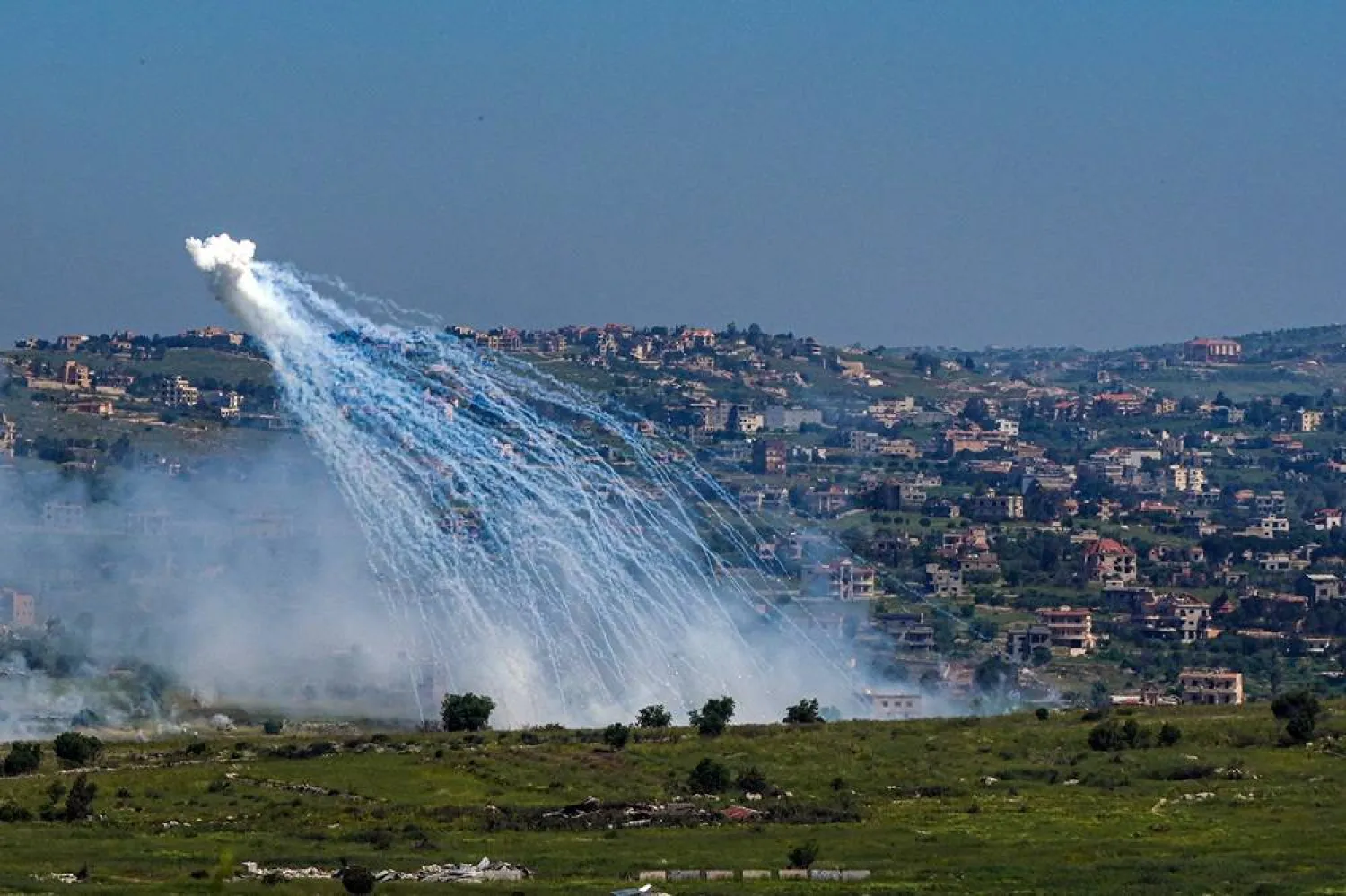
An explosion of what appears to be white phosphorus fired by the Israeli army on the Lebanese side of the Israel-Lebanon border as seen from the Israeli side of the border, April 30, 2026. (Reuters)
TT

US Urges Meeting Between Lebanese President, Israeli PM

An explosion of what appears to be white phosphorus fired by the Israeli army on the Lebanese side of the Israel-Lebanon border as seen from the Israeli side of the border, April 30, 2026. (Reuters)

The US embassy in Lebanon on Thursday urged a meeting between Lebanese and Israeli leaders as the health ministry said Israeli strikes on the country's south killed at least 17 people despite an ongoing ceasefire.

Israeli and Lebanese representatives this month have met twice in Washington -- the first such meetings in decades -- after Iran-backed Hezbollah group drew Lebanon into the Middle East war on March 2, sparking heavy Israeli strikes and a ground invasion.

After the first talks, US President Donald Trump announced a 10-day ceasefire in Lebanon that began on April 17, and a three-week extension after the second round.

Trump has said he hopes to host Lebanese President Joseph Aoun and Israeli Prime Minister Benjamin Netanyahu "over the next couple of weeks" as the two countries prepare for direct negotiations.

The planned negotiations have caused a rift in Lebanon, with Hezbollah rejecting direct negotiations as well as Beirut's previous commitment to disarm it.

"Lebanon stands at a crossroads. Its people have a historic opportunity to reclaim their country and shape their future as a truly sovereign, independent nation," the embassy said, adding that "the time for hesitation is over".

A direct meeting between Aoun and Netanyahu, "facilitated by President Trump, would give Lebanon the chance to secure concrete guarantees on full sovereignty, territorial integrity, secure borders, humanitarian and reconstruction support, and the complete restoration of Lebanese state authority over every inch of its territory -- guaranteed by the United States," the statement added.

- 'Violations' -

On Wednesday, Aoun said Israel "must first fully implement the ceasefire in order to move on to negotiations... Israeli attacks cannot continue as they are."

"We are now waiting for the United States to set a date to begin direct negotiations" with Israel, he said.

Israel has kept up deadly strikes on Lebanon despite the truce, and its soldiers are operating inside a "Yellow Line" running some 10 kilometers (six miles) deep inside Lebanon along the border.

Lebanon's health ministry said Israeli strikes in the south killed 17 people on Thursday, including five women and two children, while the army said another strike killed one of its soldiers.

Israel's army also said one of its soldiers had been killed in south Lebanon.

Aoun on Thursday slammed "continuing Israeli violations" in the country's south.

Speaking to a delegation from the International Federation of Red Cross and Red Crescent Societies, he said these were occurring "despite the ceasefire, as do demolitions of homes and places of worship, while the number of killed and wounded rises".

"Pressure must be exerted on Israel to ensure it respects international laws and conventions and ceases targeting civilians, paramedics, civil defense, and humanitarian health and relief organizations," Aoun said, on a day when three civil defense personnel killed by Israel were buried.

- 'Will not surrender' -

The NNA reported multiple Israeli airstrikes on southern Lebanon on Thursday, while an Israeli army spokesperson called for the evacuation of more than 20 southern villages.

Hezbollah claimed 10 attacks on Israeli army targets in south Lebanon, including tanks and soldiers.

In Beirut, dozens of southern Lebanon residents and local officials gathered to protest Israel's ongoing destruction of their villages.

Protester Hanaa Ibrahim, 48, told AFP that "we will not surrender and will not normalize" relations with Israel.

The text of the ceasefire, published by the US State Department, grants Israel the right to act against "planned, imminent or ongoing attacks".

Hezbollah rejects that language, saying it was never presented to Lebanon's cabinet, in which members of the group are represented.

On Wednesday, Aoun had said the wording "is the same text that was adopted in November 2024" as part of the ceasefire agreement ending the last war, adding that "all parties" at the time had agreed to the text.

Parliament speaker Nabih Berri, a Hezbollah ally, called Aoun's remarks "inaccurate, to say the least, and this also applies to the November 2024 agreement".



Pakistan, Lebanon Army Chiefs Meet as Middle East Mediation Drags On

This handout photograph taken and released on June 9, 2026 by Pakistan's Inter-Services Public Relations (ISPR) shows Pakistan's Army Chief and Field Marshal Syed Asim Munir (R) speaking with General Rodolphe Haykal, Commander-in-Chief of the Lebanese Armed Forces during their meeting in Rawalpindi. (Photo by Handout / Pakistan's Inter-Services Public Relations (ISPR) / AFP)
TT

Pakistan, Lebanon Army Chiefs Meet as Middle East Mediation Drags On

This handout photograph taken and released on June 9, 2026 by Pakistan's Inter-Services Public Relations (ISPR) shows Pakistan's Army Chief and Field Marshal Syed Asim Munir (R) speaking with General Rodolphe Haykal, Commander-in-Chief of the Lebanese Armed Forces during their meeting in Rawalpindi. (Photo by Handout / Pakistan's Inter-Services Public Relations (ISPR) / AFP)

The heads of the Pakistani and Lebanese armed forces agreed to boost cooperation on Tuesday as they met in Pakistan with peace talks over the Middle East war dragging on.

Pakistan has been mediating between the United States and Iran to end the months-long conflict, with Tehran insisting that any deal should include Lebanon, where Israel has been fighting Iran-backed Hezbollah, reported AFP.

Lebanese army chief Rodolphe Haykal left on Saturday to meet his powerful Pakistani counterpart Asim Munir, with a Lebanon-based source telling AFP the visit was linked to the broader peace talks.

The two military commanders discussed "matters of mutual interest, (the) evolving regional security environment, defense cooperation and prospects for enhancing bilateral military relations", a statement from the media wing of the Pakistani military said on Tuesday.

Munir "underscored (the) Pakistan Army's commitment to expanding defense collaboration with the Lebanese Armed Forces," it said, after Haykal received a guard of honor ahead of the meeting in the city of Rawalpindi.

Conflict in Lebanon has become a centerpiece of weeks of stop-start efforts to bring a formal end to the war.

Armed hostilities flared further during Haykal's visit, though both Iran and Israel indicated on Monday that they had halted the fighting.

US President Donald Trump, who has expressed frustration at the slow progress of peace talks, said on Tuesday that negotiators were in the "final throes" of reaching a deal.

Lebanon was drawn into the war when Hezbollah militants fired rockets at Israel on March 2 to avenge the US-Israeli killing of Iran's supreme leader.

Israel responded with an extensive campaign of airstrikes and a ground invasion that have killed nearly 3,600 people. Exchanges of fire with Hezbollah have not stopped despite an ongoing truce.

Pakistan's Prime Minister Shehbaz Sharif has said a US-Iranian agreement to end the war was "about to be achieved" when fresh fighting between Iran and Israel erupted on Sunday.

Even after an April 17 ceasefire agreement began, the Israeli military announced a so-called Yellow Line inside Lebanese territory about a dozen kilometers from its northern border where its ground troops are fighting with Hezbollah, who have fired rockets at Israel.


Lebanon Caught between US, Iran in Reclaiming its Independent Decision-making

 Lebanese army soldiers carry the coffin of captain Elie Khoury, who was killed on Saturday in an Israeli airstrike, during his funeral procession in Kfar Jarra, southern Lebanon, Monday, June 8, 2026. (AP)
Lebanese army soldiers carry the coffin of captain Elie Khoury, who was killed on Saturday in an Israeli airstrike, during his funeral procession in Kfar Jarra, southern Lebanon, Monday, June 8, 2026. (AP)
TT

Lebanon Caught between US, Iran in Reclaiming its Independent Decision-making

 Lebanese army soldiers carry the coffin of captain Elie Khoury, who was killed on Saturday in an Israeli airstrike, during his funeral procession in Kfar Jarra, southern Lebanon, Monday, June 8, 2026. (AP)
Lebanese army soldiers carry the coffin of captain Elie Khoury, who was killed on Saturday in an Israeli airstrike, during his funeral procession in Kfar Jarra, southern Lebanon, Monday, June 8, 2026. (AP)

Iran’s attack on Israel in retaliation to Israeli strikes on Sunday on Beirut’s southern suburbs, a Hezbollah stronghold, carried several messages.

It was seen as an attempt to reinforce its claim over Lebanon as a bargaining chip in its confrontation with the United States and Israel that it can use in the ongoing negotiations in Pakistan.

It remains to be seen if Iran has succeeded in seizing the initiative in this file and tie Lebanon’s stability to its own negotiations with the US, or if the attack deepened the Lebanese state’s drive to separate the Lebanese file from the Islamabad talks and further pursue the US-sponsored negotiations with Israel.

Lebanese President Joseph Aoun openly slammed Iran last week for using Lebanon as a “bargaining chip” in its negotiations with the US and demanded that it cease interfering in its internal affairs. Hezbollah, which is backed by Iran, has been adamant that Lebanon be included in the Pakistan negotiations, putting it at odds with the Lebanese state.

Head of the Saydet El Jabal Gathering, former MP Fares Souaid noted that since 1969, Lebanon has witnessed several conflicts between foreign powers over usurping the country’s independent decision-making and holding negotiations on its behalf with or without consulting it.

The Palestinian Liberation Organization tried to do so decades ago, then it was followed by the Syrian regime, under Hafez al-Assad, that imposed hegemony over Lebanon for several years and now, the country finds itself in the Iranian sphere of influence, he told Asharq Al-Awsat.

“The Lebanese state, represented by President Joseph Aoun and Prime Minister Nawaf Salam, has now succeeded in reclaiming the initiative for the first time since 1969,” Souaid added.

This has been achieved with evident US support after Washington realized the importance of separating the Lebanese file from Iran and preventing Tehran from negotiating in its name, he went on to say.

“Iran has been trying to claim that the Lebanese negotiations with Israel are a farce and that Lebanon will be unable to achieve its demands, or impose an Israeli withdrawal without it. Iran has been claiming that it alone will be able to achieve this [for Lebanon], but it will fail,” stressed Souaid.

This handout photograph taken and released on June 9, 2026 by Pakistan's Inter-Services Public Relations (ISPR) shows Pakistan's Army Chief and Field Marshal Asim Munir (R) speaking with General Rodolphe Haykal, Commander-in-Chief of the Lebanese Armed Forces during their meeting in Rawalpindi. (Handout / Pakistan's Inter-Services Public Relations (ISPR) / AFP)

The Iranian embassy in Beirut posted on its social media an image of two clasped hands, with one covered with the Lebanese flag and the other the Iranian one, and the statement “always with you” in Lebanese dialect.

The post sparked hundreds of comments in support and criticism from users about Iranian and Lebanese interests.

Souaid noted the “sharp division in Lebanon between one camp that wants the country to be a mere bargaining chip for Iran, and another that wants to consolidate the authority of the Lebanese state and its independent decision-making.”

“The state is committed to its independent decision-making, while Iran is trying to usurp it through sparking a war in Lebanon and exploit the Israeli strike on Beirut’s southern suburbs as if to say that it alone holds the keys to the solution,” he added.

“Iran will not succeed in reclaiming Lebanon’s decision-making or again impose its authority over the country,” he stressed.

Army commander in Pakistan

Amid the developments, Lebanese army commander Rodolphe Haykal was in Islamabad at the invitation of his Pakistani counterpart Asim Munir .

The military has not revealed details about the visit.

An informed source confirmed to Asharq Al-Awsat that he was visiting at his counterpart’s invitation and that the trip was coordinated with President Aoun.

Pakistan has expressed its readiness to offer assistance to the Lebanese army in terms of its deployment in the South after the Israeli withdrawal, it said, noting that Islamabad enjoys the trust of the Americans, Iranians and the Israelis given its role in the mediation efforts between the US and Iran.


Israeli Minister Ben-Gvir under Investigation in Italy over Gaza Flotilla

Israel's far-right national security minister Itamar Ben Gvir (C) arrives at the site of a suspected shooting attack in the town of Tzur Yitzhak in central Israel close to the occupied West Bank on June 7, 2026. One person was killed and four others wounded in multiple suspected shooting attacks in Israel on June. (Photo by Jack GUEZ / AFP)
TT

Israeli Minister Ben-Gvir under Investigation in Italy over Gaza Flotilla

Israel's far-right national security minister Itamar Ben Gvir (C) arrives at the site of a suspected shooting attack in the town of Tzur Yitzhak in central Israel close to the occupied West Bank on June 7, 2026. One person was killed and four others wounded in multiple suspected shooting attacks in Israel on June. (Photo by Jack GUEZ / AFP)

Italian prosecutors put Israel's far-right National Security Minister Itamar Ben-Gvir under investigation over the treatment of activists who were part of a Gaza flotilla last month, a judicial source said on Monday.

The source, who asked not to be named, confirmed earlier reports by Italian news agencies and said Ben-Gvir was being investigated on suspicion of torture and kidnapping of Italian citizens who were among ‌the activists, Reuters said.

If ‌the probe determines charges are warranted, ‌prosecutors could ⁠lodge a formal ⁠request for trial.

In response to the Italian investigation, Ben-Gvir said in a statement: "I will not shy away from one investigation or another and will continue to stand proudly alongside our fighters."

Israel and Ben-Gvir have faced mounting international criticism after the minister in late ⁠May released a video showing detained Gaza ‌activists kneeling with their ‌hands bound after Israel intercepted the aid flotilla in international waters.

Organizers ‌said the 430 activists detained by Israeli ‌police included citizens of Italy and South Korea.

In a video Ben-Gvir posted on X, officers forced an activist to the ground after she chanted "Free, free Palestine".

The government of Italian ‌Prime Minister Giorgia Meloni called the treatment of the activists "unacceptable" and summoned the Israeli ⁠ambassador ⁠for an explanation.

Italy subsequently asked the European Union to discuss sanctions against Ben-Gvir, while France has decided to ban Ben-Gvir from its territory.

Flotilla organizers say they aimed to break Israel's blockade of Gaza by delivering humanitarian assistance, something aid bodies say is still in short supply despite a US-brokered ceasefire between Israel and Hamas in place since October 2025 that includes guarantees of increased aid.

Israel says its naval blockade on Gaza is lawful.