

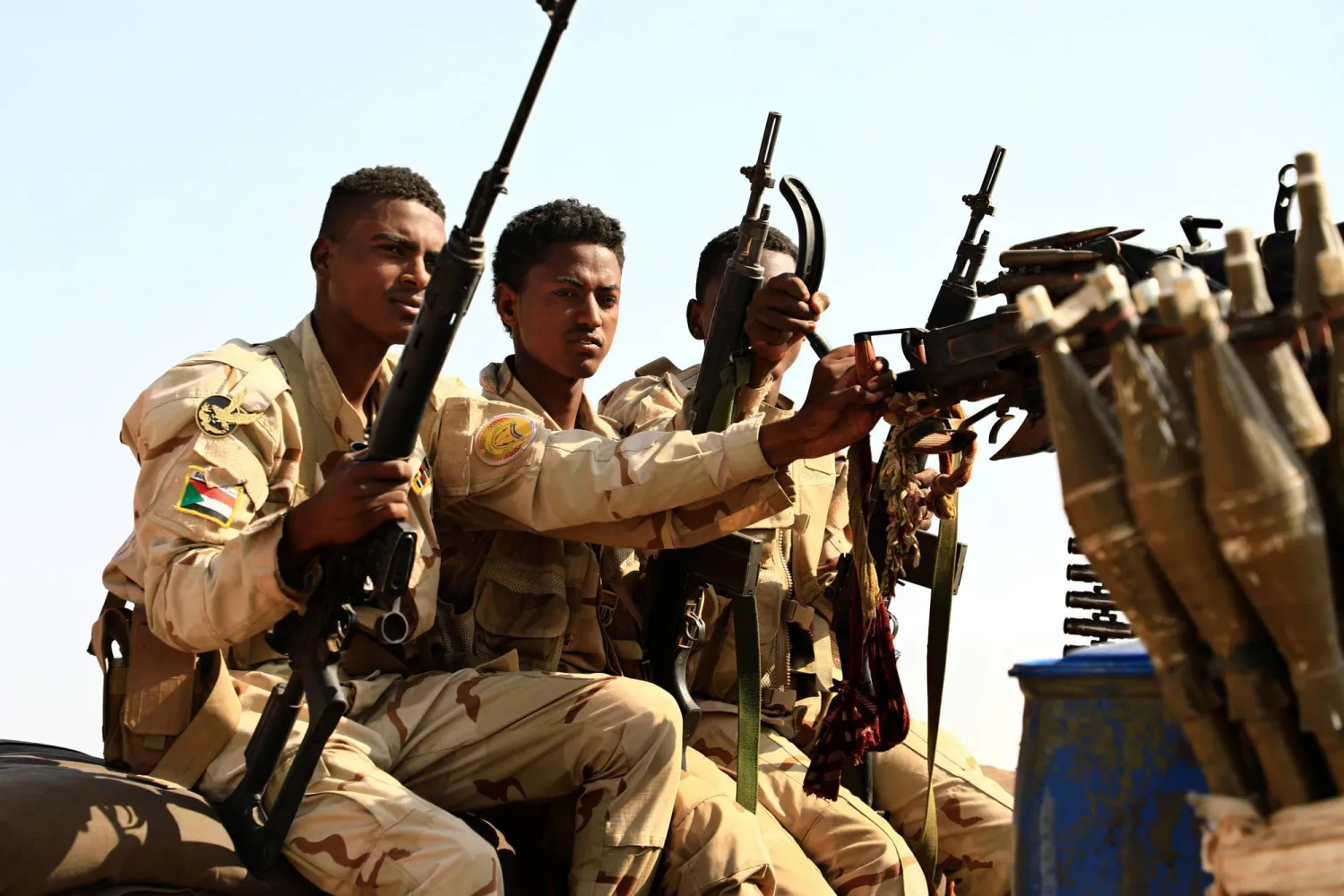

RSF-Led Alliance Claims Capture of Strategic Sudanese City Near Ethiopian Border

Members of the RSF. (AP file)
TT

RSF-Led Alliance Claims Capture of Strategic Sudanese City Near Ethiopian Border

Members of the RSF. (AP file)

Sudan’s Tasis Alliance, of the Rapid Support Forces (RSF), announced that its troops have seized the strategic city of Qeissan in the Blue Nile state, southeastern Sudan after fierce fighting with the army.

The development marks a new shift on a front that has seen intensifying combat for months. It comes weeks after government forces advanced in southern Blue Nile and recaptured the nearby border city of Kurmuk and other positions.

The Sudan Founding Alliance, known as Tasis, brings together the RSF, led by Mohamed Hamdan Dagalo, known as Hemedti; the Sudan People’s Liberation Movement-North (SPLM-N), led by Abdelaziz al-Hilu; other armed Darfuri groups; and political and civilian forces.

Tasis was formed after its members signed a political charter in Nairobi in February 2025. It later established a parallel authority called the Government of Peace and Unity, headed by Hemedti, with al-Hilu serving as deputy chairman of the presidential council. The army-aligned government in Port Sudan does not recognize the authority.

Tasis claims full control

In a statement Tuesday, Tasis forces announced they had taken “full control” of Qeissan, about 170 kilometers southeast of Blue Nile’s capital, Damazin, and seized all military positions inside the city, along with large quantities of weapons and equipment that were still being inventoried.

The alliance said it was pursuing retreating army units and inflicting losses in personnel and equipment, without providing figures.

The army had not confirmed or denied losing the city by the time of publication, while no independent estimates of casualties were available.

Field sources reported that fierce clashes were continuing in several areas of Qeissan and that the situation on the ground was changing rapidly.

Strategic importance

Qeissan is strategically important because of its location near the Ethiopian border and along an area that has become a battleground for control of key movement and supply routes.

Fighting on the Blue Nile front has intensified in recent months following joint military operations by the RSF and SPLM-N against the army.

Qeissan came under its first major drone attack of the new campaign on February 27. Between March and June, alliance forces repeatedly tried to advance toward the city and cut government supply lines but failed to capture it.

Control of southern Blue Nile has shifted several times in recent months. Tasis captured Kurmuk in March before the army launched counteroffensives in July, retaking the city and other positions and expanding its control near the Ethiopian border.

The claim of Qeissan’s capture follows recent army gains in North Kordofan, where government forces and their allies retook Bara, Umm Sayala and Jabra al-Sheikh from the RSF, reopening the Export Road linking El Obeid and Omdurman.

Qeissan has repeatedly changed hands during Sudan’s past conflicts. It had remained under army control since war broke out between the military and the RSF on April 15, 2023, with ground fighting largely bypassing the area during the first two years. This year, however, it has emerged as a key front between the army and the RSF-SPLM-N alliance.


Houthis Escalate Attacks Across Taiz, Yemen’s Western Coast

 The navigation bridge of a sunken vessel is all that is seen at the surface of the water in the Port of Mokha the day after an attack by the Houthis on the city Mokha, held by Yemen's legitimate government on August 10, 2026. (AFP)
The navigation bridge of a sunken vessel is all that is seen at the surface of the water in the Port of Mokha the day after an attack by the Houthis on the city Mokha, held by Yemen's legitimate government on August 10, 2026. (AFP)
TT

Houthis Escalate Attacks Across Taiz, Yemen’s Western Coast

 The navigation bridge of a sunken vessel is all that is seen at the surface of the water in the Port of Mokha the day after an attack by the Houthis on the city Mokha, held by Yemen's legitimate government on August 10, 2026. (AFP)
The navigation bridge of a sunken vessel is all that is seen at the surface of the water in the Port of Mokha the day after an attack by the Houthis on the city Mokha, held by Yemen's legitimate government on August 10, 2026. (AFP)

The Iran-backed Houthi group stepped up military operations on several fronts west of Yemen’s Taiz governorate and along the Red Sea coast on Thursday.

Houthis fired more than 12 ballistic missiles at rural areas in Taiz and Hodeidah governorates as fierce clashes erupted with government forces and the National Resistance in Maqbanah, al-Kadha, al-Tuwair and Ghabari.

Military sources said the fighting began in the early hours of Thursday when the Houthis launched a broad assault on government and National Resistance positions across several sectors. The attack developed into direct clashes and artillery exchanges that lasted for hours.

The group fired hundreds of artillery and mortar rounds during the assault and deployed drones in combat operations, the sources said. The fighting spread to hills overlooking the al-Aqma area in Mawza district, where brigades affiliated with the National Resistance are stationed.

The Houthis seized several positions during the opening hours of the attack before government forces, fighters from Taiz and the National Resistance launched a counterattack and recaptured a number of them, according to military sources.

The sources said the ballistic missiles had no effect on government forces’ battlefield operations. Most of the Houthi missile strikes targeted areas around vital facilities and civilian and military supply routes, causing panic among residents.

Government forces suffered deaths and injuries, while the Houthis also sustained casualties, the sources said, without providing figures for either side. Four Houthi fighters were reportedly captured.

Reports from the Joint Operations Room said air-defense systems and military formations on the Red Sea coast were “maintaining a high level of vigilance in confronting these repeated missile threats, which have become the group’s most prominent means of trying to offset its successive battlefield losses.”

The reports said the attacks were also intended to send a message linked to regional developments around the Red Sea shipping corridor and strategic Bab al-Mandeb Strait.

The missile attacks coincided with an attempted infiltration and ground assault by Houthi fighters against government positions in al-Kadha, west of Taiz.

Three drones downed

Government forces said they shot down three Houthi drones flying over subdistricts in Jabal Habashi district as fighting continued on fronts west of Taiz.

Military sources said the drones were intercepted as the group continued using unmanned aircraft to attack government and National Resistance positions. Clashes persisted in several sectors as forces deployed reinforcements to combat positions.

The ground escalation coincided with a new wave of Houthi missile strikes on the Red Sea coast. The group fired more than 12 ballistic missiles toward several areas east and north of the city of Mokha, as well as areas in Hodeidah’s Khokha district.

Local sources said the missiles were launched from Houthi-held positions in Ibb governorate and from al-Hawban and Sharab, east and north of Taiz. One missile caused a fire on the northern outskirts of Mokha.

The National Resistance’s military media office said the Houthis fired eight ballistic missiles toward rural areas around Mokha, while a ninth landed south of Khokha district. Local sources said three more missiles were launched shortly afterward.

Red Sea coast targeted

The missile strikes coincided with fighting on the Maqbanah and al-Kadha fronts west of Taiz, while air defenses operated by the “Taiz Military Axis” responded to drones launched by the group during the assault.

The escalation came hours after the Houthis targeted residential areas, the vicinity of camps for displaced people and front-line positions in Taiz, where fighting has intensified steadily since August.

Government forces and the National Resistance have continued to repel Houthi attacks across western Taiz and the Red Sea coast as the group persists in using ballistic missiles, drones and artillery.

The simultaneous broad ground assault and missile strikes point to an expansion of the Houthi escalation in the region, which has seen repeated attacks on military positions and areas near residential communities and civilian facilities.

Government forces in Marib and al-Dhale governorates carried out strikes on Wednesday targeting Houthi positions, gatherings and vehicles, and released footage of the operations.


Syria Says Begun Destroying Assad-Era Chemical Weapon Materials

Syrian Ambassador to the United Nations Ibrahim Olabi addresses the Security Council during the meeting on the situation in the Middle East, at UN headquarters in New York City, US, February 18, 2026. (Reuters)
TT

Syria Says Begun Destroying Assad-Era Chemical Weapon Materials

Syrian Ambassador to the United Nations Ibrahim Olabi addresses the Security Council during the meeting on the situation in the Middle East, at UN headquarters in New York City, US, February 18, 2026. (Reuters)

Syria has begun the process of destroying chemical weapon materials identified by an international watchdog, the country's UN envoy said Thursday, signaling a major step forward since the 2024 ouster of autocratic leader Bashar al-Assad.

"This is the very first destruction process since we have been liberated from the previous regime," Ibrahim Olabi told the Security Council. "It's also the first of its kind to destroy chemical materials on Syrian territory for over a decade."

In 2021, the Organization for the Prohibition of Chemical Weapons (OPCW) took the unprecedented step of stripping Syria of its voting rights after finding its air force had used nerve agent sarin and chlorine gas on its own people.

But since Assad's overthrow, the new authorities in Damascus have vowed to cooperate with the OPCW to destroy the chemical weapons the former president was repeatedly accused of using during Syria's 13-year civil war.

"We aim at protecting the Syrian people so that such weapons will not fall into the wrong hands," Olabi said Thursday.

He added that his country was "also protecting the world and the region through such work. Every site that is secured, every ammunition that is identified, does not merely remove a danger to Syria, but the entire world."


Israeli Minister Presents Plan to Remove Gaza Population

Israel's far-right National Security Minister Itamar Ben Gvir - File photo
TT

Israeli Minister Presents Plan to Remove Gaza Population

Israel's far-right National Security Minister Itamar Ben Gvir - File photo

Israel's far-right National Security Minister Itamar Ben Gvir set out a plan on Thursday to remove Palestinians from the Gaza Strip and send them abroad.

Speaking in the run-up to close-fought Israeli elections, he said the plan aimed to see the departure of 250,000 Palestinians from Gaza in the first year, followed by the rest of the roughly two million residents over the following six years.

"It's realistic," said Ben Gvir, claiming that there were countries who were "ready" to take in Gazans, without naming which ones.

Forced displacement of civilians in occupied territory is considered a war crime under the Geneva Conventions.