


Who Are the Radwan Commanders Israel Has Killed in Lebanon?

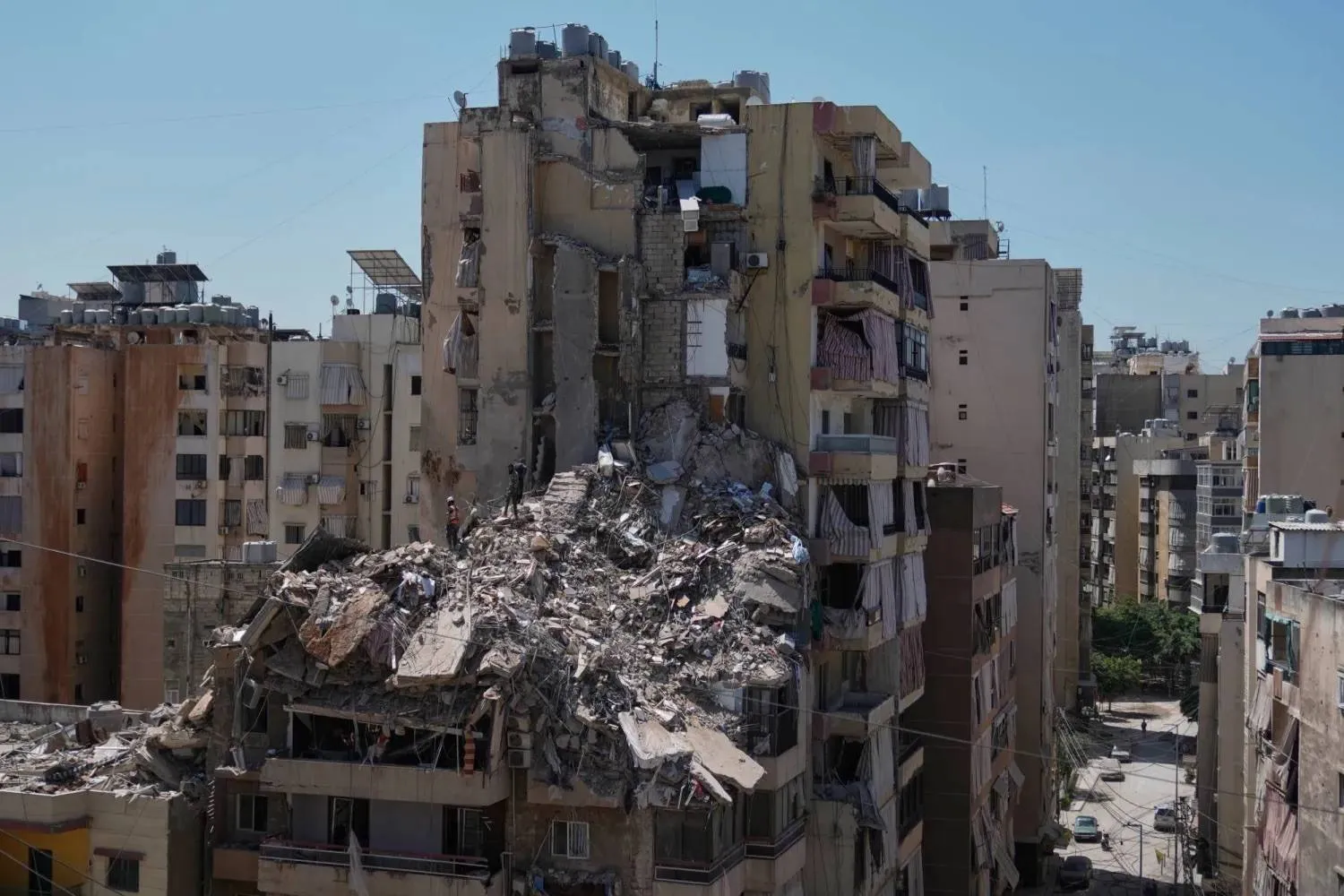
Rescue workers search through the rubble of a building destroyed in an Israeli airstrike targeting Beirut’s southern suburbs, a day after the attack that took place on the evening of Wednesday, May 7, 2026 (AP). 
TT

Who Are the Radwan Commanders Israel Has Killed in Lebanon?

Rescue workers search through the rubble of a building destroyed in an Israeli airstrike targeting Beirut’s southern suburbs, a day after the attack that took place on the evening of Wednesday, May 7, 2026 (AP). 

Israel’s announcement that it had killed Ahmad Ghaleb Ballout in a strike targeting the Haret Hreik area of Beirut’s southern suburbs on Wednesday renewed focus on the series of assassinations targeting commanders of Hezbollah’s Radwan Force since the outbreak of the Gaza war.

The strikes seem to be a concentrated campaign aimed at weakening the leadership structure of the group’s elite unit.

Since the early months of the confrontation, the Radwan Force has become a primary target of Israeli strikes, both in south Lebanon and Beirut’s southern suburbs, as Israel pursued field and military commanders responsible for offensive operations and oversight of drone, assault and combined operations units.

Israeli army spokeswoman Ella Waweya said the military “carried out a strike on Wednesday and eliminated Ahmad Ghaleb Ballout, a commander in the Radwan Force, Hezbollah’s elite commando unit, in Beirut’s southern suburbs.”

According to the Israeli account, Ballout held several positions within the Radwan Force over the years, most notably operations commander, where he was responsible for the unit’s “combat readiness and mobilization against the Israeli army.”

Waweya said Ballout also played a role in “efforts to restore the capabilities of the Radwan Force,” particularly what Israel refers to as the “plan to occupy the Galilee,” long viewed by Israel’s military establishment as one of the main threats posed by Hezbollah’s elite unit.

Over recent months, details have gradually emerged about commanders who played central roles within the force before becoming direct targets in the ongoing assassination campaign.

Wissam al-Tawil: The first major target

Wissam Hassan al-Tawil was the first prominent Radwan commander whose killing was announced by Israel after the start of the confrontation linked to Hamas’ Oct. 7 attack on Israel. Born in 1970 in Tyre, he joined Hezbollah at a young age and rose through the group’s military ranks.

According to the Israeli announcement, Tawil “was known as one of the overseers of the external operations and military manufacturing portfolio” and was also a member of Hezbollah’s central Shura Council, making him one of the influential military figures within the organization.

On Jan. 8, 2024, an Israeli drone targeted the vehicle carrying him in the southern town of Khirbet Selm, in what marked the beginning of a new phase in the targeting of Radwan commanders.

Mohammad Nasser: Commander of the western sector

Mohammad Nasser emerged as one of the leading commanders of the Aziz Unit, part of the Radwan Force and responsible for the western sector of the southern front.

Born in 1965 in the southern town of Haddatha, he joined Hezbollah in 1986 and participated in operations against the Israeli army during the occupation period. His military role later expanded to include fighting alongside Syrian government forces between 2011 and 2016.

After the killing of commander Hassan Mohammad al-Hajj in Syria in 2015, Nasser took command of the Aziz Unit and oversaw operations involving drones, rockets and combined attacks during Hezbollah’s campaign of support for Hamas.

In July 2024, Israel announced it had killed him in a strike targeting his vehicle in Tyre.

Ibrahim Aqil and Ahmad Wahbi: Targeting the most experienced circle

While the assassination of field commanders placed operational pressure on the Radwan Force, targeting leaders involved in planning and training appeared even more sensitive for Hezbollah, as reflected in the killings of Ibrahim Aqil and Ahmad Wahbi.

Aqil, who served as commander of the Radwan Force and was among the founding figures of Hezbollah’s military wing, joined the group in the 1980s before becoming one of its leading military commanders.

His name was linked to sensitive security and military files. The United States accuses him of involvement in the 1983 bombing of the US Embassy in Beirut and the attack on the US Marine barracks the same year. Within Hezbollah, he was a member of the Jihad Council and played a major role in developing the Radwan Force’s military capabilities. He also helped oversee operations in Syria after Hezbollah became involved in the conflict there.

On Sept. 20, 2024, Israel killed him in an airstrike targeting a meeting of Radwan Force commanders that he was chairing in the Jamous area of Beirut’s southern suburbs. Several senior commanders in the unit were also killed in the strike.

Ahmad Wahbi: Architect of training and ambushes

Ahmad Wahbi was regarded as one of the key architects behind the training of Radwan Force fighters. He joined Hezbollah shortly after its founding and took part in operations against the Israeli occupation before being captured by Israel in 1984.

His name later emerged as one of those involved in the 1997 Ansariya ambush targeting Israel’s Shayetet 13 naval commando unit, before he assumed responsibilities related to central training within Hezbollah.

According to the Israeli military, Wahbi had overseen training for the Radwan Force since 2012 and played a pivotal role in developing its manpower and military capabilities. He also assumed additional responsibilities after the killing of Wissam al-Tawil.

In the same strike that killed Ibrahim Aqil in September 2024, Wahbi was killed alongside several Radwan commanders, in what was described as one of the heaviest blows suffered by the force since its establishment.



Israel Orders New Evacuations as Forces Push Deeper into Lebanon

Smoke billows from southern Lebanon, following Israeli strikes, as seen from Nabatieh, Lebanon, May 30, 2026. REUTERS/ Stringer
TT

Israel Orders New Evacuations as Forces Push Deeper into Lebanon

Smoke billows from southern Lebanon, following Israeli strikes, as seen from Nabatieh, Lebanon, May 30, 2026. REUTERS/ Stringer

Israel's military issued evacuation warnings on Saturday for residents of seven villages in southern Lebanon, after Prime Minister Benjamin Netanyahu said Israeli forces had pushed deeper into the country. 

The latest warnings came a day after military delegations from the two countries held landmark security talks in Washington and ahead of US-brokered negotiations early next week -- the fourth round since the latest Israel-Hezbollah conflict erupted. 

Israel has kept up its heavy bombardment of south Lebanon, with President Joseph Aoun emphasizing in a call with US Secretary of State Marco Rubio "the need to exert all efforts to reach a ceasefire". 

A truce to halt the fighting between Israel and Tehran-backed Hezbollah officially took effect on April 17, but has never been observed, and Iran insists that Lebanon be included in any agreement with the United States to end the wider war that engulfed the region in February. 

Both Israel and Hezbollah accuse each other of violating the ceasefire and justify their attacks by the other's alleged breaches. 

The Israeli military's evacuation warnings for Saturday included some villages near Nabatieh. 

Also on Saturday, Hezbollah said it fired rockets at the northern Israeli town of Kiryat Shmona. 

The group later said it ambushed Israeli soldiers near Ghandouriyeh, southern Lebanon, saying it forced them to withdraw, and fired rockets at a military base in north Israel. 

On Friday, Hezbollah had said it launched attacks in northern Israel and Israel's military confirmed intercepting several projectiles from Lebanon, with one hitting near Kiryat Shmona. 

Hezbollah also said it attacked Israeli troops trying to advance near the medieval Beaufort fortress, also known as Qalaat al-Chakif, which Israel's forces had used as a base during their two-decade occupation of southern Lebanon ending in 2000. 

Netanyahu announced Friday that Israeli forces had advanced beyond a river that runs around 30 kilometers (20 miles) north of the Lebanon-Israel frontier. 

"Our forces have crossed the Litani, they have moved up to the commanding terrain," he said, adding Israel was "hitting Hezbollah head on". 

- Wave of displacement - 

Israel and Lebanon began direct talks in April, with a fourth round expected next week in Washington following Friday's meeting at the Pentagon, running parallel to US efforts to strike a deal with Iran to end the regional war. 

Elbridge Colby, the Pentagon's second-in-command, called the discussions "productive" in a post on X. 

Israeli strikes in the southern city of Tyre killed 11 people on Friday, according to Lebanon's health ministry, which called the bombardment a "flagrant violation of humanitarian law". 

Lebanon was drawn into the regional war when Hezbollah launched rockets at Israel in early March in retaliation for the death of Iran's supreme leader in US-Israeli strikes. 

Hezbollah strongly opposes talks with US representatives and has refused to disarm. 

On Friday, Lebanon's state-run National News Agency (NNA) reported Israeli airstrikes on more than 20 locations in the south. 

Hundreds of people have fled to the usually touristy old city of Tyre, which has not been included in recent Israeli army evacuation orders issued for swathes of the rest of the city and surrounding areas. 

With shelters full, displaced residents were sleeping in cars or tents, an AFP correspondent said. 

"The situation is very difficult. Tyre is a peaceful, touristic city. We never imagined going through this," said Karam Amin, 43, whose family of seven have been sleeping in his clothing shop. 

Lebanon's health ministry said on Friday Israeli attacks have killed at least 3,355 people since March 2 -- an increase of 31 compared to Thursday when Israeli carried out its first airstrike near Beirut in weeks. 


US Hails ‘Productive’ Talks Between Lebanon, Israel Military Officials

The border wall separating Israel (R) and Lebanon is pictured from a position along the Upper Galilee region of northern Israel on May 29, 2026. (AFP)
TT

US Hails ‘Productive’ Talks Between Lebanon, Israel Military Officials

The border wall separating Israel (R) and Lebanon is pictured from a position along the Upper Galilee region of northern Israel on May 29, 2026. (AFP)

Military officials from Lebanon and Israel held "productive" talks in Washington on Friday, a US official said, adding that the meeting will complement upcoming diplomatic discussions.

"Today at the Pentagon, I hosted military delegations from Israel and Lebanon for the security track supporting the ongoing peace talks between their two countries," Elbridge Colby, the Pentagon's second-in-command, said on X.

"We held productive military-to-military discussions which will inform the Department of State-led political track next week," he said.

It was the first meeting between Lebanese and Israeli military officials in decades.

"The United States anticipates reconvening soon to continue the security track," Colby said.

He made no mention of the truce to halt fighting between Israel and the Iran-backed Hezbollah group in Lebanon that was supposed to have taken effect on April 17, but has never been observed.

Israeli Prime Minister Benjamin Netanyahu said Friday that his country's forces had pushed deeper into Lebanon and continued heavy bombardment of the country's south.

Israeli strikes on Friday in three areas of Tyre, in southern Lebanon, killed 11 people including a rescuer, the country's health ministry said. Eight people were wounded.

Hezbollah said it had launched a series of attacks targeting soldiers, barracks and a military camp in northern Israel on Friday.

Lebanese President Joseph Aoun stressed to US Secretary of State Marco Rubio "the need to exert all efforts to reach a ceasefire" as an essential first step for progress in negotiations.

The State Department said Rubio "commended President Aoun's courage and vision in pursuing direct negotiations with Israel" despite Hezbollah's opposition, adding the group was "entirely responsible for the ongoing fighting."

The meeting at the Pentagon took place amid ongoing negotiations between the United States and Iran, with Tehran seeking to include the Lebanese front in any agreement aimed at ending the war in the Middle East.


Iraq Awaits Zaidi’s First Move on Disarmament of Factions

Zaidi speaks before presenting his government to parliament in Baghdad on May 14, 2026. (AFP)
TT

Iraq Awaits Zaidi’s First Move on Disarmament of Factions

Zaidi speaks before presenting his government to parliament in Baghdad on May 14, 2026. (AFP)

Iraqi sources said on Friday that the prime minister’s office is preparing intensive consultations after Eid al-Adha as part of a plan to “reorganize the file of armed factions” and confine weapons to the state, as early moves emerge to dismantle the factions and merge them into official institutions.

Sources said Prime Minister Ali al-Zaidi has been in contact and exchanged direct messages in recent days with political forces with armed factions, in an effort to establish gradual mechanisms for the handover of weapons.

Five armed factions have so far declared an initial readiness to hand over their weapons, but have given no clear details or timetable.

The move is being viewed as the first political and security test of efforts to dismantle armed groups outside the state in a country where about 20 of them still operate beyond full official control, according to political estimates.

Weapons handover

The sources said the government plans to hold separate meetings with political leaders and blocs with armed factions, particularly within the ruling pro-Iran Coordination Framework, to agree on handover mechanisms and the reintegration of fighters into the regular forces or civilian state institutions.

In a significant move, influential Shiite cleric Moqtada al-Sadr announced that he was breaking with his armed faction, Saraya al-Salam, and handing its weapons and headquarters to the state.

Observers saw the step as backing the prime minister’s efforts and raising political pressure on other factions to follow suit.

A motorbike drives past a banner depicting influential cleric Moqtada al-Sadr, erected along a street the Iraqi capital Baghdad on May 27, 2026. (AFP)

The sources said the restructuring of Saraya al-Salam involved three main brigades, which include about 9,000 members, and placing them under the command of the commander-in-chief of the armed forces. That could make it easier to integrate them later into state institutions.

Sadr’s return

Other factions remain divided. Some political forces with armed groups have said they do not plan to join the current government, while others voiced conditional support for reform steps, demanding guarantees over the legal status of their members.

The Nujaba faction renewed its refusal to hand over weapons outside what it calls an “ideological path.” Other factions have adopted a more flexible tone, but have not publicly committed to any timetable.

A source within the Coordination Framework said the dismantling of Saraya al-Salam could open the way for a wider political repositioning by the Sadrist movement and give the government more room to maneuver on the armed factions file.

Political researcher Ghalib al-Daami told Asharq Al-Awsat that Sadr’s move “will strengthen the government’s ability to control weapons outside state authority and weaken the justifications of factions that refuse to hand them over.”

Al-Daami said some members of Saraya al-Salam are already part of the pro-Iran Popular Mobilization Forces and receive salaries from it.

He said the faction’s civilian wing is expected to be reintegrated into civilian groups working in the humanitarian field.
