

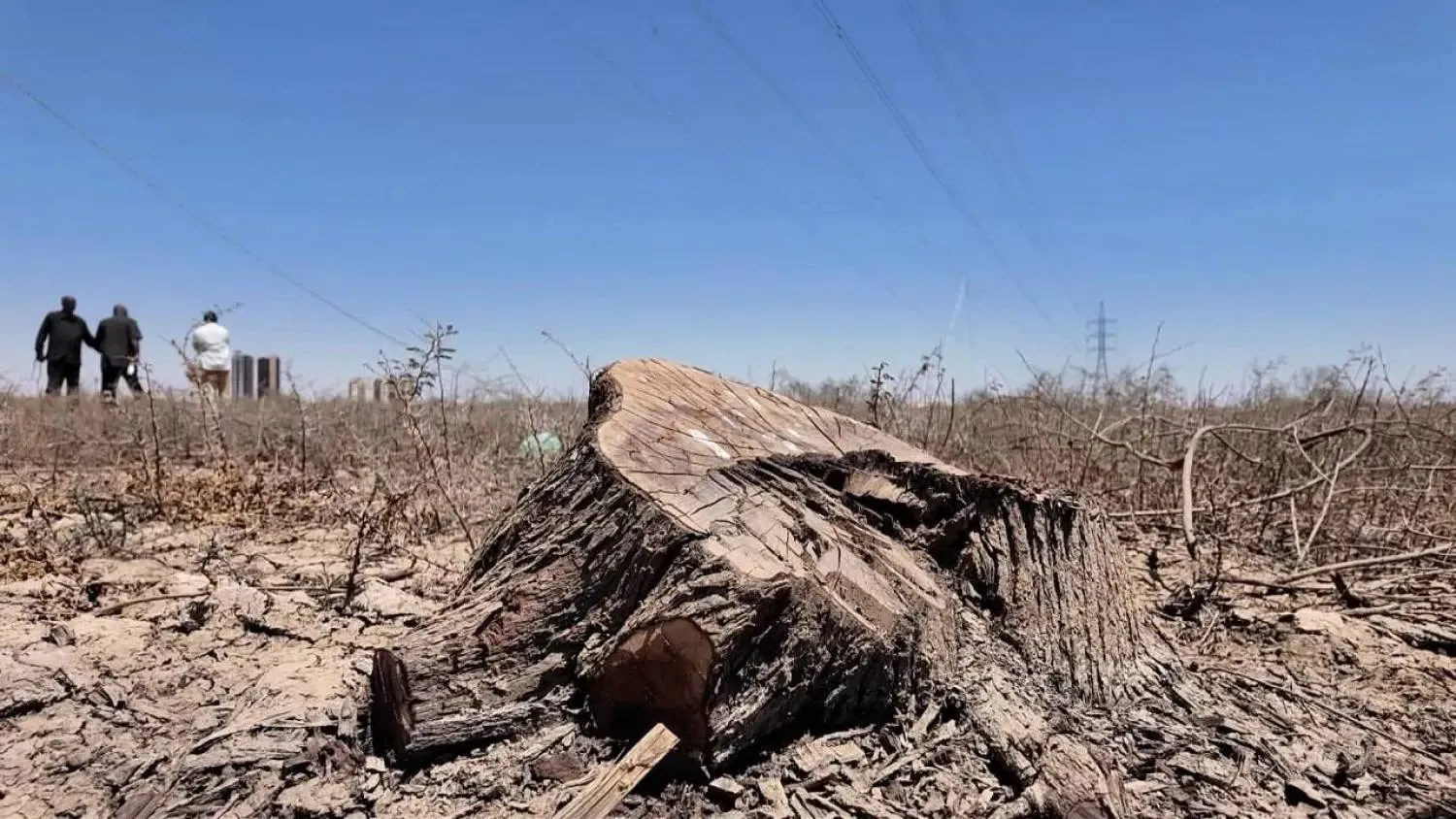

Sudan’s War Fuels Silent Disaster for Forests

Damage to Sudan’s forests caused by the war and indiscriminate tree cutting (Asharq Al-Awsat)
TT

Sudan’s War Fuels Silent Disaster for Forests

Damage to Sudan’s forests caused by the war and indiscriminate tree cutting (Asharq Al-Awsat)

As war tears through Sudan, the environment has been buried beneath the smoke of battle, mass displacement and hunger. Yet it is one of the sectors suffering the broadest and deepest losses.

Experts say what is unfolding in Sudan’s forests is no longer routine environmental degradation. It is a silent disaster threatening the country’s natural resources and climate balance, as the state’s ability to monitor and protect them weakens and living pressures grow.

The collapse of basic services, fuel shortages and soaring living costs have forced thousands of Sudanese families back to firewood and charcoal as alternative energy sources.

The result has been a surge in tree felling and the depletion of forest belts. Internal displacement has added to the pressure, with large numbers of people moving to safer areas and setting up temporary shelters in wooded zones, amid an almost total absence of environmental oversight and law enforcement.

A bitter reality

On the outskirts of Khartoum state, among acacia trees near the confluence of the two Niles, Aisha Abdullah collected firewood and described the choices now facing families.

“We used to rely on cooking gas, but the price of a cylinder has risen to about 90,000 Sudanese pounds, around $22.50, and we can no longer afford it,” she said. “We have no option left but firewood to cook food. We know that cutting trees harms the environment, but how can a family live without food?”

In Gezira state, Salah al-Tayeb said economic hardship has pushed many people toward the forests.

“The price of a sack of charcoal has reached about 105,000 Sudanese pounds, around $26.25, which is beyond the means of most families,” he said. “That is why firewood has become the only available option for many people to meet their daily needs.”

Saadia Abdullah, a tea seller on Nile Street in Omdurman, said the war has upended her work as fuel prices climbed and incomes fell.

“I used to use gas and charcoal in my work normally, but prices have become beyond our capacity,” she said. “Today I rely on firewood so I can prepare tea and continue working under these difficult conditions.”

Accelerating environmental damage

Moussa Suleiman Moussa, director general of the National Forestry Corporation, said forests have become an emergency energy source during the war because of power cuts and shortages of cooking gas.

Official data show about 60% of acacia forests in Gezira state have deteriorated, along with 45% in Sennar state. Other states have been affected to varying degrees.

In remarks to Asharq Al-Awsat, Moussa said Sudan’s forest area is estimated at about 30 million feddans after South Sudan’s secession in 2011, equal to around 12.5% of the country’s area. Plans had aimed to raise that figure to 25% , but the war halted that path and accelerated the depletion.

Bishra Hamed, former head of the Higher Council for Environment and Natural Resources in Khartoum state, said Sudan’s environmental resources are facing a “wide and multifaceted assault” as the effects of war intersect with economic, social and security crises.

He said the weakened role of the state and declining law enforcement have allowed the firewood, charcoal and timber trade to expand. Modern methods are being used to cut trees and move them quickly through networks operating inside and outside the country.

“Between 70% and 80% of the population depends directly on natural resources for their livelihoods, whether through farming, herding or firewood production. This makes environmental degradation a direct threat to economic and social stability in a country already suffering from structural fragility,” he said.

Hamed also warned that unregulated mining inside forests and natural reserves is deepening the crisis by stripping more vegetation and polluting soil and water, creating complex environmental challenges that will be hard to contain in the near term.

Environmental expert Awad Mohammed Siddig said the damage goes beyond temporary resource consumption. It amounts to the rapid dismantling of an entire ecosystem.

He said the loss of vegetation strips soil of its ability to retain moisture and allows desertification to spread in already fragile areas, while habitats disappear and biodiversity declines.

In remarks to Asharq Al-Awsat, Siddig said rural communities are paying the price directly through falling agricultural production, weaker protection from advancing sand and disruption to the water cycle.

Climate and environmental expert Noureldin Ahmed said forests are among Sudan’s most important natural resources because they help moderate the climate, protect soil and provide food and shelter for millions of living organisms.

He said wide areas have become barren after once serving as a natural lung that supplied oxygen and reduced the effects of desertification and climate change. He warned that the continued deterioration of vegetation cover threatens to multiply Sudan’s climate and humanitarian crises.

Mounting economic losses

Forestry expert Talaat Dafallah said the loss of dense vegetation contributes to rising temperatures and weakens the local environment’s ability to absorb carbon emissions.

He said the damage is also draining vital resources such as timber and gum arabic, with annual losses in the forestry sector estimated at about $500 million because of illegal tree cutting.

In remarks to Asharq Al-Awsat, Dafallah said the immediate priority is to reduce household dependence on firewood by providing cooking gas where possible, expanding the use of improved stoves and supporting solar energy in neighborhoods and displacement centers.

The damage has not stopped at the natural environment. It has reached key economic sectors. In Kordofan, one of the world’s most important gum arabic producing regions, production chains have been badly hit, affecting millions of people who depend on the sector as a main source of income.

With the war dragging on and state institutions retreating, Sudan’s environment is facing a real existential challenge. Depletion is accelerating without protection or recovery plans, while environmental, economic and humanitarian losses deepen day by day, raising the prospect of long-term consequences that could affect generations to come.



PM Says Lebanon Facing Dangerous Israeli Escalation

Destroyed buildings are pictured in the village of Kfar Kila in southern Lebanon as seen from across the border in the Upper Galilee region of northern Israel on May 29, 2026. (AFP)
TT

PM Says Lebanon Facing Dangerous Israeli Escalation

Destroyed buildings are pictured in the village of Kfar Kila in southern Lebanon as seen from across the border in the Upper Galilee region of northern Israel on May 29, 2026. (AFP)

Lebanese Prime Minister Nawaf Salam denounced on Saturday what he called a dangerous Israeli escalation in the south, urging an immediate ceasefire and insisting that a "scorched-earth policy" would not ensure Israel's security.

In a televised address, Salam also defended his government's direct negotiations with Israel -- which Iran-backed Hezbollah opposes -- saying that the talks were the "least costly path" for Lebanon.

"In light of the dangerous and unprecedented Israeli escalation over the past few days, it is necessary to step up political and diplomatic efforts to achieve a swift and real ceasefire," Salam said.

He accused Israel of "pursuing a scorched-earth policy and collective punishment" by "destroying towns and villages, and forcing their inhabitants into exile".

This will bring "neither security nor stability" to Israel, he said.

Salam's broadcast came after Israel's military issued new evacuation warnings for residents of more south Lebanon villages, and a day after military delegations from both countries held landmark security talks in Washington.

Those talks took place ahead of US-brokered negotiations early next week -- the fourth round since the latest Israel-Hezbollah conflict erupted in March.

Salam said the outcome of the direct negotiations with Israel was "not guaranteed", but that they "are the least costly path for our country and our people".

A US statement after Friday's talks made no mention of a ceasefire, and Israel has recently intensified its air and ground operations against Hezbollah.

A truce to halt the fighting officially took effect on April 17, but has never been observed.


Kataib Hezbollah Vows to Keep Arms as Iraq Faces US Pressure to Disarm Groups

Fighters carry flags of Iraq and paramilitary groups, including Kataib Hezbollah, during a funeral in Baghdad for five militants killed in a US strike in northern Iraq, on Dec. 4, 2023. (AFP via Getty Images)
TT

Kataib Hezbollah Vows to Keep Arms as Iraq Faces US Pressure to Disarm Groups

Fighters carry flags of Iraq and paramilitary groups, including Kataib Hezbollah, during a funeral in Baghdad for five militants killed in a US strike in northern Iraq, on Dec. 4, 2023. (AFP via Getty Images)

The influential Iraqi armed group Kataib Hezbollah pledged on Saturday to keep up its "action", as Baghdad faces mounting US pressure to disarm factions backed by Iran.

Following the outbreak of the US-Israeli war on Iran at the end of February, groups operating under the banner of the "Islamic Resistance in Iraq" carried out repeated drone and rocket attacks on US interests in the country.

Washington, in turn, bombed facilities and bases belonging to the groups, including Kataib Hezbollah, killing dozens of their members.

Since taking office in mid-May, Iraqi Prime Minister Ali al-Zaidi has pledged to restrict weapons to the hands of the state.

But in a statement on Saturday, Kataib Hezbollah security chief Abu Mujahid al-Assaf said "action is today a collective duty, and we will carry it out on behalf of the brothers who have decided to abandon it".

While some factions have shown willingness to operate under state institutions, others, like Kataib Hezbollah, refuse to discuss disarmament under US pressure.

Assaf suggested that Kataib Hezbollah was willing to work with those other groups, and was "also prepared to pay for" weapons they no longer needed.

He said his group was ready "to cooperate and play a constructive role" by supervising the transfer and storage of weapons, and receiving specialized weapons such as cruise missiles, for which "there are no experts within state agencies".

Kataib Hezbollah insists it will not discuss its weapons so long as foreign forces remain deployed in Iraq's northern Kurdistan region as part of a US-led international coalition formed in 2014 to fight the extremist ISIS group.

The coalition is scheduled to end its mission in the Kurdistan region by September.

Earlier this month, a senior US State Department official had demanded Iraq take "concrete actions" on pro-Iran armed groups, preconditioning renewed support on "expelling terrorist militias from any state institution" and cutting off payments to them.


Israeli Strike Kills Nurse in Gaza

 Mourners take the last look at the body of Jamal Abu Aoun, who was killed in an Israeli airstrike, during his funeral at al-Aqsa Hospital in Deir al-Balah, central Gaza Strip, Saturday May 30, 2026. (AP)
Mourners take the last look at the body of Jamal Abu Aoun, who was killed in an Israeli airstrike, during his funeral at al-Aqsa Hospital in Deir al-Balah, central Gaza Strip, Saturday May 30, 2026. (AP)
TT

Israeli Strike Kills Nurse in Gaza

 Mourners take the last look at the body of Jamal Abu Aoun, who was killed in an Israeli airstrike, during his funeral at al-Aqsa Hospital in Deir al-Balah, central Gaza Strip, Saturday May 30, 2026. (AP)
Mourners take the last look at the body of Jamal Abu Aoun, who was killed in an Israeli airstrike, during his funeral at al-Aqsa Hospital in Deir al-Balah, central Gaza Strip, Saturday May 30, 2026. (AP)

A Palestinian nurse was killed in an Israeli strike on Gaza Saturday, hospital authorities said, the latest death by Israeli fire since a shaky ceasefire halted major fighting in the enclave last year.

The strike late Saturday morning hit a Hamas-manned police point in the central city of Deir al-Balah. At least three other people were wounded, according to the city’s Al-Aqsa Martyrs hospital, which received the casualties.

The Israeli military didn’t immediately respond to a request for comment.

The dead nurse was identified as Jamal Abu Aoun, who worked at Yafa Hospital in Deir al-Balah. His funeral was held at noon in the Al-Aqsa Martyrs hospital’s courtyard.

He was the latest fatality among Palestinians in the coastal enclave since a fragile October ceasefire deal attempted to halt a more than two-year war between Israel and Hamas in Gaza.

While the heaviest fighting has subsided, the shaky ceasefire has seen almost daily Israeli fire. Israeli forces have carried out repeated airstrikes and frequently fire on Palestinians near military-held zones, killing at least 929 Palestinians, according to Gaza’s health ministry.

The ministry, which is part of the Hamas-led government, maintains detailed casualty records that are seen as generally reliable by United Nations agencies and independent experts. But it does not give a breakdown of civilians and militants.

Fighters have carried out shooting attacks on troops, and Israel says its strikes are in response to that and other violations. Four Israeli soldiers have been killed since the ceasefire.