

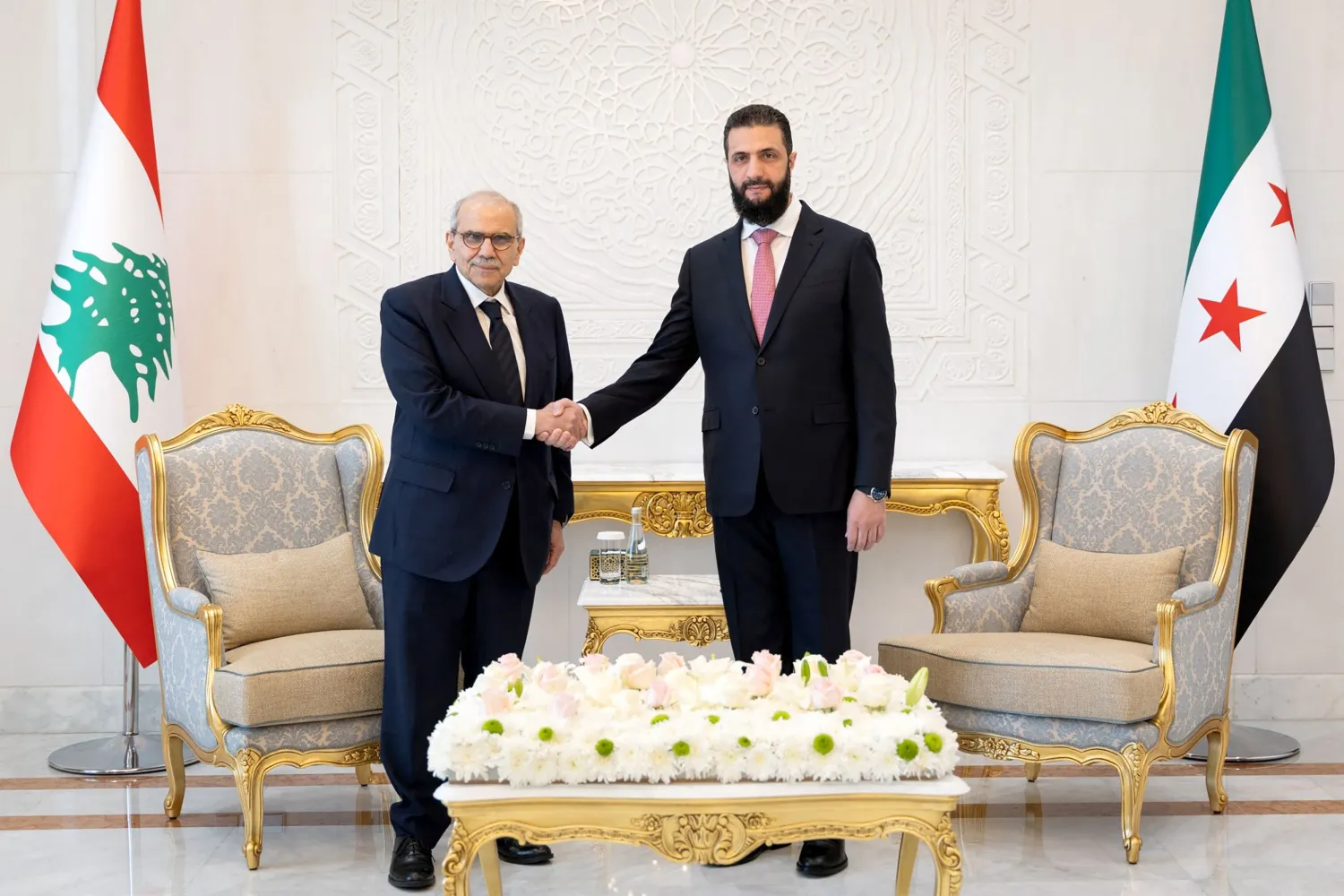

Syria President Discusses Security with Visiting Lebanon PM

This handout photo provided by Syria's SANA news agency's Telegram channel on May 9, 2026, shows Syrian President Ahmed al-Sharaa (R) shakes hands with Lebanese Prime Minister Nawaf Salam at the People's Palace in Damascus. (SANA / AFP)
TT

Syria President Discusses Security with Visiting Lebanon PM

This handout photo provided by Syria's SANA news agency's Telegram channel on May 9, 2026, shows Syrian President Ahmed al-Sharaa (R) shakes hands with Lebanese Prime Minister Nawaf Salam at the People's Palace in Damascus. (SANA / AFP)

Syrian President Ahmed al-Sharaa met Lebanon's Prime Minister Nawaf Salam in Damascus on Saturday on a visit tackling issues including security, transport and energy.

Beirut and Damascus have been rebuilding their ties after the December 2024 overthrow of longtime ruler Bashar al-Assad in Syria, whose family dynasty exercised control over Lebanese affairs for decades and is accused of assassinating numerous officials in Lebanon who expressed opposition to its rule.

A statement from the Syrian presidency said the officials discussed "developing economic and trade cooperation... and bolstering security coordination in order to support stability and confront challenges", as well as regional and international developments, AFP reported.

Syrian state news agency SANA said the visit aimed to "develop joint cooperation... particularly the economy, transportation and energy" sectors.

Salam was accompanied by Deputy Prime Minister Tarek Mitri as well as Lebanese ministers for energy, economy and transport.

Salam hailed "significant progress" on joint issues at the end of the visit, telling reporters that "we discussed continuing efforts to address the issue of detained Syrians (in Lebanon) and to uncover the fate of the missing and forcibly detained in both countries".

In March, Lebanon transferred more than 130 Syrian convicts to their home country to serve the remainder of their sentences there, as part of an agreement signed a month earlier.

Lebanon has also been seeking information on political assassinations in the country under the Assad dynasty.

The discussions also addressed "the need for stricter Syria-Lebanon border controls and preventing all types of smuggling", Salam added.

Lebanon and Syria share a porous, 330-kilometre (205-mile) border notorious for the smuggling of people and goods.

Last month, the main border crossing was closed for several days due to an Israeli threat to target it, with Israel accusing Hezbollah of using the crossing for military purposes and smuggling, though it ultimately did not carry out the strike.

Israel and Hezbollah have been fighting since the Iran-backed group drew Lebanon into the Middle East war with rocket fire at Israel on March 2, though a ceasefire was announced last month.

Hezbollah, which fought alongside Syrian government forces during the country's civil war, lost a major ally and cross-border supply route with Assad's ouster.

Syria's new authorities are hostile to the Lebanese group and its sponsor, and have announced the arrest of alleged Hezbollah-affiliated cells in recent months, while the group has denied having any presence in Syria.

Salam said that "we will not allow Lebanon to be used as a platform to harm any of its Arab brothers, including Syria".


Report: US Negotiates Secret Deal Over Clandestine Syrian Assad-era Nuclear Site

US President Donald Trump and Syrian President Ahmed al-Sharaa meet at the White House in November 2025. (AFP/SANA)
TT

Report: US Negotiates Secret Deal Over Clandestine Syrian Assad-era Nuclear Site

US President Donald Trump and Syrian President Ahmed al-Sharaa meet at the White House in November 2025. (AFP/SANA)

The International Atomic Energy Agency (IAEA) will soon remove nuclear material stored at a clandestine site in Syria after the Trump administration reached understandings with Syria and Israel, according to Israeli and US officials cited by Axios on Tuesday.

The Trump administration and IAEA scrambled to reach a diplomatic agreement to secure the material and prevent an escalation involving Israel, Syria and possibly even Türkiye over the sensitive site.

US officials said the episode validates President Donald Trump's approach to Syria and shows how the US used its close relations with the new Syrian government to neutralize a potential crisis.

The dramatic, behind-the-scenes exchange of threats and diplomacy over the secret site, which played out for months before reaching a resolution several weeks ago, was kept secret and has not been previously reported.

Assad’s nuclear program

Bashar al-Assad's regime had developed a secret nuclear program centered on the clandestine Al-Kibar reactor.

After Israel bombed the reactor in 2007, the Syrian nuclear program was mostly destroyed. But several research-and-development and storage sites remained and were mostly inactive.

After the fall of the Assad regime in December 2024, the IAEA signed an agreement with the new Syrian government that allowed it to visit the Al-Kibar reactor and several other sites connected to Syria's past nuclear activity.

Charles Lister, a resident fellow at the Middle East Institute, said Syria's new government is eager to resolve sensitive issues inherited from the Assad regime, including its nuclear and chemical weapons files, that could damage its efforts to rehabilitate the country's international standing.

One of the facilities Israel has been closely monitoring over the last two years is called “Site 99.”

According to two Israeli officials city by Axios, the Assad regime stored nuclear material there that was part of the Al-Kibar nuclear reactor project.

A US official said the material included yellowcake, a powder from uranium ore that can later be further processed and eventually enriched as part of a nuclear fuel cycle.

The US official said the regime stored other residue and “leftovers” from the al-Kibar site at Site 99.

While the material at the site can't be used for a nuclear weapon, it can be used for a “dirty bomb” - a conventional explosive device that disperses radioactive material to contaminate an area rather than produce a nuclear explosion.

The Israeli officials said the Israeli army bombed the entrances to the site shortly after the fall of the regime to prevent access to it.

For more than a year, Israel and the US have been discussing the best way to deal with Site 99, a US official told Axios.

Senior officials from the White House National Security Council and its counterpart in the Israeli prime minister's office have been working closely on the issue.

Israel made clear to the Trump administration that it would not tolerate nuclear material remaining at the site, according to an Israeli official.

Israeli officials said Israel even threatened to bomb the site again if the nuclear material was not removed or if there were signs that Syria was trying to access the material.

A US official also said that while the Israelis were concerned, they were never on the verge of bombing the site.

Cooperation with Damascus

Eventually, a US official said, the US and Israel agreed the best approach was to get a “buy in” from the Syrian government to remove the material.

When the Trump administration raised the issue with the Damascus government, Syrian officials said they didn't know there was nuclear material at the site, sources said.

“Very few people in the US, Israel and Syria were aware of this,” a US official told Axios.

The same official said the US had established a productive relationship with the post-Assad regime. “When we work with the Syrians on things — they are good partners,” the US official said.

Several weeks ago, Israelis monitoring the site detected movements in the area that led them to suspect the new Syrian government was reneging on understandings and trying to access the nuclear material, according to Israeli and US officials.

The Israelis were even concerned that Türkiye was helping the Syrian government get hold of the nuclear material.

“The Israelis are always kicking the tires on different things to make sure it looks right and it's good they do that,” a US official said.

The Trump administration asked Israel not to take any action and brought the IAEA into the picture.

The result was an agreement that was signed three weeks ago between the IAEA and the Syrian government to remove the nuclear material from the site.

The White House, the IAEA and the Israeli prime minister's office declined to comment.

US officials say the work on Site 99 is still an ongoing operation. The material hasn't been removed yet.

But “we think everybody is happy with the result. Hopefully we will be able to kick off the removal process soon and end it before the end of the year,” the official said.


US ‘Veto’ Stalls Talks to Complete Zaidi Govt in Iraq

Iraqi Prime Minister Ali al-Zaidi meets US envoy Tom Barrack in Baghdad, June 16, 2026. (Government media)
TT

US ‘Veto’ Stalls Talks to Complete Zaidi Govt in Iraq

Iraqi Prime Minister Ali al-Zaidi meets US envoy Tom Barrack in Baghdad, June 16, 2026. (Government media)

A US “veto” has stalled talks to fill vacant posts in Iraqi Prime Minister Ali al-Zaidi’s government, political sources said, as Washington prioritizes a plan to bring armed factions’ weapons under state control despite Iranian objections.

Al-Zaidi told a meeting of the ruling Coordination Framework on Monday that he was close to completing his cabinet, which he announced in mid-May with 14 ministerial portfolios filled and nine posts vacant.

The vacancies include key ministries such as defense, interior, higher education and planning.

Iraq’s federal parliament has often approved incomplete governments in previous terms because of disputes among political parties and blocs over quotas and ministerial posts, with compromises reached later to fill the remaining portfolios.

But the formation of al-Zaidi’s government appears more complicated, and the remaining posts could stay vacant for months, according to a senior Framework official.

US ‘red lines’

The official told Asharq Al-Awsat that disputes over posts could delay completion of the government for a short period, but recent US intervention, particularly under al-Zaidi’s government, could hold it up for months.

The official said discussions within the Framework pointed to “a veto and red lines” imposed by the United States and US presidential envoy Tom Barrack on virtually all candidates nominated by the Framework.

“Some clearly believe Washington does not want the government completed at the moment,” the official said.

Several sources have previously said Washington categorically rejected representatives of armed factions taking ministerial posts and had raised the issue explicitly with al-Zaidi during his latest visit to Washington in July.

Framework uncertainty

Amid reports that Washington has rejected Laith al-Khazali for the post of deputy prime minister, the senior official said there was confusion within the Coordination Framework over the US position, saying Washington had placed red lines on most of its parties and factions.

“Take the State of Law coalition, for example. It has no factions or armed wings, but it too is under the weight of US anger and is not allowed to take ministerial posts,” the official said. “The same happened with its leader Nouri al-Maliki, whom the US president publicly rejected when he was nominated for prime minister.”

Maliki is the head of the State of Law coalition and Trump had vehemently opposed his nomination.

The official said the US priority appeared to be bringing weapons under state control and countering Tehran’s influence in Iraq, rather than completing the cabinet.

“Washington may prefer the defense and interior ministries to remain directly under Prime Minister al-Zaidi,” the official said.

Amid unconfirmed media reports that the head of Iran’s Quds Force is in Baghdad to counter moves to dissolve the armed factions, political sources said al-Zaidi’s announcement that the remaining cabinet posts would be filled was “a cover for the failure to reach an agreement with the Iranians over bringing weapons under state control, and for concerns about the fate of the government itself.”

After September

Kifah Mahmoud, political adviser to Kurdistan Democratic Party leader Masoud Barzani, said negotiations to fill the remaining government posts could take place in September at the earliest.

September 30 is the deadline set by the Baghdad government to resolve the issue of disarming the factions, he told Asharq Al-Awsat.

He added that Iraq’s federal constitution does not accept the presence of any armed faction outside the authority of the state and government.

Mahmoud agreed with the view that there was US resistance to completing the government, saying Washington had repeatedly opposed senior government posts going to figures close to armed factions.

“The two main parties in Kurdistan, the Democratic Party and the Patriotic Union, support al-Zaidi and his efforts to complete his cabinet,” he said.

“But the issue is tied to disputes among the leading forces within the Coordination Framework, as well as among Sunni parties.”

Still, Mahmoud said “serious US reservations over who holds government posts, and the red lines Washington has imposed, could obstruct al-Zaidi’s efforts to fill the remaining vacancies.”


Iran’s Revolutionary Guards Overhaul Houthi Security Measures

A barge is secured to the dock at the Port of Mokha the day after an attack by the Houthis on the city of Mokha, held by Yemen's internationally recognised, Aden-based government on 10 August 2026. (AFP)
TT

Iran’s Revolutionary Guards Overhaul Houthi Security Measures

A barge is secured to the dock at the Port of Mokha the day after an attack by the Houthis on the city of Mokha, held by Yemen's internationally recognised, Aden-based government on 10 August 2026. (AFP)

The Iran-backed Houthis in Yemen have dispersed senior leaders and shifted the running of institutions in areas under their control to new locations under tight security in wake of their latest military escalation, Yemeni security sources told Asharq Al-Awsat.

The measures include turning major hotels in Sanaa, Hodeidah, Saada and other cities into temporary bases for security and intelligence agencies and civilian institutions, as the group seeks to shield its leadership from possible strikes.

The sources revealed that officers from Iran’s Revolutionary Guards were overseeing the escalation, while Ali Mohammad Rezaei, the so-called Iranian ambassador to the Houthis, was personally supervising an operations room directing military and security affairs in Houthi-held areas.

Security and intelligence officials, ministers and heads of state bodies in the Houthis’ internationally unrecognized government have been ordered to move into hotels and continue working from there, the sources said. They said the aim was to place senior figures among civilians and hotel guests, making them harder to target.

The Revolutionary Guards have also set up a dedicated operations room to track developments on the ground and coordinate the media campaign accompanying the escalation, according to the sources.

That campaign includes promoting claims of a blockade and demands for the payment of government employees’ salaries, in what the sources described as an attempt to cast the escalation as driven by domestic grievances.

Its main purpose, however, was to support Tehran in its confrontation with the United States, the sources said.

Iranian officers expect the Coalition to Support Legitimacy in Yemen to respond by targeting Houthi military, security and government leaders, as it did during earlier rounds of conflict, they added. That expectation has prompted the group to tighten precautions around its senior figures.

Hotels turned into hideouts

A number of Houthi leaders have been moved into hotels in major cities under the group’s control, with trusted intelligence operatives appointed as links between them and the institutions they oversee, the sources said.

Those operatives relay orders and requests to lower-ranking officials in government institutions and facilities, while supplying senior leaders with information and other needs at their new locations.

Second-tier officials have meanwhile been left to handle day-to-day operations.

The changes have coincided with the disappearance from public view of several top Houthi figures, who have moved to more secure locations, the sources said.

The group has also tightened security at hotels, linking some to networks operated by intelligence and police agencies under its control to monitor guests, verify identities and prevent infiltration.

Saada sealed off

Several of the Houthis’ most senior leaders have moved to Saada, the group’s main stronghold in northern Yemen, the sources said.

They described the province as effectively sealed off, with entry and exit subject to tight checks.

The province contains fortified Houthi sites beneath mountains that are used as shelters, military command centers and weapons storage facilities, the sources said. Similar sites have also been developed elsewhere.

Houthi officials and supervisors running government institutions under the group’s control have been instructed by Revolutionary Guards personnel to move into hotels in major cities.

Military commanders, by contrast, have been told to remain in trenches and fortified positions prepared across several areas.

The Houthis have also built a network of tunnels and hardened sites for shelter and command operations, particularly in Ibb, Hajjah and Hodeidah provinces, according to the sources.

The precautions draw on the group’s experience during its attacks on shipping in the southern Red Sea from late 2023 through the first quarter of 2025.

During that period, military and security leaders moved into secret locations and residences away from visible centers of activity, helping several senior figures avoid being hit during US and Israeli strikes, the sources said.

Those precautions, however, did not prevent a secret meeting of the Houthi government from being struck, killing the head of government and nine ministers, according to the sources.

The group’s chief of staff was also targeted despite efforts by senior leaders to conceal their whereabouts.

Launch sites dispersed

At the same time, Iranian officers have overseen the establishment of additional positions near front lines and selected multiple sites for launching missiles and drones, the sources said.

The move is designed to prevent the Houthis from relying on a single launch point and to make the sites harder to detect and destroy.

Launch positions have been spread across Ibb, Taiz and Al-Bayda provinces, a pattern that was evident during the heavy missile attack on Mokha port, according to the sources.

The Houthis fired around 20 missiles from areas in Ibb province, some of which fell on the province’s outskirts, they said.

The group also used areas under its control in rural Taiz to fire further volleys of missiles and drones.
