


Syria Court Charges Former Security Official with Acts Amounting to ‘War Crimes’

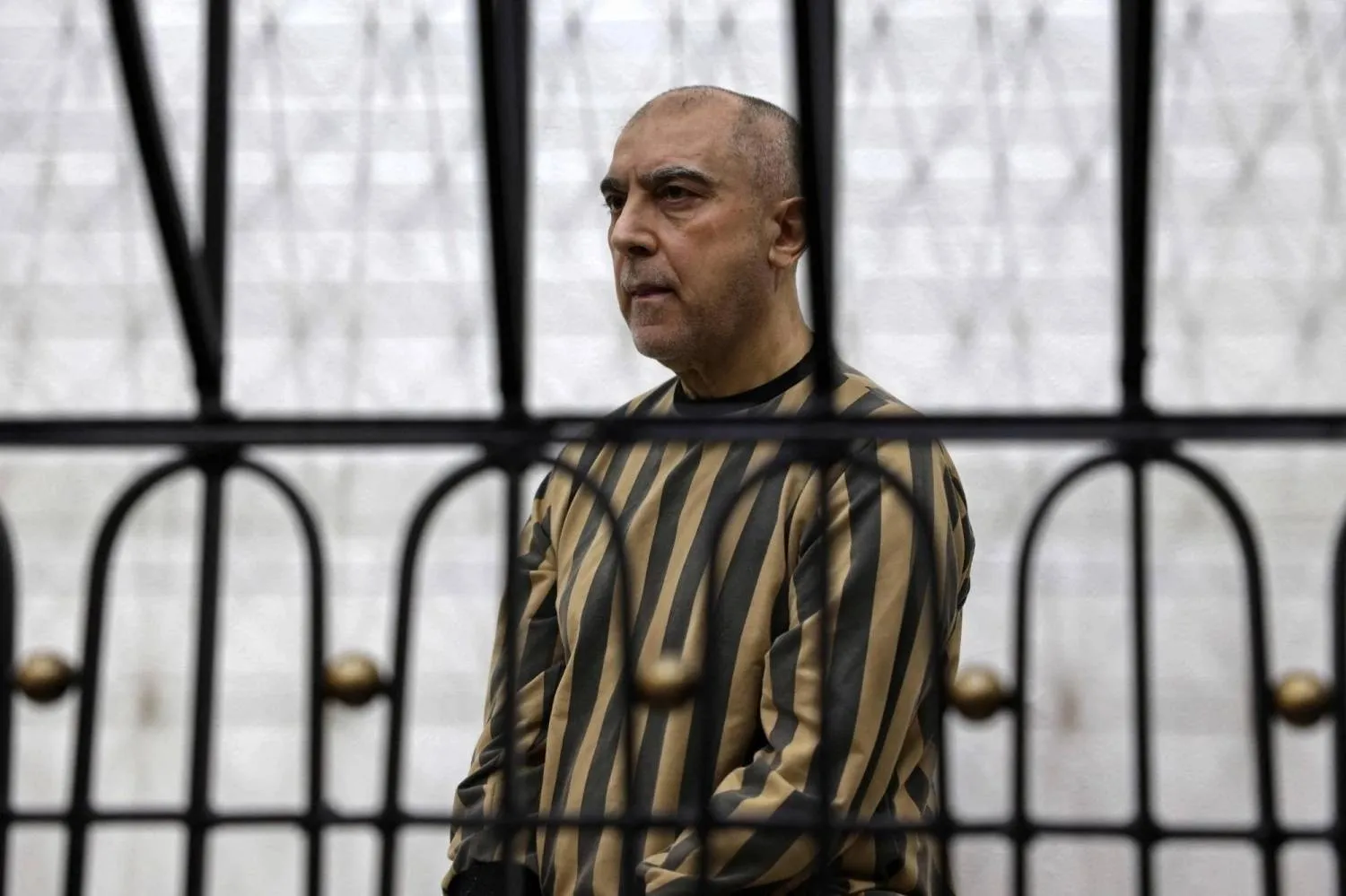
 Former head of political security in south Syria's Daraa province, Atef Najib attends the first trial session at the Palace of Justice, in Damascus last month. (AFP)
Former head of political security in south Syria's Daraa province, Atef Najib attends the first trial session at the Palace of Justice, in Damascus last month. (AFP)
TT

Syria Court Charges Former Security Official with Acts Amounting to ‘War Crimes’

 Former head of political security in south Syria's Daraa province, Atef Najib attends the first trial session at the Palace of Justice, in Damascus last month. (AFP)
Former head of political security in south Syria's Daraa province, Atef Najib attends the first trial session at the Palace of Justice, in Damascus last month. (AFP)

Syria's judiciary brought charges on Sunday against former security official Atef Najib for acts "amounting to war crimes" in 2011 against peaceful protesters in Daraa province, the cradle of the country's uprising.

Najib was the former head of political security in the south Syrian province and is accused of orchestrating a crackdown there. Washington sanctioned him for human rights abuses in April 2011, one month after the uprising erupted.

He appeared in a Damascus criminal court again on Sunday after the opening session last month in the trials of former senior figures, most prominently longtime president Bashar al-Assad and his brother Maher al-Assad, who are both being tried in absentia.

Judge Fakhr al-Din al-Aryan read out the charges at Sunday's session, part of which was broadcast on state television, as Najib stood in the docks.

"The accusations against you relate to events in Daraa province in early 2011, when the peaceful (protest) movement was met with an excessive use of force," Aryan said.

"As head of the political security branch then, you held direct and joint leadership responsibility for systematic acts that targeted civilians including killing, torture and arbitrary detention," he added.

He said abuses attributed to Najib, some of them deadly, include the arrest and torture of children due to "political writings on walls", involvement in "suppressing protests with excessive force" and "opening direct fire" on a peaceful sit-in at Daraa's Al-Omari mosque.

They also include "torture leading to death" in his branch's detention centers.

"You were the ultimate authority in Daraa province and hold direct responsibility for issuing orders to kill, arrest and torture... and for participating with political, security and military leaders in an organized hierarchical structure in committing these grave violations," the judge said.

The actions attributed to Najib and others not present "amount to war crimes... and crimes against humanity", he added.

The court heard statements from Najib and witnesses, state media said, after the judge halted media coverage.

Syria's more than 13-year civil war killed more than half a million people and displaced millions of others. Tens of thousands of people disappeared, some into the country's brutal prison system.

The uprising began in Daraa on March 15, 2011, after 15 students were arrested for allegedly writing anti-government slogans on the city's walls.

Residents said the children were tortured, leading to a protest to demand their release that ended in bloodshed.

Security personnel suppressed peaceful demonstrations with force and fired live ammunition to disperse sit-ins at several locations.

Najib was dismissed after the crackdown, as the protests spread to other provinces.

He was among the first Assad-era officials arrested by the new authorities after the December 2024 ousting of the longtime ruler.



Israeli Military Says It Has Control of Lebanon’s Strategic Ali Al-Taher Area

A satellite image shows damage at the Ali al-Taher ridge near Nabatiah, Lebanon, March 8, 2026. 2026 (Planet Labs PBC/Handout via Reuters)
TT

Israeli Military Says It Has Control of Lebanon’s Strategic Ali Al-Taher Area

A satellite image shows damage at the Ali al-Taher ridge near Nabatiah, Lebanon, March 8, 2026. 2026 (Planet Labs PBC/Handout via Reuters)

Israel's military said on Thursday it had taken “operational control” of the strategic Ali al-Taher ridge area in southern Lebanon, the site of sporadic clashes between Israeli forces and Hezbollah in recent weeks. It is where Hezbollah is believed to have an extensive underground military facility.

The military said troops had cleared Hezbollah fighters from two underground routes, killing some while others fled. It said operations were ongoing.

Operations aimed at neutralizing underground infrastructure, after clearing them of Hezbollah operatives, are ongoing, with the military set to redeploy defensively following the completion of the activity, based on a situational assessment, it added.

The military accused the fighters inside the facilities of working to carry out plots against Israel and army forces. It noted that operations in the area in recent weeks have neutralized the capability to launch attacks against Israelis and army forces from it.

The Israeli army stated that inside the underground infrastructure, it discovered operations rooms, rooms designated for combat gear, and others for generators and accommodation, in addition to showering facilities and a kitchen, allowing Hezbollah fighters to manage combat and remain inside for extended periods.

It described these facilities as “strategic infrastructure” built over two decades, saying they were planned and funded by the Iranian regime.

There was no immediate comment from Hezbollah.

The Israeli army said its forces will continue to clear the occupied so-called “security zone” in southern Lebanon of Hezbollah, saying it will not allow the party to carry out plots against it,

Any attempt by Hezbollah to launch attacks against the army “will be met with force,” warned Israel, while saying it was committed to the ceasefire agreement in Lebanon.

The Ali al-Taher hill overlooks several villages as well as main roads leading to the city of Nabatieh. Losing control of it would disrupt Hezbollah’s presence and supply lines in the area.


Libya's NOC Reports Drone Attack Attempt at Fuel Depot

No casualties ‌were reported and the incident ‌did not impact supply operations. (EPA file)
TT

Libya's NOC Reports Drone Attack Attempt at Fuel Depot

No casualties ‌were reported and the incident ‌did not impact supply operations. (EPA file)

A remote-controlled drone attack targeted a fuel depot in Libya's capital Tripoli on Thursday, causing minor damage, the state-owned National Oil Corporation (NOC) said in a statement.

The NOC said that technical teams had begun drawing fuel from the tanks to reduce the fuel level as a ‌precaution.

There was ‌no immediate claim of ‌responsibility ⁠and authorities did not ⁠say who they believed was behind the attack.

The attack caused minor damage to some pipelines and tanks no. 213 and 220 due to falling shrapnel, said Ahmed Al-Masallati, ⁠spokesperson for Brega Petroleum ‌Marketing, which is ‌in charge of Libya's fuel supplies.

No casualties ‌were reported and the incident ‌did not impact supply operations.

Libyan oil facilities have been subject to repeated attacks and closures for various political and technical ‌reasons since the 2011 uprising that toppled Maammar al-Gaddafi and ⁠set ⁠off a prolonged period of chaos.

In August, fuel storage tanks at the nearby Zawiya oil complex, in western Tripoli, were targeted by several explosive-laden drone strikes that hit one of the tanks and completely burned it.

Attempts to target oil facilities represent "a direct threat to the supply system," the NOC said in the statement.


Houthis Escalate Attacks Across Taiz, Yemen’s Western Coast

 The navigation bridge of a sunken vessel is all that is seen at the surface of the water in the Port of Mokha the day after an attack by the Houthis on the city Mokha, held by Yemen's legitimate government on August 10, 2026. (AFP)
The navigation bridge of a sunken vessel is all that is seen at the surface of the water in the Port of Mokha the day after an attack by the Houthis on the city Mokha, held by Yemen's legitimate government on August 10, 2026. (AFP)
TT

Houthis Escalate Attacks Across Taiz, Yemen’s Western Coast

 The navigation bridge of a sunken vessel is all that is seen at the surface of the water in the Port of Mokha the day after an attack by the Houthis on the city Mokha, held by Yemen's legitimate government on August 10, 2026. (AFP)
The navigation bridge of a sunken vessel is all that is seen at the surface of the water in the Port of Mokha the day after an attack by the Houthis on the city Mokha, held by Yemen's legitimate government on August 10, 2026. (AFP)

The Iran-backed Houthi group stepped up military operations on several fronts west of Yemen’s Taiz governorate and along the Red Sea coast on Thursday.

Houthis fired more than 12 ballistic missiles at rural areas in Taiz and Hodeidah governorates as fierce clashes erupted with government forces and the National Resistance in Maqbanah, al-Kadha, al-Tuwair and Ghabari.

Military sources said the fighting began in the early hours of Thursday when the Houthis launched a broad assault on government and National Resistance positions across several sectors. The attack developed into direct clashes and artillery exchanges that lasted for hours.

The group fired hundreds of artillery and mortar rounds during the assault and deployed drones in combat operations, the sources said. The fighting spread to hills overlooking the al-Aqma area in Mawza district, where brigades affiliated with the National Resistance are stationed.

The Houthis seized several positions during the opening hours of the attack before government forces, fighters from Taiz and the National Resistance launched a counterattack and recaptured a number of them, according to military sources.

The sources said the ballistic missiles had no effect on government forces’ battlefield operations. Most of the Houthi missile strikes targeted areas around vital facilities and civilian and military supply routes, causing panic among residents.

Government forces suffered deaths and injuries, while the Houthis also sustained casualties, the sources said, without providing figures for either side. Four Houthi fighters were reportedly captured.

Reports from the Joint Operations Room said air-defense systems and military formations on the Red Sea coast were “maintaining a high level of vigilance in confronting these repeated missile threats, which have become the group’s most prominent means of trying to offset its successive battlefield losses.”

The reports said the attacks were also intended to send a message linked to regional developments around the Red Sea shipping corridor and strategic Bab al-Mandeb Strait.

The missile attacks coincided with an attempted infiltration and ground assault by Houthi fighters against government positions in al-Kadha, west of Taiz.

Three drones downed

Government forces said they shot down three Houthi drones flying over subdistricts in Jabal Habashi district as fighting continued on fronts west of Taiz.

Military sources said the drones were intercepted as the group continued using unmanned aircraft to attack government and National Resistance positions. Clashes persisted in several sectors as forces deployed reinforcements to combat positions.

The ground escalation coincided with a new wave of Houthi missile strikes on the Red Sea coast. The group fired more than 12 ballistic missiles toward several areas east and north of the city of Mokha, as well as areas in Hodeidah’s Khokha district.

Local sources said the missiles were launched from Houthi-held positions in Ibb governorate and from al-Hawban and Sharab, east and north of Taiz. One missile caused a fire on the northern outskirts of Mokha.

The National Resistance’s military media office said the Houthis fired eight ballistic missiles toward rural areas around Mokha, while a ninth landed south of Khokha district. Local sources said three more missiles were launched shortly afterward.

Red Sea coast targeted

The missile strikes coincided with fighting on the Maqbanah and al-Kadha fronts west of Taiz, while air defenses operated by the “Taiz Military Axis” responded to drones launched by the group during the assault.

The escalation came hours after the Houthis targeted residential areas, the vicinity of camps for displaced people and front-line positions in Taiz, where fighting has intensified steadily since August.

Government forces and the National Resistance have continued to repel Houthi attacks across western Taiz and the Red Sea coast as the group persists in using ballistic missiles, drones and artillery.

The simultaneous broad ground assault and missile strikes point to an expansion of the Houthi escalation in the region, which has seen repeated attacks on military positions and areas near residential communities and civilian facilities.

Government forces in Marib and al-Dhale governorates carried out strikes on Wednesday targeting Houthi positions, gatherings and vehicles, and released footage of the operations.