


Sudden ‘Veto’ from Iran Thwarts Govt Formation Efforts in Iraq

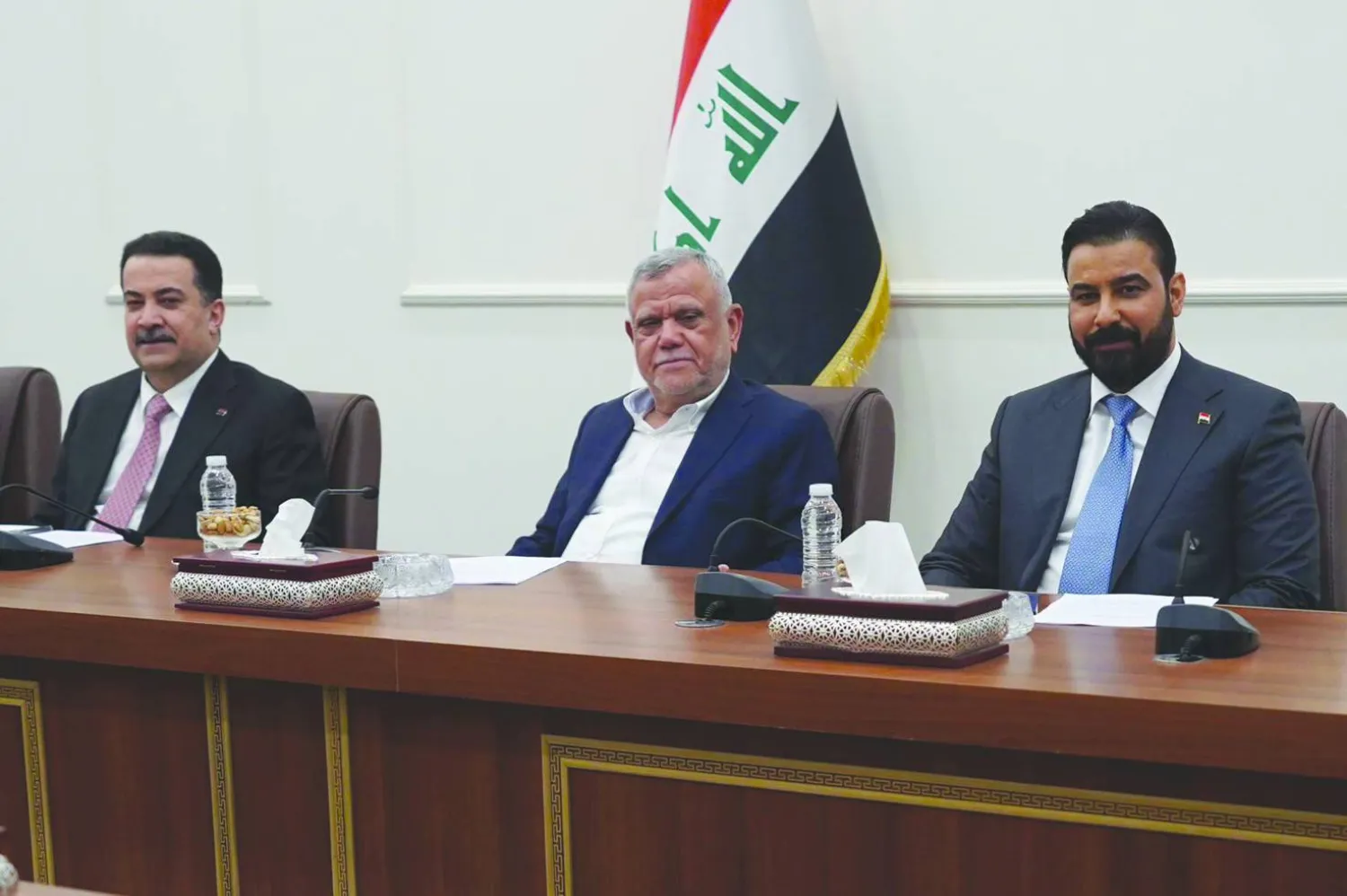
From right to left: Prime Minister-designate Ali al-Zaidi, Coordination Framework member Hadi al-Amiri, and caretaker Prime Minister Mohammed Shia al-Sudani. (Coordination Framework)
TT

Sudden ‘Veto’ from Iran Thwarts Govt Formation Efforts in Iraq

From right to left: Prime Minister-designate Ali al-Zaidi, Coordination Framework member Hadi al-Amiri, and caretaker Prime Minister Mohammed Shia al-Sudani. (Coordination Framework)

Two Iraqi officials revealed on Sunday that a sudden “veto” from Iran has thwarted efforts to form a new Iraqi government. Iran has expressed its objection to keeping pro-Tehran armed factions out of the new government.

Tehran has demanded that the ruling Shiite Coordination Framework refrain from voting in favor of a cabinet lineup that “harms the influence of its allies” in the Iraqi state, the officials told Asharq Al-Awsat.

Amid these developments, reports said that Esmail Qaani, commander of Iran’s Quds Force, the foreign arm of the Iranian Revolutionary Guards Corps (IRGC), made a surprise visit to Baghdad as Prime Minister-designate Ali al-Zaidi had reportedly been making progress in the government formation process.

Significant throughout these developments is the United States’ pressure on al-Zaidi to keep the armed factions out of the new government, reflecting mounting tensions with Tehran that are playing out on a larger scale in the region over Hormuz and the war on Iran.

Sources said Qaani had arrived in Baghdad in recent hours with a message that “Tehran objects” to Iraq’s “complete subservience to Washington.”

An official compared to Asharq Al-Awsat the tensions in Iraq over the government to the tensions between Washington and Tehran over Hormuz.

‘Purely American government’

The two officials said Iran wants to prevent Iraq from forming a “purely American government,” amid US pressure on Baghdad to curb the activity of the pro-Iran armed factions.

Al-Zaidi was named PM-designate on April 27, receiving unprecedented American backing from President Donald Trump himself, who described his appointment as a victory for the Washington administration.

A PM-designate has no more than 30 days to present a cabinet lineup to parliament for a vote of confidence. Time is of the essence with several MPs travelling to Saudi Arabia for the Hajj, meaning the necessary quorum for the parliament session to be held may not be met.

American officials are expected to arrive in Baghdad within days. Sources said Washington not only wants the armed factions out of the government, but it wants to ensure that they will not seek “alternate arrangements” that would get them in the cabinet. This prompted Iran to resort to its “veto” and throttle the government negotiations.

The disagreements over the government in Iraq largely reflect the negotiations between the US and Iran in the region that have been ongoing for weeks without reaching a final settlement.

One of the Iraqi officials quoted a prominent member of the Framework as describing as “unprecedented” the US involvement in the formation of the government. He warned that the differences could turn into an “open conflict” between Washington and Tehran, concerns that were heightened with Qaani’s arrival in Baghdad ahead of American officials who are expected there soon too.

Should Iran resort to informing the Framework MPs to refrain from voting for al-Zaidi's cabinet, Washington may in turn increase pressure on Baghdad, such as imposing sanctions and cutting off support, to get its way, a senior advisor in an influential Shiite party told Asharq Al-Awsat.

The ongoing dispute between Washington and Tehran may lead to al-Zaidi quitting as PM-designate, he warned.

The Iraqi officials, who are involved in the government formation efforts, revealed that al-Zaidi had received messages from several parties, including the US, over the need to from a cabinet that “does not have Iranian influence.”

Negotiators have said that Washington “is now interfering in the tiniest detail” in the formation process and it has “accurate information about how the factions operate to try to outmaneuver” American conditions.

The conditions are not only limited to the government, but also include restricting the factions’ economic and political connections with Tehran, especially issues related to water resources, oil, and independence of political decision-making, revealed political sources.

Al-Zaidi has tried to keep sovereign portfolios out of the hands of the armed factions and granting them “lesser” ministries. The move has angered Iran, which was hoping that it would retain influence over powerful ministries.

An informed source said noted the Asa’ib Ahl al-Haq movement, which boasts 27 MPs in parliament and has been demanding that its political weight be reflected in cabinet. It has been demanding that it be granted the Oil Ministry, putting it at great odds with Washington.



Officials Reject Handing Lebanon over to Iran’s Influence

Displaced people make their way back to their homes in southern Lebanon following an interim deal between the US and Iran, in Sidon, Lebanon, June 21, 2026. (Reuters)
TT

Officials Reject Handing Lebanon over to Iran’s Influence

Displaced people make their way back to their homes in southern Lebanon following an interim deal between the US and Iran, in Sidon, Lebanon, June 21, 2026. (Reuters)

Officials in Lebanon were vocal about firmly rejecting that their country being tied to Iran as Washington and Tehran carry out negotiations about ending the conflict in the region.

The officials, who are largely opposed to Iran-backed Hezbollah, said the current phase demands support to the Lebanese state as the sole authority in any negotiations, rejecting Iranian attempts to include Lebanon in its negotiations with the US.

In an open letter to US Vice President JD Vance, Lebanese Forces leader Samir Geagea said the greatest form of backing to Lebanon lies in supporting the state and its legitimate institutions as the sole national authorities.

Any negotiations or discussions about Lebanon should be held with the state alone, keeping Iran “permanently” away from the Lebanese file, he urged.

He added that the rise of a “sovereign, free and capable” state that can provide stability for all Lebanese people lies in supporting the state in imposing its authority throughout Lebanese territories, restricting the possession of weapons to the legitimate institutions and ending Hezbollah’s military and security presence.

Kataeb leader Sami Gemayel warned said that Iran was “trying to save what remains of Hezbollah’s” military power “so that it can use it whenever needed and whenever it is in danger.”

Speaking at a press conference, he stressed: “Lebanon sacrificed ten times what Iran did during the war as confirmed by Iranian parliament Speaker Mohammad Bagher Ghalibaf.”

“The Lebanese state must demonstrate to the world that it exists and that it speaks and acts. It is time for the Lebanese army to implement decisions. No more excuses,” he added.

“No matter the outcomes of the negotiations, we will not coexist with Hezbollah,” he declared. “They must commit to the conditions of the Lebanese state. The majority of the Lebanese people are not prepared to live as hostages to Hezbollah.”

Lebanese fishermen set fishing creels off the coast of Dbayeh, north of Beirut, on June 17, 2026. (AFP)

“Hezbollah’s weapons arsenal is the only obstacle preventing Lebanon’s revival. Land will not be liberated, the displaced will not return home and we will not live in peace as long as militias operate on our territories,” Gemayel said.

Reconstruction, the return of expatriates and creation of job opportunities are tied to the rise of the state and imposing state monopoly over arms, he went on to say.

MP Fouad Makhzoumi echoed Gemayel’s remarks, saying: “Real sovereignty is achieved through one state, one army, and one voice responsible for national decisions.”

Lebanon cannot reclaim its sovereignty and voice as long as Hezbollah’s weapons remain outside state control and as long as decisions of war and peace are taken outside legitimate institutions, he added.

The Saydet al-Jabal Gathering warned that Lebanon was facing a new attempt to usurp its voice through Iran’s insistence on using it as a bargaining chip in its negotiations with the US.

It accused Iran of seeking to obstruct the US-sponsored direct negotiations between Lebanon and Israel.

“The absolute national priority lies in the state claiming its complete sovereignty and decisions of war and peace,” he added. It must also insist on ensuring the success of its negotiations with Israel, away from foreign hegemony or dictates, to end the Israeli occupation.

“Keeping Lebanon’s fate attached to regional calculations does not in any way benefit the Lebanese people,” it stressed.

Meanwhile, over 400 Lebanese figures, including expatriates, launched an appeal to rally behind the state and its legitimate institutions.

The “Call to Save Lebanon” also backs the negotiations with Israel and rejects any foreign hegemony over Lebanon.

It threw its support behind President Joseph Aoun and Prime Minister Nawaf Salam in fulfilling their vows to impose state monopoly over arms and rejecting any partisan or foreign attempts to negotiate on Lebanon’s behalf.


Gazans Flee Scorching Tents for a Polluted Sea

 Tents housing displaced Palestinians stand amid summer heat in Gaza City, June 20, 2026. (Reuters)
Tents housing displaced Palestinians stand amid summer heat in Gaza City, June 20, 2026. (Reuters)
TT

Gazans Flee Scorching Tents for a Polluted Sea

 Tents housing displaced Palestinians stand amid summer heat in Gaza City, June 20, 2026. (Reuters)
Tents housing displaced Palestinians stand amid summer heat in Gaza City, June 20, 2026. (Reuters)

Residents of the Gaza Strip have been flocking from suffocating tents to the territory's polluted Mediterranean shore to bathe and wash their clothes, as summer temperatures rise and fresh water remains hard to come by.

Nearly all Gaza's population was displaced during two years of war between Israel and Hamas, with Gazans now crammed into a narrow strip along the coast, mainly in tents and damaged buildings.

"The only outlet in the Gaza Strip, from north to south, is the sea," said Wadie al-Ras, 36, a displaced Palestinian standing on Gaza ‌City's shore.

"The tents ‌we have been staying in since the war ‌are ⁠a torment."

Before war with ⁠Israel broke out in October 2023, Gaza City's sandy beach was a favorite spot for locals to relax. Now it is their only refuge from the crammed, makeshift tents, which are a hotbed of bugs and disease.

Temperatures in Gaza range between 28 and 31 degrees Celsius in the mornings, and inside the tents, it feels far hotter.

The sea offers little comfort. The water is thick with sewage and waste, the ⁠result of a collapse of infrastructure that once served a population ‌of more than two million people.

"The seawater ‌is not clean. There's sewage in it, filled with dirt," said Shehab al-Suwaireki, 36, a ‌displaced father of six.

With no steady supply of fresh water, however, families have been ‌left with little choice.

"We go in and wash (clothes) and bathe then we get out," Suwaireki said. "In any case, germs are getting to our bodies."

Many water pumps have stopped working due to Israeli bombardment, while sewage stations, pumping facilities, and water treatment plants have all been ‌severely damaged, said Husni Muhanna, a spokesperson for the Gaza municipality.

"Residents resort to the beach despite all the dangers," Muhanna ⁠said.

The war began ⁠when Hamas-led fighters attacked Israel from Gaza on October 7, 2023, killing 1,200 people and seizing 251 hostages.

Israel responded with an all-out assault on Gaza that killed at least 73,000 Palestinians, according to health officials in the Hamas-controlled territory.

Despite an October 2025 truce, Israel has continued to carry out deadly attacks in Gaza, which it says aim to thwart imminent attacks by Hamas and other fighters. Hamas has so far rebuffed calls to lay down its arms in exchange for Israel withdrawing its troops.

Aid and basic essentials are scarce.

Nahed Hamouda, a 56-year-old father of four who has been displaced from Jabalia, north of Gaza City, said the tents were "like an oven".

"There's no electricity, no fan, no water, even the food is inedible," he said, as he sat fanning himself with a piece of cardboard.


Lebanon Ceasefire Largely Holds but Fears Persist It May Collapse

 People check destroyed cars following a ceasefire between Israel and Hezbollah in the village of Mayfadoun, southern Lebanon, Monday, June 22, 2026. (AP)
People check destroyed cars following a ceasefire between Israel and Hezbollah in the village of Mayfadoun, southern Lebanon, Monday, June 22, 2026. (AP)
TT

Lebanon Ceasefire Largely Holds but Fears Persist It May Collapse

 People check destroyed cars following a ceasefire between Israel and Hezbollah in the village of Mayfadoun, southern Lebanon, Monday, June 22, 2026. (AP)
People check destroyed cars following a ceasefire between Israel and Hezbollah in the village of Mayfadoun, southern Lebanon, Monday, June 22, 2026. (AP)

A ceasefire largely held in Lebanon on Monday as the country experienced the longest lull yet in three months of war between Hezbollah and Israel, even as fear of renewed hostilities kept displaced people from going home.

A senior Lebanese security official said that adherence to the ceasefire had been "almost total" since Saturday evening, though the official said an Israeli tank fired shells towards a village near Tyre and Israeli forces fired sound grenades in two other locations on Monday. An Israeli drone buzzed over Beirut.

The war has tested the interim US-Iran deal on ending the regional conflict, leading Tehran to announce at the weekend it had once more closed the Strait of Hormuz, saying the US had failed to meet its commitment to halt the fighting in Lebanon.

US Vice President JD Vance, who led Washington's delegation to a first round of talks with Iran aimed at reaching a final peace deal, said on Monday that progress had been made towards ending hostilities in Lebanon, ‌and that the Strait ‌was open.

He said Lebanon was a work in progress.

Hassan Wazni, director of a hospital in ‌Nabatieh - ⁠a city in the ⁠south that has been heavily bombarded during the conflict - said there had been calm since Saturday evening.

"I'm monitoring the situation day by day, and most of the time I'm sleeping in the hospital. This is the longest a ceasefire has held," he told Reuters by phone.

'PEOPLE ARE STILL UNEASY'

But people were hesitant to return, he added, noting that a ceasefire declared on Friday had quickly collapsed, with 20 people in Lebanon killed by Israeli attacks on Saturday, according to Lebanon's civil defense.

"People are still uneasy," Wazni said.

The municipal council of the village of Zawtar al-Sharqiyeh, in a statement circulated on social media, warned residents against returning until safe to do so.

Israeli forces remain deployed deep inside southern Lebanon, occupying a ⁠self-declared security zone where they have been razing villages, saying Hezbollah has embedded itself in civilian ‌areas.

Israeli Prime Minister Benjamin Netanyahu said on Monday that troops had full freedom of ‌action to thwart any Hezbollah direct or emerging threat against them or Israeli citizens, and would remain in Lebanon for "as long as is necessary".

Still, the ‌Israeli military lifted safety restrictions in eight communities near the Lebanese border beginning at 6 a.m. (0300 GMT) on Monday.

VANCE DISCUSSES CEASEFIRE WITH LEBANESE PRESIDENT

A joint statement issued at the end ‌of US-Iranian talks mediated by Pakistan and Qatar in Switzerland said the parties had agreed to create "a de-confliction cell" to ensure adherence to the termination of hostilities in Lebanon.

Israel has yet to issue ⁠any comment on this.

At Iran's ⁠insistence, an interim deal signed with the United States last week requires Washington, Tehran, and their allies to declare an immediate and permanent termination of military operations on all fronts, including Lebanon.

Israel and Hezbollah agreed to a ceasefire on Friday afternoon, only for hostilities to flare up again on Saturday, leading Iran to announce that it had again shut the Strait of Hormuz.

US officials disputed that the strait was closed, but commercially available shipping data showed an immediate impact.

On Saturday evening, an Israeli military official said the military had received updated directives from the political echelon to cease fire. The Israeli military was operating in "a defensive manner within the security zone", the official said.

Lebanese President Joseph Aoun discussed efforts to maintain a ceasefire and halt Israeli military escalation during a phone call with Vance, Qatari Prime Minister Sheikh Mohammed bin Abdulrahman al-Thani, and White House envoy Jared Kushner, the Lebanese presidency said.

Since Hezbollah opened fire in support of Iran on March 2, Israeli attacks in Lebanon have killed 4,106 people, including 773 women, children and health care workers, according to the Lebanese health ministry. The toll does not say how many combatants are among the dead.

Israeli attacks have forced some 1.2 million people from their homes in Lebanon, according to Lebanese authorities.

Direct damage to buildings in south Lebanon in the latest war between Israel and Hezbollah is estimated at around $1.38 billion, a UN agency and Lebanese research center said on Monday.

"In total, 11,095 buildings were completely destroyed, impacting 17,891 housing units, while 2,242 buildings sustained partial damage... and 9,311 buildings incurred minor damage," the United Nations Development Program (UNDP) and Lebanon's government-linked National Council for Scientific Research (CNRS) said.

The assessment compared satellite imagery from late April, nearly two months into the latest war, with those from October 2025.

Israel's death toll from this round of hostilities with Hezbollah includes at least 32 soldiers and four Israeli civilians.