


Defections Hit Sudan’s RSF … Has the Breakup Phase Begun?

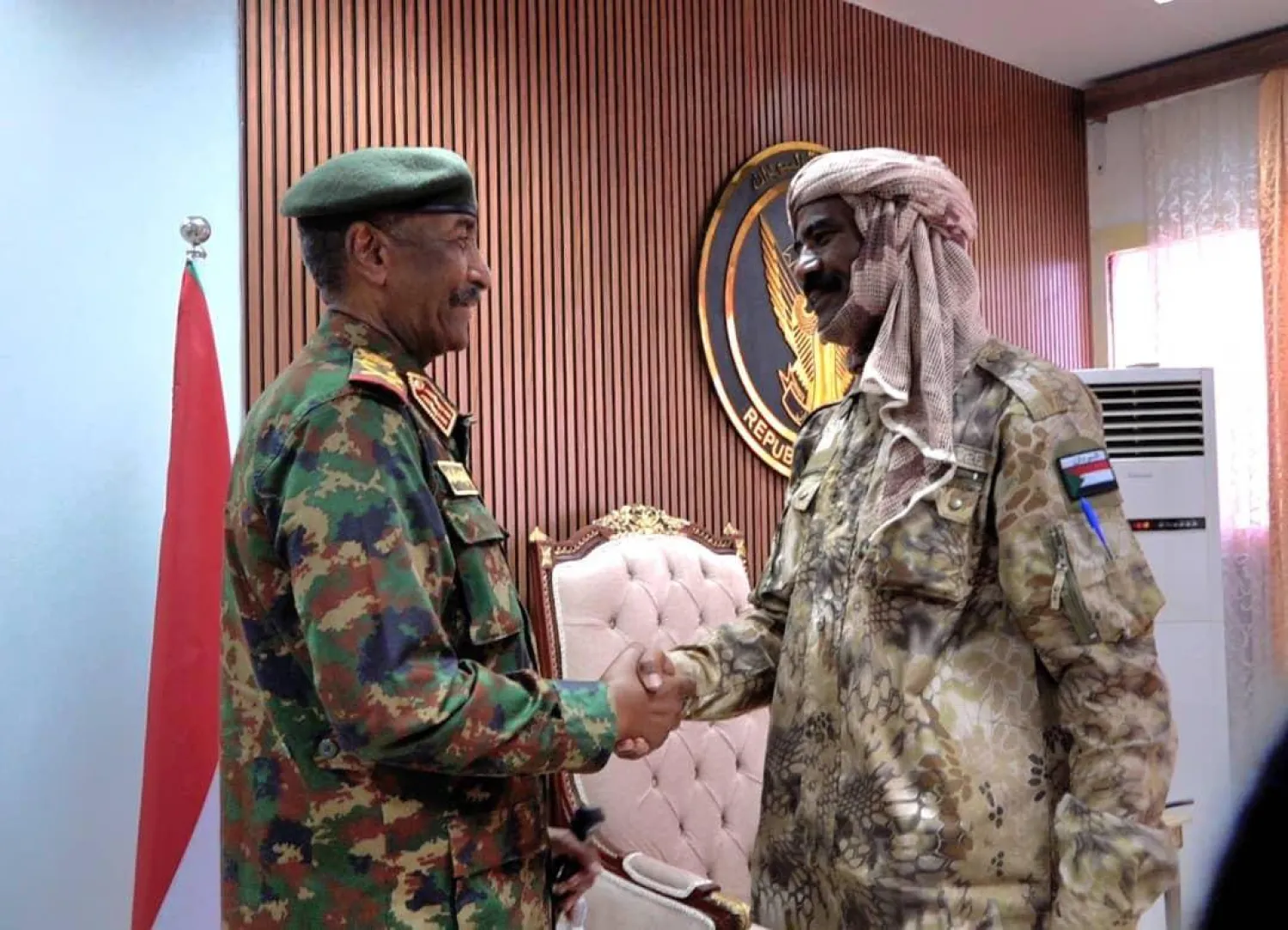
Sudanese Army Commander Abdel Fattah al-Burhan welcoming Major General Al-Nour Al-Qubba, who defected from the Rapid Support Forces (Sovereignty Council)
TT

Defections Hit Sudan’s RSF … Has the Breakup Phase Begun?

Sudanese Army Commander Abdel Fattah al-Burhan welcoming Major General Al-Nour Al-Qubba, who defected from the Rapid Support Forces (Sovereignty Council)

Sudan’s Rapid Support Forces (RSF) are facing a growing wave of defections, raising questions over the future of the paramilitary group’s military cohesion and tribal alliances as the conflict with the Sudanese army enters its fourth year and turns into a prolonged war of attrition.

The latest and most prominent defection came from senior field commander Ali Rizqallah, known as “Al-Safana,” one of the RSF’s leading battlefield commanders in Darfur and Kordofan.

His departure follows a series of similar moves in recent months, including the defection of Major General Al-Nour Ahmed Adam, known as “Al-Nour Al-Qubba,” and field commander Bishara Al-Huwaira, who left RSF ranks in North Kordofan weeks ago. Before them, Abu Aqla Keikel, commander of the Sudan Shield Forces, became one of the first high-profile defectors in late 2024.

Observers say Al-Huwaira’s defection carries particular military significance because of his position in the Bara area near El-Obeid, the Sudanese army’s main stronghold in North Kordofan. The area is a strategic junction linking western Sudan with the east and center of the country and serves as a key corridor for supplies, fuel and fighters.

Local reports said Al-Huwaira joined the Sudanese army with a force of between 11 and 15 fully equipped combat vehicles, in what was seen as another blow to the RSF despite efforts by its leadership to downplay the impact.

After Al-Nour Al-Qubba defected in April, there was speculation that Al-Safana would be the next commander to leave, especially after reports emerged that he had withdrawn from the battlefield and traveled abroad. He later appeared in a video denying those reports before formally announcing his defection weeks later.

Sources said Al-Safana had left the frontlines for Uganda before traveling to India for medical treatment. He later appeared in a video from an undisclosed location believed to be in India, announcing he had left the RSF.

Although Al-Safana said he was not aligning himself with any armed faction, sources close to the Sudanese army expect him to formally join the military. RSF sources, meanwhile, insisted that the move posed no real threat to the force or to the “Sudan Founding Alliance” project run by the RSF in areas under its control.

RSF leaders say the departure of some commanders has not altered the balance of power on the ground, stressing the group still controls territories it captured during the war and that field units linked to those commanders continue to fight under its banner.

But analysts say the defections carry significance beyond their immediate military effect because of the RSF’s structure, which relies heavily on tribal loyalties, local alliances and influential field commanders, particularly in Darfur.

Unlike conventional armies with centralized command structures, the RSF has relied since its inception on tribal alliances and armed groups with overlapping loyalties. While that structure helped it expand rapidly, it also left it vulnerable to internal divisions and shifting allegiances as the war dragged on.

Analysts also attribute the defections to growing tensions within the RSF leadership, where commander Mohamed Hamdan Dagalo, known as Hemedti, and his brother Abdel Rahim Dagalo control military decision-making, reportedly sidelining some field commanders.

While the defections are unlikely to immediately shift the military balance, observers say they could deepen internal instability within the RSF and gradually weaken its military and tribal cohesion.


Aoun Awards Al-Bukhari the National Order of the Cedar: Saudi Arabia Remains a Steadfast Supporter of Lebanon

President Joseph Aoun awards Ambassador Waleed Al-Bukhari the National Order of the Cedar (Lebanese Presidency)
TT

Aoun Awards Al-Bukhari the National Order of the Cedar: Saudi Arabia Remains a Steadfast Supporter of Lebanon

President Joseph Aoun awards Ambassador Waleed Al-Bukhari the National Order of the Cedar (Lebanese Presidency)

Lebanese President Joseph Aoun affirmed that Saudi Arabia remains a steadfast supporter of Lebanon, praising the role of Custodian of the Two Holy Mosques King Salman bin Abdulaziz and Crown Prince Mohammed bin Salman.

Prime Minister Nawaf Salam, meanwhile, commended the considerable efforts made by Saudi Ambassador Waleed Al-Bukhari to strengthen and deepen bilateral ties between the two countries.

Aoun made the remarks on Tuesday during a meeting with the Saudi ambassador at the presidential palace in Baabda where he awarded the diplomat the National Order of the Cedar, rank of Grand Officer, on the occasion of the conclusion of his diplomatic mission in Lebanon and in recognition of his efforts to enhance Lebanese-Saudi relations.

Aoun said that the ties binding Lebanon and Saudi Arabia transcend longstanding historical and brotherly relations, stressing that the Kingdom has, throughout the years, remained a constant pillar of support for Lebanon under all circumstances. He added that Saudi Arabia’s generous initiatives reflect its enduring commitment to the country’s stability and prosperity.

The Lebanese president also praised the leadership of King Salman and Crown Prince Mohammed bin Salman, saying their vision has contributed to promoting development and stability across the region.

Al-Bukhari thanked the president for awarding him the decoration and expressed hope that Lebanon would regain its pioneering regional role, and that its people would enjoy lasting security and stability.

The Ambassador also met Parliament Speaker Nabih Berri during a farewell visit that, according to a statement issued by the Speaker’s office, included discussions on the general situation in Lebanon and bilateral relations between Lebanon and Saudi Arabia.

In a separate farewell meeting, Salam received the diplomat at the Grand Serail, where he praised “the significant efforts exerted by Ambassador Al-Bukhari in consolidating and advancing bilateral relations between Lebanon and the Kingdom of Saudi Arabia, as well as the pivotal role he played during a delicate period in our nation’s history.”


Israel Crosses Litani by Fire, Tests New Border Strip

An Israeli military vehicle moves inside Lebanese territory (Reuters)
TT

Israel Crosses Litani by Fire, Tests New Border Strip

An Israeli military vehicle moves inside Lebanese territory (Reuters)

Israeli escalation in southern Lebanon has entered a new phase after the Israeli army announced operations north of the Litani River, as heavy vehicles crossed toward the outskirts of eastern Zawtar.

The move signaled a shift from limited strikes to an effort to impose new facts on the ground north of the river.

Israeli Army Radio said forces from the Egoz Unit and the Golani Reconnaissance Unit carried out an operation lasting about a week on the outskirts of eastern Zawtar, after heavy military vehicles crossed the Litani.

It said the operation aimed to reach areas from which Hezbollah had fired rockets, mortar shells, and drones at Israeli forces.

Israel’s Channel 12 said the operation lasted 10 days and sought to reach the launch zone used by Hezbollah rockets and drones. Channel 14 reported engineering work above the Litani that could allow armored and infantry forces to cross in the future if needed.

The developments came with an Israeli media push. Prime Minister Benjamin Netanyahu posted a video backing the soldiers involved, saying: “We are proud of our heroic fighters, the best in the world, who continue to intensify operations in Lebanon.”

Israel also widened evacuation warnings in the western Bekaa. At 4 a.m., residents of Sohmor were told to evacuate before heavy strikes began.

Later in the morning, Israeli army spokesperson Avichay Adraee twice issued urgent warnings to residents of Arzoun, Tayr Debba, Bazouriyeh, and Housh, telling them to leave and move 1,000 meters away toward open areas.

Zawtar, a military node north of the Litani

A local source in southern Lebanon told Asharq Al-Awsat that Zawtar is “one of the most sensitive points for Israel, given its geographic location and proximity to the border.” The source said it is “the closest point north of the Litani to the Israeli border compared with other areas, and is also exposed on the ground to drone activity.”

The source said Zawtar is “a strategic node” linking western Zawtar, Yohmor, and Arnoun. “Any control over it would effectively mean the surrounding villages fall militarily,” the source said, adding that Israel regards the area as “a key zone for Hezbollah drone activity” because it is “geographically open and lacks natural obstacles” that limit drone movement.

Israel seeks to recreate the border strip, but major expansion remains costly

Retired Brig. Gen. Bassam Yassin told Asharq Al-Awsat that Israel’s announcement that its forces had crossed the Litani toward Zawtar “cannot be separated from the nature of the military zone where Israeli forces have been operating for weeks.”

He said “the clashes had effectively begun about a week ago in Wadi Raj,” the corridor linking the Litani to Zawtar, while eastern and western Zawtar and Yohmor fall “within what is known as the area under the yellow line, meaning within the scope of Israeli military operations.”

Yassin said Zawtar’s importance for Israel “stems from its strategic location,” because it protects the Israeli presence along the Taybeh, Deir Seryan axis and gives Israel fire control over wide areas north of the Litani.

“If Israel manages to entrench its presence on the heights of Beaufort Castle, Yohmor and Zawtar, it would be able to place the areas of Nabatieh, Kfar Tebnit, Nabatieh al-Fawqa and Nabatieh al-Tahta under direct fire pressure, given the elevated nature of the area,” he said.

He said the scene “closely resembles a reproduction of the border strip that existed before 2000,” when Arnoun, Yohmor, Beaufort Castle (Qal’at al-Shaqif), and Zawtar were under direct Israeli military pressure, and towns such as Kfar Tebnit were almost emptied of residents because they were constantly targeted by fire.

Yassin said Israel “has already announced the expansion of its ground operations,” but military estimates suggest the move may remain limited to areas Israel considers necessary for its security. North of the Litani, he said, is Hezbollah’s second line of defense, and any broad advance there would mean “a harsh and costly confrontation.”

“If Israel is able to consolidate its control in this area, this could later open the door to a wider expansion toward the Zahrani, which would effectively mean turning the area stretching from the Zahrani to the international border into an isolated military strip. But I do not believe the Israeli decision has reached that point yet,” he said.

Yassin tied any major shift to the fate of political negotiations.

“If negotiations fail and Israel receives an international green light, then we can speak of an entirely different phase,” he said.

What about the western Bekaa?

In the western Bekaa, Yassin said Israel is pursuing a policy of “pressure through fire, warnings and gradual displacement.”

He said strikes are focused on areas believed to be used for launching drones or rockets, while other areas are sometimes bombed without warning when direct field targets are available.

“The warnings that targeted Sohmor, Zellaya, and their surroundings fall within an attempt to empty the area of residents, because evacuating villages facilitates any later military movement and increases pressure on Hezbollah’s support base,” he said.

Yassin said current indicators do not suggest Israel intends to launch a wide ground operation in the western Bekaa or north of the Litani unless negotiations collapse completely.

“I believe Israel currently has room to maneuver to reach some of the points it has identified within the yellow zone, but it does not have sufficient capacity to expand its ground occupation on a large scale. That is why it is currently focusing on threats, shelling, and emptying areas of their residents,” he said.

Military escalation and direct targeting of civil defense

On the ground, Israeli military escalation continued in the south, where civil defense personnel in Nabatieh had been targeted. The General Directorate of Civil Defense said two members of its Nabatieh regional center were killed and a third was wounded in an Israeli strike while they were trying to rescue someone wounded in an earlier Israeli strike in Nabatieh.

Israeli strikes also hit several southern towns, including Hinniyeh, Khirbet Selm, eastern Zawtar, and Nabatieh, while Mansouri and Majdal Zoun came under shelling.

Three people from Aadchit were killed in a strike on a car in Doueir while transporting a wounded person. A Syrian man was killed, and his wife was wounded when a motorcycle was targeted in Tayr Debba. A drone caused injuries in Mansouri. An archaeological area near an army position in Ras al-Ain was also hit.

Israeli strikes on Nabatieh, Jibsheet, and Kafra caused deaths.

Hezbollah said Tuesday it had attacked two Merkava tanks in Bayyada and Khirbet al-Manara, a gathering of soldiers near Deir Seryan, and a soldier with a drone opposite Houla.


Iraqi Authorities Make Late Admission of Makeshift Israeli Base in Desert

Iraq’s Popular Mobilization Forces are seen during their operation in the Karbala desert on May 12, 2026. (PMF)
TT

Iraqi Authorities Make Late Admission of Makeshift Israeli Base in Desert

Iraq’s Popular Mobilization Forces are seen during their operation in the Karbala desert on May 12, 2026. (PMF)

Iraqi authorities are still trying to contain the embarrassment caused by reports that an Israeli force was stationed in a desert area between Najaf and Karbala in early March, taking what observers describe as belated security measures while issuing conflicting accounts of the incident.

The Wall Street Journal reported on Saturday that Israel had set up a secret makeshift military base in the Iraqi desert to support its war against Iran, which began on Feb. 28, 2026.

Citing US officials, the newspaper said Israel built the site to support its air campaign against Iran and carried out airstrikes on Iraqi forces that nearly uncovered it early in the war.

On Tuesday, Iraqi army Chief of Staff General Abdul Amir Rashid Yarallah arrived in the Al-Nukhaib district of Karbala with a senior military delegation to review security conditions.

The Defense Ministry said the visit was aimed at following up on security preparations and assessing the latest developments in the area.

The statements by security bodies and officials appeared increasingly contradictory. On Tuesday, Karbala Operations Commander Ali al-Hashemi acknowledged that an Israeli force had been present inside Iraqi territory in early March.

Media outlets quoted Hashemi as saying the force in the Najaf desert in March was Israeli and “did not remain for more than 48 hours.”

Tahseen al-Khafaji, the Defense Ministry’s media director, said the “unknown force” had been carrying American weapons and had been in the area for only a few hours. He denied that it had set up a military base.

‘Imposing sovereignty’

In a related move, the Popular Mobilization Forces announced on Tuesday the launch of an operation to “impose sovereignty” the Najaf and Karbala desert. The operation was ordered by the commander-in-chief of the armed forces and is being supervised by Yarallah, according to a statement.

Ali al-Hamdani, commander of the PMF’s Middle Euphrates operations, said the operation began along four axes in the Najaf and Karbala desert to secure the road linking the city of Karbala to Al-Nukhaib.

He said the forces were conducting search-and-comb operations as deep as 70 kilometers, under strict military plans and with a high level of professionalism.

Denial

Iraq’s Joint Operations Command on Monday denied the presence of any unauthorized bases or forces on Iraqi territory.

“We are closely following statements and reports about the presence of unauthorized bases and forces on Iraqi territory, specifically in the Karbala desert east of Al-Nukhaib and Najaf,” it said.

It said the issue stemmed from an incident on March 5 when Iraqi security forces from Karbala and Najaf moved into the area and clashed with unknown, unauthorized detachments backed at the time by aircraft.

One Iraqi security fighter was killed, two others were wounded, and a vehicle was disabled.

It said its units and commands, under the direction and planning of the Joint Operations Command, were continuing regular searches of all sectors, especially desert areas, up to Iraq’s international borders. It stressed that no unauthorized bases or forces had been present since the March incident.

Criticism

The revelation that an Israeli force had been present on Iraqi territory triggered criticism of the government and security leadership.

The Joint Operations Command said some parties were trying to exploit the incident politically and were making “one-upmanship” statements without knowing the facts.

It said such statements harmed Iraq’s reputation and that of its security leadership, which “confirms, indeed asserts,” that there are currently no unauthorized forces or bases on Iraqi territory.

Former Prime Minister Mustafa al-Kadhimi sharply criticized authorities on Monday over the breach.

“A state in whose name slogans of sovereignty and security preservation are raised must not be surprised by incidents of this scale on its territory, nor should it be run according to the logic of media images and propaganda victories. Reality reveals a dangerous fragility in control, decision-making, and oversight,” Kadhimi said in a post on X.

He said Iraq’s protection cannot be secured through speeches or political promotion campaigns, but by building a state that owns its decision, imposes its authority over all its territory, subjects weapons to the law, and prevents the country from becoming an open arena for settling regional and international conflicts.