


100 Days After His Assassination, Public Pressure Mounts to Reveal Killers of Saif al-Islam Gaddafi

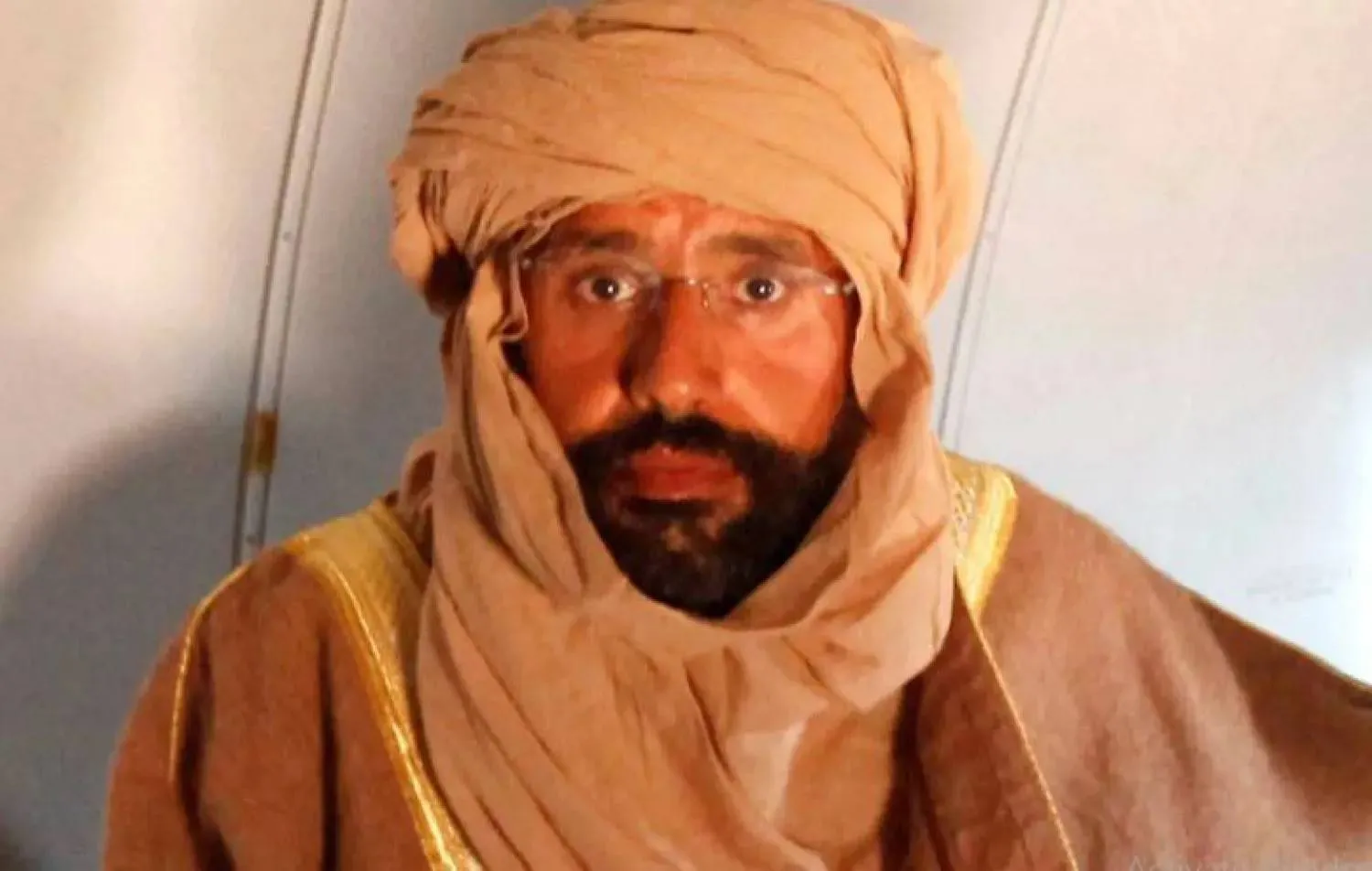
Saif al-Islam Gaddafi seated inside an aircraft in Zintan on Nov. 19, 2011. (Reuters) 
TT

100 Days After His Assassination, Public Pressure Mounts to Reveal Killers of Saif al-Islam Gaddafi

Saif al-Islam Gaddafi seated inside an aircraft in Zintan on Nov. 19, 2011. (Reuters) 

Legal moves and public pressure inside Libya, particularly from supporters of the former regime, have intensified in recent weeks, demanding that authorities disclose the circumstances surrounding the killing of Saif al-Islam Gaddafi.

Saif al-Islam, son of Libya’s late leader Moammar Gaddafi, was killed in the western city of Zintan on Feb. 3, 100 days ago.

Since Libyan Attorney General al-Siddiq al-Sour announced on March 5 that three suspects had been identified in connection with the crime - without revealing their names - public calls have grown for the full investigation findings to be released, for those behind the incident to be identified, and for all those involved to be brought to trial in order to ensure transparency and justice.

A Libyan source familiar with the matter in the capital, Tripoli, confirmed that new legal efforts are underway in the case.

Asharq Al-Awsat learned that Khaled al-Zaidi, head of the defense team in the Saif al-Islam assassination case, visited the office of the head of the Supreme Judicial Council, counselor Abdullah Abu Rzeiza, in Tripoli on Sunday morning. No details were disclosed about the visit or the issues discussed.

The same source, who requested anonymity, said that “these legal moves could lead to positive results and developments that may help uncover the truth and push the case toward greater clarity in the coming period,” without elaborating further.

Additionally, an initiative known as the “National Truth Committee on the Saif al-Islam Gaddafi Case” launched an online public petition calling on the attorney general to disclose details of the crime and announce the investigation results publicly, stressing the need to uphold the law and ensure the principles of justice.

The petition also called for legal measures against the three individuals referred to in the attorney general’s office statement, as well as an expansion of the investigation to include anyone who planned, participated in, financed or assisted in carrying out the crime.

At the same time, public pressure has increased across Libya. The Conference of Social and Political Activities and Civil Society Institutions in Fezzan called on the attorney general to clarify the reasons behind the delay in arresting the suspects, saying the continued ambiguity has raised widespread questions among the public.

Political activist Dr. Khaled al-Hijazi, who is close to the former regime, said the public pressure was “logical,” given that “the assassination of Saif al-Islam is a public opinion issue that cannot be ignored or covered up.”

He told Asharq Al-Awsat that “the importance of the case is compounded by its connection to a public political figure who previously ran in a presidential race and enjoys significant popular support inside the country.”

A source in the public prosecution office had previously told Asharq Al-Awsat that investigations into the case were still ongoing, in response to unofficial accounts circulating in Libya regarding the identities and regional affiliations of the perpetrators.


Syria, Iraq Agree to Expand Cooperation in Energy, Security and Economy

Syrian President Ahmed al-Sharaa receives Iraqi FM Fuad Hussein in Damascus on Monday. (SANA)
TT

Syria, Iraq Agree to Expand Cooperation in Energy, Security and Economy

Syrian President Ahmed al-Sharaa receives Iraqi FM Fuad Hussein in Damascus on Monday. (SANA)

Iraqi Foreign Minister Fuad Hussein visited Damascus on Monday on his first trip since there since the ouster of Bashar al-Assad's regime in December 2024.

He held talks with President Ahmed al-Sharaa and his Syrian counterpart Asaad al-Shaibani.

The meeting with Sharaa focused on bilateral relations and ways to expand cooperation across various sectors, reported Syria’s state news agency SANA.

The two sides also discussed regional and international developments and stressed the importance of strengthening coordination and consultation between Syria and Iraq in addressing shared challenges.

Talks with Shaibani focused on practical mechanisms to strengthen bilateral relations and advance mutual cooperation across various sectors.

The FMs agreed to establish a high committee for joint coordination, co-chaired by both ministers, to ensure the consistent follow-up and execution of outcomes stemming from bilateral cooperation while streamlining joint initiatives.

The discussions also focused on energy infrastructure, specifically looking into mechanisms for oil transit and grid integration, alongside a project to rehabilitate oil pipelines extending from Iraq to Syria.

They also addressed frameworks for strategic cooperation in the sectors of water management and agriculture, which aims to boost mutual food security, stimulate economic integration, and serve shared bilateral interests.

They explored avenues to upgrade security coordination and intelligence sharing, bolstering regional stability and supporting collaborative efforts to confront mutual security challenges.


UN Chief Slams ‘Relentless’ Israeli Settlement Expansion

United Nations Secretary-General Antonio Guterres delivers a statement during a media conference at the EU summit in Brussels, March 19, 2026. (AP)
TT

UN Chief Slams ‘Relentless’ Israeli Settlement Expansion

United Nations Secretary-General Antonio Guterres delivers a statement during a media conference at the EU summit in Brussels, March 19, 2026. (AP)

UN chief Antonio Guterres has condemned the "relentless" expansion of Israeli settlements in the West Bank, saying in a report seen Monday by AFP they are contributing to the territory's worst displacement crisis since 1967.

The secretary-general, in a quarterly report on the West Bank, said an increase in settler outposts was leading to an upsurge in violence and restricting Palestinians' access to their land.

"These developments fuel tensions, further entrench the unlawful Israeli occupation, undermine the right of the Palestinian people to self-determination, and threaten the viability of a fully independent, contiguous, and sovereign Palestinian State," Guterres said.

He specifically warned against Israeli plans to develop in the so-called E1 area of the West Bank, saying new settlements "would effectively sever the connection between the northern and southern West Bank."

"As such, it would have severe consequences for the territorial contiguity of the Occupied Palestinian Territory and present an existential threat to the two-state solution," Guterres said.

The report also denounced impunity towards violence by Israeli settlers, pointing out it often occurs in the presence of -- or with the support of -- Israeli security forces.

"Settler violence, access restrictions, demolitions and prolonged security operations have intensified in recent years, resulting in the largest displacement crisis in the West Bank since 1967," Guterres said.

In a joint statement ahead of a UN Security Council meeting on the West Bank, five European members of the council -- France, Britain, Greece, Latvia and Denmark -- condemned settlement activity.

"We call on the Israeli Government to end its expansion of settlements and administrative powers, ensure accountability for settler violence and investigate allegations against Israeli forces," France's UN envoy Jerome Bonnafont said.


Iraq Sets September 30 Deadline for Pro-Iran Groups to Disarm

 Vehicles drive along the Al-Jumhuri street in central Baghdad on June 28, 2026. (AFP)
Vehicles drive along the Al-Jumhuri street in central Baghdad on June 28, 2026. (AFP)
TT

Iraq Sets September 30 Deadline for Pro-Iran Groups to Disarm

 Vehicles drive along the Al-Jumhuri street in central Baghdad on June 28, 2026. (AFP)
Vehicles drive along the Al-Jumhuri street in central Baghdad on June 28, 2026. (AFP)

Iraq's government has given pro-Iran armed groups in the country until September 30 to disarm, coinciding with the end of the US-led anti-ISIS coalition's mission, its spokesman said on Monday.

The announcement comes ahead of a visit to the United States by new Prime Minister Ali al-Zaidi, with Washington exerting pressure on Baghdad to ensure the factions turn in their weapons.

"All the armed groups have been informed of a specific date that marks the end of this issue (of disarmament) ... which is September 30, which also marks the end of the international coalition's presence," government spokesman Haidar al-Aboudi said in a weekly press conference.

"After this date, all weapons outside the state framework will be subject to legal redress," he added.

Iraq is home to dozens of Iran-backed armed factions, many of which form part of the Popular Mobilization Forces (PMF).

Many emerged in the wake of the 2003 US-led invasion of Iraq and gained further power and prominence during the fight against the ISIS group from 2014 onwards.

Under heavy US pressure in recent months, Iraqi authorities said they would seek the full integration of those member factions in the PMF into government forces in a bid to limit the possession of weapons to the hands of the state.

The government aims to include within the integration drive brigades that currently operate outside the framework of the PMF.

The move came after some of the factions with forces in the PMF launched attacks on US interests in Iraq following the start of the Middle East war in late February.

Washington in turn launched its own attacks on the factions, before withholding cash payments for Iraqi oil revenues that are paid as part of a deal following the 2003 US-led invasion.

Iraqi authorities have repeatedly attempted to fully integrate the PMF into the state forces, but some of the groups have cited the continued presence of US forces in Iraq as a reason to delay the disarmament process.

Earlier in June, Iraqi authorities announced that they had received data on weapons belonging to the pro-Iran faction Kataeb Imam Ali, a first step in the plan to integrate such groups into the state forces.

Shortly before, two pro-Iran factions, the Kataeb Imam Ali and Asaib Ahl al-Haq, announced they would be handing over administration of their brigades in the PMF to the state.

The PMF was formed in 2014, bringing together armed factions to fight the ISIS group after it seized swathes of the country.
