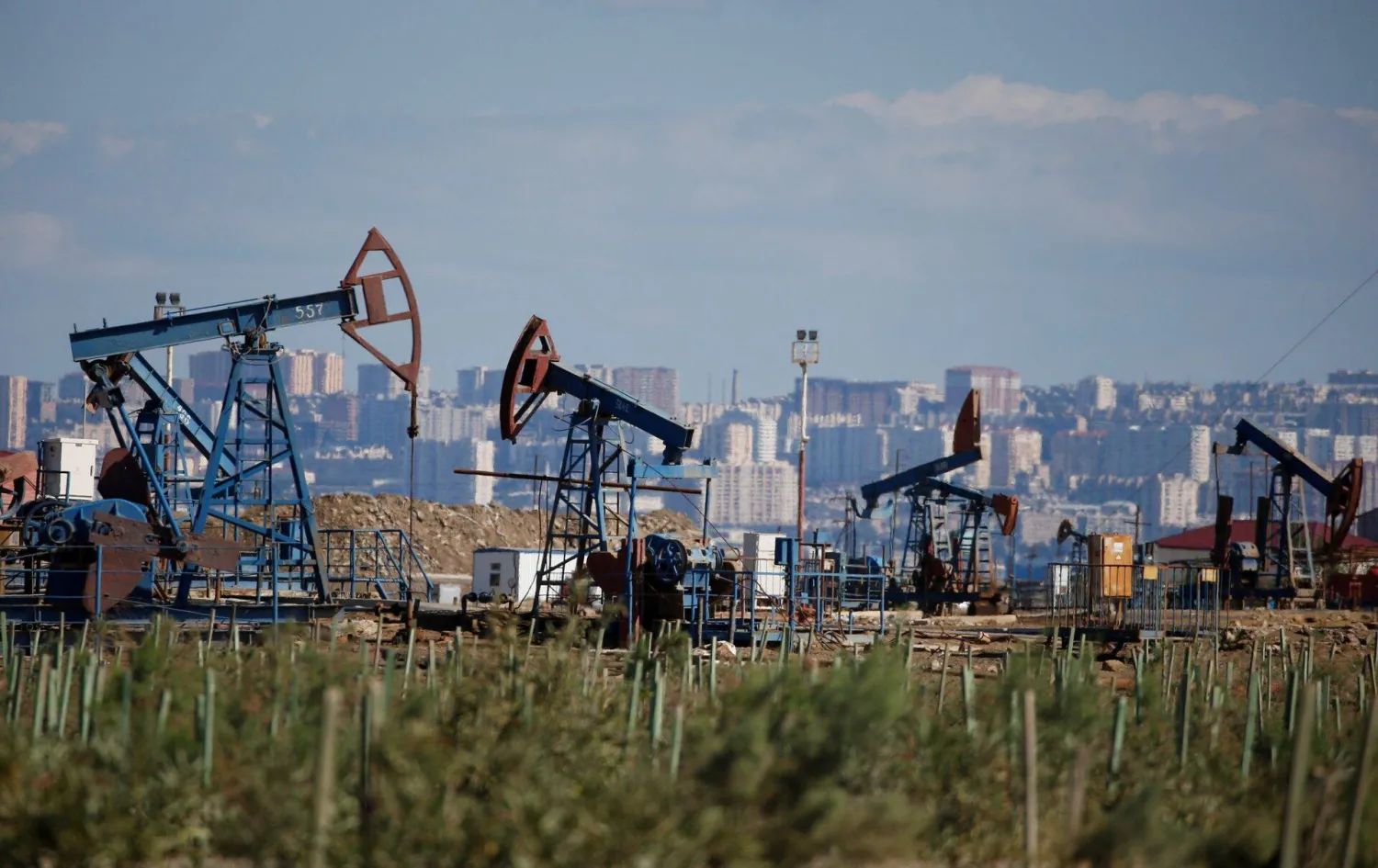
Oil Prices Spike after Trump Rejects Iran Truce Offer

Oil rigs operate in a field on the shores of the Caspian Sea in Azerbaijan's capital, Baku (Reuters)
TT

Oil Prices Spike after Trump Rejects Iran Truce Offer

Oil rigs operate in a field on the shores of the Caspian Sea in Azerbaijan's capital, Baku (Reuters)

Oil prices spiked with bond yields Monday as Donald Trump's rejection of an Iranian offer of a seven-day truce stoked inflation concerns, while stocks were mixed as traders look ahead to the release of key US data.

Tehran last week set out a plan at the UN General Assembly for a halt in hostilities that would see the Strait of Hormuz reopened, which would ease a crippling supply crisis that has jacked up costs around the world, said AFP.

The waterway is key to the world's energy supply and is now central to the conflict between the US and Iran, particularly with Houthis seizing Yemen's entire Red Sea coast, including the Bab al-Mandab Strait, a vital shipping lane.

However, the US president told reporters outside the White House "I reject their proposal".

Still, he told Axios that he expects negotiations to resume.

"They want to make a deal, but it is not the deal that I want to make," he told the news platform. "It is what we would have maybe agreed to a year ago."

"They overplayed their hand," Trump added, in the interview published Sunday.

Citing sources familiar with the matter, Axios reported that indirect talks between Washington and Tehran could take place as early as Monday.

Iran was still standing by its conditions for reopening the Strait, including the release of frozen assets, the lifting of sanctions on its oil and an end to the US naval blockade.

Oil prices, which fell more than two percent Friday on news of the offer, bounced back at the start of the new week, with Brent back above $106 a barrel.

That stoked inflation concerns again, and weighed on stock markets.

Seoul shed more than two percent as it reopened after a long break, while Tokyo, Shanghai, Manila, Bangkok and Jakarta also dropped.

There were gains in Hong Kong, Sydney, Singapore and Wellington.

Bond yields climbed, with the average on a gauge of world bonds topping four percent last week for the first time since 2007, according to Bloomberg.

The rise in prices puts the focus back on the Federal Reserve ahead of its next policy meeting at the end of October, with CME's FedWatch tool putting the chances of a second successive interest rate hike at more than 65 percent.

Before that decision is made, investors will see the release of the bank's preferred gauge of inflation this week as well as a key jobs report that could play a vital role in policymakers' thinking.

"Middle East tensions have flared again after President Donald Trump rejected Iran's latest proposal to reopen the Strait of Hormuz," wrote Stephen Innes at Quintex Intel.

"Oil has pushed higher, Asian equities are softer, and suddenly the brief Friday reprieve in global fixed income looks more like an intermission than the end of the show."

Still, he added: "The market is still pricing some probability that everyone eventually finds their way back to the table, even if they continue to spend the next few weeks shouting across it first."


Anthropic Commits 5% of Its Stock to a New 'Public Benefit' Fund

FILE PHOTO: An Anthropic logo is displayed at Moscone Center during the Dreamforce 2026 technology summit in San Francisco, California, US, September 17, 2026. REUTERS/Carlos Barria/File Photo
TT

Anthropic Commits 5% of Its Stock to a New 'Public Benefit' Fund

FILE PHOTO: An Anthropic logo is displayed at Moscone Center during the Dreamforce 2026 technology summit in San Francisco, California, US, September 17, 2026. REUTERS/Carlos Barria/File Photo

Anthropic said Sunday it is committing 5% of its shares to a new “public benefit” fund, with the fund's worth potentially increasing as its shares grow in value.

The shares will go to the Anthropic Public Benefit Fund, a new entity within the company, The Associated Press said.

The fund “will have increased flexibility and scale, enabling us to pursue our mission in new ways: for example, we might explore large donations to traditional nonprofits or direct distributions to specific populations,” Anthropic said in a blog post. It gave labor market impacts as an example, saying that while it has already committed $200 million to study the effects of artificial intelligence, “given the pace of AI progress, bolder approaches may be needed.”

CEO Dario Amodei and the company’s five other cofounders established Anthropic as a public benefit corporation, a designation that for-profit companies select to balance financial goals and social impact.

They have also pledged that they will donate 80% of their wealth. An equity donation match program, in which about half of the company's employees participate, lets workers pledge equity that Anthropic matches.

When combined with Sunday’s announcement, Anthropic said roughly 20% of its shares will be dedicated to the “public good,” plus any additional percentage that could be added if the company’s valuation reaches specific milestones.

Anthropic is planning a massive initial public offering as soon as November.


Syria, World Bank Agree to Set Up Fund for Recovery and Reconstruction

FILE PHOTO: A view of the Syrian central bank, after the ouster of Syria's Bashar al-Assad, in Damascus, Syria, January 12, 2025. REUTERS/Firas Makdesi/File Photo
TT

Syria, World Bank Agree to Set Up Fund for Recovery and Reconstruction

FILE PHOTO: A view of the Syrian central bank, after the ouster of Syria's Bashar al-Assad, in Damascus, Syria, January 12, 2025. REUTERS/Firas Makdesi/File Photo

Syria and the World Bank have agreed to set up a multi-donor ‌trust ‌fund focused ‌on ⁠recovery and reconstruction, they ⁠said in a joint statement on ⁠Sunday, as Damascus ‌aims to ‌rebuild after ‌a ‌more than decade-long civil war.

The fund aims ‌to provide concessional financing, ⁠investment guarantees, technical ⁠support, and capacity building, said Reuters.


China’s Economic Growth Picks up as Exports Boom, Consumers Balk

Construction workers walk in front of a residential compound in Beijing, China, 19 October 2026. (EPA)
TT

China’s Economic Growth Picks up as Exports Boom, Consumers Balk

Construction workers walk in front of a residential compound in Beijing, China, 19 October 2026. (EPA)

China's economic growth bounced off three-year lows in the third quarter, as roaring exports offset consumers' tight grip on their wallets, though analysts warn the growing reliance on external drivers is deepening structural imbalances.

The 4.5% pace beat consensus forecasts and analysts expect Beijing to reach its 2026 target of 4.5%-5.0% without resorting to additional stimulus, helped by a strong start to the year and some recent modest fiscal and monetary support.

Monday's data showed retail sales again lagging industrial output, while the property market was still in a downturn, having significantly eroded household wealth for the past five years.

Together with last week's releases showing soft consumer inflation and exports soaring by more than a third, a picture emerges of an economy increasingly dominant in global markets but struggling to generate prosperity at home.

Weak domestic demand has pushed Zhang Chao's motorbike headlights company to all but abandon selling in China to focus on export markets, where orders have doubled this year.

"It's too competitive and there's no profit," Zhang, who manages Southeast Asia operations for his firm, ‌said of China. "The ‌barrier to entry is a bit lower overseas."

Weak consumer demand has intensified price wars, forcing companies to ‌slash ⁠costs, including on ⁠payroll.

Having lost her sales job in June, Laura Shi still road-tripped through China's week-long national holidays in October, but slept in her car on most nights to save on hotels.

"The downside was that I couldn't shower, and there was noise outside," she said.

China's increasingly lopsided growth is prompting the rest of the world to react.

The European Union and China have agreed to limit hybrid car exports to the bloc, but Brussels is planning further curbs as data last week showed September's trade surpluses with Germany and France each jumping more than 200% year-on-year.

"This year’s growth figures highlight a deeper rebalancing challenge for the medium term," ANZ analysts said in a note on Monday's data.

"Rising trade tensions, protectionist measures and geopolitical frictions pose significant risks to future growth," they said, adding "the economy is exposed ⁠to changes in the external environment to a greater extent than policymakers would prefer."

The yuan firmed to its ‌strongest level since July 2022 on Monday.

EXPORT TSUNAMI

China is on track to top last year's $1.2 ‌trillion trade surplus despite rising global tensions.

Exports ranging from chicken meat and beauty products to electric cars and prefabricated homes have surged.

Some manufacturers that moved production abroad ‌are coming back, as US tariffs on Chinese goods are now closer to those on rivals such as Vietnam.

"High-tech manufacturing, chip output, new energy ‌vehicles, and export delivery values reflect a competitive industrial upgrading that is real and accelerating," said ITC Markets analyst Andy Ji.

"However, the growth composition remains deeply unbalanced... Growth is export- and state-led. Domestic demand is not yet self-sustaining, and the property sector shows no floor."

Industrial output rose 5.5% in September.

Statistics bureau official Mao Shengyong said the 4.6% growth in the first nine months of the year was "hard won," acknowledging "unbalanced and inadequate development." High-end manufacturing, "the digital economy" and "modern services" contributed more than 40% of the growth over ‌the period.

Even so, Beijing has rolled out fresh support measures, underscoring concerns over lingering weakness beyond the factory sector.

Measures since late September include cheaper credit for infrastructure and tech, modest mortgage subsidies, and more funds for ⁠local governments, whose tight finances contributed ⁠to a 7.2% fall in fixed-asset investment in January-September.

Economists say the measures are enough to dispel fears of missing the growth target, but remain tilted to the supply side.

"China's export expansion is not without limits," Societe Generale economist Michelle Lam said.

"Without a decisive policy shift toward supporting household incomes and consumption, China is likely to remain trapped in a prolonged period of low inflation and sub-par growth."

On the demand side of the ledger, October's holiday saw average spending per trip fall to four-year lows, while social media flare-ups over gruelling work schedules, low pay and weak labor protections are becoming more frequent.

Retail sales were up 1.1% in September, marking the quickest growth in six months, though off a low base.

In the eastern city of Ningbo, a restaurant owner surnamed Dai said many diners now bring their own drinks rather than ordering from the menu.

"Everyone is cutting jobs these days," Dai said. "Sometimes I wonder whether I should let one or two staff members go and do more work myself."

Unemployment inched lower to 5.2% in September, but economists say the figures are flattered by a growing gig economy. Anyone working even one hour a week is considered employed.

In Hangzhou, 26-year-old accountant Carol Huang is angry that her employer almost halved her bonus. But she says similar jobs in the city offer 3,000-6,000 yuan ($449-$897) per month, much less than she earns, so she is staying put.

"What on earth happened to the job market?" Huang said.