


Somalia is in a Deadly Drought again. Most Humanitarian Aid Isn't there this Time

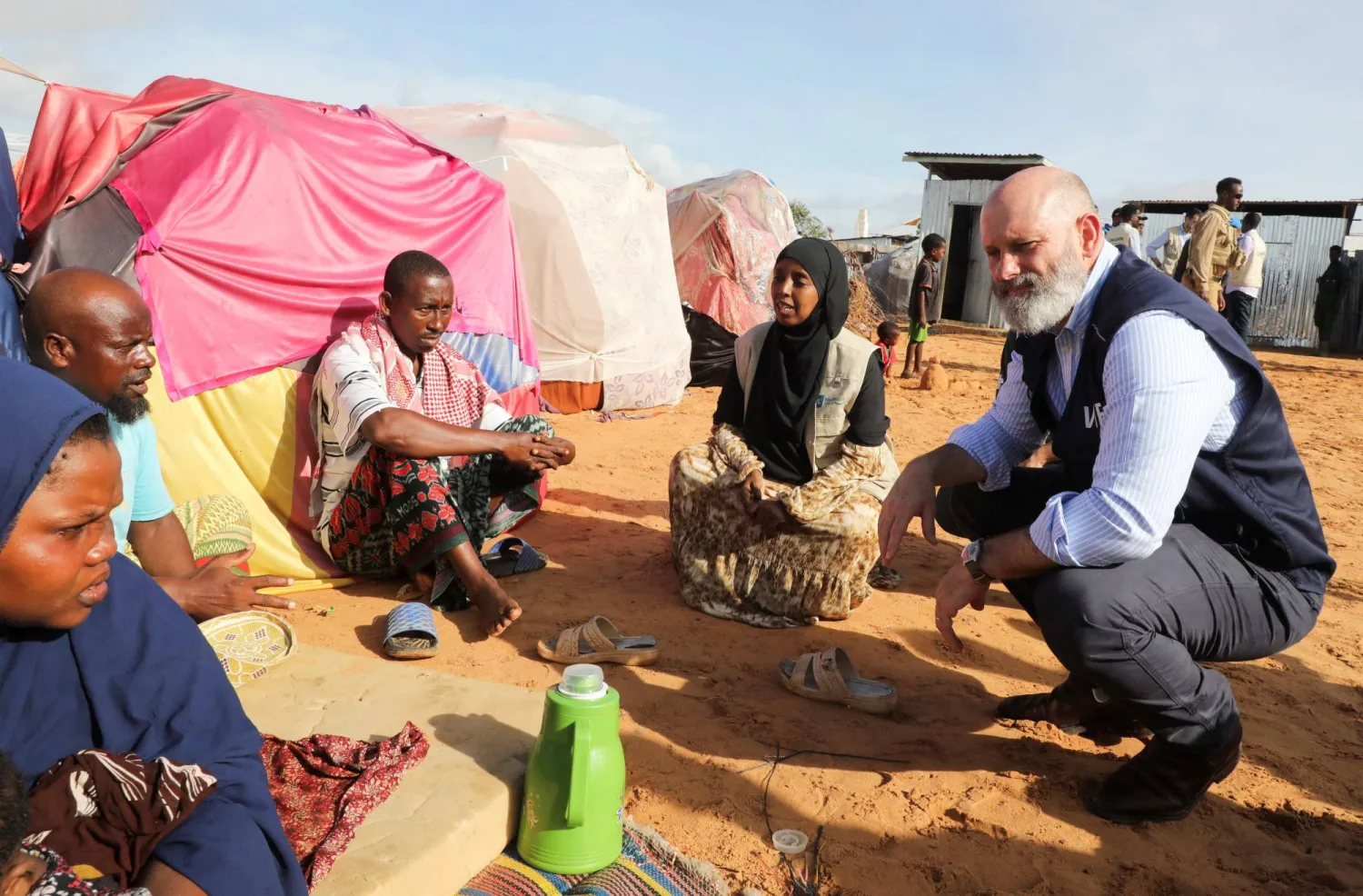
The World Food Program’s Assistant Executive Director for Program Operations, Matthew Hollingworth, talks to civilians during his visit to a camp for the internally displaced people to assess the knock on effects from the escalation in the Middle East, alongside drought and sharp cuts in humanitarian funding that are worsening hunger, in Kahda district of Mogadishu, Somalia May 7, 2026. REUTERS/Feisal Omar
TT

Somalia is in a Deadly Drought again. Most Humanitarian Aid Isn't there this Time

The World Food Program’s Assistant Executive Director for Program Operations, Matthew Hollingworth, talks to civilians during his visit to a camp for the internally displaced people to assess the knock on effects from the escalation in the Middle East, alongside drought and sharp cuts in humanitarian funding that are worsening hunger, in Kahda district of Mogadishu, Somalia May 7, 2026. REUTERS/Feisal Omar

Most of Abdi Ahmed Farah’s hundreds of goats have died. It has not rained steadily in this part of Somalia for three years, something the 70-year-old never thought possible.

He is in debt from buying water. The reservoir outside his tent is nearly empty. His family is down to one meal a day: rice with sugar and oil. The youngest of his 22 children was born three weeks ago and his wife produces only occasional drops of breast milk.

“I have considered abandoning my family because I cannot provide for them,” said Farah, sitting in front of dwindling food supplies, as if on guard.

Yet another drought is affecting millions of people across Somalia, one of the world's most vulnerable countries to climate shocks. Some rivers are dry. Crops have withered. Experts say the drought could be among the worst in Somali history, The Associated Press said.

The crisis is compounded by aid cuts, most dramatically by the Trump administration, and rising prices from the Iran war. Somalia buys most of its fuel from the Middle East, and 70% of its food is imported.

Production of staple crops of maize and sorghum in the October-December rainy season was the lowest on record in Somalia, according to the UN Food and Agriculture Organization.

Food security experts warn that nearly a half-million children might face severe acute malnutrition, the harshest kind. That would be higher than the number of children requiring treatment for it during droughts in 2011 and 2022, according to UNICEF.

‘It’s a repeated climate shock' "2026 is the worst year on record for Somalia in terms of drought,” said Hameed Nuru, the UN World Food Program director for Somalia. “Children have started dying.”

The Somali government and United Nations estimate that 6.5 million people face crisis levels of hunger, representing a third of the country’s population and a 25% increase since January.

Aid agencies are trying to maximize resources, and the Somali diaspora is sending money to help, but humanitarian workers warn it is not enough.

“This drought is not just another cycle of dry season. It’s a repeated climate shock with shrinking humanitarian support,” said Mohamed Assair, a manager with Save the Children in Puntland, a semi-autonomous region.

People drank dirty rainwater and got sick

Farah once had 680 goats, but a lack of food and water as well as diseases exacerbated by drought have claimed all but 110 of them, barely clinging to life.

“There is no market for my goats because they are so thin. Previously we would trade them for rice, but now we can’t,” he said. Farah’s family has been at a site outside Usgure village for 10 days. Almost a dozen goat carcasses lie nearby.

In Usgure, home to 700 families, community leader Abshir Hirsi Ali said the local economy has collapsed because they rely on pastoralists like Farah. Shops have closed and food rations have run low.

A recent, brief shower brought puddles of dirty rainwater. “Some families were so desperate they drank it ... now there is a high number of people with fever,” Ali said.

Save the Children occasionally brings free water to Usgure, but private water trucks have quadrupled their prices and the cost of a 50-kilogram (110-pound) bag of flour has increased by a third, to $40.

“I’m not only afraid for my family but the future of the whole village,” said Muhubo Tahir Omar, a 47-year-old mother of 11 children.

Omar, like other parents, had sold her goats to pay for school fees, “but when we didn’t pay, the teachers left.” Her last goat is now sick.

‘Conflict made our situation even worse’ Decades of conflict in Somalia have displaced millions of people. The drought has displaced another 200,000 this year, the UN estimates.

Some families flee across harsh landscapes with limited supplies.

“People are on the move ... and when people move, people die,” said Kevin Mackey, the Somalia director for humanitarian group World Vision. He recently met people who had walked for nine days to get aid in Dollow in the south.

Around 80 families live in a displacement camp outside Shahda village in Puntland.

Shukri, a 20-year-old mother of four, usually can eke out one meal a day from handouts. Now there is nothing to eat and limited access to clean water.

“The children got diarrhea (from dirty water) and malnourishment worsened,” said Shukri, who gave only her first name. “I know a few people who have died.”

Many people head to Mogadishu, the capital, where food also remains scarce.

Fadumo, a 45-year-old mother of seven, moved there from Lower Shabelle, where livelihoods were already threatened by al-Qaeda-linked al-Shabab militants.

“The water sources we depended on for farming, including the river, dried up,” Fadumo said. “Conflict made our situation even worse, forcing us to flee."

‘The outlook is deeply concerning’ Drought ravaged Somalia in 2022 and an estimated 36,000 people died, according to the UN. Now the kind of aid that was rushed to respond to such crises is shrinking.

“Unless there is a sudden and substantial response from donors, the outlook is deeply concerning. A drought of similar severity in 2022 received a response five times greater than what we are seeing,” said Antoine Grand, head of the International Committee of the Red Cross in Somalia.

Aid funding to Somalia dropped to $531 million in 2025 in large part because of aid cuts by the United States, which had been Somalia's top donor. In 2022, aid funding was nearly five times as much at $2.38 billion.

WFP said it intended to help 2 million people with food aid this year but has reached only 300,000 because of funding gaps.

A center at the hospital in Qardho, Puntland, treats children with severe acute malnutrition. But therapeutic milk is now rarely in stock, and nurses resort to homemade alternatives such as cow's milk, said director Shamis Abdirahman.

The center receives around 15 children a month, but they expect more as displaced people arrive.

One 4-year-old, Farhia, weighs a scant 7.5 kilograms (16.5 pounds). Her eyes are sunken and her bones are prominent under her skin.

Her family fled to Qardho when all of their goats died, said her mother, Najma.

“I don’t know what to hope for, or see how we can get back to what we had,” she said.


Syria, Iraq Agree to Expand Cooperation in Energy, Security and Economy

Syrian President Ahmed al-Sharaa receives Iraqi FM Fuad Hussein in Damascus on Monday. (SANA)
TT

Syria, Iraq Agree to Expand Cooperation in Energy, Security and Economy

Syrian President Ahmed al-Sharaa receives Iraqi FM Fuad Hussein in Damascus on Monday. (SANA)

Iraqi Foreign Minister Fuad Hussein visited Damascus on Monday on his first trip since there since the ouster of Bashar al-Assad's regime in December 2024.

He held talks with President Ahmed al-Sharaa and his Syrian counterpart Asaad al-Shaibani.

The meeting with Sharaa focused on bilateral relations and ways to expand cooperation across various sectors, reported Syria’s state news agency SANA.

The two sides also discussed regional and international developments and stressed the importance of strengthening coordination and consultation between Syria and Iraq in addressing shared challenges.

Talks with Shaibani focused on practical mechanisms to strengthen bilateral relations and advance mutual cooperation across various sectors.

The FMs agreed to establish a high committee for joint coordination, co-chaired by both ministers, to ensure the consistent follow-up and execution of outcomes stemming from bilateral cooperation while streamlining joint initiatives.

The discussions also focused on energy infrastructure, specifically looking into mechanisms for oil transit and grid integration, alongside a project to rehabilitate oil pipelines extending from Iraq to Syria.

They also addressed frameworks for strategic cooperation in the sectors of water management and agriculture, which aims to boost mutual food security, stimulate economic integration, and serve shared bilateral interests.

They explored avenues to upgrade security coordination and intelligence sharing, bolstering regional stability and supporting collaborative efforts to confront mutual security challenges.


UN Chief Slams ‘Relentless’ Israeli Settlement Expansion

United Nations Secretary-General Antonio Guterres delivers a statement during a media conference at the EU summit in Brussels, March 19, 2026. (AP)
TT

UN Chief Slams ‘Relentless’ Israeli Settlement Expansion

United Nations Secretary-General Antonio Guterres delivers a statement during a media conference at the EU summit in Brussels, March 19, 2026. (AP)

UN chief Antonio Guterres has condemned the "relentless" expansion of Israeli settlements in the West Bank, saying in a report seen Monday by AFP they are contributing to the territory's worst displacement crisis since 1967.

The secretary-general, in a quarterly report on the West Bank, said an increase in settler outposts was leading to an upsurge in violence and restricting Palestinians' access to their land.

"These developments fuel tensions, further entrench the unlawful Israeli occupation, undermine the right of the Palestinian people to self-determination, and threaten the viability of a fully independent, contiguous, and sovereign Palestinian State," Guterres said.

He specifically warned against Israeli plans to develop in the so-called E1 area of the West Bank, saying new settlements "would effectively sever the connection between the northern and southern West Bank."

"As such, it would have severe consequences for the territorial contiguity of the Occupied Palestinian Territory and present an existential threat to the two-state solution," Guterres said.

The report also denounced impunity towards violence by Israeli settlers, pointing out it often occurs in the presence of -- or with the support of -- Israeli security forces.

"Settler violence, access restrictions, demolitions and prolonged security operations have intensified in recent years, resulting in the largest displacement crisis in the West Bank since 1967," Guterres said.

In a joint statement ahead of a UN Security Council meeting on the West Bank, five European members of the council -- France, Britain, Greece, Latvia and Denmark -- condemned settlement activity.

"We call on the Israeli Government to end its expansion of settlements and administrative powers, ensure accountability for settler violence and investigate allegations against Israeli forces," France's UN envoy Jerome Bonnafont said.


Iraq Sets September 30 Deadline for Pro-Iran Groups to Disarm

 Vehicles drive along the Al-Jumhuri street in central Baghdad on June 28, 2026. (AFP)
Vehicles drive along the Al-Jumhuri street in central Baghdad on June 28, 2026. (AFP)
TT

Iraq Sets September 30 Deadline for Pro-Iran Groups to Disarm

 Vehicles drive along the Al-Jumhuri street in central Baghdad on June 28, 2026. (AFP)
Vehicles drive along the Al-Jumhuri street in central Baghdad on June 28, 2026. (AFP)

Iraq's government has given pro-Iran armed groups in the country until September 30 to disarm, coinciding with the end of the US-led anti-ISIS coalition's mission, its spokesman said on Monday.

The announcement comes ahead of a visit to the United States by new Prime Minister Ali al-Zaidi, with Washington exerting pressure on Baghdad to ensure the factions turn in their weapons.

"All the armed groups have been informed of a specific date that marks the end of this issue (of disarmament) ... which is September 30, which also marks the end of the international coalition's presence," government spokesman Haidar al-Aboudi said in a weekly press conference.

"After this date, all weapons outside the state framework will be subject to legal redress," he added.

Iraq is home to dozens of Iran-backed armed factions, many of which form part of the Popular Mobilization Forces (PMF).

Many emerged in the wake of the 2003 US-led invasion of Iraq and gained further power and prominence during the fight against the ISIS group from 2014 onwards.

Under heavy US pressure in recent months, Iraqi authorities said they would seek the full integration of those member factions in the PMF into government forces in a bid to limit the possession of weapons to the hands of the state.

The government aims to include within the integration drive brigades that currently operate outside the framework of the PMF.

The move came after some of the factions with forces in the PMF launched attacks on US interests in Iraq following the start of the Middle East war in late February.

Washington in turn launched its own attacks on the factions, before withholding cash payments for Iraqi oil revenues that are paid as part of a deal following the 2003 US-led invasion.

Iraqi authorities have repeatedly attempted to fully integrate the PMF into the state forces, but some of the groups have cited the continued presence of US forces in Iraq as a reason to delay the disarmament process.

Earlier in June, Iraqi authorities announced that they had received data on weapons belonging to the pro-Iran faction Kataeb Imam Ali, a first step in the plan to integrate such groups into the state forces.

Shortly before, two pro-Iran factions, the Kataeb Imam Ali and Asaib Ahl al-Haq, announced they would be handing over administration of their brigades in the PMF to the state.

The PMF was formed in 2014, bringing together armed factions to fight the ISIS group after it seized swathes of the country.
