

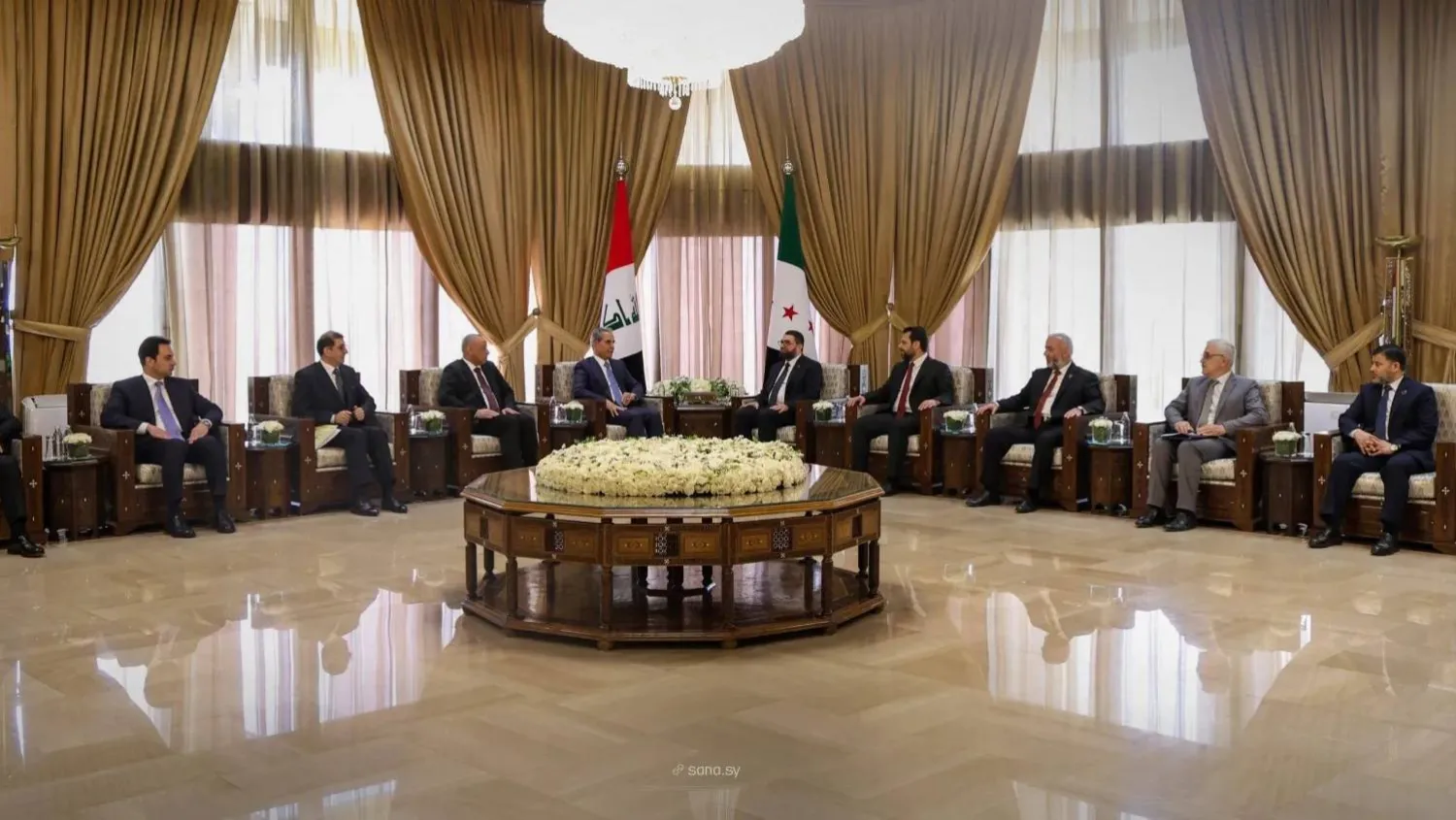

Iraq’s Top Judge in Damascus to Discuss ISIS Detainees, Judicial Cooperation

Iraq’s Supreme Judicial Council President Judge Faiq Zidan and his accompanying delegation at Tishreen Palace in Damascus, with Syrian Justice Minister Mazhar al-Wais in attendance. (SANA/Justice Ministry)
TT

Iraq’s Top Judge in Damascus to Discuss ISIS Detainees, Judicial Cooperation

Iraq’s Supreme Judicial Council President Judge Faiq Zidan and his accompanying delegation at Tishreen Palace in Damascus, with Syrian Justice Minister Mazhar al-Wais in attendance. (SANA/Justice Ministry)

Syrian Justice Minister Mazhar al-Wais met Faiq Zidan, head of Iraq’s Supreme Judicial Council, in Damascus on Thursday for talks aimed at deepening judicial cooperation, and the fate of Syrian detainees transferred to Iraq high on the agenda.

The Iraqi News Agency (INA) said Zidan arrived in the Syrian capital to discuss several issues of mutual concern, foremost among them ISIS detainees transferred to Iraqi prisons.

Al-Wais and Mohammad Taha al-Ahmad, adviser for Arab affairs at Syria’s Ministry of Foreign Affairs and Expatriates, received Zidan.

Judge Laith Jabr, head of Iraq’s Judicial Supervision Authority, said the visit opened broad prospects for judicial and legal cooperation between the two countries and included talks on detainees transferred from al-Hol camp.

Jabr told INA the Iraqi delegation, headed by Zidan, visited Damascus at the Syrian justice minister’s invitation to discuss a range of shared judicial issues.

He said the talks focused on Syrian detainees handed over to Iraq from al-Hol and their legal status, adding that Iraqi authorities had carried out judicial investigations and provided the detainees with all legal guarantees required under Iraqi law.

The two sides agreed to form joint judicial committees that would meet regularly to resolve issues linked to the detainees’ trials, Jabr said.

The meetings also covered stronger judicial coordination, expanded exchanges of information and expertise, and preparations for future memorandums of understanding between the two countries.

Sources following the visit said Zidan was expected to meet Syrian President Ahmed al-Sharaa and hold separate talks with the justice and foreign ministers and other Syrian officials.

The discussions were expected to cover ISIS members detained in Iraq, transitional justice, anti-corruption efforts and greater transparency.

Informed sources also said Iraq and Syria were close to signing a joint agreement to regulate the transfer and prosecution of Syrian detainees held by Iraqi authorities.

Al-Wais said Syria hoped the progress already made in economic and security relations would help drive closer judicial and legal coordination and strengthen ties between the two countries’ justice institutions.

Syria’s state news agency SANA quoted him as saying Damascus was committed to balanced and positive relations with its neighbors based on mutual respect and shared interests.

He said Syria’s historical ties and mutual interests with Iraq gave both countries stronger reason to expand bilateral cooperation.

Al-Wais said Syria was entering a new phase focused on building a state based on the rule of law and institutions, while strengthening national unity and justice.

He said the Justice Ministry was pursuing a broad judicial reform program to bolster judicial independence and integrity, improve judges’ efficiency, speed up the delivery of justice and simplify procedures for citizens.

Zidan, in turn, pointed to the historic and fraternal ties between Iraq and Syria and said Iraq’s judiciary was seeking new avenues of cooperation to improve judicial work and reinforce the rule of law in both countries.

He called for stronger coordination between justice institutions and greater exchanges of expertise, saying regional stability and justice required close judicial cooperation and partnership.

Iraqi and Syrian sources also said preparations were under way for a possible visit by Iraqi Prime Minister Ali al-Zaidi to Damascus for talks with Syrian President Ahmed al-Sharaa.

Asharq Al-Awsat reported on Sunday, citing sources in Baghdad, that Kurdistan Region President Nechirvan Barzani’s recent visit to Damascus had helped ease mutual concerns in Baghdad and Damascus over bilateral relations and several unresolved political and security issues.

The sources said Barzani carried messages between al-Zaidi and al-Sharaa and helped pave the way for a possible visit by the Iraqi prime minister to Damascus.



2 Killed Near Israeli-Occupied Zone in South Lebanon

A Lebanese flag placed on a damaged olive tree in the southern Lebanese village of Zawtar al-Gharbiyeh, near the neighboring village of Zawtar al-Sharqiyeh, where Israeli forces are stationed, in southern Lebanon, 10 October 2026. (EPA)
TT

2 Killed Near Israeli-Occupied Zone in South Lebanon

A Lebanese flag placed on a damaged olive tree in the southern Lebanese village of Zawtar al-Gharbiyeh, near the neighboring village of Zawtar al-Sharqiyeh, where Israeli forces are stationed, in southern Lebanon, 10 October 2026. (EPA)

Two men were killed in south Lebanon on Sunday, one by Israeli fire and the other by an explosive remnant of war, as they took part in the annual olive harvest, according to state media and local officials.

South Lebanon has been the scene of two wars since 2023 between Israel and Iran-backed Hezbollah, and Israeli troops still occupy a band of territory 10 kilometers (six miles) wide running along the border.

The official National News Agency (NNA) said one of the men was killed in Yater, in Bint Jbeil district, when Israeli "shelling targeted the outskirts of the town while he was inspecting his land and olive harvest".

The Lebanese army blamed Israeli tank fire and called the ongoing attacks "a flagrant breach of existing agreements".

Afterwards, the Yater municipality urged residents "to avoid the outskirts of the town and refrain from crossing the earthen barrier separating some unsafe neighborhoods" for fear of Israeli attacks.

In the village of Froun, in the same district, the NNA reported that "a foreign object" left over from previous Israeli operations exploded and killed an engineer as he and others tended their trees.

The engineer had come down from Beirut, where he lives, for the harvest, Froun mayor Hassan Bazzi told AFP.

The incident prompted local residents to call off the harvest and wait for "the Lebanese army to complete the decontamination of the village", Bazzi said.

Since a framework agreement between Lebanon and Israel was struck in June, the violence in the south has diminished but not stopped.

Israel continues to carry out sporadic strikes and demolitions in and around the territory it occupies, while Hezbollah refuses to submit to government plans to disarm it.

About eight kilometers (five miles) away, in Jibshit, volunteers from the north came to help locals with the harvest in a show of solidarity.

"From north to south, one people and one land," said organizer Ahmad Chahhal.

As workers swatted at branches to make the olives fall, an AFP photographer saw drones and heard fighter jets overhead, and explosions could be heard in the distance.

Hezbollah drew Lebanon into the Middle East war in early March by launching attacks against Israel in support of its backer Iran. Israel responded with an intense bombing campaign and a ground invasion.

The framework deal between Lebanon and Israel involves Hezbollah's disarmament, a gradual Israeli withdrawal and the deployment of the Lebanese army to the region.


Saddam Haftar Assures Shaibani of General Command’s Readiness to Support Syrian People

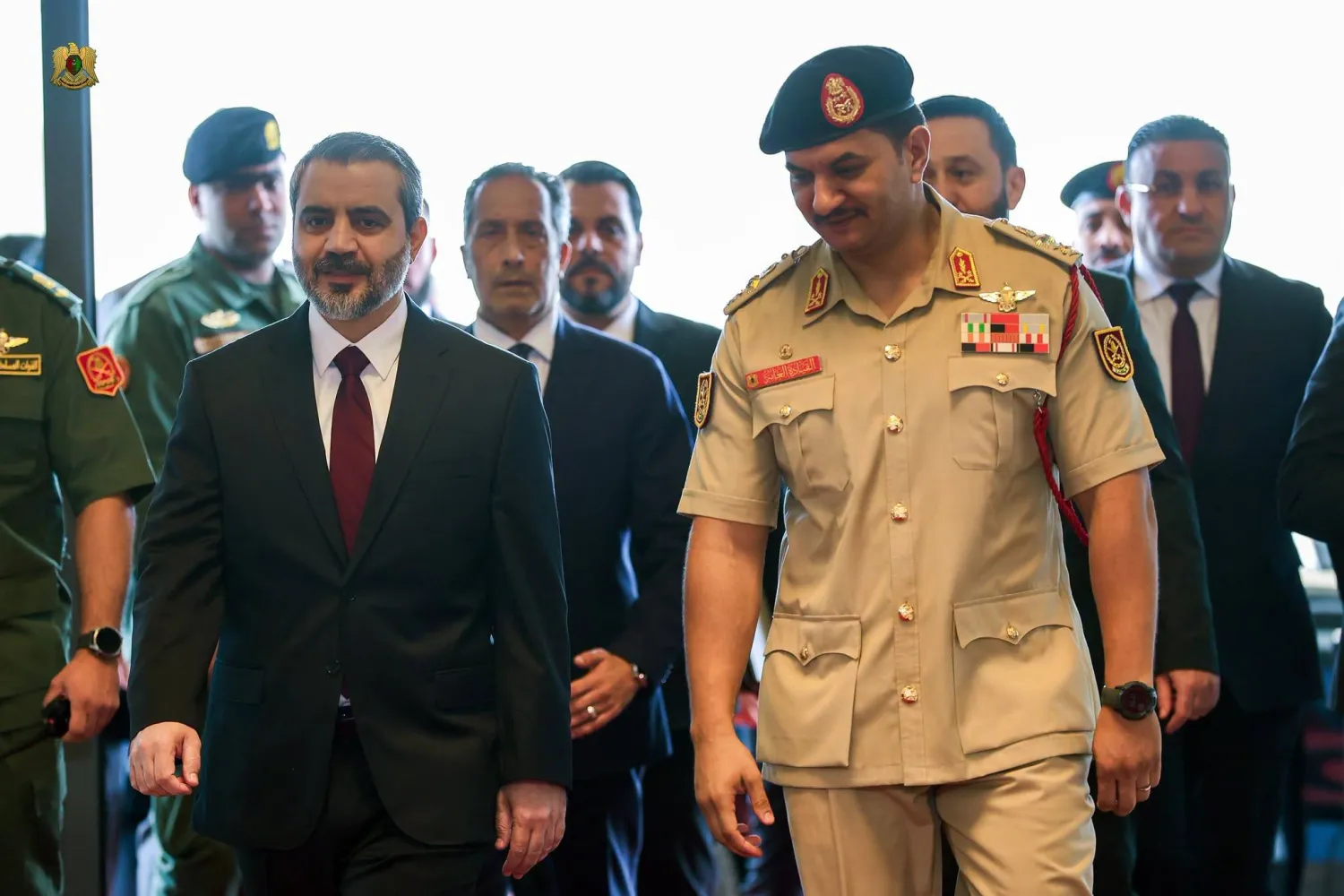
General Saddam Haftar, deputy commander-in-chief of the Libyan National Army, and Syrian Foreign Minister Asaad al-Shaibani in Benghazi. (LNA General Command)
TT

Saddam Haftar Assures Shaibani of General Command’s Readiness to Support Syrian People

General Saddam Haftar, deputy commander-in-chief of the Libyan National Army, and Syrian Foreign Minister Asaad al-Shaibani in Benghazi. (LNA General Command)

General Saddam Haftar, deputy commander-in-chief of the Libyan National Army, discussed with Syrian Foreign Minister Asaad al-Shaibani several issues of common interest during the minister’s first visit to Benghazi.

They also underlined the depth of the fraternal and historical relations uniting the Libyan and Syrian people.

Libya and Syria restored diplomatic ties after nearly 14 years after Shaibani visited Tripoli in August. Talks discussions aimed to strengthen bilateral relations and expand joint cooperation between the two countries, culminating in the reopening of the Syrian embassy in Libya.

The LNA General Command said on Sunday that Saddam praised the role of the Syrian leadership "in achieving security and stability in Syria, overcoming the challenges faced during the transition phase, and working to restore normalcy and open up to the international community."

He underscored the General Command's support for the Syrian leadership, and “its readiness to provide everything within its power to support the brotherly Syrian people to help Syria regain its position in the Arab and international arenas.”

For his part, Shaibani expressed the Syrian leadership's keenness to support everything that would achieve permanent stability in Libya.


139 Migrants, Including Children, Die After Boat Capsizes off Djibouti

 A portion of the vessel floats after it capsized while carrying about 305 people from Djibouti to Yemen. (Kennedy Omondi Okoth/International Organization for Migration/Handout via Reuters)
A portion of the vessel floats after it capsized while carrying about 305 people from Djibouti to Yemen. (Kennedy Omondi Okoth/International Organization for Migration/Handout via Reuters)
TT

139 Migrants, Including Children, Die After Boat Capsizes off Djibouti

 A portion of the vessel floats after it capsized while carrying about 305 people from Djibouti to Yemen. (Kennedy Omondi Okoth/International Organization for Migration/Handout via Reuters)
A portion of the vessel floats after it capsized while carrying about 305 people from Djibouti to Yemen. (Kennedy Omondi Okoth/International Organization for Migration/Handout via Reuters)

At least 139 people, including children, have died after a boat carrying more than 300 migrants capsized off the coast of Djibouti in east Africa, the International Organization for Migration said Sunday.

That number only includes those buried by authorities in Djibouti. Others have been buried by the migrants themselves, but they won't be added to the official count until authorities can verify the bodies, Alexandre Coissac, IOM Chief of Mission in Djibouti, told the AP via the phone.

“What is terrible is that they were buried with no names, in a common grave, like in a war situation,” Coissac said. “They all have a mother, a father, and we may never learn what happened.”

Coissac said the migrants boarded the ship in the evening of Oct. 8 and that it sank very soon after, close to the shore, “mainly because it was overcrowded.”

“The local authorities did their best,” Coissac said, “but they were overwhelmed with all the bodies that kept coming at once towards the shore.”

He said authorities were bringing the surviving migrants to the IOM rescue center in Obock where they received medical assistance after swallowing sea water, and psychological support.

“They're all in a state of shock,” Coissac, who visited the area of the shipwreck Saturday, said. “I tried to talk to some of them but it's very difficult.”

Some of the migrants in the IOM center are already aware that their family members died during the shipwreck. Others were given access to phones to call loved ones back home to notify them they are alive.

At least 84 people remained missing in one of the deadliest shipwrecks yet on the popular but perilous crossing from the Horn of Africa to the Arabian Peninsula, where many migrants seek work in Gulf nations.

The boat was traveling from Djibouti to Yemen when it capsized on Thursday night or Friday morning, according to the IOM. More than 80 people survived, all of them Ethiopian nationals, it said.

The Geneva-based UN migration agency said the vessel had 305 people on board and warned that the death toll could still rise.

Personal items likely belonging to the migrants, including shoes, were seen on a beach in a video shared by IOM. Rescue work continued as fears grew for the missing.

Tens of thousands of migrants from the Horn of Africa travel every year through Djibouti and across the Bab al-Mandeb Strait towards Gulf countries in search of safety and economic opportunities, the IOM said in its statement.

That movement has continued despite newly escalating fighting in Yemen, on the other side of the strait.

“This is a devastating loss of life,” said Coissac. “This tragedy is a stark reminder of the dangers faced by migrants along this migration corridor as they seek economic opportunities.”

In recent weeks, at least 2,000 Yemenis have received aid in Djibouti as the fighting has escalated in Yemen between the legitimate government and Iranian-backed Houthi militia.

That's the opposite direction from the movement of the migrants who died in the shipwreck and the typical migration patterns of recent years: The tens of thousands who cross from eastern Africa toward Yemen each year have typically been looking for work in the Gulf.

Over 900 migrants died or went missing along the route last year, according to IOM’s Missing Migrants Project.

“No one gets into a boat like that unless they believe there is no other safe way,” IOM Director-General Amy Pope said. “We cannot keep treating these deaths as normal. Safe and legal pathways save lives. I am asking governments and donors to act before the next boat goes down.”
