


Accusations, Troop Buildup Raise Fears of Sudan-Ethiopia Clash

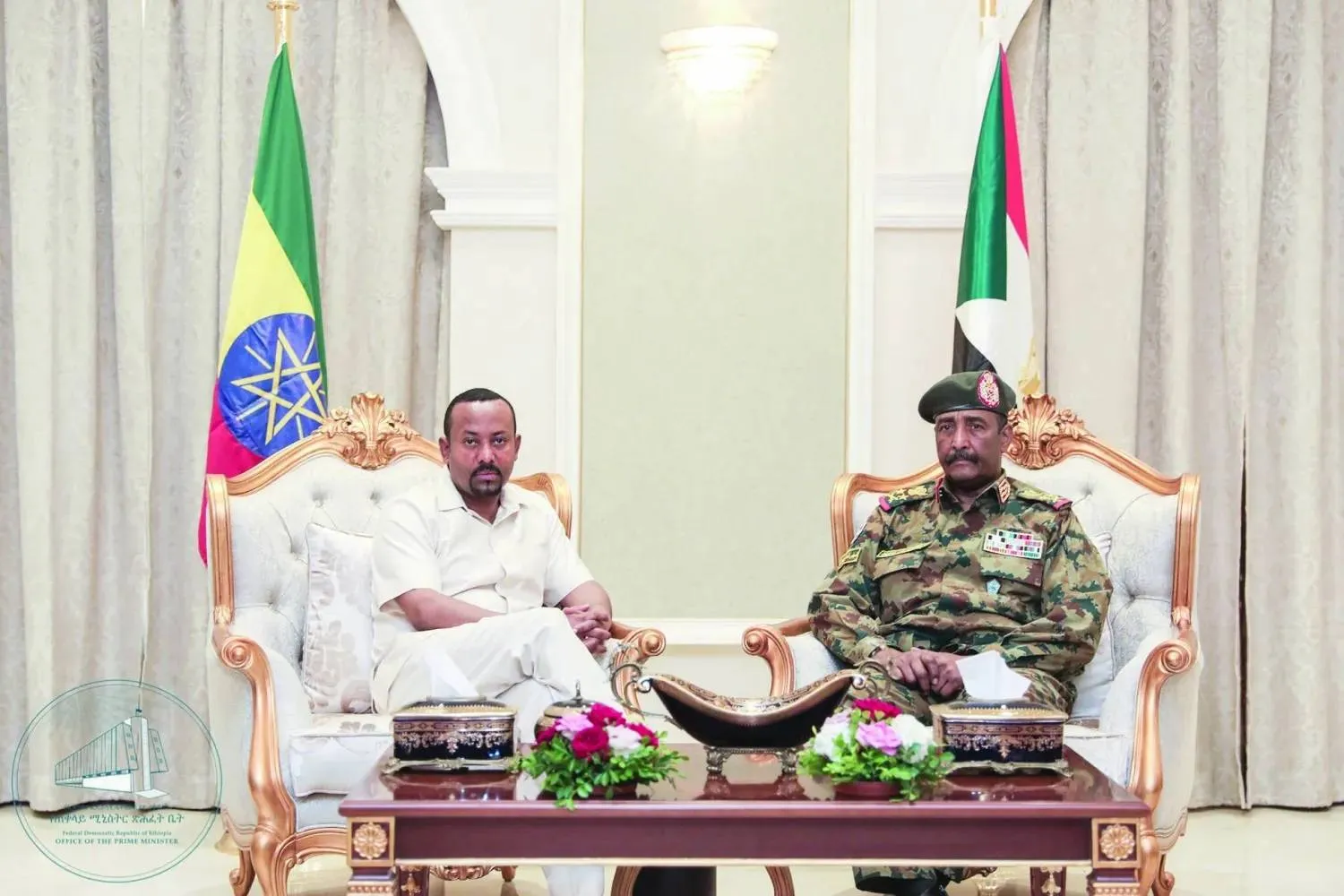
Chairman of the Transitional Military Council Abdel Fattah al-Burhan and Prime Minister of Ethiopia Abiy Ahmed Ali  during a previous meeting in Khartoum (Photo courtesy of the Ethiopian prime minister’s office)
TT

Accusations, Troop Buildup Raise Fears of Sudan-Ethiopia Clash

Chairman of the Transitional Military Council Abdel Fattah al-Burhan and Prime Minister of Ethiopia Abiy Ahmed Ali  during a previous meeting in Khartoum (Photo courtesy of the Ethiopian prime minister’s office)

Relations between Sudan and Ethiopia are experiencing an unprecedented escalation after the two countries exchanged political and military accusations over support for armed groups and drone attacks, amid military movements along their shared border and growing fears that the crisis could slide into an open regional confrontation.

The tensions come as Sudan faces extremely complex internal conditions because of the continuing war between the Sudanese army and the Rapid Support Forces, raising questions about Khartoum’s ability to handle a new external crisis and whether the mutual accusations will remain within the bounds of political and security escalation or develop into a direct military clash between the two countries.

Attention has focused on comments by Cameron Hudson, a former US diplomat and expert on Sudan and the Horn of Africa, who warned of deteriorating diplomatic relations between Sudan and Ethiopia and said Khartoum was massing forces near the shared border.

His comments came days after the Sudanese army accused Addis Ababa of involvement in hostile acts targeting Sudan and of allowing Ethiopia’s Bahir Dar base to be used as a launch site for drones operated by the Rapid Support Forces.

US concerns

Hudson said in a post on X that Sudan had “severed diplomatic relations with Ethiopia” and deployed new forces along the border, expressing concern over the consequences of the historic tensions between the two countries and the possibility that they could escalate into a broader confrontation at a time when Sudan is already living through highly sensitive conditions because of the internal war that has continued since 2023.

Although Sudan has not issued an official announcement confirming a complete severing of diplomatic relations, the Sudanese government recalled its ambassador to Ethiopia after the Sudanese army accused Addis Ababa and the United Arab Emirates of involvement in drone attacks targeting Khartoum airport and other sites.

Hudson’s post said Sudan had severed ties, while AP reported that Sudan recalled its ambassador and that Ethiopia denied the accusations as baseless.

The Sudanese army said last week that the latest attacks were launched from Ethiopia’s Bahir Dar airport, an accusation Addis Ababa categorically denied, describing it as “baseless.”

Reuters reported that the Sudanese armed forces accused Ethiopia and the UAE of aiding a drone attack on Khartoum International Airport, and that Ethiopia’s Foreign Ministry rejected the allegation.

These developments came months after an investigative report by Reuters said there was a secret camp inside Ethiopia used to train thousands of fighters from the Rapid Support Forces in the Benishangul-Gumuz region bordering Sudan, citing field sources and satellite images.

Reuters said the camp was evidence that Sudan’s war was expanding regionally, while Ethiopia did not issue an official comment on the report.

In the same context, a report by Yale University’s Humanitarian Research Lab said it had detected indications of Ethiopian military support for the Rapid Support Forces at a base in Asosa last April.

Ethiopia, in turn, responded with counteraccusations. Its Foreign Ministry said Sudan supports hostile groups in the Tigray region and violates Ethiopia’s territorial integrity.

It also accused Khartoum of using Tigrayan rebel elements in the war against the Rapid Support Forces, saying it had previously avoided making these accusations public in order to preserve bilateral relations.

A history of accusations

The current escalation is rooted in a long history of suspicion and undeclared conflict between the two countries.

Ethiopia hosted Sudanese opposition groups at various stages and played a political role in mediating between Sudanese factions, particularly with the Sudan People’s Liberation Movement led by John Garang.

After the current Sudanese war broke out, Addis Ababa hosted Rapid Support Forces commander Mohamed Hamdan Dagalo, as well as meetings of Sudanese civilian opposition groups, including the Taqaddum coalition led by former Sudanese Prime Minister Abdalla Hamdok.

Sudan also played an influential role in Ethiopia’s internal conflicts over past decades. The late Sudanese Islamist leader Hassan Al-Turabi said in media interviews that Ethiopian rebels entered Addis Ababa in Sudanese tanks driven by Ethiopians.

Former Sudanese national security adviser and retired air force Lt. Gen. al-Fatih Erwa said he piloted the plane that flew former Ethiopian President Meles Zenawi from Khartoum to Addis Ababa in 1991 after the fall of Mengistu Haile Mariam’s regime.

Relations between the two countries later entered a period of sharp tension after the attempted assassination of former Egyptian President Hosni Mubarak in Addis Ababa in 1995 while he was attending an Organization of African Unity summit.

Ethiopia and Egypt accused the government of former Sudanese President Omar al-Bashir and the National Islamic Front of involvement in the operation, an accusation Khartoum denied at the time.

The border dispute in the al-Fashqa area of eastern Sudan also remained one of the main sources of ongoing tension between the two countries, especially after the Sudanese army redeployed in the area at the end of 2020, reclaiming land that Ethiopian groups had controlled for years, while Addis Ababa viewed the move as an attempt to exploit its preoccupation with the war in Tigray.

Skirmishes or war?

Amid the current escalation, a central question is whether these mutual accusations could develop into a direct war between the two countries.

Military experts say the chances of a full-scale war remain limited because of the high political, military, and economic costs for both sides, especially as the Sudanese army is already fighting a broad war against the Rapid Support Forces that began in April 2023, while Ethiopia faces internal unrest and complex security challenges in several regions.

Military expert and retired Sudanese army Brig. Gen. Jamal al-Shahid said the escalation between Sudan and Ethiopia had gone beyond traditional diplomatic disputes and entered a phase of strategic signaling and security pressure. But he ruled out a full military confrontation at present.

He said the tensions could lead to limited border skirmishes, especially given the unresolved issues related to al-Fashqa, the Grand Ethiopian Renaissance Dam, and mutual accusations of supporting armed groups.

He said Sudan is currently focused on resolving its internal conflict and restoring national stability, making an external war extremely costly.

Retired Air Force Lt. Col. al-Tayeb al-Malkabi, however, said the current escalation goes beyond political rhetoric and could indicate that a regional confrontation is approaching.

But he ruled out the Sudanese army’s actual readiness to wage an open war with Ethiopia, saying talk of an external threat could also be an attempt to ease pressure stemming from the complexities of the internal war.

Between diplomatic escalation, military movements, a history of border disputes, and mutual interference, Sudanese-Ethiopian relations appear to be facing an extremely dangerous test in a region already suffering from chronic security fragility and overlapping conflicts.

Any slide toward direct confrontation would pose an additional threat to the stability of the entire Horn of Africa.



Trump Warns Israel and Iran Not to 'Blow It' after New Strikes Threaten Emerging Ceasefire Deal

US President Donald Trump speaks to reporters aboard Air Force One on a flight back to Washington March 15, 2026. REUTERS/Kevin Lamarque/File Photo
TT

Trump Warns Israel and Iran Not to 'Blow It' after New Strikes Threaten Emerging Ceasefire Deal

US President Donald Trump speaks to reporters aboard Air Force One on a flight back to Washington March 15, 2026. REUTERS/Kevin Lamarque/File Photo

US President Donald Trump on Sunday urged no further attacks by anyone after Israel's military said it launched strikes on Hezbollah targets in Beirut's southern suburbs, potentially complicating efforts to finalize a deal to end the US-Iran war.

The Public Health Emergency Operations Center said three people, including two women, were killed, and 16 were wounded.

Trump reacted on social media and said Israeli strikes on Beirut "should not have happened" as he vowed a regional peace deal was at hand, though he did not confirm reports it would be signed during the day.

"We are very close to a Deal that will bring peace to the region, including to Lebanon, and all sides should stand down," Trump said on social media.

"This could be the beginning of a long and beautiful peace -- Let's not blow it!"

The deal in its current form is a deep disappointment to Israel's government, which has been sidelined in negotiations led by Pakistan and others. The last time Israel struck the Beirut suburbs a week ago, it set off the most serious escalation of fighting between Iran and Israel since the tenuous ceasefire took hold April 7.

Trump, who had said the deal could be signed Sunday, has pressed Israeli Prime Minister Benjamin Netanyahu to stop hitting Lebanon hard while a deal is near, but the prime minister has defied him.

Netanyahu's office said the strikes were in response to Hezbollah attacks on northern Israel. Israel’s military said Hezbollah launched three projectiles, releasing footage where an audible boom was followed by rising smoke. There was no immediate comment from the Iranian-backed Hezbollah.


Trump to Meet Sisi at G7 Summit in France

US President Donald Trump holds a meeting with Egypt's President Abdel Fattah al-Sisi during a summit on Gaza in Sharm el-Sheikh on October 13, 2025. (AFP)
TT

Trump to Meet Sisi at G7 Summit in France

US President Donald Trump holds a meeting with Egypt's President Abdel Fattah al-Sisi during a summit on Gaza in Sharm el-Sheikh on October 13, 2025. (AFP)

US President Donald Trump is set to hold talks with Egypt's President Abdel Fattah al-Sisi on the sidelines of the G7 summit in France this month, the Egyptian presidency said on Sunday.

In a statement, the presidency said Sisi is expected to hold a series of meetings with world leaders during the summit, "including a bilateral meeting with US President Donald Trump".

It added that Sisi's meetings would focus on "discussing ways to resolve international geopolitical crises and address their repercussions on trade, energy and supply chains".

The G7 summit will be one of the first major international gatherings since the United States and Israel launched a war against Iran in late February, upending the Middle East and widening transatlantic tensions.

French President Emmanuel Macron, who is hosting the summit in the city of Evian on June 15-17, said that leaders from Egypt, Saudi Arabia, Qatar and the United Arab Emirates had been invited to discuss the Middle East war, according to the French presidency.

Saudi Crown Prince Mohammed bin Salman said he would not attend the summit due to "prior commitments", the Saudi Press Agency (SPA) reported on Thursday.

The G7 brings together the leaders of Britain, Canada, France, Germany, Italy, Japan and the United States, along with invited leaders from several other countries, including Brazil and India.

Macron is due to arrive in Evian on Sunday evening, with other leaders, including Trump, expected on Monday.

Leaders are set to have a packed agenda of potentially explosive issues, including efforts to end the war in Iran and re-open the key Strait of Hormuz shipping bottleneck.


Arab League Warns of Devastating Effects of Attacking Education in Occupied Territories

Arab League headquarters in Cairo (The League's official Facebook page)
TT

Arab League Warns of Devastating Effects of Attacking Education in Occupied Territories

Arab League headquarters in Cairo (The League's official Facebook page)

Assistant Secretary-General and Head of the Palestine and Occupied Arab Territories Sector at the Arab League Ambassador Dr. Faed Mustafa stressed that targeting education in the occupied Palestinian territories, particularly in the Gaza Strip, cannot be regarded as merely a side effect of war.

He asserted that it represents part of a systematic plan aimed at erasing the Palestinian national identity and depriving future generations of their awareness, culture, and sense of belonging. He warned that what he described as educational genocide would have devastating consequences extending to generations to come, SPA reported.

He made the remarks during his speech at the opening of the 111th Session of the Committee on Educational Programs for Arab Students in Occupied Arab Territories, which kicked off today at the headquarters of the General Secretariat of the Arab League in Cairo.

Mustafa noted that Palestinian efforts to resume the educational process, particularly in the Gaza Strip, face major challenges due to the blockade, Israeli restrictions, and shortages of educational supplies. These circumstances have compelled the concerned authorities to resume classes in partially damaged schools, as well as in tents and temporary educational centers with limited resources.

He called on the international community and relevant institutions to fulfill their obligations toward rebuilding the Palestinian educational system, ensuring sustainable funding for United Nations Relief and Works Agency for Palestine Refugees in the Near East (UNRWA), and supporting psychological and educational recovery programs.

Mustafa stressed that saving Palestinian education is a national, humanitarian, and moral duty that requires concerted local, regional, and international efforts.