Lebanon PM Says Country Has Had Enough ‘Reckless’ Wars for Foreign Interests

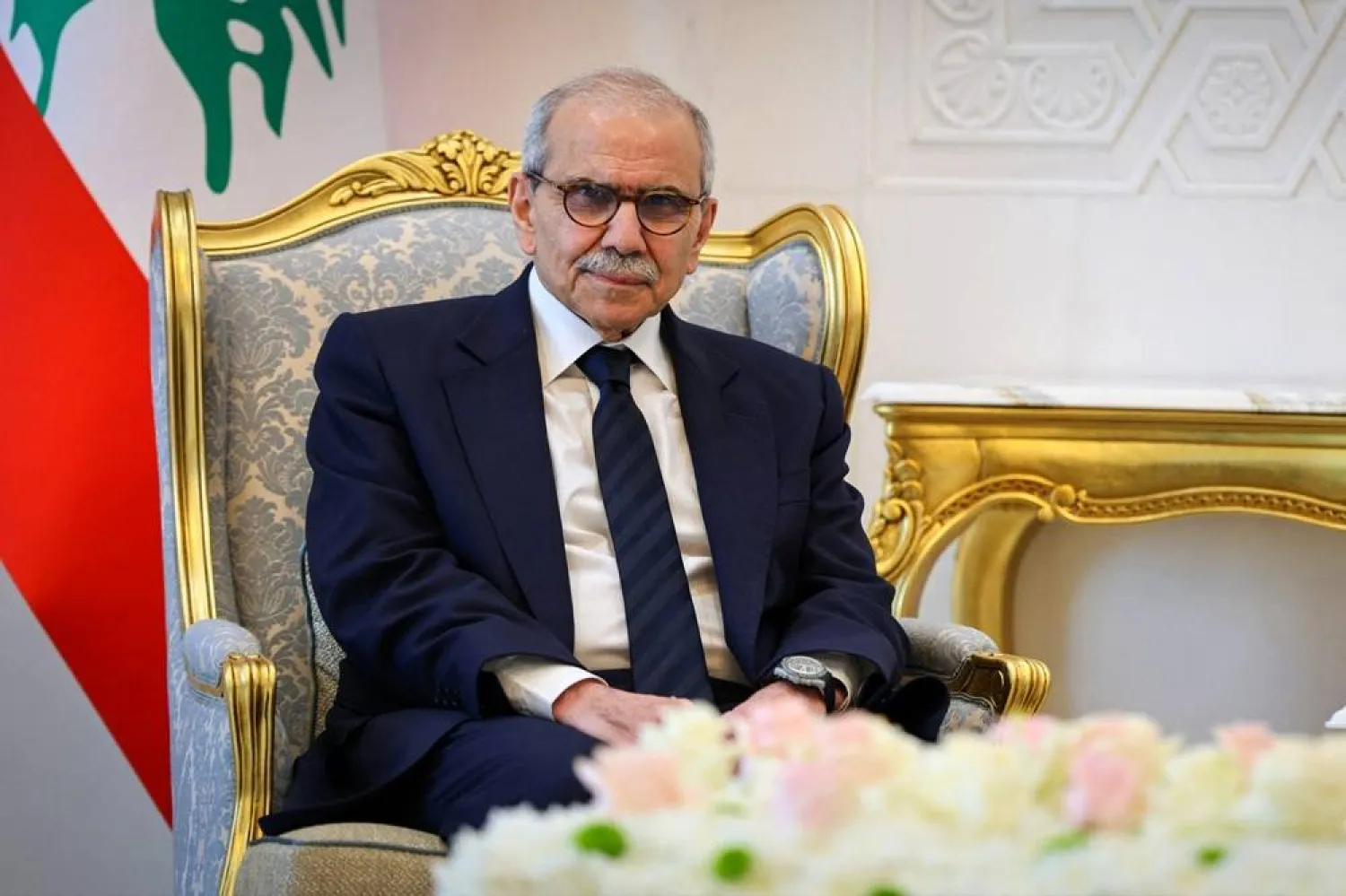
This handout photo provided by Syria's SANA news agency's Telegram channel on May 9, 2026, shows Lebanese Prime Minister Nawaf Salam meeting with the Syrian president (unseen) at the People's Palace in Damascus. (SANA / AFP / Handout)
TT

Lebanon PM Says Country Has Had Enough ‘Reckless’ Wars for Foreign Interests

This handout photo provided by Syria's SANA news agency's Telegram channel on May 9, 2026, shows Lebanese Prime Minister Nawaf Salam meeting with the Syrian president (unseen) at the People's Palace in Damascus. (SANA / AFP / Handout)

Lebanese Prime Minister Nawaf Salam on Friday said his country has had enough "reckless" wars for foreign interests, calling for Arab and international support in Beirut's negotiations with Israel.

Speaking at an NGO dinner, Salam said that he hoped to "mobilize all Arab and international support to bolster our position in the negotiations" with Israel, shortly after the last round of talks ended and extended the ongoing truce for 45 days.

In an implicit rebuke to Hezbollah, which joined the Middle East war in support of Iran on March 2, Salam said the country had "enough of these reckless adventures serving foreign projects or interests, the latest being a war we did not choose but was forced upon us, which led to Israel occupying 68 towns and villages".

Israeli attacks since the start of the war have killed more than 2,900 people in Lebanon, including more than 400 since an April 17 truce took effect, according to Lebanese authorities.

More than a million people were displaced, and Israeli soldiers are operating inside an Israeli-declared occupied "yellow line", which runs around 10 kilometers (six miles) north of the Israel-Lebanon border, carrying out broad demolition operations there.

"And after all this, with all the killing, destruction, displacement, and tragedies (the war) brought, someone comes along trying to insult our intelligence and calls it a victory," he added, also hinting at Hezbollah.

"Enough with the incitement and accusations of treason; this will not and cannot intimidate us."

Salam also said that the Lebanese military should be the only armed body in the country.

Beirut last year committed to disarming Hezbollah after the group was weakened by its 2024 war with Israel.

After the group started the latest war in March, the Lebanese government outlawed its military activities.

Hezbollah strongly rejected all of Beirut's moves against it, and is opposed to direct negotiations with Israel, accusing the government of committing a "sin" and urging it to withdraw from the talks.


Iraq’s Maliki Joins Chorus Rejecting Militia Disarmament

Members of Iraq’s Kataib Hezbollah carry the group’s flag in central Baghdad. (File photo - AFP)
TT

Iraq’s Maliki Joins Chorus Rejecting Militia Disarmament

Members of Iraq’s Kataib Hezbollah carry the group’s flag in central Baghdad. (File photo - AFP)

State of Law Coalition leader Nouri al-Maliki has joined a growing chorus of critics of Iraqi Prime Minister Ali al-Zaidi’s government program, unanimously approved by parliament, to restrict arms to state control.

Less than a month after the State Administration Coalition, comprising leading Shiite, Sunni and Kurdish forces, gave Zaidi full authority to determine how to handle the issue after Sept. 30 — when the remaining US troops are due to leave Iraq — armed factions, notably Kataib Hezbollah and Harakat al-Nujaba, rejected the deadline. They argue that their weapons are “ideological” and tied to the Iran-led “Axis of Resistance.”

Maliki joined them Wednesday, declaring in televised remarks that “there will be no handover of weapons” after Sept. 30.

Instead, he advocated “regulation and containment” of weapons through a mechanism still under discussion.

Maliki pointed that distinctions could be drawn among heavy, medium and light arms.

His position came despite an earlier warning from the State Administration Coalition that any armed activity outside state authority after Sept. 30 would be dealt with under the counterterrorism law.

Shifting Terms

A visit to Iraq by Iranian parliament speaker Mohammad Bagher Ghalibaf further complicated the process amid indications that Tehran was unwilling to see all factions surrender their weapons.

The government subsequently agreed to a Shiite Coordination Framework committee that would begin talks with armed groups after the end of September to persuade them to establish a mechanism for “regulating weapons, not disarming them,” as Maliki put it.

Maliki serves on the three-member committee alongside former Prime Minister Mohammed Shia al-Sudani and Badr Organization leader Hadi al-Amiri.

While Sudani has made no statement on surrendering weapons, Amiri and Maliki have taken turns, using terms such as “regulating,” “freezing” or “deferring” weapons rather than “disarmament.”

Maliki’s comments followed Amiri’s description two days earlier of the 2019 Tishreen protests as a “sedition” intended to topple the Shiite political system.

Amiri also identified the “resistance” as the so-called “third party” that carried out killings of protesters, leaving thousands dead or wounded, mostly from poor Shiite neighborhoods in Baghdad and central and southern provinces.

Political observers viewed his remarks as a deliberate message that armed factions “were, and remain, the ones protecting the political system when it is threatened.”

Akram al-Kaabi, secretary-general of Harakat al-Nujaba, meanwhile said US President Donald Trump was “deluded” if he believed he could achieve a victory in Iraq after failing to do so in Iran.

The government has maintained that the deadline for surrendering weapons remains unchanged and coincides with the US withdrawal, saying armed groups could be compelled to comply once the American presence ends and there is no longer justification for carrying arms.

Saleh al-Arbawi, head of the Wa’i Movement, told Asharq Al-Awsat that any handover could be circumvented or merely symbolic, saying armed groups follow “a transnational ideology and leadership” and have received no order to relinquish their weapons.

The government, he said, faces either confrontation or potentially lengthy dialogue and compromise. He added that the wider the current conflict becomes, the more difficult restricting arms to state control will be.


Syria Says Thwarted Escape Attempt of Man Linked to Assad-era General

A large Syrian flag flutters above Tishreen Park in Damascus, June 4, 2025. (AFP)
TT

Syria Says Thwarted Escape Attempt of Man Linked to Assad-era General

A large Syrian flag flutters above Tishreen Park in Damascus, June 4, 2025. (AFP)

Syrian authorities on Thursday said they foiled an escape attempt by a man close to a general who served ousted ruler Bashar al-Assad and led a militia linked to Assad's cousin.

Security forces in the Damascus countryside said they "thwarted an escape attempt by Alaa Zahreddine, a key associate of the criminal Ghiath Dalla and former leader of the 'Shield of the Homeland Brigade' militia", accusing him of being "implicated in crimes against civilians".

"After his identity was confirmed during a stop at a security checkpoint, Zahreddine drew his weapon and shot himself, committing suicide to avoid capture. His companion in the vehicle was arrested."

Syrian authorities had previously said that the brigade was linked to Rami Makhlouf, cousin of former Syrian president Assad who was ousted in 2024.

The operation comes days after security forces said they killed an Assad-era army commander in a firefight while trying to arrest him in the Alawite-majority Syrian coast.

Authorities said both men were linked to Assad-era general Dalla.

Dalla, a former officer in the much-feared Fourth Brigade, had announced on social media last year the formation of a "military council for the liberation of Syria".

The announcement came shortly before deadly violence targeting the Alawite minority, to which Assad's family belongs, erupted on the Syrian coast in March 2025.

Authorities accused armed Assad supporters of sparking the violence by attacking security forces.

A national commission of inquiry said at least 1,426 members of the minority were killed, while the Syrian Observatory for Human Rights monitor put the toll at more than 1,700.


DR Congo Latest to Promise Moving Israel Embassy to Jerusalem

 Felix-Antoine Tshisekedi, president of the Democratic Republic of Congo, addresses the African Water Forum in N’Djamena, Chad, on July 16, 2026. (AFP file)
Felix-Antoine Tshisekedi, president of the Democratic Republic of Congo, addresses the African Water Forum in N’Djamena, Chad, on July 16, 2026. (AFP file)
TT

DR Congo Latest to Promise Moving Israel Embassy to Jerusalem

 Felix-Antoine Tshisekedi, president of the Democratic Republic of Congo, addresses the African Water Forum in N’Djamena, Chad, on July 16, 2026. (AFP file)
Felix-Antoine Tshisekedi, president of the Democratic Republic of Congo, addresses the African Water Forum in N’Djamena, Chad, on July 16, 2026. (AFP file)

The Democratic Republic of Congo said Thursday it would move its embassy in Israel to Jerusalem, joining a small group of countries including the United States in taking the symbolic step of backing Israeli sovereignty in the contested holy city.

After a visit by President Felix-Antoine Tshisekedi, the two countries in a statement said they would take steps for "the relocation of the embassy of the Democratic Republic of the Congo from Tel Aviv to Jerusalem", without giving a timeline.

Tshisekedi and Israeli Prime Minister Benjamin Netanyahu in a meeting spoke of their "shared commitment to strengthening diplomatic relations", the statement said.

Tshisekedi has spoken warmly about Israel for years, saying his support is driven by his Christian faith. He has also been eager for support from the United States, which has increasingly pressured Rwanda over armed rebel advances in DR Congo.

The announcement comes weeks after Colombia's new hard-right president, Abelardo de la Espriella, also announced that he would move his country's embassy to Jerusalem, a sharp shift from his leftist predecessor who criticized Israel over its Gaza offensive.

The vast majority of countries, if they recognize Israel, keep their embassies in Tel Aviv on the grounds that the status of Jerusalem will be settled in a final resolution of the Palestinian-Israeli conflict.

President Donald Trump shattered that consensus in 2018 during his first term by moving the US embassy to Jerusalem, which is home to Israel's parliament, prime minister and most other major governmental institutions.

Since Trump's move, only a handful of small, US-aligned countries have followed suit -- Fiji, Guatemala, Honduras, Papua New Guinea and Paraguay.

Kosovo and Somaliland, which are not member-states of the United Nations, have also opened what they consider their embassies in Jerusalem.

Argentine President Javier Milei, another right-wing Latin American who is an outspoken supporter of Israel, has promised to move his country's embassy to Jerusalem.

The shift has not yet taken place, however, reportedly due to disagreement over an Israeli company's plans to drill in the British-ruled Falkland Islands, which Argentina claims and calls the Malvinas.

Israel captured the eastern part of Jerusalem from Jordan in the 1967 Six-Day War and annexed it, declaring Jerusalem, home to Judaism's holiest site, to be its eternal, undivided capital.