


Defector ‘Savannah’ Arrives in Khartoum, Deepening RSF Crisis

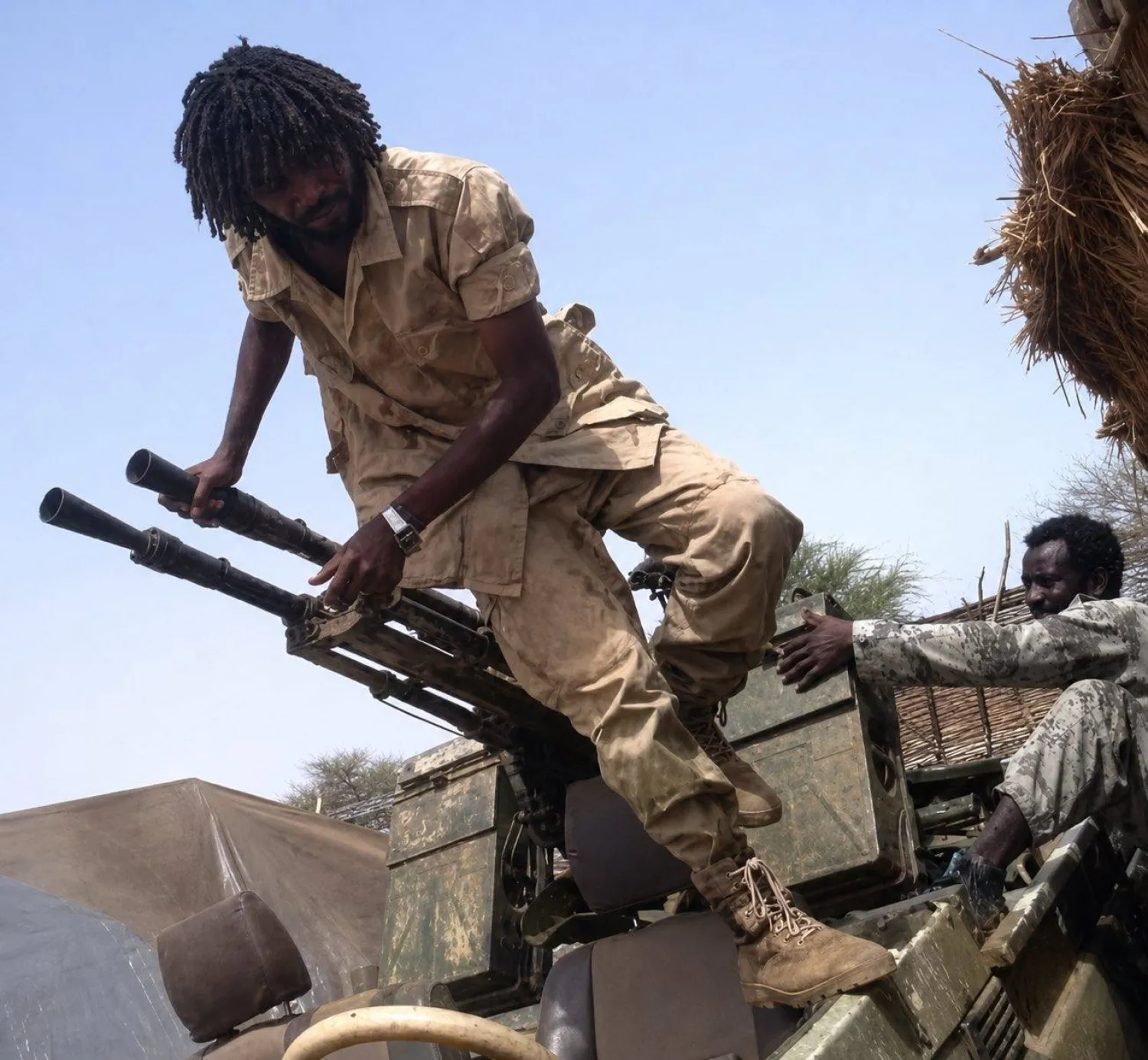
A circulated image shows defector Savanna among his troops during military operations before splitting from the Rapid Support Forces. 
TT

Defector ‘Savannah’ Arrives in Khartoum, Deepening RSF Crisis

A circulated image shows defector Savanna among his troops during military operations before splitting from the Rapid Support Forces. 

Former Rapid Support Forces (RSF) field commander Brigadier General Ali Rizqallah, known as “Savannah,” arrived in the Sudanese capital Khartoum days after announcing his split from the paramilitary force led by Mohamed Hamdan Dagalo (Hemedti), in a move observers say highlights growing divisions within the RSF leadership and field ranks.

When Savannah announced his defection last week, he stressed he would not side with either party in the conflict, saying only that he had “sided with the will of the people.” But his arrival in Khartoum was widely seen by observers as a practical indication that he had joined the Sudanese army, dealing another blow to the RSF, which has faced a growing wave of defections in recent months.

Media sources said Savannah arrived in Khartoum without official details about his next moves, but the timing of his arrival, amid escalating military operations on several fronts, reinforced speculation of significant internal shifts within the RSF structure.

Defected RSF Major General Al-Nour Ahmed Adam, known as “Al-Nour al-Qubba,” told local media that Savannah was among the RSF’s most prominent field commanders and that his defection had generated wide attention because of his military influence and standing within the force.

He described Savannah as “one of the strong men and men of principle,” predicting that his joining the army would represent “a real addition to the armed forces and the Sudanese people.”

Al-Qubba also hinted at further defections within the RSF, saying the coming days would witness new developments following Savanna’s move to the army, in remarks suggesting that other commanders could join the Sudanese armed forces.

Savannah emerged as one of the leading RSF field commanders in the Kordofan region after the outbreak of war in April 2023. He led several military operations against the army and helped expand RSF control across large parts of the region.

He is the fourth prominent commander to defect from the RSF in recent months after Abu Aqla Keikel, commander of the Sudan Shield forces, who joined the army in October 2024, followed by Major General Al-Nour Ahmed Adam al-Qubba and field commander Bashara al-Huwaira, who also defected and joined the armed forces.

Tribal leader Musa Hilal, the former head of the Janjaweed militia, had previously declared support for the army after relocating to Port Sudan following the RSF’s takeover of his hometown of Misterei in Darfur, in a development observers say contributed to growing unrest and divisions within the RSF.

Observers say RSF attacks on areas controlled by Musa Hilal and his forces affected tribal and military balances in Darfur and indirectly accelerated defections from the paramilitary group.

Neither the Sudanese army nor the RSF issued official comment on Savannah’s arrival in Khartoum. The RSF had previously described him in a Telegram statement as a “defeated general,” while pro-RSF platforms circulated videos showing fighters from his combat group rejecting his defection.

The war between the Sudanese army and the RSF has entered the first month of its fourth year, with humanitarian and security conditions continuing to deteriorate across the country.

The International Organization for Migration estimates that the conflict has displaced more than 14 million people, including nearly four million who fled to neighboring countries, while the United Nations has described the Sudan crisis as the world’s “largest humanitarian catastrophe.”

Unofficial estimates say the war has killed around 150,000 civilians, in addition to thousands of fighters from both sides, amid the absence of precise figures on military losses.


Iraq Sentences US-Sanctioned Oil Official to Prison

The sun sets behind apartment buildings in Baghdad, Iraq, Friday, Aug. 28, 2026. (AP)
TT

Iraq Sentences US-Sanctioned Oil Official to Prison

The sun sets behind apartment buildings in Baghdad, Iraq, Friday, Aug. 28, 2026. (AP)

Iraq sentenced a US-sanctioned oil official to seven years in prison after he was arrested as part of a government-led anti-corruption campaign, the country's anti-graft body said on Sunday.

Deputy oil minister for distribution affairs Ali al-Bahadli is among dozens of officials who were detained in June during anti-graft raids that took place in several areas, mostly in Baghdad's fortified Green Zone.

The Commission of Integrity said in a statement that an anti-corruption court sentenced Bahadli to seven years in prison for "illicit gains".

The ruling requires Bahadli to return to the state an amount equivalent to more than $20 million in ill-gotten gains, in addition to paying a fine of the same amount.

The United States imposed sanctions on Bahadli in May, accusing him of fraudulently mixing Iraqi and Iranian oil as part of a scheme to help Iran avoid sanctions.

At the time, Iraq's oil ministry denied the accusations against Bahadli, who was then arrested during the anti-graft raids.

Iraqi authorities said that the raids were part of new Prime Minister Ali al-Zaidi's campaign to fight the corruption that has plagued Iraq for decades.

But several Iraqi officials told AFP that the raids were also part of al-Zaidi's campaign against funding for pro-Iran armed groups and the smuggling of Iranian oil.

Iraq has been under mounting pressure from the United States to curb Tehran's influence and rein in Iran-backed armed factions, which Washington designates as terrorist groups.

Al-Zaidi, who took office this year with the blessing of the United States, has pledged to ensure the armed factions that emerged after the US-led invasion hand over their weapons to the state.

In Iraq, corruption is especially rampant across public institutions, but convictions typically target mid-level officials or minor players and rarely those at the top of the power hierarchy.


US News Agency Says Crew Attacked by Israeli Settlers in West Bank

 Israeli settlers look out through a metal fence, as an Israeli flag flutters nearby, on the day of their weekly tour in Hebron, in the Israeli-occupied West Bank, August 29, 2026. (Reuters)
Israeli settlers look out through a metal fence, as an Israeli flag flutters nearby, on the day of their weekly tour in Hebron, in the Israeli-occupied West Bank, August 29, 2026. (Reuters)
TT

US News Agency Says Crew Attacked by Israeli Settlers in West Bank

 Israeli settlers look out through a metal fence, as an Israeli flag flutters nearby, on the day of their weekly tour in Hebron, in the Israeli-occupied West Bank, August 29, 2026. (Reuters)
Israeli settlers look out through a metal fence, as an Israeli flag flutters nearby, on the day of their weekly tour in Hebron, in the Israeli-occupied West Bank, August 29, 2026. (Reuters)

Israeli settlers attacked an NBC crew in the central West Bank Saturday, as they were interviewing a Palestinian woman who said she’d been driven out of her house by settlers, the network said.

NBC’s American correspondent Matt Bradley, two other crew members and the woman they were interviewing were all treated for injuries sustained during the attack, NBC said. There were no further details on their injuries.

The assault was caught on video and shared by NBC, with footage showing masked settlers approaching the crew with sticks and beating the crew’s vehicles.

Israel’s military said it was “aware of reports of Palestinian injuries, including a Palestinian woman who sustained non-life-threatening injuries and was evacuated by the Red Crescent for medical treatment.” It did not comment on the attack on the NBC crew.

It was the latest in a growing wave of violence by West Bank settlers. Prime Minister Benjamin Netanyahu issued a rare condemnation of the violence on Saturday. The Israeli leader has come under heavy US criticism for the settler attacks.

Settlers seized British activist and held him locked in shed

Israeli settlers seized a British activist from a Palestinian village in the West Bank and locked him in a shed before turning him over to police, his lawyer said Sunday.

The lawyer, Inbar Shaked Vardi, said settlers held her client, Finn Joughin, for half an hour Saturday before turning him over to Israeli police. Joughin was set to appear before a Jerusalem court later Sunday, she said.

Video showed two settlers, one armed, restraining Joughin and marching him away from the village.

It was not immediately clear what led to his capture. Settlers say he assaulted a child, accusations Vardi vehemently denied.

Settlers point to a video where the activist uses his body in an apparent attempt to block a settler boy from passing through a fence. Vardi said the video shows he was trying to protect the village.

Police said they were investigating and holding Joughin in custody on suspicion of committing an indecent act against a minor.


Libya Rivals Agree Roadmap for Elections Within 24 Months at UN-Led Talks

People wave Libyan flags during a demonstration in Benghazi February 7, 2014. (Reuters)
TT

Libya Rivals Agree Roadmap for Elections Within 24 Months at UN-Led Talks

People wave Libyan flags during a demonstration in Benghazi February 7, 2014. (Reuters)

Representatives of ‌Libya's rival political parties on Sunday signed an agreement on holding long-delayed national elections within two years to resolve contentious issues over electoral laws and reform the national elections body.

The political process to resolve more than a decade of conflict in Libya has been stalled since an election scheduled for December 2021 collapsed following disputes over the eligibility of the main candidates.

Sunday's signing ceremony was held at the United Nations Support Mission in Libya, UNSMIL, in ‌the Libyan capital ‌Tripoli.

It followed talks in a ‌smaller ⁠format, known as ⁠the 4+4, that involved two representatives of each of Libya's four main institutions: the Government of National Unity, the High Council of State, the House of Representatives and the Libyan National Army.

Walid Ellafi, state minister of political affairs and communications in the Government of National Unity, said legislative and ⁠presidential elections should be held "within a period not ‌exceeding 24 months" under a ‌single executive authority and unified national institutions.

Shibani AbuHamoud, head ‌of the army's general command, said the 4+4 would work ‌with UNSMIL "to develop a framework within one month of the signing of the agreement to follow up on all matters related to its implementation".

The agreement says that if Libya's House ‌of Representatives and High Council of State fail to approve the deal within a month, the ⁠parties ⁠will seek to adopt it nationally as a constitutional document through broad national mechanisms and secure international backing through the UN Security Council.

Libya has had little stability or security since a 2011 NATO-backed uprising.

It split in 2014 between warring eastern and western factions but there has been little major warfare since a 2020 ceasefire.

All Libya's major political players have repeatedly called for elections, but many Libyan people have voiced doubts that they would want a vote that could push most of them from positions of authority.
