


Israel PM Says Close to Killing All Architects of October 7 Attack

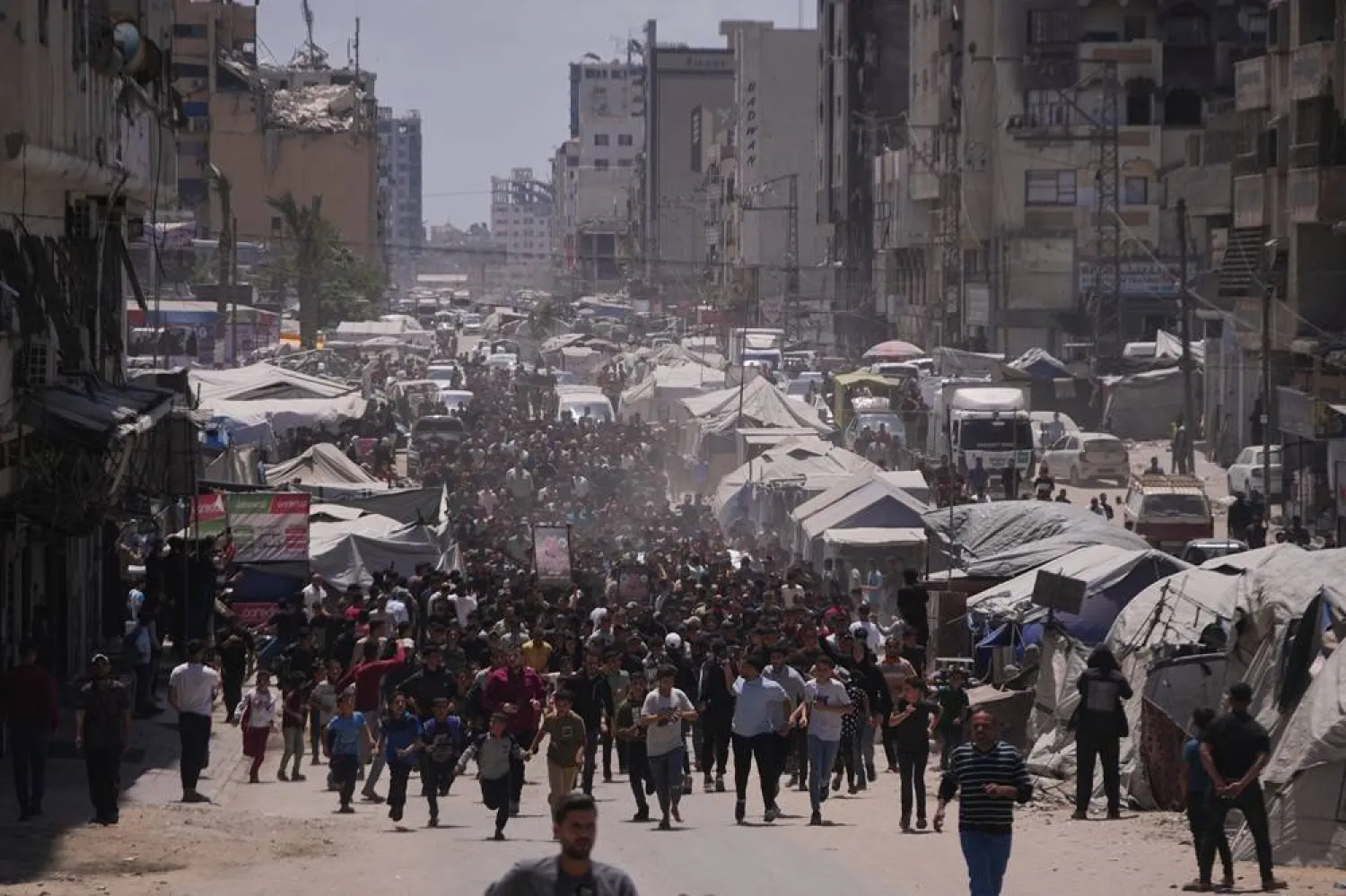
 Palestinians attend the funeral of Ezzedine Al-Haddad, commander of Hamas's armed wing, and his daughter and wife in Gaza City, Saturday, May 16, 2026. (AP)
Palestinians attend the funeral of Ezzedine Al-Haddad, commander of Hamas's armed wing, and his daughter and wife in Gaza City, Saturday, May 16, 2026. (AP)
TT

Israel PM Says Close to Killing All Architects of October 7 Attack

 Palestinians attend the funeral of Ezzedine Al-Haddad, commander of Hamas's armed wing, and his daughter and wife in Gaza City, Saturday, May 16, 2026. (AP)
Palestinians attend the funeral of Ezzedine Al-Haddad, commander of Hamas's armed wing, and his daughter and wife in Gaza City, Saturday, May 16, 2026. (AP)

Prime Minister Benjamin Netanyahu said Sunday that Israel had almost completed a key goal of the war in Gaza -- eliminating all those responsible for orchestrating the October 7 attack.

His remarks followed the Israeli military's announcement that Ezzedine Al-Haddad, commander of Hamas's armed wing, had been killed in an airstrike in Gaza on Friday.

In the aftermath of the October 7 assault, Netanyahu pledged to target and eliminate the masterminds behind the attacks, which, according to an AFP tally based on official Israeli figures, resulted in the deaths of 1,221 people.

"I promised that every single architect of the massacre and the hostage-taking would be eliminated down to the last one, and we are very close to completing this mission," Netanyahu said during the weekly cabinet meeting, describing Haddad as a "despicable terrorist".

Since Hamas's cross-border assault, the Israeli military and intelligence services have waged a campaign targeting the group's senior political leaders and militant commanders in Gaza and across the region.

During the war triggered by the Hamas attacks, Israel has claimed responsibility for assassinating several Hamas leaders, including the group's former political chief Ismail Haniyeh.

Israeli soldiers also killed Yahya Sinwar, who was widely regarded as a key mastermind behind the October 7 attack.

Mohammed Deif, the longtime commander of Hamas's armed wing and considered an architect of the attack, was also killed during the war.

Israeli strikes have also targeted Hamas operatives in Lebanon, as well as senior Iran-backed Hezbollah commanders allied with the group, including former Hezbollah chief Hassan Nasrallah.

Netanyahu, meanwhile, reiterated on Sunday that Israeli forces currently control 60 percent of Gaza's territory.

The statement suggests that the military has continued to expand its operational presence in Gaza, following recent media reports that Israeli troops had advanced toward a newly-designated "Orange Line".

Under the terms of the US-brokered ceasefire between Israel and Hamas, in effect since October 10, Israeli forces were to withdraw to a so-called "Yellow Line" in Gaza, leaving them in control of more than 50 percent of the Palestinian territory.

"We have Hamas in our grip. We know exactly what our mission is, and our mission is: To ensure that Gaza will never again pose a threat to Israel," Netanyahu said.

Israel's military campaign against Hamas since the October 2023 attacks has killed at least 72,763 people in Gaza, the majority of them civilians, according to the territory's health ministry, which operates under Hamas authority.

Despite an October ceasefire, Gaza remains gripped by daily violence as Israeli strikes continue, with both the military and Hamas accusing one another of violating the truce.

At least 871 Palestinians have been killed since the truce began, according to the territory's health ministry.

The United Nations considers these figures reliable.

Over the same period, the Israeli military said five soldiers have been killed in Gaza.


Lebanon Says Israeli Strikes Kill 7 Including an ‘Islamic Jihad’ Commander

17 May 2026, Lebanon, Tyre: Smoke from an Israeli air raid billows from the village of Zibqin. (dpa)
TT

Lebanon Says Israeli Strikes Kill 7 Including an ‘Islamic Jihad’ Commander

17 May 2026, Lebanon, Tyre: Smoke from an Israeli air raid billows from the village of Zibqin. (dpa)

Israeli strikes killed seven people in Lebanon on Sunday, including an "Islamic Jihad commander", Lebanese authorities and state media said, despite a fragile ceasefire as Hezbollah called US-brokered talks between the two countries a "dead end".

The health ministry published a "preliminary toll" for Israel's strikes on Sunday, with three people killed in the town of Tayr Felsay, including a child, and two killed in the town of Tayr Debba, including another child.

It said 11 people were wounded in those strikes and four more were wounded in strikes in two other southern towns.

Later Lebanon's state-run National News Agency (NNA) said an Israeli missile strike around midnight on an apartment on the outskirts of the city of Baalbek in the country's east had killed Islamic Jihad commander Wael Abdel Halim and his 17-year-old daughter.

Despite the ceasefire, Israel continues to strike widely in southern Lebanon and issues frequent evacuation warnings to towns and villages across the south.

Two Israeli strikes also hit the town of Sohmor in eastern Lebanon's Bekaa valley on Sunday, the state-run NNA said.

The Israeli army later issued an evacuation warning to four villages near the southern coastal city of Sidon, dozens of kilometers from the border area, which were also subject to an evacuation warning on Saturday.

Israeli airstrikes hit three of the four villages following the warning, the NNA said.

- Washington talks -

Speaking at the start of a cabinet meeting on Sunday, Israeli Prime Minister Benjamin Netanyahu said Israel was "holding territory, clearing territory, protecting Israel's communities, but also fighting an enemy that is trying to outsmart us".

"We are facing the challenge of neutralizing FPV (First-Person view) drones," he said, as Hezbollah has increasingly made use of the drones to strike Israeli forces.

The latest exchanges of fire came after envoys from Israel and Lebanon held a third round of negotiations in Washington and agreed to extend the ceasefire, talks that Iran-backed Hezbollah has repeatedly denounced.

"The direct negotiations that the authorities in Lebanon have conducted with the Israeli enemy have... led them down a dead-end path that will result in nothing but one concession after another," Hezbollah lawmaker Hussein Hajj Hassan said on Sunday.

"Neither they nor anyone else will be able to carry out what the enemy wants, especially when it comes to the issue of disarming the resistance," he said, adding that authorities were creating "very big predicaments" for the country.

In a statement on Saturday, the group called the proposed establishment of a US-facilitated security track a fresh addition "to the series of free concessions" the Lebanese government "offers the enemy".

On Saturday the group also said it had struck a military target in northern Israel, having earlier announced several operations against Israeli forces in southern Lebanon.

Israel sent ground forces into southern Lebanon during the latest war and they continue to occupy territory near the border between the two countries.

Israeli attacks since the start of the war have killed more than 2,900 people in Lebanon, including more than 400 since the truce began on April 17, according to Lebanese authorities.


Israel’s Army Wants a ‘Political Breakthrough' for Its War in Lebanon

Israeli soldiers attend the funeral of Capt. Maoz Israel Recanati, who was killed in a Lebanese drone attack in southern Lebanon, at Mt. Herzl Military Cemetery in Jerusalem Sunday, May 17, 2026. (AP Photo/Ohad Zwigenberg)
TT

Israel’s Army Wants a ‘Political Breakthrough' for Its War in Lebanon

Israeli soldiers attend the funeral of Capt. Maoz Israel Recanati, who was killed in a Lebanese drone attack in southern Lebanon, at Mt. Herzl Military Cemetery in Jerusalem Sunday, May 17, 2026. (AP Photo/Ohad Zwigenberg)

Israel has widened its military operations against Lebanon’s Iran-back Hezbollah group while Israeli media outlets have published leaks from the military indicating that it is urging the government of Prime Minister Benjamin Netanyahu to achieve a political solution.

According to the leaks, the Israeli military believes there is no military solution to disarm Hezbollah, and that even if it were to occupy all of Lebanon, it could not guarantee eliminating the group’s last drone.

Israel has expanded its airstrikes into the eastern Bekaa Valley and carried out dozens of raids, while Hezbollah has intensified its drone attacks targeting Israeli soldiers in occupied areas and towns across the Galilee.

Netanyahu’s criticism

The Israeli PM accused the military of shortcomings. At the beginning of a cabinet meeting on Sunday, Netanyahu said that six years ago he had warned about the danger posed by Hezbollah acquiring Iranian drones and had instructed the army to take action against it.

His remarks were considered an attempt to incite the public opinion against the army’s leadership, which has failed to address the problem for six years.

Israeli Dissatisfaction

The exchange of accusations emerged as the US administration and Lebanon’s government announced positive progress during the third round of talks between the two delegations in Washington on Thursday.

The two sides agreed to extend the ceasefire for 45 days and to launch a fourth round of direct Lebanese-Israeli negotiations at the political level on June 2 and 3, as well as military-level talks at the Pentagon on the 29th of May under the supervision of the US Department of Defense.

Israeli officials dismissed the optimistic tone surrounding the talks, saying Hezbollah still refuses to disarm and is demanding changes to the terms set after the November 2024 ceasefire.

Continued Escalation

The Israeli army considers Hezbollah’s continued drone strikes against Israel allows it to maintain its occupation of five strategic military points in Lebanon and to freely strike the party’s positions and operatives but views this situation as “unsustainable and futile”.

According to a report in Yedioth Ahronoth, Israeli analysts believe it will be difficult to resolve the Lebanese crisis through an agreement without first addressing the Iranian crisis.

According to Israeli security sources cited by Kan 11, even a full occupation of southern Lebanon would not eliminate Hezbollah’s remaining drones or missiles. They say military action may weaken the group, but it cannot fully resolve the underlying threat.

Comprehensive Agreement

The sources added that the Israeli military adopts various and costly defensive measures to counter Hezbollah’s drone attacks but has also stressed that a “military solution alone is not enough”, and that the matter requires a “political breakthrough” alongside military deterrence.

According to Maariv, the reported Israeli demands include the full disarmament of Hezbollah, enhanced Israeli monitoring north of the border, and the creation of a demilitarized zone in southern Lebanon up to the Litani River, along with a 3–5 km security buffer zone along the border restricting Lebanese access.

However, the political leadership in Israel is reportedly using military operations as leverage in parallel with talks in Washington, arguing that a political settlement depends on external actors. It views Iran as decisive in shaping Hezbollah’s stance and believes that escalating military pressure in Lebanon could help influence Iranian negotiators.


Israeli Strikes Kill Five People in Gaza

Mourners carry a body during the funeral of Palestinians who were killed in an Israeli strike, according to medics, in Gaza City, May 17, 2026. REUTERS/Dawoud Abu Alkas
TT

Israeli Strikes Kill Five People in Gaza

Mourners carry a body during the funeral of Palestinians who were killed in an Israeli strike, according to medics, in Gaza City, May 17, 2026. REUTERS/Dawoud Abu Alkas

Israeli strikes killed at least five Palestinians in the Gaza Strip on Sunday, health officials said, as ceasefire efforts meant to end fighting between Israel and Hamas falter.

In the weeks since halting its joint bombing with the US in Iran, Israel has stepped up its attacks in Gaza, where Hamas has been tightening its grip, even as Israeli troops remain in control of more than half the territory.

Medics said an Israeli strike killed one Palestinian near a police ⁠post and another ⁠at a tent encampment in Khan Younis in the southern Gaza Strip. The Israeli military said it killed a militant who posed an immediate threat to forces in the area.

Separately, Gaza medics said another Israeli airstrike killed at least three people at a community kitchen near Al-Aqsa Hospital in Deir Al-Balah, in the central Gaza area. The Israeli military did not immediately ⁠comment on that incident.

On Saturday, the Israeli military said that Izz al-Din al-Haddad, the head of Hamas' armed wing in Gaza, was killed in what it described as a precise strike on Gaza City on Friday.

Hamas confirmed Haddad's death but stopped short of threatening revenge.

The Israeli military said it had also killed Bahaa Baroud, a Hamas Operations Headquarters commander, in an airstrike on Saturday, accusing him of planning multiple imminent attacks against troops and Israeli civilians in recent weeks.

According to Reuters, the military said Baroud posed an immediate threat and was targeted in a precise strike, adding ⁠that measures ⁠were taken beforehand to reduce civilian harm, including the use of precision munitions and aerial surveillance.

Gaza health officials said Baroud, along with another person, was killed in the airstrike, which targeted their car in Gaza City.

Israel and Hamas remain deadlocked in indirect talks to advance US President Donald Trump's post-war plan for Gaza that is meant to end more than two years of fighting with Hamas disarming as Israeli troops withdraw from Gaza.
