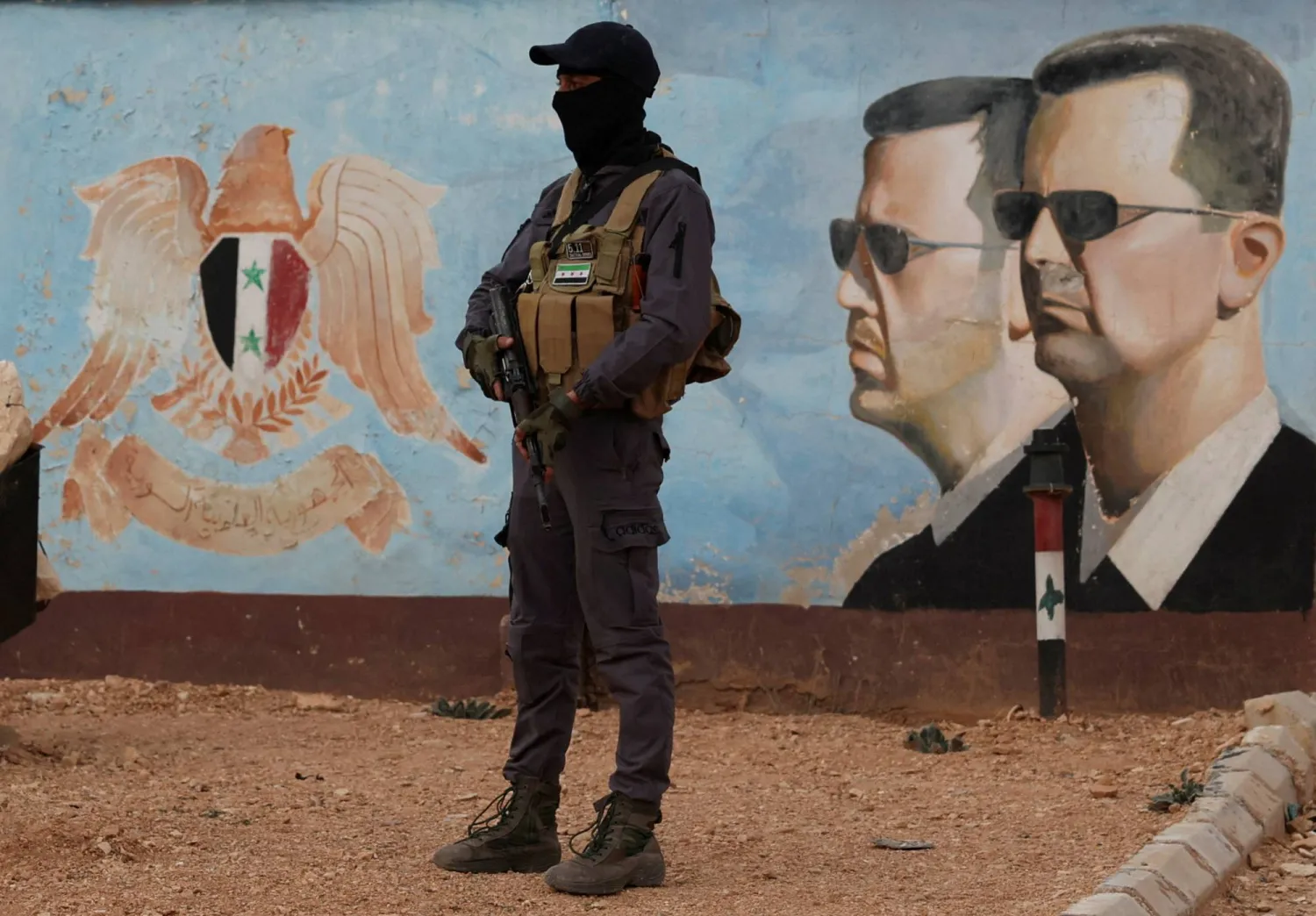
EU Renews Restrictions on People Involved in former Syria Administration under Assad

FILE PHOTO: Guard standing near an image of Syria's Bashar al-Assad at the fourth division headquarters in Damascus, Syria, January 23, 2025 REUTERS/Yamam Al Shaar/File Photo
TT

EU Renews Restrictions on People Involved in former Syria Administration under Assad

FILE PHOTO: Guard standing near an image of Syria's Bashar al-Assad at the fourth division headquarters in Damascus, Syria, January 23, 2025 REUTERS/Yamam Al Shaar/File Photo

The European Union has decided to renew restrictions on individuals and entities linked to the former Syrian administration run by Bashar al-Assad, who was toppled in December 2024.

"The EU considers that networks linked to the former al-Assad regime continue to retain influence and pose a risk of undermining the transition process and hindering efforts towards national reconciliation and accountability," said a statement from the Council of the European Union on Monday, Reuters reported.

"Those designated are subject to an asset freeze and EU citizens and companies are prohibited from making funds available to them. Individuals are additionally subject to a travel ban, which prevents them from entering or transiting through EU member states," it added.

The EU has, at the same time, increased ties with the new Syrian government, led by President Ahmed al-Sharaa, which replaced Assad's administration.

Earlier this month, EU foreign ministers agreed to restore trade ties with Syria, reinstating a cooperation agreement that had been suspended in 2011.


Palestinians in Gaza Mark Anniversary of Nakba, Say Today’s Catastrophe Is Worse

Palestinians inspect the site of an Israeli strike on a house that was pre-warned by the Israeli military to evacuate before the strike was carried out late on Monday, in Jabalia refugee camp in the northern Gaza Strip May 19, 2026. (Reuters)
TT

Palestinians in Gaza Mark Anniversary of Nakba, Say Today’s Catastrophe Is Worse

Palestinians inspect the site of an Israeli strike on a house that was pre-warned by the Israeli military to evacuate before the strike was carried out late on Monday, in Jabalia refugee camp in the northern Gaza Strip May 19, 2026. (Reuters)

Blink and you might miss the few stone walls that are all that’s left of the village that Yusuf Abu Hamam’s family was forced to flee when he was an infant in 1948.

The village, al-Joura, was demolished by the Israeli military at the time. It has since vanished under neighborhoods of the southern Israeli city of Ashkelon and the grounds of a national park.

The neighborhood where Abu Hamam’s family ended up — and where he spent most of his life — now lies also largely in ruins. Buildings in the Shati Camp in the northern Gaza Strip have been razed and wrecked by Israeli bombardment and demolitions during the past 2½ years of war.

On Friday, Abu Hamam and millions of Palestinians mark the 78th anniversary of the Nakba, Arabic for “catastrophe,” referring to the mass expulsion and flight of some 750,000 Palestinians from what is now Israel during the 1948 war surrounding Israel’s creation. It’s the third commemoration of the Nakba since the war in Gaza began.

The 78-year-old Abu Hamam, one of a dwindling number of Nakba survivors, says the current war is an even greater catastrophe.

Israel’s military has pushed deep into Gaza, now controlling 60% of the territory, Israeli Prime Minister Benjamin Netanyahu said on Friday, during a Jerusalem Day celebration.

"Today it is 60%, tomorrow we will see, tomorrow we will see,” he told a cheering crowd in Jerusalem.

More than six months after an October ceasefire, Gaza’s more than 2 million people are now crammed into less than half of the 25-mile-long strip along the Mediterranean coast, surrounded by the Israeli-controlled zone.

“There is no country left,” Abu Hamam said, speaking next to his home, which was heavily damaged by Israeli shelling earlier in the war. “A square kilometer and a half extending from the sea, this is what we are living in ... It’s indescribable, unbearable.”

For Palestinians, the Nakba meant the loss of most of their homeland. Some 80% of the Palestinians who lived in the area that became Israel were driven from their homes by forces of the nascent state before and during the war. The fighting began when Arab armies attacked following Israel’s establishment as a home for Jews in the wake of the Holocaust. Palestinians who remained behind hold Israeli citizenship.

After the war, Israel refused to allow Palestinian refugees to return to ensure a Jewish majority within its borders. Palestinians became a seemingly permanent refugee community that now numbers some 6 million, with most living in refugee camps in the Israeli-occupied West Bank, Lebanon, Syria, Jordan and Gaza.

Around 530 Palestinian villages in what became Israel were destroyed, according to the Palestinian Bureau of Statistics.

Abu Hamam’s birth village was one of them. Al-Joura was seized by the Israeli military as it advanced against Egyptian forces in November 1948. Soldiers were ordered to destroy every home in al-Joura and neighboring villages to ensure their Palestinian populations couldn’t come back, according to military archives cited by Israeli historian Benny Morris.

Refugees swelled the population of the tiny patch of territory along the southern coast that became the Gaza Strip. They stayed in tent camps, run by a newly created UN agency for Palestinians, UNRWA, which provided aid and schooling. Those camps, like Abu Hamam’s Shati Camp, grew into dense urban neighborhoods over the decades, before many were flattened during the latest Gaza war by Israeli bombardment.

In Gaza, Palestinians say they live a new Nakba

The ancestors of Ne’man Abu Jarad and his wife, Majida, were already living in what would become the Gaza Strip in 1948. They both recall stories from their families about refugees streaming in by foot from areas further north, like the village Abu Hamam came from.

Though they avoided the original Nakba, there was no escaping from what Majida now calls “our Nakba.”

Their hometown has been wiped off the map. Over the past year, Israeli bulldozers and controlled detonations have razed nearly every building in the northern Gaza towns of Beit Lahiya and Beit Hanoun. A new Israeli military base stands about 700 meters (765 yards) from where the Abu Jarads’ house once stood, according to satellite photos.

Also gone is the southern Gaza city of Rafah, once home to a quarter million people, and other villages and neighborhoods located in the Israeli-held half of the Gaza Strip. The military says it is destroying positions used by Hamas and preparing the area for reconstruction. Satellite photos show nearly every structure reduced to rubble.

Over the last 31 months of war, the Abu Jarads and their six daughters have been displaced more than a dozen times as they fled Israeli bombardment and offensives. They currently live in a camp in the southern city of Khan Younis. Their tent offers little shelter from biting winter winds or summer heat, Majida said.

Their daughters have been out of school for over two years now.

“The Nakba of ’48, I don’t think it can be compared to our Nakba,” Majida said. “In ’48, they say people were displaced once and settled in one place, and they are still there until now. But our Nakba, honestly, is more severe because our displacement has happened multiple times. There is no stability.”

Around 90% of Gaza’s more than 2 million people have lost their homes, according to UN estimates, with most of them now sheltering in huge tent camps with rat infestations and pools of sewage. They are dependent on aid to survive.

Israel’s offensive has killed over 72,700 Palestinians, according to local health officials. It was triggered by Hamas’ Oct. 7, 2023, attack on southern Israel that killed some 1,200 people. Militants also abducted 251 hostages.

In the northern West Bank, tens of thousands of Palestinians are entering their 15th month of displacement, after the Israeli military ordered them out of their refugee camps as it launched an operation it said was targeting militant groups.

Since then, troops have demolished or heavily damaged at least 850 structures across the refugee camps of Nur Shams, Jenin and Tulkarem, according to an analysis of satellite imagery by Human Rights Watch released in December.

Saving what was lost, again and again

The 1948 Nakba also brought the loss of Palestinians’ history, as those fleeing struggled to keep hold of the documents and possessions tying them to their homes.

One of the largest archives of Palestinian documents dating back to the Nakba belongs to UNRWA.

UNRWA staff members, who fled their offices in Gaza after Israel ordered the north evacuated, had to leave behind the agency’s extensive archive.

The staff then launched a mission to rescue the most crucial documents — birth, death and marriage certificates and refugee registration cards, according to Juliette Touma, a former senior UNRWA official.

Without those documents, Palestinians could lose their rights and refugee status. Staffers crammed their personal suitcases full of papers and carried them through checkpoints and out of the territory, Touma said.

The current war has cost Palestinians in Gaza what little remained of their personal histories. Majida’s parents’ home in Beit Hanoun was destroyed, and with it family photos.

“There is nothing left,” she said.

Abu Hamam, too, says everything has been lost.

“When this war came, it devoured trees, stones and people,” he said. “Entire families were erased from the civil registry. Hundreds of families are still buried under the rubble.”


Syrian Soldier Killed, 18 People Wounded by Car Bomb in Damascus

 Syrian security personnel inspect the site of an explosion outside a Defense Ministry building in Damascus, Syria, Tuesday, May 19, 2026. (AP)
Syrian security personnel inspect the site of an explosion outside a Defense Ministry building in Damascus, Syria, Tuesday, May 19, 2026. (AP)
TT

Syrian Soldier Killed, 18 People Wounded by Car Bomb in Damascus

 Syrian security personnel inspect the site of an explosion outside a Defense Ministry building in Damascus, Syria, Tuesday, May 19, 2026. (AP)
Syrian security personnel inspect the site of an explosion outside a Defense Ministry building in Damascus, Syria, Tuesday, May 19, 2026. (AP)

One Syrian soldier was killed and at least 18 people were wounded by a car bomb that exploded on Tuesday outside a Defense ‌Ministry building in ‌Damascus, authorities said.

Soldiers ‌had ⁠discovered a different ⁠bomb near the building in the capital's Bab Sharqi district and were trying to dismantle it ⁠when the car ‌bomb ‌went off nearby, the ‌Defense Ministry said in ‌a statement carried by state media.

The head of Syria's ambulance ‌and emergency directorate, Najib al-Nassan, told state-owned agency ⁠SANA ⁠that 18 injured people had been taken to hospitals after the explosion.

No group immediately claimed responsibility for the attack.


MSF Warns Aid Used for 'Military Objectives' in S.Sudan

FILE PHOTO: Sudanese women from community kitchens run by local volunteers prepare meals for people who are affected by conflict and extreme hunger and are out of reach of international aid efforts, in Omdurman, Sudan, June 22, 2024. REUTERS/Mazin Alrasheed/File Photo
TT

MSF Warns Aid Used for 'Military Objectives' in S.Sudan

FILE PHOTO: Sudanese women from community kitchens run by local volunteers prepare meals for people who are affected by conflict and extreme hunger and are out of reach of international aid efforts, in Omdurman, Sudan, June 22, 2024. REUTERS/Mazin Alrasheed/File Photo

Medical charity Doctors Without Borders warned Tuesday that aid in South Sudan was being "instrumentalized" for military and political objectives, despite the country's dire humanitarian needs.

After gaining independence in 2011, South Sudan descended into civil war and remains mired in extreme poverty, corruption and insecurity, said AFP.

Government troops under President Salva Kiir have again been clashing with militias allied to his longtime rival Riek Machar over the past 18 months, with conflict reported in 73 of 79 counties, according to the ACLED monitoring group.

Doctors Without Borders, known by its French initials MSF, warned of a "concerning trend" to block humanitarian and civilian access to contested or opposition-controlled areas and said all sides were using aid for "military and political objectives".

In a report, it said the government had prevented MSF from accessing Akobo town, a hotspot of recent fighting in Jonglei state, where the charity supported one of the few hospitals.

It condemned targeted attacks on other MSF facilities around the country between January 2025 and April 2026, saying an estimated 762,000 people had lost access to healthcare as a result.

MSF's warning comes as some global partners withdraw due to humanitarian cuts and others become increasingly outspoken about the country's dire governance.

Nick Checker, a senior US State Department official for Africa, said recently that the government had issued "insincere promises of reform" to elicit donor funds, "while simultaneously obstructing the delivery of lifesaving assistance".

The US embassy said in April the crisis was worsening despite billions of dollars in oil revenue and foreign assistance, while the United Nations says roughly two-thirds of the population faces acute hunger.