Iraqi Kataib Hezbollah Denies Link to Man Charged in US

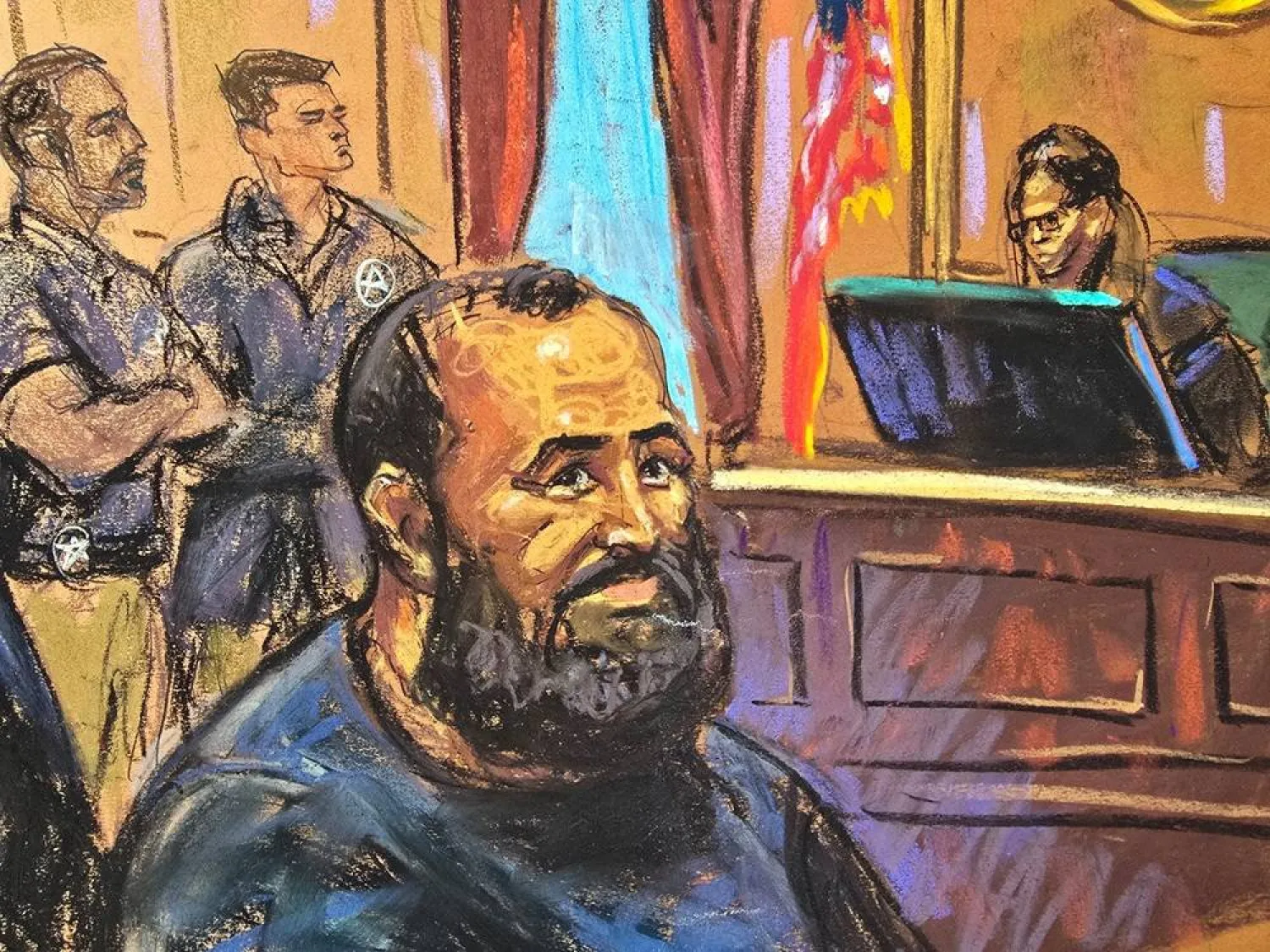
 Judge Sarah Netburn presides as Mohammad Al-Saadi, accused of planning an attack on a synagogue, appears in federal court in Manhattan, New York, US, May 15, 2026 in this courtroom sketch. (Reuters)
Judge Sarah Netburn presides as Mohammad Al-Saadi, accused of planning an attack on a synagogue, appears in federal court in Manhattan, New York, US, May 15, 2026 in this courtroom sketch. (Reuters)
TT

Iraqi Kataib Hezbollah Denies Link to Man Charged in US

 Judge Sarah Netburn presides as Mohammad Al-Saadi, accused of planning an attack on a synagogue, appears in federal court in Manhattan, New York, US, May 15, 2026 in this courtroom sketch. (Reuters)
Judge Sarah Netburn presides as Mohammad Al-Saadi, accused of planning an attack on a synagogue, appears in federal court in Manhattan, New York, US, May 15, 2026 in this courtroom sketch. (Reuters)

The Iran-backed Iraqi group Kataib Hezbollah, denied on Monday that a man accused of plotting attacks in the United States and Europe was a member of the group.

US authorities on Friday detailed charges against Mohammad Baqer Saad Dawood Al-Saadi, 32, who was identified as a senior figure in Kataib Hezbollah, which the US designates as a terrorist organization.

"The abductee, Mohammaed Baqer al-Saadi does not belong to Kataib Hezbollah," the group's security commander Abou Moujahed al-Assaf said in a statement.

But he added that Saadi "will return to his country with his head held high, because he is among the lovers and supporters of the resistance."

According to US court filings, Saadi and unidentified associates planned, coordinated and claimed responsibility for at least 18 attacks in Europe, and two in Canada, including a non-fatal stabbing of two Jewish men in London, and several arson attacks on synagogues in other countries.

He is most recently alleged to have also plotted attacks in the United States.

He appeared on Friday at a Manhattan court where he was charged with six counts including conspiracy to provide material support to Kataib Hezbollah and Iran's Revolutionary Guard Corps (IRGC).

A senior Iraqi security source told AFP that Saadi was arrested in Türkiye before being transferred to the US.

Kataib Hezbollah is part of the umbrella movement known as the “Islamic Resistance in Iraq”, which claimed hundreds of attacks against US interests in Iraq and the wider region during the Middle East war.

The attacks have ceased since a ceasefire was announced in April.

The US State Department announced last month that it was offering up to $10 million for information on the group's leader, Ahmad al-Hamidawi.


Lebanon Between Two Truces: More Than 100 Evacuation Warnings, 970 Homes Destroyed

Mourners attend the funeral of two Lebanese Civil Defense members killed in an Israeli strike on the city of Nabatieh on May 13, 2026. (Reuters) 
TT

Lebanon Between Two Truces: More Than 100 Evacuation Warnings, 970 Homes Destroyed

Mourners attend the funeral of two Lebanese Civil Defense members killed in an Israeli strike on the city of Nabatieh on May 13, 2026. (Reuters) 

Field data gathered since the Lebanon-Israel ceasefire took effect on April 17 shows the truce has brought little calm on the ground. Southern areas have remained under strikes, evacuation warnings and continued destruction, reinforcing the view that the military operations have shifted from broad confrontation to sustained military and security pressure.

Asharq Al-Awsat documented around 41 villages and border points that Israel still controls, occupies or maintains positions in or around since the latest war and the ensuing field arrangements. More than 100 evacuation warnings were issued during the period, including 104 alerts targeting villages and towns across the South, Nabatieh and Bekaa governorates.

The warnings extended beyond southern border areas into the western Bekaa, including Sohmor, Yohmor, Mashghara, Zellaya and Eliya, reflecting the widening geographic scope of military pressure.

Researcher and writer Mohammad Shamseddine said field data recorded between April 17 and May 13 pointed to a continuing heavy toll in southern Lebanon despite the declared truce.

Shamseddine told Asharq Al-Awsat that 970 homes were completely destroyed during the period, while 545 sustained severe damage and around 3,400 suffered minor damage.

The figures underscore not only the scale of material losses, but also the continuing impact of the war despite the ceasefire, with direct consequences on residents, returns and reconstruction efforts.

The human toll has also continued to rise. According to Lebanon’s Ministry of Public Health operations room, 694 people were killed and 1,666 wounded between midnight on April 16 and May 17.

Fears of a New Security Belt

Retired Brig. Gen. Naji Malaeb said recent Israeli movements point to an attempt to establish new security realities inside Lebanese territory rather than carry out limited military operations.

“Recent developments in southern Lebanon suggest Israel is pursuing an approach that goes beyond localized operations toward imposing a new security reality through control of hills and strategic high ground inside Lebanese territory,” Malaeb told Asharq Al-Awsat.

He stressed that developments following the truce, particularly in recent days in areas stretching between Deir Siryan, Deir Aames and villages opposite the Shaqif area, showed a clear focus on strategically important terrain.

“There appears to be an effort to recreate the model Israel adopted in late November 2024, when it advanced toward several hills and highlands and established positions and defensive lines inside Lebanese territory,” he remarked.

Malaeb warned of Israeli attempts to shift the defensive line to new locations along a chain of hills and natural elevations, potentially creating a security belt or buffer zone that would provide strategic military advantages.

He said a key issue after the ceasefire announcement was the differing interpretations of the agreement itself. A statement issued by the US State Department after meetings with envoys, he noted, treated Israel’s actions as self-defense rather than direct hostile acts.

“Israel relies on this interpretation in its approach on the ground, presenting its operations as preemptive measures to prevent future threats rather than conventional offensive operations,” he said. “This is highly sensitive because it leaves the door open to continued military operations under different labels.”


Erbil Stresses it Does Not Want to Get Involved in Conflict with Tehran

A photograph shows a fire at the site of a drone strike in Iraq's northeastern city of Sulaymaniyah in the autonomous Kurdistan region late on March 3, 2026. (AFP)
TT

Erbil Stresses it Does Not Want to Get Involved in Conflict with Tehran

A photograph shows a fire at the site of a drone strike in Iraq's northeastern city of Sulaymaniyah in the autonomous Kurdistan region late on March 3, 2026. (AFP)

A prominent Kurdish security official denied on Monday the Iranian Revolutionary Guards Corps’ (IRGC) repeated claims that the Iraqi Kurdistan Region had allowed American weapons shipments to the Iranian Kurdish opposition.

Speaking to Asharq Al-Awsat on condition of anonymity, the official described the claims as “inaccurate,” adding that “Kurdish authorities in the region do not allow arms shipments or the delivery of any other illicit goods to Iran because that would primarily harm its security and because Kurdistan does not want to become embroiled in a conflict with Iran.”

Such a conflict may have “dangerous” repercussions, he warned. Kurdistan “will not become a party to any regional war.”

At the same time, the official did not rule out the possibility that arms trade groups were carrying out smuggling operations without the knowledge of the authorities.

Kurdish authorities had repeatedly denied over the recent months that weapons were being smuggled to Iran through its territories.

Reports had said that Washington was smuggling weapons into Iran and US President Donald Trump had hinted at support to the opposition in Iran.

The IRGC announced on Monday the thwarting for a “large” American arms smuggling operation from Kurdistan to Iran.

Trump had previously accused a Kurdish party of failing to deliver American weapons that were to be sent to Iranian protesters, expressing his “disappointment” in them.

Washington had “sent some guns with ammunition, and it was supposed to be delivered, but they kept it,” he revealed without disclosing which Kurdish party he was referring to.

Kurdish authorities refuted Trump’s claims.

Excuse to strike Kurdistan

Kifah Mahmoud, media advisor to Kurdistan Democratic Party president Masoud Barzani, strongly denied Iran and the US’ claims about the weapons smuggling.

He told Asharq Al-Awsat that the claims are being used by Iran as an excuse to carry out almost daily strikes against Kurdish cities or Iranian opposition camps. He accused Tehran and its allied armed factions of launching the attacks.

He denied that the Iranian opposition in Kurdistan was carrying out any “hostile” activities against Tehran, explaining that their camps are supervised by the United Nations.

Kurdish authorities also oppose any hostile acts against Iran being carried out from its territories, he stressed.

Similar to the Kurdish official, he did not deny that arms smuggling operations were taking place between Iran and Iraq.

Furthermore, Kurdistan itself suffers from drugs smuggling operations, which the official authorities have constantly strived to counter, Mahmoud added.

He also dismissed Trump’s claims about the stolen weapons shipment, saying all Kurdish parties have rejected them.


Palestinian President's Son Vows to Put 'Gaza First'

Yasser Abbas, newly-elected member of Fatah's central committee, poses for a picture at his office in Ramallah in the occupied West Bank on May 18, 2026. (AFP)
TT

Palestinian President's Son Vows to Put 'Gaza First'

Yasser Abbas, newly-elected member of Fatah's central committee, poses for a picture at his office in Ramallah in the occupied West Bank on May 18, 2026. (AFP)

The son of Palestinian president Mahmoud Abbas on Monday said Fatah would prioritize Gaza and return it "to the fold of Palestinian legitimacy", the day after being elected to the movement's top decision-making body.

Fatah's first congress in a decade came as the Palestinian movement faces existential challenges in the wake of the devastating Gaza war, said AFP.

Veteran Palestinian leader Mahmoud Abbas, 90, was re-elected as head of the movement, with his 64-year-old son Yasser Abbas securing a place on its central committee.

In his first remarks since his election, Yasser Abbas said he would focus on "Gaza first, prisoners and the families of martyrs, and the refugee camps."

"We will work to return Gaza to the fold of Palestinian legitimacy," he told journalists in the occupied West Bank city of Ramallah.

Fatah has historically been the dominant force within the Palestine Liberation Organization (PLO), the sole representative of the Palestinian people in international forums.

It groups most Palestinian factions but excludes the Hamas and Islamic Jihad movements.

"Achieving full national unity requires agreement to all the conditions for joining the Palestine Liberation Organization in all its provisions: one law, one state, one legitimate weapon, and recognition that the organization is the sole legitimate representative" of the Palestinian people, Yasser Abbas said.

"Whoever accepts that is welcome."

In recent decades, Fatah's popularity and influence have dwindled amid internal divisions and growing public frustration over the stagnation of the Israeli-Palestinian peace process.

The sense of disappointment led to a surge in support for rival Hamas, which won the last legislative elections held in 2006, before going on to expel Fatah from the Gaza Strip after a bout of factional fighting.

Under US President Donald Trump's Gaza peace plan, Hamas is to play no role in the future governance of the territory.

It also demands sweeping reforms of the Fatah-led Palestinian Authority as a condition for it to play any meaningful role in post-war Gaza.

On Monday, the Fatah congress announced the official preliminary results of the elections for its central committee and the revolutionary council, the party's parliament.

A closing statement read out on Monday said that: "there is no state without Gaza, and no state in Gaza".

"Any international administrative arrangement must preserve the ceasefire, end the occupation, ensure the flow of aid, and begin recovery and reconstruction, all clearly linked to the Palestinian government, which must be enabled to exercise all its responsibilities in Gaza," it added.

It also said it was moving towards elections for the Palestinian National Council, the PLO parliament, on November 1, followed by general elections.

Abbas and the Palestinian Authority are under mounting international pressure to implement reforms and hold elections, amid widespread accusations of corruption and political stagnation.