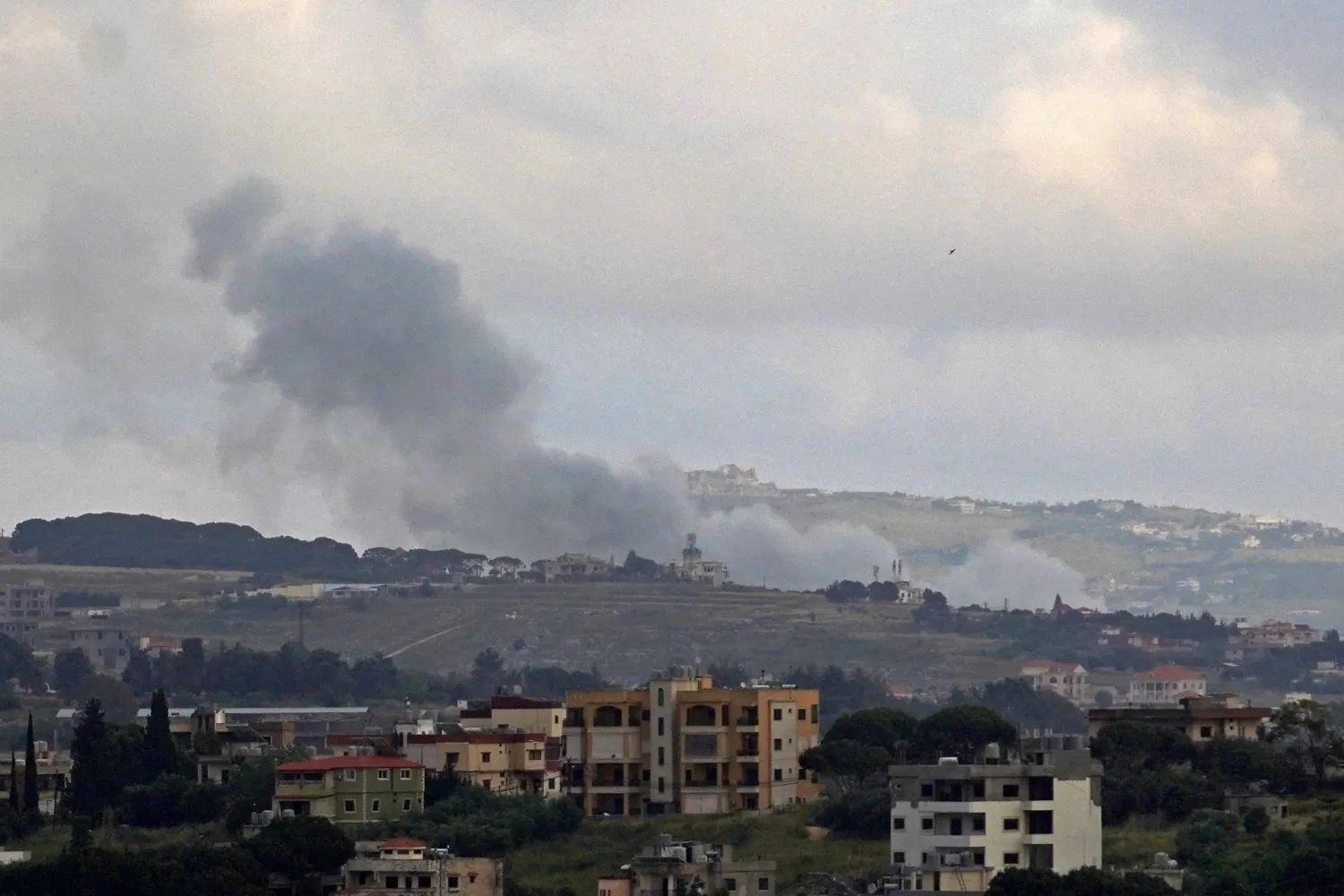
Lebanon Says Israeli Strike Kills Six, Including Two Rescuers and Child

Smoke rises from the site of an Israeli strike that targeted the southern Lebanese village of Kfar Tibnit on May 21, 2026.  (Photo by Abbas FAKIH / AFP)
Smoke rises from the site of an Israeli strike that targeted the southern Lebanese village of Kfar Tibnit on May 21, 2026. (Photo by Abbas FAKIH / AFP)
TT

Lebanon Says Israeli Strike Kills Six, Including Two Rescuers and Child

Smoke rises from the site of an Israeli strike that targeted the southern Lebanese village of Kfar Tibnit on May 21, 2026.  (Photo by Abbas FAKIH / AFP)
Smoke rises from the site of an Israeli strike that targeted the southern Lebanese village of Kfar Tibnit on May 21, 2026. (Photo by Abbas FAKIH / AFP)

An Israeli strike on southern Lebanon killed six people on Friday, including two rescuers and a child, the Lebanese health ministry said, despite a fragile ceasefire in the Israel-Hezbollah war. 

In a statement, the ministry said that "six people were martyred" including two rescuers from the Risala Scouts association, one of them also working as a freelance photographer, and a Syrian girl in a strike on Deir Qanun al-Nahr village. The association is linked with the Hezbollah-allied Amal movement. 

An earlier strike on the southern town of Hanaway on Friday also killed four rescuers from the Hezbollah-linked Islamic Health Committee, the ministry said. 


‘Dawn of Yemen’ Offensive Intensifies Pressure on Houthis by Land and Air

Fighters from the Yemeni government’s Southern Giants Brigades near the Bab al-Mandab Strait (AP) 
TT

‘Dawn of Yemen’ Offensive Intensifies Pressure on Houthis by Land and Air

Fighters from the Yemeni government’s Southern Giants Brigades near the Bab al-Mandab Strait (AP) 

The Dawn of Yemen military offensive entered its seventh day on Sunday, with intensified airstrikes targeting Houthi positions and reinforcements in Taiz and along the western coast, as government forces pressed their ground assault and surrounded Houthi groups near the Bab al-Mandab Strait.

Military estimates put Houthi casualties at around 12,000 killed and wounded during the operation’s first six days.

Airstrikes extended beyond the Taiz frontlines to military targets in Houthi-held areas of Sanaa, Saada, Hajjah and Ibb, while government forces received air support as the Houthis attempted to recapture positions along the western coast.

On the western coast, the Southern Giants Brigades announced the destruction of five Houthi armored vehicles, killing their occupants, during an attempted advance toward Dhubab Airport. The brigades also reported repelling an attack north of the airport as airstrikes targeted Houthi reinforcements.

Government forces are seeking to consolidate control over recaptured areas around Bab al-Mandab, Mayyun Island and the Kahbub Mountains, preventing the Houthis from retaking strategic positions overlooking the strait.

More Than 1,900 Strikes in 24 Hours

The armed forces announced more than 1,900 direct precision strikes over 24 hours across the eastern, western and southwestern fronts.

Military spokesman Col. Majed al-Nuzaili explained that the strikes targeted weapons and ammunition depots, fortifications, military camps, strategic hilltop positions, troop concentrations, artillery emplacements and supply vehicles.

He added that high-value military targets deep inside Houthi-held territory were also struck.

Preliminary field estimates indicated that more than 1,150 Houthi fighters had been neutralized and over 180 combat, transport and supply vehicles destroyed or disabled during the same period, according to Nuzaili. Ground forces also advanced, recapturing additional positions and securing strategic heights.

In Taiz, military sources reported continued clashes southeast and west of the city, with government troops and Popular Resistance fighters repelling Houthi attacks and striking their positions and movements.

Government Vows to Restore State Authority

Presidential Leadership Council Chairman Rashad al-Alimi reaffirmed the leadership’s determination to continue the offensive until the Houthi threat is eliminated and state institutions restored, regardless of the sacrifices required.

Prime Minister Shaya Mohsen al-Zindani maintained that the operation was steadily achieving its objectives, with the Southern Giants Brigades and Nation’s Shield Forces advancing with support from the Saudi-led coalition to secure Bab al-Mandab, Dhubab and the Kahbub Mountains.

He described the gains as reflecting Yemenis’ determination to end the Houthi takeover and restore state authority.

Zindani accused the Houthis of targeting civilians and civilian infrastructure, citing the recent attack on Aden International Airport and violations in Taiz. He also praised Saudi support as crucial to restoring state institutions and protecting national security.

Meanwhile, the cabinet warned that the Houthis’ expanding siege of Taiz threatened the lives, security and livelihoods of more than six million residents.

It instructed civilian, security and military authorities to coordinate efforts to protect residents, maintain essential services, ensure humanitarian aid deliveries and address security threats while respecting international humanitarian law.

The cabinet urged the United Nations and international community to pressure the Houthis to halt their attacks and lift the siege, reaffirming its commitment to restoring state authority and achieving the offensive’s objectives.



Egypt’s Consul to Asharq Al-Awsat: Repatriation of Azza’s Body to Cairo Nears Completion

Egyptian flight attendant Azza Ramzy
TT

Egypt’s Consul to Asharq Al-Awsat: Repatriation of Azza’s Body to Cairo Nears Completion

Egyptian flight attendant Azza Ramzy

The formal procedures for repatriating the body of Egyptian flight attendant Azza Ramzy to Cairo is expected to arrive on Monday, pending the completion of the necessary permits and shipping arrangements, a senior official at the Egyptian Embassy in Saudi Arabia revealed on Sunday.

Meanwhile, the health condition of seven Egyptian nationals injured in the attack on Riyadh's King Khalid International Airport, have stabilized. Two have been discharged from the hospital after receiving treatment, while the remaining five continue to receive medical care.

“The relevant authorities are working to complete the procedures for repatriating the body of Azza Ramzy after obtaining the transfer permit and finalizing the police report and death-related documents,” the consul general of the Egyptian embassy in Riyadh, Yasser Hashem, told Asharq Al-Awsat in a phone interview.

He said the procedures were progressing well and were expected to be completed on Sunday.

“The airline company for which Azza worked as a flight attendant would handle arrangements to transport her body to Cairo,” Hashem said.

He noted that a flight would be scheduled after preparing the coffin and coordinating with the shipping company and the relevant authorities.

According to Hashem, Azza’s body would be repatriated from Riyadh, depending on operational conditions at King Khalid International Airport and flight availability.

He affirmed that seven Egyptians were injured in the attack. Two of them received medical care and were discharged from the hospital, while the remaining five continue their treatment.

According to information obtained by Asharq Al-Awsat, Azza Ramzy spent three years working in Saudi Arabia. During that time, she left a positive impression on those who knew her, earning respect for her good character, dedication to her work and ambition.

One of Azza’s friends told Asharq Al-Awsat that she was the youngest of her siblings and was known for her exemplary character, good manners and respect for others.


2 Killed Near Israeli-Occupied Zone in South Lebanon

A Lebanese flag placed on a damaged olive tree in the southern Lebanese village of Zawtar al-Gharbiyeh, near the neighboring village of Zawtar al-Sharqiyeh, where Israeli forces are stationed, in southern Lebanon, 10 October 2026. (EPA)
TT

2 Killed Near Israeli-Occupied Zone in South Lebanon

A Lebanese flag placed on a damaged olive tree in the southern Lebanese village of Zawtar al-Gharbiyeh, near the neighboring village of Zawtar al-Sharqiyeh, where Israeli forces are stationed, in southern Lebanon, 10 October 2026. (EPA)

Two men were killed in south Lebanon on Sunday, one by Israeli fire and the other by an explosive remnant of war, as they took part in the annual olive harvest, according to state media and local officials.

South Lebanon has been the scene of two wars since 2023 between Israel and Iran-backed Hezbollah, and Israeli troops still occupy a band of territory 10 kilometers (six miles) wide running along the border.

The official National News Agency (NNA) said one of the men was killed in Yater, in Bint Jbeil district, when Israeli "shelling targeted the outskirts of the town while he was inspecting his land and olive harvest".

The Lebanese army blamed Israeli tank fire and called the ongoing attacks "a flagrant breach of existing agreements".

Afterwards, the Yater municipality urged residents "to avoid the outskirts of the town and refrain from crossing the earthen barrier separating some unsafe neighborhoods" for fear of Israeli attacks.

In the village of Froun, in the same district, the NNA reported that "a foreign object" left over from previous Israeli operations exploded and killed an engineer as he and others tended their trees.

The engineer had come down from Beirut, where he lives, for the harvest, Froun mayor Hassan Bazzi told AFP.

The incident prompted local residents to call off the harvest and wait for "the Lebanese army to complete the decontamination of the village", Bazzi said.

Since a framework agreement between Lebanon and Israel was struck in June, the violence in the south has diminished but not stopped.

Israel continues to carry out sporadic strikes and demolitions in and around the territory it occupies, while Hezbollah refuses to submit to government plans to disarm it.

About eight kilometers (five miles) away, in Jibshit, volunteers from the north came to help locals with the harvest in a show of solidarity.

"From north to south, one people and one land," said organizer Ahmad Chahhal.

As workers swatted at branches to make the olives fall, an AFP photographer saw drones and heard fighter jets overhead, and explosions could be heard in the distance.

Hezbollah drew Lebanon into the Middle East war in early March by launching attacks against Israel in support of its backer Iran. Israel responded with an intense bombing campaign and a ground invasion.

The framework deal between Lebanon and Israel involves Hezbollah's disarmament, a gradual Israeli withdrawal and the deployment of the Lebanese army to the region.