


Hamas Calls Netanyahu’s Plan to Expand Control in Gaza a Dangerous Escalation

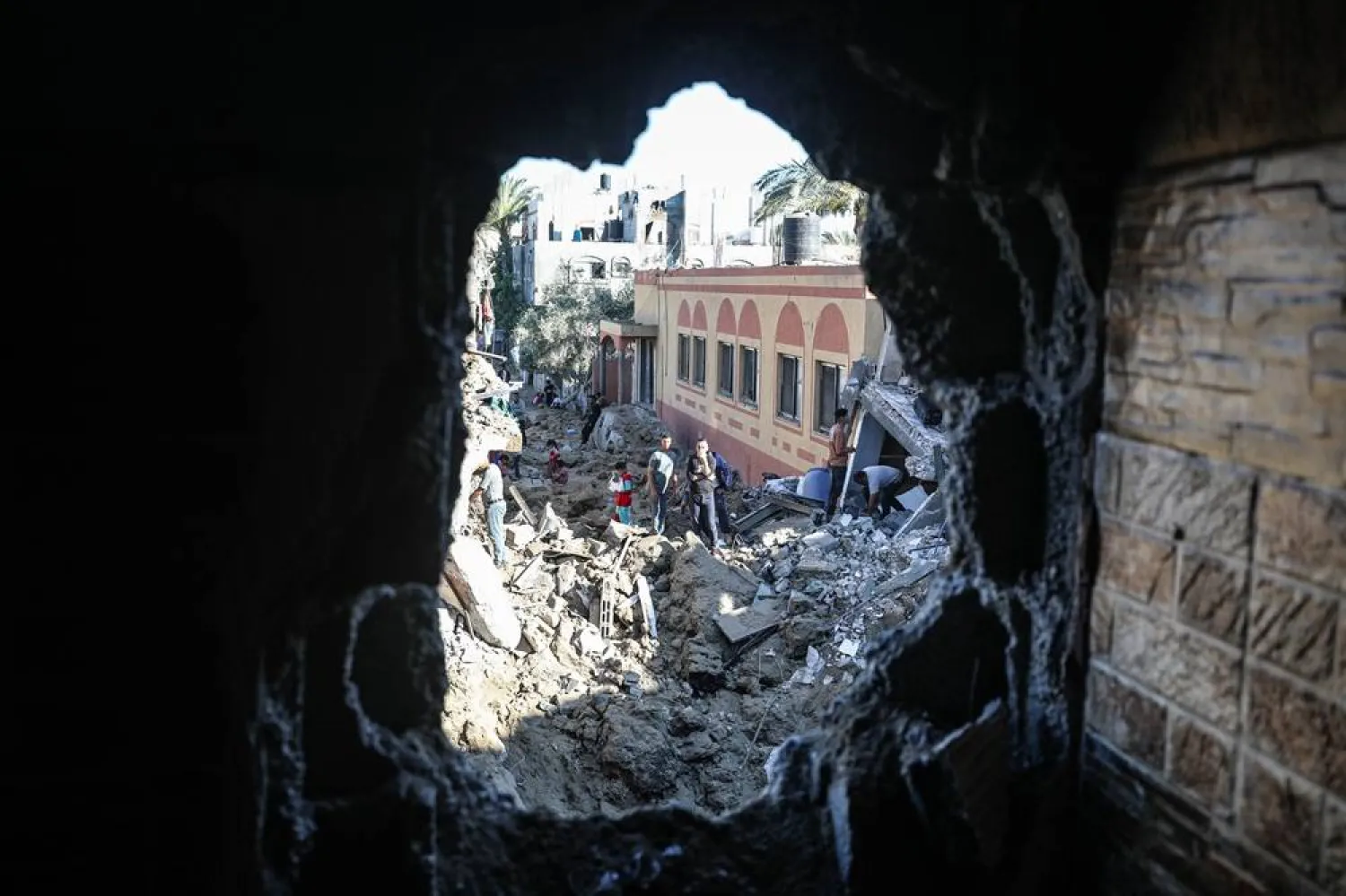
 29 May 2026, Palestinian Territories, Dair al-Balah: Palestinians inspect the rubble of a building destroyed in an Israeli airstrike in Deir al-Balah, central Gaza Strip. (dpa)
29 May 2026, Palestinian Territories, Dair al-Balah: Palestinians inspect the rubble of a building destroyed in an Israeli airstrike in Deir al-Balah, central Gaza Strip. (dpa)
TT

Hamas Calls Netanyahu’s Plan to Expand Control in Gaza a Dangerous Escalation

 29 May 2026, Palestinian Territories, Dair al-Balah: Palestinians inspect the rubble of a building destroyed in an Israeli airstrike in Deir al-Balah, central Gaza Strip. (dpa)
29 May 2026, Palestinian Territories, Dair al-Balah: Palestinians inspect the rubble of a building destroyed in an Israeli airstrike in Deir al-Balah, central Gaza Strip. (dpa)

Hamas said on Friday that Israeli Prime Minister Benjamin Netanyahu's declaration that his country would expand its area of control in Gaza was a dangerous escalation, as residents of the Palestinian territory also voiced alarm at the plan.

Under a ceasefire deal in October Israel's military was to remain in control of 53% of Gaza, but Netanyahu said on Friday that it would expand that area to an initial 70%, without laying out details or a timeline.

The Palestinian group, which triggered two years of devastating warfare in Gaza with its October 7, 2023, attack on Israel, described his comments as a plan for ethnic cleansing and forced displacement of Palestinians.

MAJOR DISPUTES POSTPONED

"Any attempt to impose a new reality of occupation in Gaza is null and illegitimate," said Ismail al-Thawabta, head of the Hamas-run Gaza government media office, adding that Netanyahu's statement "represents a dangerous escalation".

More than eight months into the ceasefire, and with global attention fixed on the war in Iran, Gaza's underlying conflict remains stubbornly ‌unresolved with continued ‌Israeli attacks, little aid reaching civilians and the risk of major new violence.

Israel has already expanded its ‌area ⁠of control in ⁠Gaza from the 53% lying behind a "yellow line" mapped into the ceasefire deal up to around 64%, with an area it has designated as restricted in maps shared with aid groups.

Any further reduction in space available to the more than 2 million Gaza residents who are mostly crammed into tents in the tiny Palestinian territory risks worsening already dire conditions there.

"Where do we go? To the sea? There is no space," said Mohammed al-Shagra, 72, in Khan Younis.

Last year's deal brokered by US President Donald Trump established a Board of Peace to oversee a phased ceasefire, and was ratified by the United Nations Security Council.

However, many of the toughest areas of dispute including the disarmament of Hamas, a full Israeli ⁠withdrawal and the make-up of a Gaza government were postponed to later in the process. ‌

The Board of Peace negotiators have been talking to both sides on the disarmament issue.

Israel ‌and Hamas have repeatedly accused each other of violating the truce. Israeli strikes in Gaza have killed more than 900 Palestinians since the start of ‌the truce while Palestinian attacks have killed four Israeli soldiers.

Israel's military and the prime minister's office did not immediately respond ‌to a Reuters request for additional information and comment on Netanyahu's statement.

A spokesperson for the Board of Peace said it would not have a comment on Netanyahu's statement.

The foreign ministries of permanent UN Security Council members Britain and France did not immediately respond to requests for comment.

A German foreign ministry spokesperson said Germany was concerned about Israeli plans to take more of Gaza and opposed a permanent division of the Palestinian territory.

RISK OF FURTHER VIOLENCE

Facing ‌elections this year and under pressure for Israel's failure to secure its strategic goals in wars in Iran and Lebanon, Netanyahu may be seeking to bolster his standing with voters.

"He's determined ⁠to look tough in front of ⁠the electorate and he's blamed by his opponents for having fought this seven-front war, but having won none of the wars," said Max Rodenbeck, Israel-Palestine Project Director at International Crisis Group.

"Unless there's some sort of pushback from the Trump administration it really does risk a return to something very bloody," he added, pointing to other ways in which Israel has been ramping up pressure on Hamas including continued aid restrictions on Gaza and strikes targeting Hamas figures.

For people inside Gaza, where nearly all the population had to flee their homes during the war and with most still living in temporary tents or shelters, the prospect of increased Israeli military pressure is alarming.

"We see no ceasefire or anything and they keep advancing beyond the yellow line. For how long will the world stay silent?" said Mohammed al-Jundi, a displaced man in Gaza City.

In Israel, a return to tougher military pressure is seen by security hawks as the only way to force Hamas to disarm and achieve a longer-term agreement.

"It looks as if we are taking a step towards another collision. But I believe this time it will be much shorter and maybe would open the path towards a new future," said Kobi Michael, a researcher at Israel's Institute for National Security Studies and a former official in the country's strategic affairs ministry.




Lebanon Urges Greece to Help Implement Truce with Israel

Greek President Konstantinos Tasoulas (R) talks next to Lebanese President Joseph Aoun (L) during their meeting at the Presidential Palace in Athens, Greece, 31 August 2026. (EPA)
TT

Lebanon Urges Greece to Help Implement Truce with Israel

Greek President Konstantinos Tasoulas (R) talks next to Lebanese President Joseph Aoun (L) during their meeting at the Presidential Palace in Athens, Greece, 31 August 2026. (EPA)

Lebanese President Joseph Aoun asked Greece on Monday for support to help implement a ceasefire agreement with Israel and end Israeli attacks on his country, hours after Greece and Israel announced a multibillion arms deal.

The June 26 accord, brokered by the United States, says both sides must cease hostilities and allow the Lebanese army to restore control over the entire country.

Beirut wants Israel to withdraw from all territory it has occupied in southern Lebanon. Israel first wants Lebanese group Hezbollah evacuated from the sector.

"Lebanon and the Lebanese people are tired of wars, and from the start of the negotiations with Israel the aim was to put an end to the state of hostility," Aoun told a press conference in Athens alongside Greek President Konstantinos Tassoulas.

"The framework agreement ... cannot be implemented unilaterally. It needs to be implemented on both sides," he insisted.

"We request Greece's assistance as much as possible to help Lebanon."

Lebanon was dragged into the US-Israeli war against Iran in March, when Israel launched a massive bombardment of its neighbor and invaded, while Hezbollah fired missiles at Israeli territory.

Since then, Aoun said, Israeli strikes have killed 4,300 Lebanese, wounded 12,000 and destroyed 60-70 villages.

"Solving the problem by military force will not succeed," he said, insisting on the total withdrawal of Israeli forces from his country.

After a later meeting, Greek Prime Minister Kyriakos Mitsotakis said Greece supported "the sovereignty, independence and unity of Lebanon" and would support "all efforts aimed at de-escalation and mutual comprehension".

On Monday, Greece and Israel announced Athens was buying a $3.5-billion aerial defense system from Israel.


Iraq Sentences Kidnapper of US Journalist to 15 Years in Prison

American freelancer Shelly Kittleson. (Facebook)
TT

Iraq Sentences Kidnapper of US Journalist to 15 Years in Prison

American freelancer Shelly Kittleson. (Facebook)

Iraq's judiciary has sentenced a man to 15 years in prison for the kidnapping of an American journalist who was abducted earlier this year by a powerful Iran-backed group, a judicial source said Monday.

At the height of the Middle East war, on March 31, Kataeb Hezbollah kidnapped journalist Shelly Kittleson in Baghdad, holding her for several days before setting her free just hours before the United States and Iran agreed to a ceasefire.

Iraqi authorities arrested one member of the group at the time.

According to a document shared by local media, a criminal court on Sunday sentenced Amir Rahim Jabbar to 15 years in prison under an "anti-terrorism law... for the crime of kidnapping" Kittleson.

A judicial source verified to AFP the document's authenticity, and a Kataeb Hezbollah source confirmed the ruling against one of its members.

Kittleson, who shared a copy of the ruling on X, said she was "grateful to the Iraqi judiciary".

Kataeb Hezbollah is among several pro-Iran armed groups that intervened in support of Tehran during the Middle East war, claiming attacks on US facilities in Iraq and across the region.

Under mounting US pressure to curb Tehran's influence, the new Iraqi government of Prime Minister Ali al-Zaidi says it is committed to ensuring that pro-Iran armed groups, which Washington designates as terrorist organisations, hand over their weapons to the state.

The issue has fuelled tensions in Iraq, with several groups, including Kataeb Hezbollah, refusing to disarm.

Earlier this month, Kataeb Hezbollah accused Zaidi of engaging in "provocative and irresponsible actions".

Baghdad was once notorious for kidnappings and attempted abductions, but they have decreased as the security situation in Iraq improved in recent years.


Israeli Fire Kills Two People in Gaza, Medics Say

Smoke rises following an Israeli strike at the al-Bureij refugee camp in central Gaza Strip on August 24, 2026. (AFP)
TT

Israeli Fire Kills Two People in Gaza, Medics Say

Smoke rises following an Israeli strike at the al-Bureij refugee camp in central Gaza Strip on August 24, 2026. (AFP)

An Israeli strike killed at least two Palestinians in the Gaza Strip on Monday, health officials said.

Medics said two people were killed and several others wounded when an Israeli airstrike hit a crowd of people near the municipal public ‌park in ‌Gaza City, an ‌area ⁠densely populated with displaced ⁠families.

The Israeli military did not immediately comment on the incident.

An October 2025 US-backed ceasefire halted major fighting in the shattered territory, but it ⁠failed to end strikes ‌by ‌the Israeli military, which says such actions ‌are aimed at thwarting attacks ‌by Hamas and other Gaza fighters.

Hamas accuses Israel of violating the ceasefire and undermining efforts to ‌implement a broader plan by US President Donald Trump ⁠to ⁠end the Gaza conflict, which also includes Israeli withdrawals and Hamas disarmament.

More than 1,300 Palestinians have been killed in Gaza since the ceasefire took effect last October, according to Gazan health officials, while the Israeli military says four Israeli soldiers have been killed.