
Israel's Netanyahu Orders Attacks in Beirut's Southern Suburbs

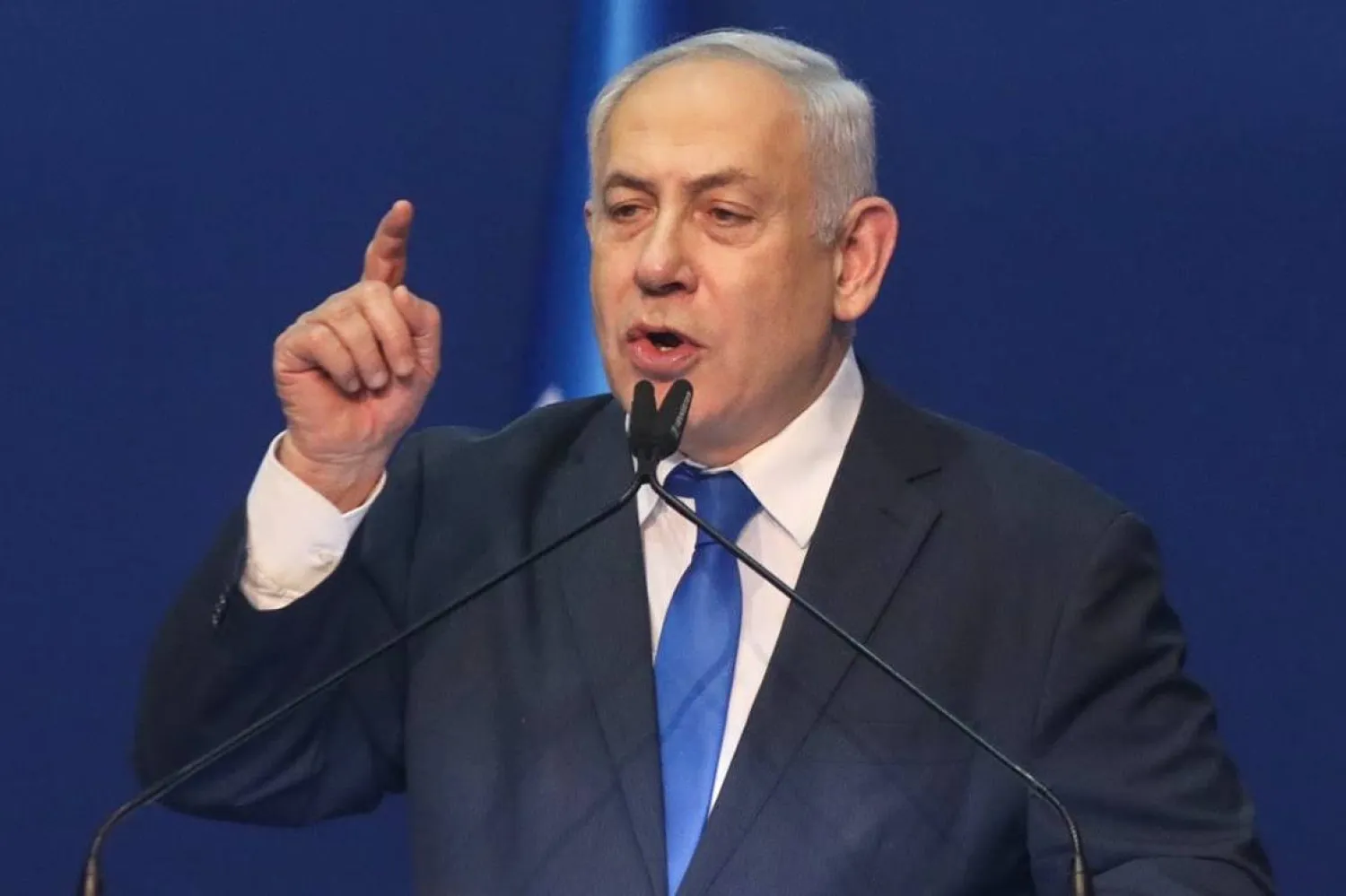
FILED - 03 March 2020, Israel, Tel Aviv: FILE PHOTO - Israeli Prime Minister Benjamin Netanyahu delivers an address. Photo: Ilia Yefimovich/dpa
TT

Israel's Netanyahu Orders Attacks in Beirut's Southern Suburbs

FILED - 03 March 2020, Israel, Tel Aviv: FILE PHOTO - Israeli Prime Minister Benjamin Netanyahu delivers an address. Photo: Ilia Yefimovich/dpa

Israeli Prime Minister Benjamin Netanyahu ordered attacks on the Hezbollah-controlled southern suburbs of Beirut on Monday, signaling further escalation of a war that has complicated mediation towards resolving the US-Iran conflict. 

Iran's foreign ministry spokesperson, Esmaeil Baghaei, said on Monday that Israeli attacks in Lebanon were among factors causing a delay to the diplomatic process to end the US-Iran war, reiterating that a Lebanon ceasefire was an integral part of any deal. 

Netanyahu and Defense Minister Israel Katz ordered the Israeli military to attack "terrorist targets" in the southern suburbs of Beirut, known as Dahiyeh, following Hezbollah's "repeated violations" of a ceasefire and "attacks against our cities and citizens", a statement from Netanyahu's office said. 

Having pounded Dahiyeh in the early weeks of the war, Israel has carried out only two strikes on the area since US President Donald Trump announced a ‌Lebanon ceasefire on ‌April 16, even as hostilities have raged in southern Lebanon. 

ISRAEL CAPTURES 900-YEAR-OLD CASTLE 

The ‌order ⁠follows an intensification ⁠of hostilities in the south over the weekend, with Israeli troops capturing the 900-year-old Beaufort Castle and Netanyahu ordering the military to expand ground operations. 

Lebanese authorities say more than 3,370 people have been killed in the country as a result of Israeli attacks since March 2, when Hezbollah opened fire at Israel in support of Iran as it came under US-Israeli attack. 

Israel says 24 of its soldiers and four civilians have been killed over the same period. 

Israel has carved out a self-declared security zone in southern Lebanon where it has been razing villages, saying it aims to shield northern Israel ⁠from Hezbollah militants embedded in civilian areas. 

The Lebanon war has been the deadliest ‌spillover of the US-Israeli conflict with Iran, and has forced more than ‌1 million people to flee their homes, according to Lebanese authorities. 

Netanyahu on Sunday ordered the Israeli military to expand "its ground maneuver ‌in Lebanon", aiming to "deepen and expand our grip on the places that were under Hezbollah's control". 

Accusing Israel ‌of ceasefire violations and declaring the right to resist Israeli occupation, Hezbollah said it carried out 21 operations on Sunday, including firing a rocket salvo at what it described as Israeli military infrastructure in the Israeli city of Nahariya. 

FRANCE CALLS SECURITY COUNCIL MEETING 

Citing the escalating violence in Lebanon, France called for an emergency meeting of the United Nations Security Council on Monday. 

The United States ‌has hosted a series of rare meetings between representatives of the governments of Israel and Lebanon since the hostilities erupted, with Beirut attending despite strong objections from Hezbollah. 

But ⁠a Lebanese source familiar ⁠with the diplomacy between Beirut and Washington said Netanyahu's announcement on Monday reflected the deterioration of the US-led diplomatic track in recent days. 

A US official said on Sunday that Secretary of State Marco Rubio spoke with both Lebanese President Joseph Aoun and Israeli Prime Minister Benjamin Netanyahu on the diplomatic negotiations between Israel and Lebanon and that he had proposed a plan to allow for "gradual de-escalation". 

The US has proposed that, as a first step, Hezbollah would stop all attacks on Israel and in return Israel would refrain from escalation in Beirut, the official said. 

"This would create space for gradual de-escalation and an effective cessation of hostilities," according to the official. 

The official added that Aoun tried to advance the proposal and secure an agreement. However, Lebanese Parliament Speaker Nabih Berri, who claimed to "guarantee" Hezbollah's commitment to a ceasefire, placed the burden on Israel to stop "shooting first". 

Berri, a close ally of Hezbollah, in a comment reported by Lebanese media on Sunday, said he would guarantee "full and immediate commitment to a ceasefire by the resistance", referring to Hezbollah. 

"But the question is, who will compel Israel to stop its aggression?" he said.  


Iran Foreign Ministry Says Ceasefire in Lebanon Remains Condition for US Deal

Civil defense workers inspect the site of an Israeli strike in the southern Lebanese city of Tyre on May 31, 2026. (Photo by KAWANT HAJU / AFP)
TT

Iran Foreign Ministry Says Ceasefire in Lebanon Remains Condition for US Deal

Civil defense workers inspect the site of an Israeli strike in the southern Lebanese city of Tyre on May 31, 2026. (Photo by KAWANT HAJU / AFP)

Iran's foreign ministry said on Monday that a ceasefire in Lebanon remains a key condition for any deal with the United States to end the Middle East war.

"We insist that a ceasefire in Lebanon is an essential condition for any deal aimed at ending the war," foreign ministry spokesman Esmaeil Baqaei said at a weekly press briefing, as Israel expands its offensive in Lebanon.

Israeli Prime Minister Benjamin Netanyahu has vowed to push deeper into Lebanon, while the UN Security Council is set to hold an emergency meeting on Monday after Israel's military took control of the medieval Beaufort castle.

Baqaei said Iran "will take all measures to support Lebanon and the resistance against the Zionist regime's illegal aggression".

His remarks come as Tehran and Washington continue exchanging messages in an effort to finalize a framework agreement aimed at ending the war, which erupted with US-Israeli strikes on Iran in late February and subsequently engulfed the region.

A fragile ceasefire between Iran, the United States and Israel has been in place since April 8, but military confrontations have continued in Lebanon despite Tehran's insistence that Lebanon should be covered by the truce.

On Monday, Baqaei accused the United States of "violating the ceasefire" following a brief overnight flare-up in which the US struck a telecommunications tower in a southern Iranian port city.

Iran's Revolutionary Guards said they targeted the US base from which the attack originated, without specifying its location.

Iran will "take whatever measures we deem necessary to defend Iran's national security", Baqaei said.

He said Iran was not seeking concessions in its exchanges with Washington but rather the fulfilment of its rights, including the release of assets frozen abroad under US sanctions.

He also said details related to Iran's nuclear program -- a key sticking point for Washington -- have not yet been part of the exchanges.

"No negotiations have taken place on the details of the nuclear file. At this stage, our priority is ending the war," said Baqaei.

He added that the exchange of messages with the United States was continuing, but that "we have not yet reached a final conclusion".

"We will decide on the arrangements for signing at the appropriate time," he added.


Zaidi Raises Stakes in Confrontation with Iraq’s Armed Factions

Iraqi Prime Minister Ali al-Zaidi meets with journalists on Saturday. (Iraqi PM's office)
TT

Zaidi Raises Stakes in Confrontation with Iraq’s Armed Factions

Iraqi Prime Minister Ali al-Zaidi meets with journalists on Saturday. (Iraqi PM's office)

Iraqi Prime Minister Ali al-Zaidi has intensified his campaign against armed groups operating outside state control, emboldened by public backing from influential Shiite cleric Moqtada al-Sadr and renewed support from Iraq’s top religious establishment in Najaf.

Although Zaidi reportedly intended to keep his recent visit to Najaf private, cameras captured him among worshippers at the shrine of Imam Ali ibn Abi Talib, fueling speculation that he also met senior religious and political figures in the city, home to Iraq’s highest Shiite authority.

The prime minister’s latest moves reflect growing confidence after receiving support from Sadr, whose Saraya al-Salam faction has agreed to begin voluntarily surrendering its weapons. Zaidi has also revived long-standing calls by top Shiite authority Ali al-Sistani for tighter state control over arms and stronger action against corruption.

Previous attempts to disarm armed factions failed under former Prime Minister Mohammed Shia al-Sudani, particularly after tensions between the United States and Iran escalated in 2025 and Iraqi groups aligned themselves militarily with Tehran.

Speaking Saturday at the government palace before a group of journalists attended by Asharq Al-Awsat, Zaidi declared that Iraq faced “a zero-sum equation: either the state or the absence of a state.”

He said his government was determined to eliminate all weapons outside official authority despite mounting pressure from powerful political actors.

According to Zaidi, the disarmament process will unfold in stages, beginning with Saraya al-Salam.

A joint committee formed with Sadr’s movement has been tasked with completing the process within a week.

He added that tribal weapons outside state control would also be targeted.

“There can be no parallel armed force under any pretext,” Zaidi declared, acknowledging the intense political pressure surrounding the initiative.

He also announced that the Asaib Ahl al-Haq faction would begin surrendering weapons this week, while five other groups are preparing to hand over heavy arms to the government.

The campaign, however, has triggered growing unease within the ruling pro-Iran Shiite Coordination Framework, the coalition that helped bring Zaidi to power.

A government said the coalition leaders plan to meet the prime minister for discussions on the disarmament drive and Sadr’s role in the process.

Another meeting involving security officials and faction leaders is expected to address implementation mechanisms, integration of fighters into state institutions, dismantling faction facilities, and guarantees offered to participating groups.

Political sources told Asharq Al-Awsat that some factions fear the campaign could eventually expand into broader investigations and legal accountability measures targeting armed groups and their leadership.


Israeli Forces Shoot Dead Palestinian Man at West Bank Barrier Near Jerusalem

Mourners carry the body of Palestinian Imad Haroun Ishtayeh, 26, who was shot and killed by Israeli forces on Sunday at a concrete barrier separating the occupied West Bank from Jerusalem, during his funeral in the village of Salem, east of Nablus, Sunday, May 31, 2026. (AP)
TT

Israeli Forces Shoot Dead Palestinian Man at West Bank Barrier Near Jerusalem

Mourners carry the body of Palestinian Imad Haroun Ishtayeh, 26, who was shot and killed by Israeli forces on Sunday at a concrete barrier separating the occupied West Bank from Jerusalem, during his funeral in the village of Salem, east of Nablus, Sunday, May 31, 2026. (AP)

A Palestinian man was shot and killed by Israeli forces on Sunday at a concrete barrier separating the occupied West Bank from Jerusalem, the Palestinian Health Ministry said.

The ministry identified him as 26-year-old Imad Haroun Ishtayeh from the village of Salem, east of Nablus. It said Israeli forces shot him in a thigh in al-Ram town, and he was pronounced dead at the Palestinian Medical Complex in Ramallah.

Footage circulating online showed people carrying his body and climbing down a ladder that had been placed against the wire-topped barrier, while traffic continued to roll by and a horn blared.

Israeli police said the man tried to unlawfully enter Israel by crossing the barrier.

Ishtayeh was attempting to cross from the West Bank to Israel. Many people have been shot trying to cross the barrier, including a 44-year-old father who was killed earlier this month.

Ishtayeh previously ran a poultry slaughterhouse in his home village of Salem, financially supporting his ill father. But business deteriorated as an economic crisis hit the West Bank and he decided to cross into Israel in search of a job, a relative, Nasser Ishtayeh, told The Associated Press.

On his first attempt on Saturday, Israeli security was tight, the relative said. After spending the night with other Palestinians hoping to cross into Israel, Haroun Ishtayeh tried again on Sunday morning and was shot.

“He was directly shot with live bullets and died at the hospital,” Nasser Ishtayeh said.

An increasing number of Palestinians from the West Bank have tried to enter Israel illegally to work in recent years. Tens of thousands of Palestinians had held Israeli work permits, but access was sharply restricted after the attack by Hamas-led fighters on southern Israel on Oct. 7, 2023, sparked the war in Gaza.

Since then, unemployment in the West Bank has surged amid an economic slowdown. And around 50 workers have been killed by Israeli fire, with over 38,000 arrested though many were later released, the Palestinian official WAFA news agency reported Sunday, citing the General Federation of Palestinian Trade Unions.

In Gaza, two Palestinians were killed and at least 10 injured when a group of people was struck near the port in Gaza City, according to Shifa hospital, which received the casualties. There was no immediate comment from Israel's military.

A fragile ceasefire remains in place between Israel and Hamas in Gaza.

And in the West Bank, emergency responders said a 17-year-old Israeli girl was in serious condition and a 15-year-old teen also was hurt in what police described as a ramming attack near a bus stop at Gush Etzion Junction.

Israel's military said a soldier “eliminated the terrorist on site.” It also said a third Israeli civilian was hurt.