


War in the Heart of Hebron: 500 Settlers Share Daily Life with Thousands of Palestinians

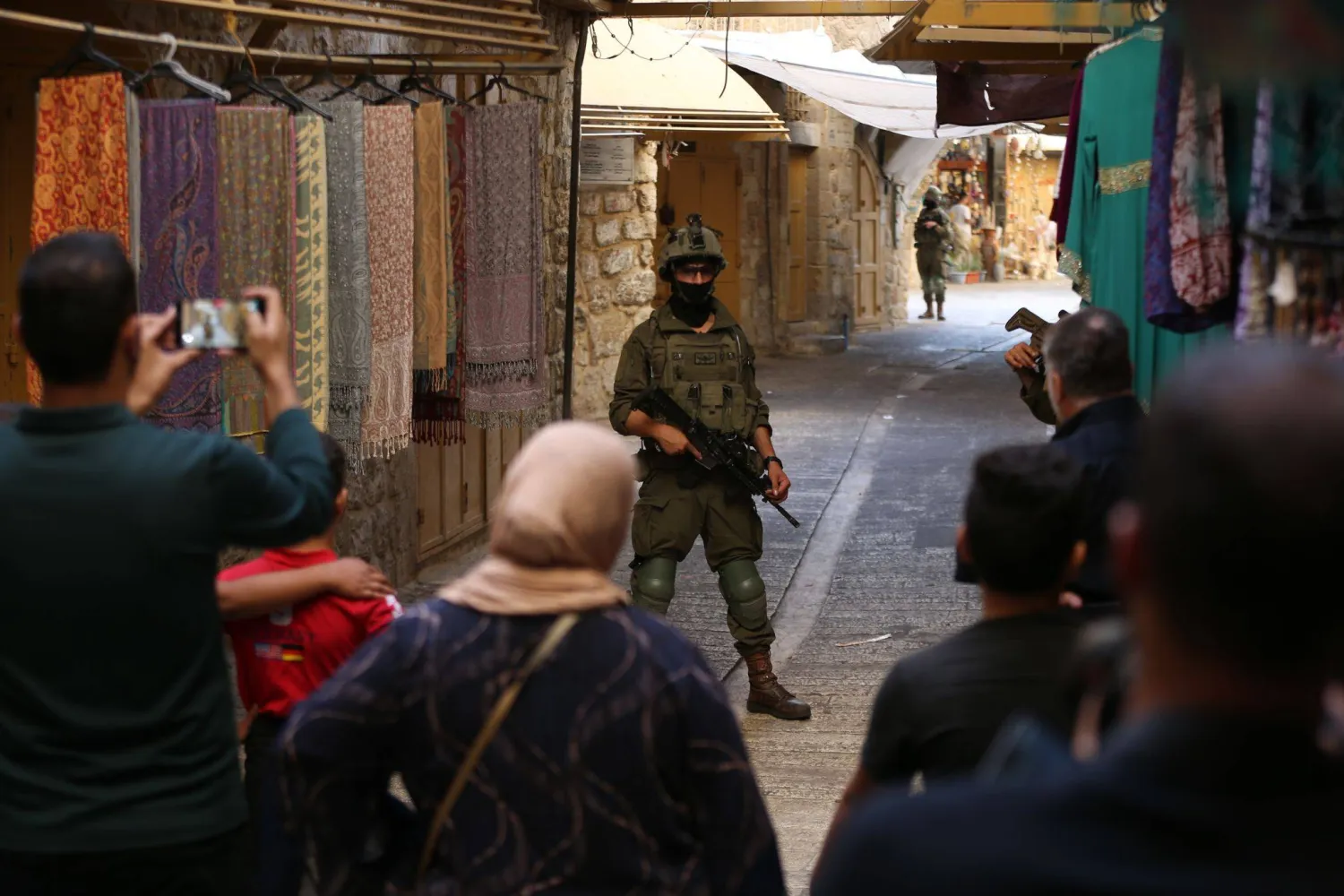
10 October 2026, Palestinian Territories, Hebron: Israeli soldiers stand guard during a tour by Israeli settlers in the Old City of Hebron. Photo: Mamoun Wazwaz/APA Images via ZUMA Press Wire/dpa
TT

War in the Heart of Hebron: 500 Settlers Share Daily Life with Thousands of Palestinians

10 October 2026, Palestinian Territories, Hebron: Israeli soldiers stand guard during a tour by Israeli settlers in the Old City of Hebron. Photo: Mamoun Wazwaz/APA Images via ZUMA Press Wire/dpa

Before reaching the city of Hebron, about 35 kilometers south of Jerusalem in the West Bank, travelers on the fast bypass road known as Route 60 encounter numerous road signs directing people of different nationalities, religions and denominations to their destinations. Written in Hebrew, English and Arabic, the signs point to Palestinian and Israeli destinations, and sometimes places farther afield: Karmei Tzur, Halhul, Beit Ummar, Kiryat Gat, Al-Arroub refugee camp, Kiryat Arba, the Ibrahimi Mosque and others.

No Entry

Shortly before the city's main entrance, a large sign warns Israelis against entering Area A, which is designated off-limits and "dangerous" to them. Yet the warning ignores the fact that 500 settlers live within it, occupying the heart of the West Bank's largest city, its Old City, where they share streets, houses, shops, squares, balcony views and the Ibrahimi Mosque with Palestinian residents.

Every day, the settlers attempt to drive out their neighbors in a long and exhausting struggle that has become considerably more intense since October 7, 2023.

At the beginning of Shuhada Street, near the bustling Bab al-Zawiya district, known for its crowds and commercial activity, Israeli soldiers stand on alert. Their mission is to prevent Palestinians from entering the area, except for the few who still live in its old, dilapidated and surrounded houses and have refused to leave.

Even these residents face thorough searches every day as they enter and leave, treated as perpetual suspects.

Before and After October 7

Before October 7, we had entered the street after receiving permission from the soldiers. But just 100 meters farther along, a soldier stopped us and said we could go no farther because of our "Arab appearance," claiming he could not guarantee our safety.

Today, entry is prohibited from the very first meter.
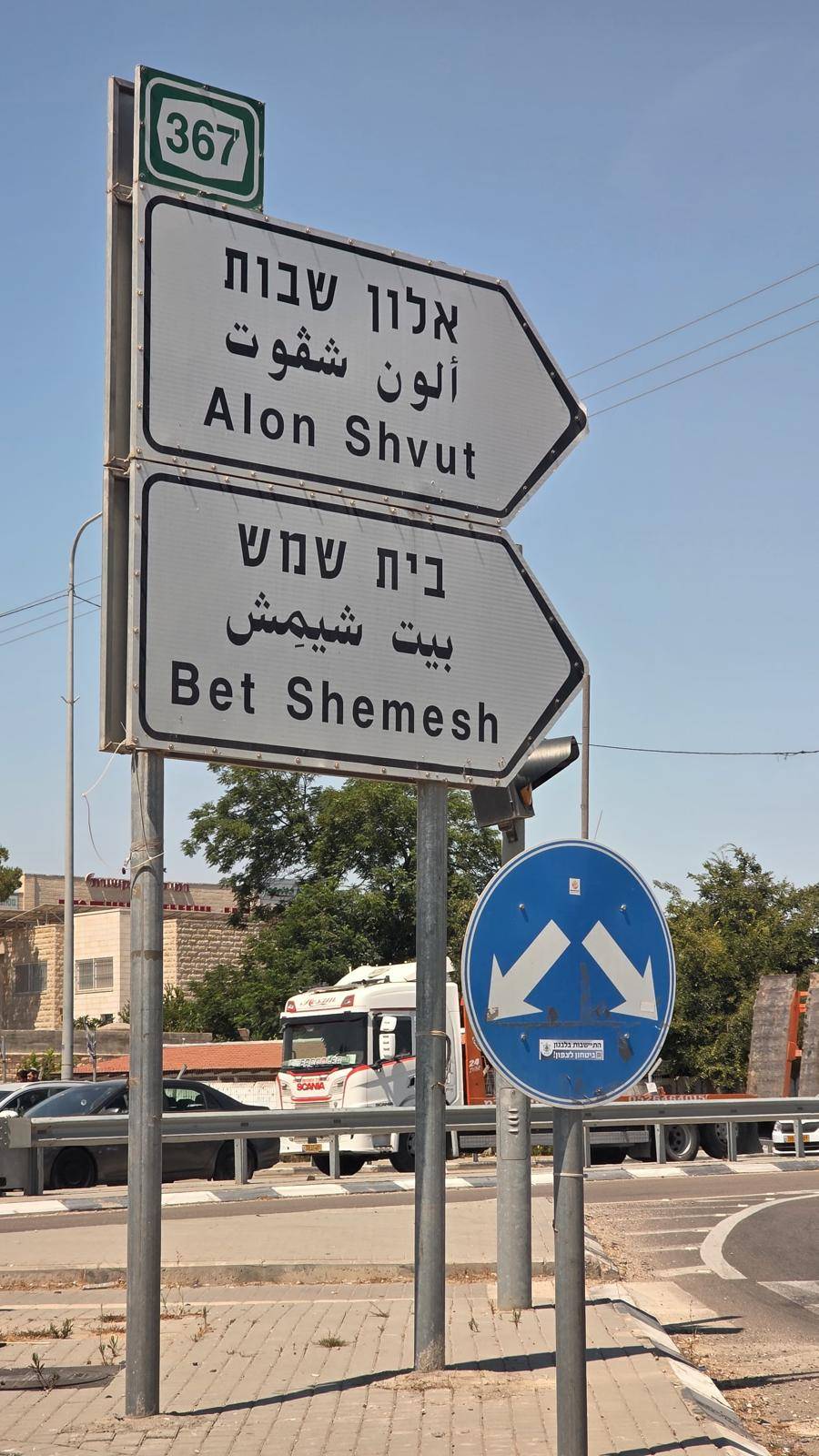
 

Intersection in the city of Hebron (Asharq Al-Awsat)

We entered the Old City through other routes that remained open, only to find that many of its streets had been closed. We could not reach several areas, including Al-Sahla Street behind the Ibrahimi Mosque, which, like Shuhada Street, had been closed to all Palestinians except the few "troublesome" residents who still lived there.

Islam al-Fakhouri came out to meet us in streets that were not closed off, including the once-busy Laban Market, which stood deserted. Shops were shuttered, with no merchants, residents or shoppers in sight. The market is part of a network of interconnected streets in the Old City.

Al-Fakhouri told Asharq Al-Awsat that he prefers to leave his home only once a day before returning for the last time, to avoid the numerous humiliating and difficult procedures.

"They treat us as suspects all the time. Your name has to be on a special list, and you undergo a search when you leave and when you return. They check your identity documents before allowing you through," he explained.

Al-Fakhouri is among the few Palestinians who have remained in their homes on Al-Sahla Street, near the Ibrahimi Mosque, which lies at the center of the conflict for both Palestinians and Israelis.

He said he stayed because he could not accept the idea of abandoning his home and because he "does not want to leave it to them."

"If I leave the house, they will immediately take it over. That is exactly what they want. Everything happening here is designed to force us out of our homes. Why does the army make our lives so difficult? Why all these restrictions? Why do settlers attack us? Because they want the entire place," he said.

Al-Fakhouri described how he and other residents had repeatedly been subjected to attacks and assaults, but insisted that he would not give up.

"I'm not leaving, and I'm not giving up my home," he said.

His determination did not waver after October 7, even as the struggle to remain became more difficult and costly.

Since that date, settlers across the West Bank have intensified their hostile actions, carrying out deadly attacks across large areas, killing Palestinians, burning their homes, properties and places of worship, destroying crops, and seizing land, houses, hilltops and even livestock.

"After October 7, every settler became a government unto himself," Al-Fakhouri said.

"We used to move around more freely, and there was less friction. But after October 7, everything changed. They closed the gates and increased the checkpoints. Every movement here is now restricted. On top of that, we face constant attacks and assaults without any accountability or oversight. They attack homes and assault us in the streets. Every day there is a problem. Every single day."

Al-Fakhouri's account helps explain why large parts of the Old City have lost their residents and why so many shops remain closed.

A Battle That Began in 1978

The closures did not begin after October 7. They date back much further. The settlers' struggle is decades old, although it has intensified significantly since that date.

According to the Palestinian National Information Center, the first settlement outposts inside the Old City were established in 1978, when a group of settlers occupied the Al-Dabouya building in the city center. They later renamed it Beit Hadassah.

Following the well-known 1980 Al-Dabouya attack, Israeli authorities demolished dozens of homes to expand the strategically located settlement outpost.

In 1983, another outpost, known as Beit Romano, was established near the Al-Dabouya building after settlers took control of the Osama ibn Munqidh School, claiming it was Jewish property.

In 1984, a new settlement outpost, Avraham Avinu, was established on an archaeological site in Tel Rumeida. Israeli authorities also closed the Old City's central vegetable market, which was later handed over to settlers to establish another outpost. Other outposts included Beit Chason and Beit Schneerson.

The Palestinian National Information Center said Israel was seeking to take control of the area and expand the settlement outposts. To achieve this, it said, Israeli authorities had adopted discriminatory policies against Arab residents, installing dozens of barriers and checkpoints and completely closing certain streets and markets in an effort to pressure residents into leaving.

The center estimated that approximately 1,829 commercial establishments had closed, including 520 shut by specific military orders. The remainder were closed by their owners because roads had been blocked and barriers and checkpoints installed throughout the narrow streets.

Residents of the Old City whom we met briefly said the struggle with settlers was longstanding but had intensified during two pivotal periods: after the Second Intifada in 2000 and following October 7, 2023.

To date, most of the Old City's 40,000 residents have left.

The Ibrahimi Mosque, Just a Stone's Throw Away

The Ibrahimi Mosque, which Palestinians describe as the oldest sacred site in the world, was just a stone's throw away.

As we approached, signs of life began to emerge. A handful of shops were open, with artisans and craftspeople displaying jewelry, pottery, wood carvings, maps of Palestine, embroidered items, decorated mugs, incense and Turkish delight produced in an exceptionally old factory, one that predates the occupation itself.

One shop window featured a portrait of the late Palestinian poet Mahmoud Darwish painted on a piece of mother-of-pearl, accompanied by his famous words: "On this earth, there is what makes life worth living."

Beside it was a portrait of the Lebanese singer Fairuz, with the lyrics "I belong to my beloved, and my beloved belongs to me." Other pieces of pottery seemed almost disconnected from the present moment.

But across from the Ibrahimi Mosque, an armed Israeli soldier stood alert behind security gates, monitoring those who wished to pray and allowing them through only when a green light appeared.

We passed through turnstiles, which Palestinians sarcastically call "the wringers," and then electronic security gates. A soldier checked each person's identification before we proceeded to security booths under surveillance cameras and the watch of armed guards. There, a female soldier inspected our identification documents once again before permitting us to enter the mosque.

The few steps felt more like crossing an international border or entering a defense ministry headquarters than approaching a mosque for prayer.

The site, deeply sacred to Muslims, retained its solemn atmosphere, but only a few worshippers were present.

Some visitors were entering for the first time in their lives. They examined the tombs of the prophets with astonishment, discovering ancient corners of the building under the watchful eyes of Israeli cameras.

Cameras were everywhere. Wherever you turned, another camera recorded every movement and every word.
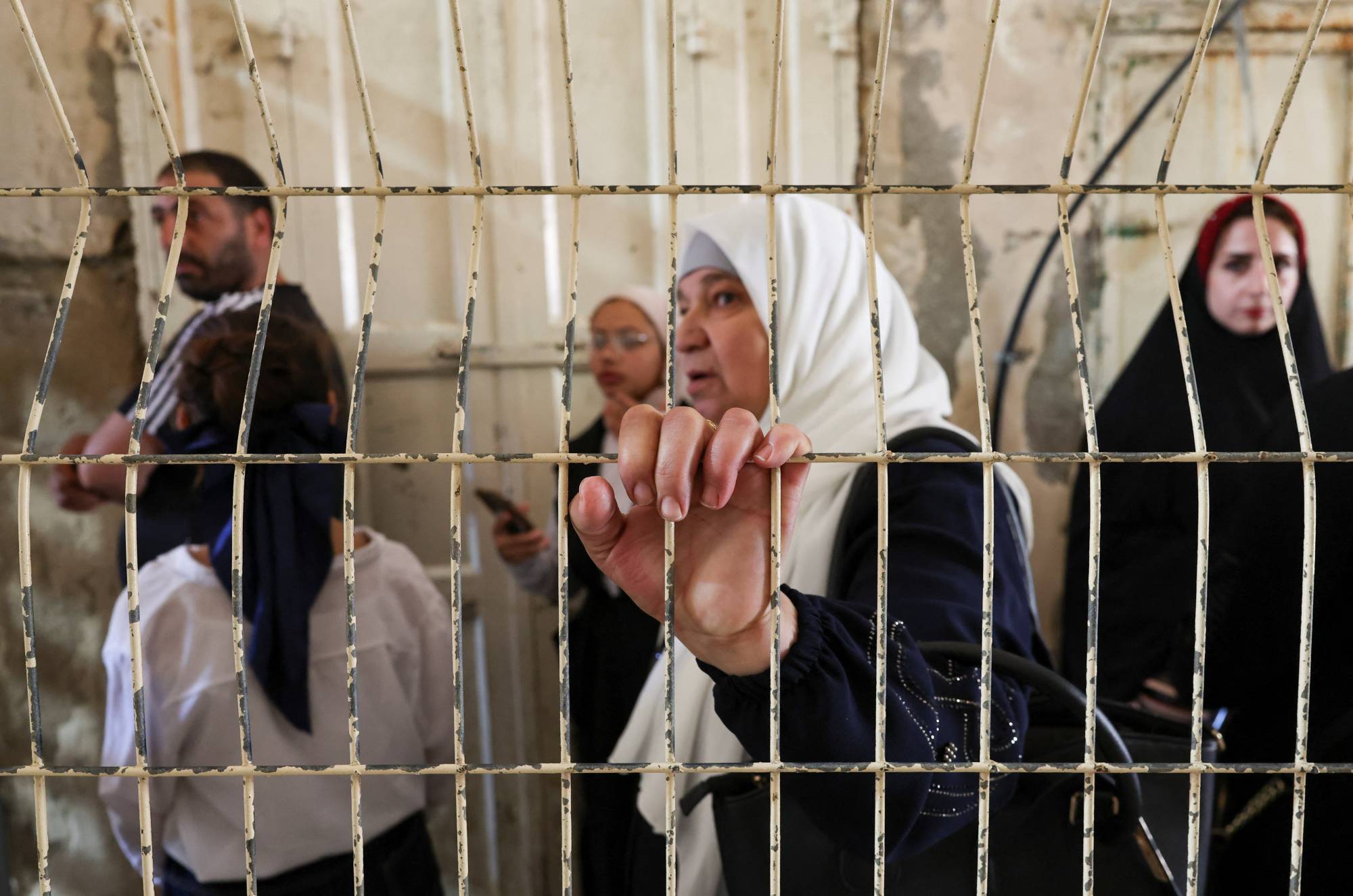
Palestinians wait at an Israeli checkpoint as they head for prayer at the Ibrahimi Mosque, also known as the Cave of Patriarchs, in the old city of Hebron, in the Israeli-occupied West Bank, June 17, 2026. REUTERS/Ammar Awad

Mosque Director: They Instill Fear in Us

Sheikh Mutaz Abu Sneineh, director of the Ibrahimi Mosque, was reluctant to give us a tour, even without cameras or filming, for fear that Israeli forces might use it as a pretext to enter the site.

We had, of course, arrived without cameras or microphones, since bringing such equipment would have meant hours of questioning and waiting for approvals that might never come.

Israeli authorities had expanded the mosque's surveillance system to cover every corner with audio and video recording. They had also compelled the mosque administration to install designated pathways over the carpets so soldiers could enter the mosque quickly at any time.

"You can see for yourself. Anyone entering here feels as though they are entering a military barracks, under surveillance," Abu Sneineh told Asharq Al-Awsat.

"Checkpoints, gates, thorough inspections, searches and identity checks. These are daily procedures imposed on everyone entering the Ibrahimi Mosque, and people are sometimes subjected to humiliation and degrading treatment.

"That includes the mosque's custodians, employees and administration. Everyone who enters this place is under intense audio and video surveillance."

For the mosque director, these measures are part of a broader policy intended to impose a new reality, empty the mosque of worshippers and turn it into a place for Jews.

The mosque was indeed largely empty, and Abu Sneineh confirmed that conditions had changed dramatically since October 7, to the point that Palestinians under the age of 25 were now completely prohibited from entering.

"They instill fear and terror in those who come here," he said.
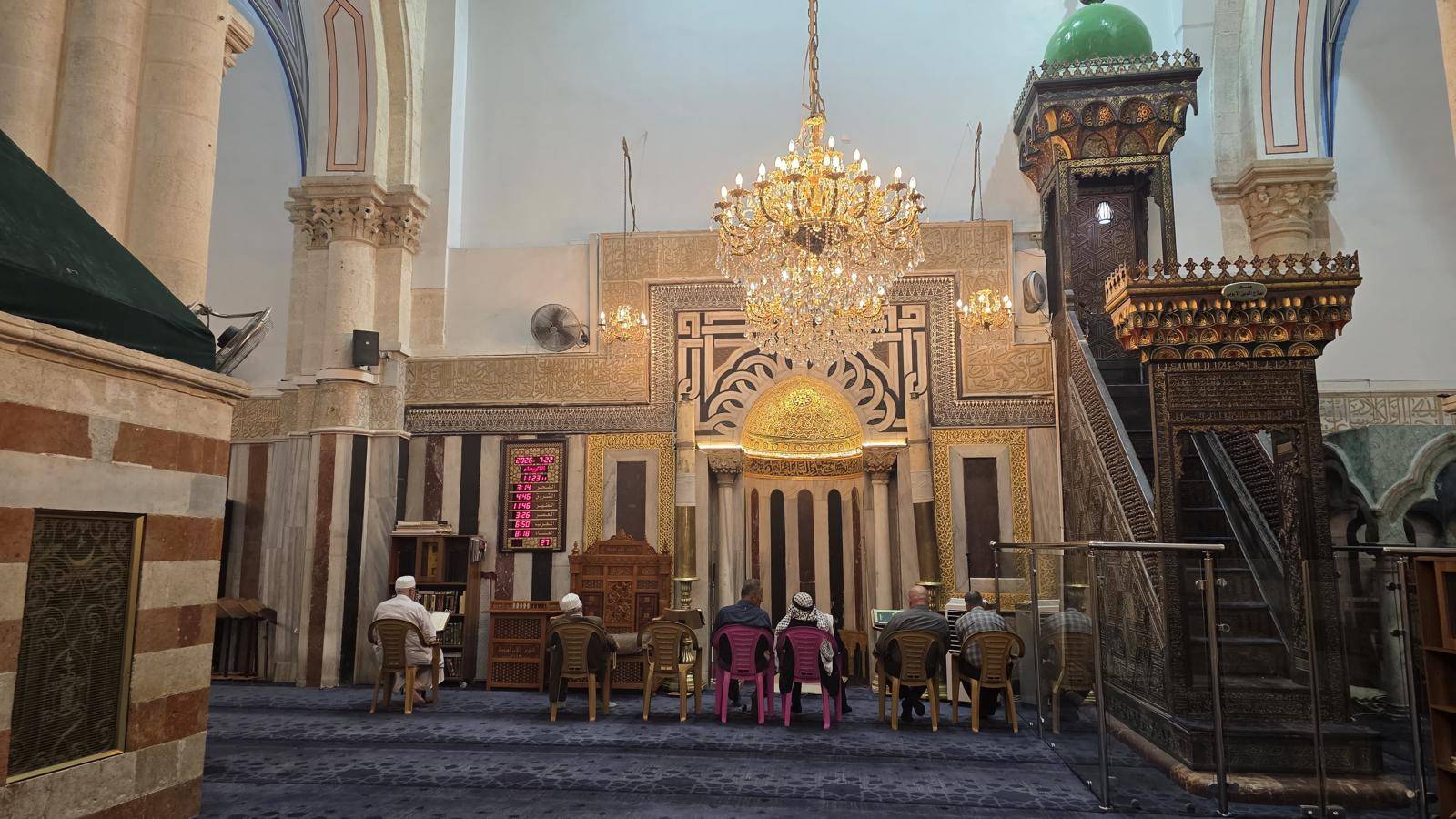
Worshippers inside the Ibrahimi Mosque (Asharq Al-Awsat)

Division by Time and Space

Another section of the mosque remained entirely off-limits to us, much like parts of the Old City.

Following the 1994 Ibrahimi Mosque massacre, in which Baruch Goldstein, an Israeli army doctor and settler, killed 29 Muslim worshippers, Israel took control of 63 percent of the mosque and designated it exclusively for Jewish use.

Goldstein was an activist in the extremist Kach movement, founded by Meir Kahane.

"Sixty-three percent has been off-limits to Muslims ever since," Abu Sneineh said.

Behind a separating door, Jewish religious prayers and noisy celebrations take place, accompanied by the blowing of the shofar.

Muslims are allowed into that section on only ten days each year, including Fridays during Ramadan, Laylat al-Qadr, Eid al-Fitr, Eid al-Adha, the Prophet Muhammad's birthday, the anniversary of the Hijra and the commemoration of Isra and Mi'raj.

Conversely, Muslims are entirely barred from the mosque for ten days associated with Jewish religious holidays.

This arrangement is known as the division of the site by time and space, a model Palestinians fear could also be imposed at Al-Aqsa

Mosque in Jerusalem.

The muezzin rose to lead the call to prayer before the small congregation, having previously been prevented from reaching his room, which is located in the section controlled by Israeli authorities.

He had also been prohibited from broadcasting the call to prayer through loudspeakers outside the mosque.

Previously, the muezzin had to wait for Israeli soldiers to arrive and escort him to his room. After issuing the call to prayer, he would leave under their escort, completing a short journey fraught with danger.

Even this arrangement does not apply to every prayer. He is barred from reaching the room during specified periods on Saturdays and Fridays and at certain hours of the night.

Shared Tombs and a Battle Over Historical Narratives

The tombs of Abraham, Jacob, Isaac and Joseph were among the most visited places and popular spots for commemorative photographs.

Jews regard these tombs as evidence that the site belongs to them as well. The conflict here is therefore not only about occupation, but also about competing historical and religious narratives and the identities they represent.

"They are trying to erase our narrative and identity," Abu Sneineh said.

"They say this place is theirs. We say it is an exclusively Islamic site. They believe they are descended from Abraham and claim that, as descendants of his son, they have a right to this place. But we have a greater claim to the prophets. Abraham was not Jewish."

The mosque director's account reflects the Palestinian and Muslim narrative, but it is not accepted in Israel.

Israelis also revere the Ibrahimi Mosque, which they call the Cave of the Patriarchs, or the Cave of Machpelah, because it contains the burial place of the Prophet Abraham and his wife Sarah in a cave beneath the present building.

Smotrich Declares Mosque 'Sovereign Property'

Shortly after our visit, far-right Israeli Finance Minister Bezalel Smotrich visited the Ibrahimi Mosque and declared it the "first sovereign property of the Jewish people."

At the site, where he had come to inaugurate the roofed areas previously mentioned by Abu Sneineh, Smotrich asserted that the mosque would forever remain a symbol of Israeli sovereignty in the West Bank.

Israel's Channel 14 reported that Smotrich, who presided over an event marking the completion of extensive roofing and restoration work at the site, was taking a historic step following his earlier decision to terminate the Hebron agreements and withdraw the Palestinian municipality's relevant powers in Hebron's Old City.

Smotrich had announced last June the cancellation of the Hebron Agreement governing the city, which he calls the land of the patriarchs.

Speaking at a ceremony inaugurating the new Doron settlement in the Hebron Hills at the time, he said:

"We have canceled the Hebron agreements. For many years, one of the most absurd provisions of Oslo remained in effect, under which authority over Jewish settlements in Hebron and the holy sites was granted to the Hebron municipality."

The decision announced by Smotrich, following its approval by the Higher Planning Council of the Israeli military's Civil Administration, stripped the Hebron municipality of its planning and construction powers in Area H2, which includes the Old City.

Hebron Turns the Page on Oslo

Hebron is the only Palestinian city in the West Bank to have been subject to a special agreement in 1997 that divided it into two areas, H1 and H2.

Known as the Protocol Concerning the Redeployment in Hebron, the arrangement followed the 1995 Oslo II Accord and the Israeli-Palestinian peace process launched under the Oslo Accords in 1993.

Under the Hebron agreement, Israel withdrew its forces from Area H1, which accounts for approximately 80 percent of the city, and the Palestinian Authority assumed responsibility for security and civilian affairs there.

In return, Israel retained security control over Area H2, comprising the remaining 20 percent of the city, including the Old City, the Ibrahimi Mosque and the Jewish settlement in Hebron, while civilian powers were transferred to the Palestinian Authority.

"This is much more than a planning measure. It is a historic correction," Smotrich said.

"We are continuing the settlement revolution, strengthening governance and deepening Israeli sovereignty in Judea and Samaria," he added, using the Israeli term for the West Bank.

According to Smotrich, the measure applies to all religious and historical sites in Hebron.

In effect, the move marked the end of the Oslo era in the Old City, at the heart of Hebron.

Palestinians rejected the decision. The Palestinian presidency warned of its dangers, saying it undermined Hebron's political and legal status and the bilateral agreements signed concerning the city.

Hebron's municipality also rejected the move and said it would not accept it.

On the ground, however, a different reality has emerged. Israel now exercises greater control over virtually everything in central Hebron, including the Ibrahimi Mosque.

Just one day after Smotrich announced the "cancellation of the Hebron agreements," a major construction project for a Jewish religious school near the mosque was approved.

Israel's Yedioth Ahronoth newspaper reported that the project had been approved without requiring authorization from the Palestinian municipality, for the first time in decades.

Speaking at the Ibrahimi Mosque during a celebration marking the roofing work, Smotrich said:

"The Cave of Machpelah, the Ibrahimi Mosque, is the first sovereign property of the people of Israel. The place purchased by our forefather Abraham has become a symbol of our sovereignty over this land."

Visits to Preserve Historical Memory

But not everything can be imposed by force.

Outside the main prayer hall, a group of schoolchildren was visiting the mosque as their teachers explained its history, religious significance and the massacre that took place there.

Teacher Sharifa Dweik told Asharq Al-Awsat that she had decided to take the risk of bringing the children to the mosque after realizing they knew almost nothing about it.

The children were excited, as though embarking on an adventure. They eagerly described how they had passed the soldiers without being searched and said they would return.

Dweik said it was essential for the children to visit a place that, in her view, Jews wanted every Palestinian to forget.

Hajj Abdulaziz Abu Haltam said he had traveled from the distant town of Tarqumiya to visit the mosque and the Old City.

"I don't come often because of the risks and the long hours of waiting. But I decided to take the chance, and I really did spend a long and exhausting time waiting before reaching the mosque," he told Asharq Al-Awsat.

Jewish visitors face none of these difficulties. Instead, they arrive accompanied by extensive security protection in what is presented as an effort to emphasize the site's Jewish identity.

Approximately 1,500 Israeli soldiers guard the 500 settlers living in central Hebron.

Israeli flags also surround the walls of the Ibrahimi Mosque, another attempt to reinforce the Israeli narrative through visual symbols wherever possible.

Many of these flags can also be seen throughout large parts of the city's Arab neighborhoods.
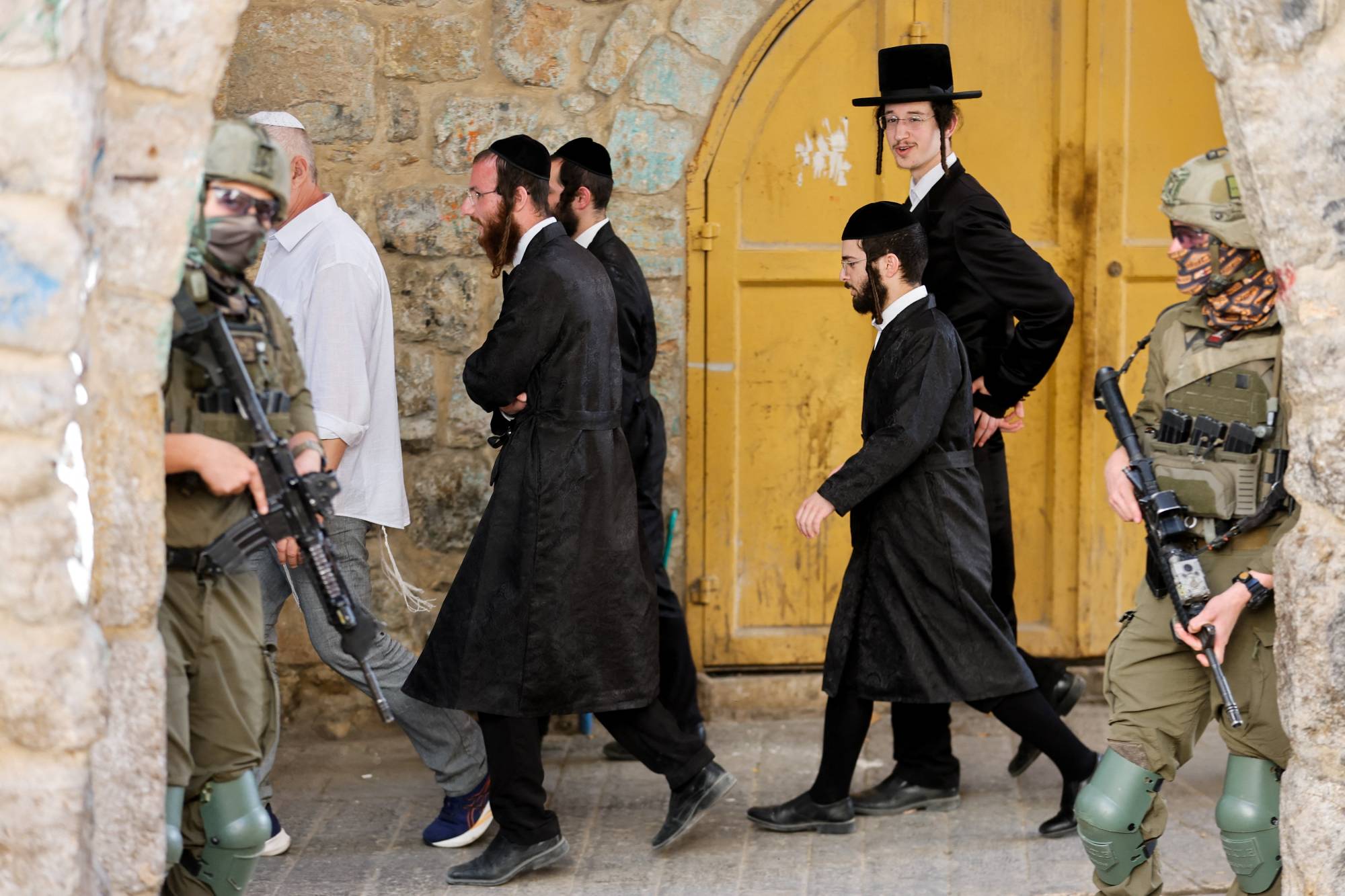
Israeli soldiers stand guard during a weekly settlers' tour in Hebron, in the Israeli-occupied West Bank, May 16, 2026. REUTERS/Mussa Qawasma

Neighbors and Enemies

From a vantage point overlooking an area not far from the mosque, the extent to which the two communities occupy the same spaces in large parts of the Old City was striking.

Jewish settlers live above shops that once belonged to Arabs, while only walls separate their homes from those of Palestinians.

Before October 7, when Palestinians were still able to open their shops, shopkeepers had been forced to install wire mesh above the street to protect themselves from objects thrown down by settlers living overhead.

Today, all those shops have closed.

While settlers in Beit Avraham, Beit Hadassah, Beit Romano and Tel Rumeida enjoy extensive protection, many Palestinians have been killed in the area over previous years on allegations that they had stabbed, or intended to stab, soldiers and settlers.

Despite this, Mahmoud Mahamra has refused to leave his home, behind which a tightly secured wooden gate has been installed to separate it from Shuhada Street.

Israeli authorities wanted to prevent any possible contact.

That gate was part of a wider network of barriers closing off Old City streets, alongside checkpoints and security cameras.

Mahamra, who describes himself as the closest Palestinian neighbor to the settlers in his area, said he lives in constant anxiety, which has turned into a nightmare since October 7.

"They always used to harass us, but after October 7, life became unbearable," he told Asharq Al-Awsat.

He recalled a period of relative prosperity before the Second Intifada, although it did not last long.

"We used to live alongside one another. There was life here. But not anymore," he said.

Standing on the roof of his home, Mahamra looked out over neighborhoods that had once been entirely Arab and were now entirely Jewish.

Settlers take over homes and raise Israeli flags above them.

Yet Mahamra has no intention of leaving.

"I'm not leaving this place," he said.

"We are not leaving" has become a slogan embraced by Palestinians across the West Bank. But not everyone is able to live up to it, as they face what the article describes as the most extreme Israeli government and the most violent settlers in the history of the conflict.

The Israeli government is now working to implement what is known as the Decisive Plan, which is based on the premise that the territory between the Jordan River and the Mediterranean Sea has room for only one legitimate national claim: the Zionist claim to full Jewish sovereignty.

Israeli human rights organization B'Tselem has accused Israel of implementing a series of simultaneous policies in the West Bank as part of a broader project aimed at erasing Palestinians as a people.

All of this is unfolding today in Hebron's Old City. For Israel, Hebron may represent a rehearsal for what could happen across the rest of the West Bank.

We left the mosque and the Old City, passing one of the oldest shops, where a large map of Palestine was displayed.

Inscribed on it were Mahmoud Darwish's familiar words:

"She used to be called Palestine. And she is still called Palestine."


How Israel’s New Parliament Can Make Netanyahu’s Life Difficult

A combination picture shows Israeli Prime Minister Benjamin Netanyahu as he attends a memorial service held for Ran Gvili, an off-duty police officer who was killed fighting militants that had infiltrated Israel during the deadly October 7, 2023, attack by Hamas, and the last hostage recovered from Gaza, in Meitar, Israel, January 28, 2026, and Israeli opposition leader and former military chief, Gadi Eisenkot, as he launches an election campaign for Yashar, his new political party, at an event near Hod Hasharon, Israel, June 30, 2026. (Reuters)
TT

How Israel’s New Parliament Can Make Netanyahu’s Life Difficult

A combination picture shows Israeli Prime Minister Benjamin Netanyahu as he attends a memorial service held for Ran Gvili, an off-duty police officer who was killed fighting militants that had infiltrated Israel during the deadly October 7, 2023, attack by Hamas, and the last hostage recovered from Gaza, in Meitar, Israel, January 28, 2026, and Israeli opposition leader and former military chief, Gadi Eisenkot, as he launches an election campaign for Yashar, his new political party, at an event near Hod Hasharon, Israel, June 30, 2026. (Reuters)

Benjamin Netanyahu remains Israel's prime minister when the new parliament takes office Tuesday but its new, less friendly composition could make his life much more difficult.

Gadi Eisenkot, a former military chief seeking to move Israel to the center, was given the mandate Sunday by President Isaac Herzog to form a new government, a complicated task as neither he nor Netanyahu command a majority.

Until then Netanyahu, Israel's longest-serving leader, remains caretaker prime minister -- but the new 120-member parliament can still go to battle against him.

The lack of a new government "does not infringe upon the Knesset's prerogatives", said Assaf Shapira, a political expert at the Israel Democracy Institute.

Eisenkot has also warned military chiefs that Netanyahu does not have a mandate to resume war against Iran -- although the statement was more about politics than the law, with Netanyahu still in charge of national security.

Netanyahu's bloc slipped to 53 seats in the new parliament, down from the decisive 68 it commanded previously.

Eisenkot's core opposition bloc has fewer seats than Netanyahu at 48 but the new parliament also has a record 19 lawmakers from Arab-majority parties that are vehemently opposed to Netanyahu and his hard-right government -- although it remains unclear if Eisenkot will seek to work with Israeli-Arabs directly.

Here are ways in which the new parliament could turn on Netanyahu:

- Commission on October 7 attacks -

One of the opposition's main campaign promises has been to set up a commission of inquiry to probe failures in the famously high-security country that allowed Hamas's October 7, 2023, attack, the deadliest ever day for Israel.

While Netanyahu denies any wrongdoing on his part, his government has consistently opposed the creation of a national, independent commission of inquiry that would have broad investigative authority, with Netanyahu instead supporting a review by political appointees.

Even before a new government is formed, the incoming parliament could set up a special committee on the attack which would hand over its findings to an eventual commission of inquiry, Shapira said.

Eisenkot declared after the election that forming a commission would be an immediate priority.

- Repealing Netanyahu-era laws -

The new parliament could also move quickly to repeal some of the most controversial laws under Netanyahu, including his efforts to revamp the judiciary -- seen by the prime minister as an enemy after he was charged with corruption.

The judicial revamp triggered some of Israel's largest ever protests, with liberals worried about the future of democracy, although the Hamas attack and subsequent wars quickly shifted public attention.

The new parliament could aim to repeal the last coalition's laws that limited the powers of the Supreme Court and made it easier to remove the country's attorney general.

Lawmakers could also roll back exemptions for ultra-Orthodox Jews from serving in the military. The exemption has angered many Israelis at a time that the military is stretched thin, although the laws did not go far enough for ultra-Orthodox parties, who are being wooed by at least one opposition figure.

Shapira said repealing Netanyahu-era laws was as simple as calling a vote and reverting to previous policies. But the process to pass new laws could take weeks as the opposition coordinates its priorities.

- Electing new speaker -

The first political clash will concern electing a new parliament speaker. The incumbent is Amir Ohana, a Netanyahu loyalist from his Likud Party.

According to parliamentary rules, the vote for speaker can take place as early as during the inaugural session and must happen before a new government is sworn in.

An initial clash took place Thursday when three parties in the Eisenkot bloc sent letters to the outgoing speaker requesting that his successor be elected at the opening session -- a timing that Shapira agreed was more common.

Ohana responded that it was customary to elect the speaker on the day a new government is sworn in.

Naftali Bennett, a key opposition figure, vowed to act "urgently" on the bloc's priorities.

"We will take control of the Knesset as quickly as possible."


Two Years in, Women Leaving Top Roles in Trump Admin

Susie Wiles has left the powerful chief of staff role inside the White House. Kent NISHIMURA / AFP
TT

Two Years in, Women Leaving Top Roles in Trump Admin

Susie Wiles has left the powerful chief of staff role inside the White House. Kent NISHIMURA / AFP

The abrupt exit of White House Chief of Staff Susie Wiles, one day after Republicans were stomped in midterm elections, adds her to a growing list of women who have departed top roles in President Donald Trump's administration since the year began.

At the beginning of his second term, the 80-year-old Republican boasted that he was "thrilled to say that we have more women in our cabinet than any Republican president in the history of our country."

At that point, there were eight women in top roles, out of more than 20 such positions.

Eighteen months later, there are only three left: Agriculture Secretary Brooke Rollins, Education Secretary Linda McMahon and Kelly Loeffler, who heads the Small Business Administration.

Half the women were pushed out over three months in the spring, AFP said.

First went Homeland Security Secretary Kristi Noem, who became the face of Trump's violent anti-immigration offensive.

She was followed by Trump's top federal prosecutor Pam Bondi, Labor Secretary Lori Chavez-DeRemer and Tulsi Gabbard, director of national intelligence.

Most recently, one day after Republicans lost in the midterms, Wiles announced her departure.

- Double standard -

"Is he out of women?" Democrat Alexandria Ocasio-Cortez said last spring, after being asked who would be next to meet that fate.

"Trump only seems to have the capability to fire female secretaries," the congresswoman said, adding: "If you're a man in the Trump administration, it seems that they reward misconduct."

For Trump, a former beauty pageant organizer, women are about appearances, Colorado State University professor Karrin Vasby Anderson told AFP.

"Trump hires and appoints women who he thinks will make him look good. The minute they don't, they are gone," she said.

"He continues to defend (Defense Secretary) Pete Hegseth, despite the fact that nearly everyone agrees that the Iran war has been a catastrophe," Anderson said.

"I think it's telling that the men he defends most vociferously are those who promote a particular kind of sexist MAGA masculinity. It's clear that Trump feels comfortable surrounding himself with that type of man."

Trump has stood by men in his administration despite national outcry against chief of staff Stephen Miller's vocal support for the violent immigration policy and the taint of scandal dogging FBI Director Kash Patel over allegations of a taxpayer-funded slush fund to reward loyalists and other missteps.

- Male successors -

The only man not spared was Mike Waltz, who was removed from his post as national security adviser in May 2025 after he inadvertently added a journalist to a leadership discussion group where they chatted about US strikes in Yemen.

But Waltz rebounded quickly and was appointed to be ambassador to the United Nations soon after.

In every case where a woman was sidelined, a man invariably replaced her.

Todd Blanche took over Bondi's role at the Justice Department after working as Trump's personal lawyer.

And Wiles -- the first woman to hold the strategic position of White House chief of staff -- has just been replaced by hard-right ideologue Miller, a longtime Trump loyalist.

Anderson said Wiles was a rare hire for Trump because she was recruited for her expertise.

But after Democratic blue wave's crushing victory in the midterm elections, the Republican president may think "Stephen Miller will defend Trump better than Susie Wiles would."

Trump, however, appears to be struggling to replace one prominent female face of his presidency: Karoline Leavitt, the youngest White House press secretary ever who left her post at the end of August.

The president jokingly called on UFC chief Dana White to take on the role instead, but the fighting executive demurred on Monday, saying: "I do not want to be in politics."


COP31 in Antalya: Climate Divisions and US Absence Test Global Consensus

Delegates from Kazakhstan pose for photographs by their pavilion on the opening day of the COP31 annual UN climate conference in Antalya, Türkiye, 09 November 2026.  EPA/TOLGA AKMEN
Delegates from Kazakhstan pose for photographs by their pavilion on the opening day of the COP31 annual UN climate conference in Antalya, Türkiye, 09 November 2026. EPA/TOLGA AKMEN
TT

COP31 in Antalya: Climate Divisions and US Absence Test Global Consensus

Delegates from Kazakhstan pose for photographs by their pavilion on the opening day of the COP31 annual UN climate conference in Antalya, Türkiye, 09 November 2026.  EPA/TOLGA AKMEN
Delegates from Kazakhstan pose for photographs by their pavilion on the opening day of the COP31 annual UN climate conference in Antalya, Türkiye, 09 November 2026. EPA/TOLGA AKMEN

Climate negotiations in Antalya, Türkiye, face a fresh test as unresolved disputes from last year's summit in Brazil carry over into the 31st United Nations Climate Change Conference (COP31), particularly over adaptation finance for developing countries.

The talks are taking place without a US delegation for the second consecutive year, amid mounting geopolitical tensions, turmoil in energy markets and rising electricity demand driven by artificial intelligence. Together, these pressures are making it harder for governments to reach international agreements on accelerating climate action.

COP30, held last year in Belém, Brazil, ended with a compromise that failed to establish a roadmap for transitioning away from fossil fuels or fully resolve disagreements over adaptation finance.

Countries have returned to the negotiating table as the United Nations increasingly warns of a widening gap between climate commitments and the pace of action needed to curb global warming.

Türkiye is hosting COP31 from November 9 to 20, with Australia serving as President of Negotiations under an arrangement that gives Ankara the conference presidency and Canberra responsibility for leading the negotiations.

The agenda focuses on cutting greenhouse gas emissions, securing climate finance for developing countries, strengthening their ability to adapt to climate change and accelerating the transition to cleaner energy systems.

Simon Stiell, executive secretary of the United Nations Framework Convention on Climate Change (UNFCCC), told delegates that "the urgency of this moment must drive us forward."

He warned that progress remained far too slow to meet the scale of the climate crisis and urged governments to prioritize climate action despite the numerous international crises competing for their attention.

Scientific findings underscore the challenge facing negotiators.

A report published in October by the United Nations Environment Programme (UNEP) warned that global temperatures were on course to exceed 1.5 degrees Celsius above preindustrial levels, the threshold established under the 2015 Paris Agreement to avert the worst consequences of global warming.

Another UN report released Monday indicated that 2026 was likely to rank among the four hottest years on record, with a powerful El Niño contributing to rising temperatures.

Several regions have experienced severe heat waves, particularly Western Europe, while a glacier collapse in Nepal triggered catastrophic flooding that killed more than 1,450 people and left thousands missing, according to the reports.

Climate Finance and Adaptation Top the Agenda

Financing for developing countries remains among the most contentious issues in international climate negotiations as their investment needs continue to grow.

These countries require funding not only to reduce emissions but also to adapt to the consequences of climate change, including floods, droughts, extreme heat and rising sea levels.

The issue extends beyond financing clean energy projects to strengthening the resilience of communities most vulnerable to climate-related disasters and reducing losses and damage caused by extreme weather.

The widening gap between the scale of these threats and the financial resources available to address them has become a central concern.

Negotiators are expected to debate how climate finance should be incorporated into the conference agenda and how the necessary funding should be mobilized and distributed, amid continuing disagreements over financial responsibilities, the scale of contributions and the mechanisms for delivering assistance.

Against this backdrop, Turkish President Recep Tayyip Erdogan said: "The world is our home, and we have no right to pollute it."

He added that Türkiye would use COP31 to discuss practical steps toward securing humanity's shared future.

Speaking to reporters aboard his plane on Sunday evening as he returned from Azerbaijan, Erdogan emphasized Türkiye's commitment to climate justice.

He said the conference agenda would address a range of issues, from raising awareness to developing cities capable of withstanding the effects of climate change.

Electrifying the Economy by 2035

Alongside negotiations on financing and emissions reductions, the Turkish presidency is promoting an ambitious target to increase electricity's share of global final energy consumption to 35% by 2035, up from just over 20% today.

The initiative, known as the "35-by-35 Global Electrification Pledge," calls on countries to support the expansion of electricity use across transportation, buildings and industry while developing renewable energy sources, electricity grids and storage technologies.

COP31 President Murat Kurum, Türkiye's Minister of Environment, Urbanization and Climate Change, said the country wanted people to see the benefits of climate negotiations in their everyday lives through more energy-efficient buildings, clean public transportation, affordable energy and new jobs.

The initiative is based on the premise that replacing fossil fuel-powered equipment, including vehicles, heating systems, boilers and cooking appliances, with electric alternatives could help reduce emissions, provided the transition is accompanied by increased electricity generation from low-carbon sources.

Wars Bring Energy Security Back Into Focus

Geopolitical developments are casting a shadow over the negotiations, particularly the continuing war in Iran, which has disrupted oil shipments through the Strait of Hormuz and driven up fuel prices worldwide.

The repercussions of the Russia-Ukraine war on global energy markets have added to these pressures.

Stiell warned that turmoil in fossil fuel prices had placed additional strain on households and contributed to rising inflation.

He argued that renewable energy offered a clear path toward stronger energy security, noting that the expansion of renewable power installations had already saved the global economy hundreds of billions of dollars.

The United States is absent from international climate negotiations for the second consecutive year, underscoring persistent differences among countries over climate transition priorities and the role of various energy sources in meeting economic needs.

Artificial Intelligence Adds Another Challenge

The challenges facing COP31 extend beyond wars and energy market disruptions.

The rapid expansion of artificial intelligence is placing additional pressure on global electricity demand as data centers and the infrastructure supporting digital applications continue to grow, bringing increased energy consumption and associated emissions.

The Turkish presidency plans to invite governments, companies and institutions to endorse a pledge establishing principles for the sustainable development and deployment of artificial intelligence.

The initiative, known as the "Antalya Pledge on Artificial Intelligence," seeks to align digital transformation with climate objectives and prevent technological expansion from placing further strain on energy systems and the environment.

At the same time, clean energy technologies are becoming more widely available, supported by growing exports of low-cost equipment from China.

This trend could accelerate the deployment of renewable energy solutions and encourage greater investment in the sector.

A Test of International Cooperation

Australian Minister for Climate Change and Energy Chris Bowen, who serves as COP31 President of Negotiations, described the conference as an opportunity to demonstrate that multilateral cooperation can deliver progress on shared challenges.

"Let's show future generations that this generation was equal to the moment, equal to the challenge," Bowen told delegates, urging countries to work together in confronting the climate crisis.

His appeal comes as climate challenges increasingly extend beyond environmental policy to encompass energy security, industrial competition, inflation and technological innovation.

Reaching international consensus on emissions reductions, financing arrangements and the future energy mix will therefore be a critical test of the conference's success.

With Türkiye seeking to accelerate global electrification, the United Nations calling for faster emissions cuts and developing countries demanding greater funding for adaptation and resilience, attention is turning to whether the Antalya negotiations can translate commitments into concrete, actionable measures.

The challenge is becoming more urgent as the gap continues to widen between the pace of climate change and the international response.
