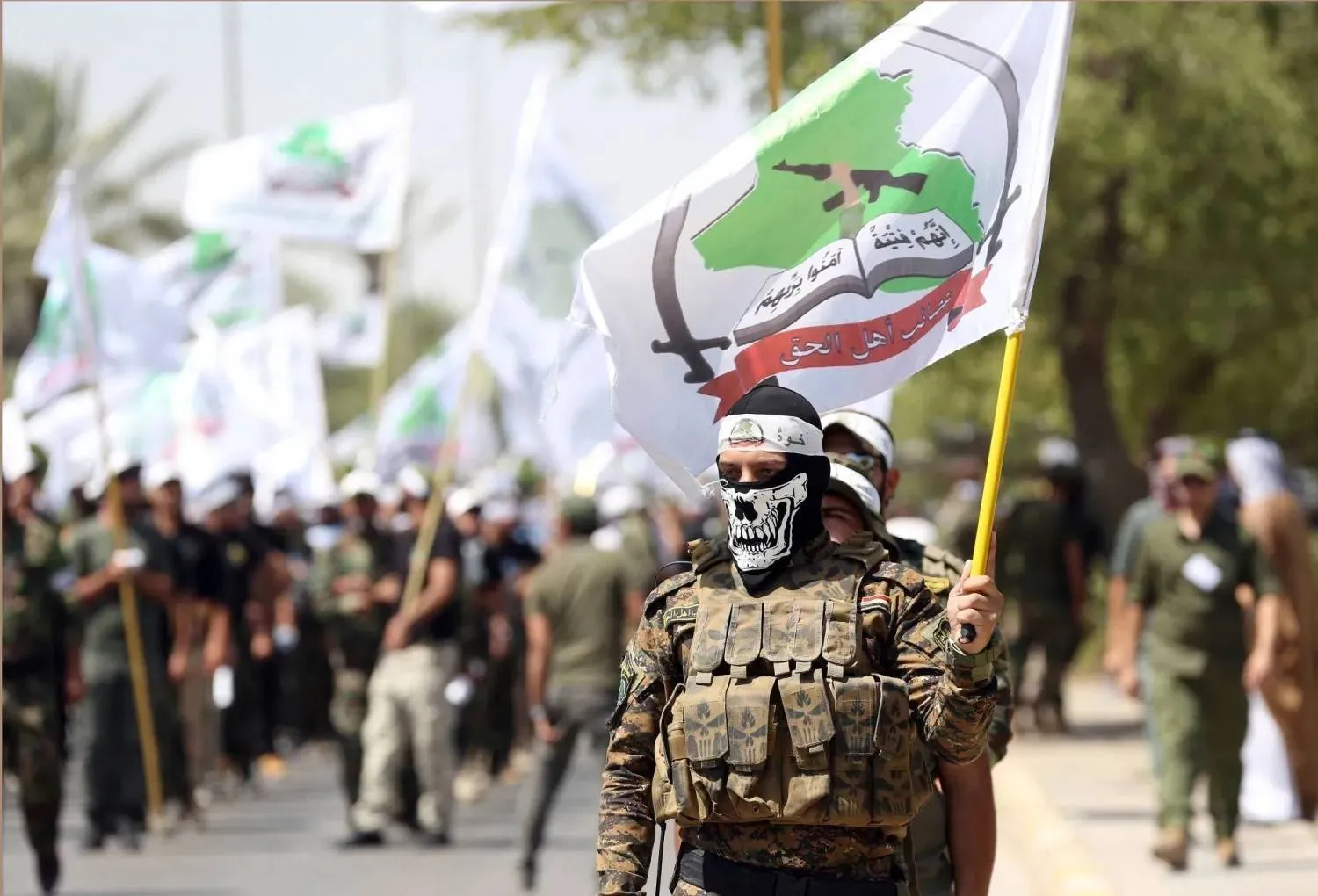

Observers in Baghdad say a long-delayed confrontation may be looming with factions that reject the principle of “placing arms under state control,” a move announced by political groups and welcomed by the Iraqi government and the United States.
The warnings come as reports suggest the US-backed government of Ali al-Zaidi could approve military appointments inside the Popular Mobilization Forces as part of a plan to restructure the powerful paramilitary body.
Within one week, the Sadrist movement, Asaib Ahl al-Haq, and Kataib Imam Ali announced they were breaking away from the Popular Mobilization Forces.
The factions had overseen about seven brigades inside the body, but their fighters no longer appear to take orders from political and party leaders.
On Wednesday, Prime Minister Ali al-Zaidi agreed with delegations from Asaib Ahl al-Haq and Kataib Imam Ali to form a joint committee to implement measures to place arms under state control within the next two days.
In a statement, al-Zaidi said Iraq was undergoing an important transition after major gains in security, making the current phase one of construction, reconstruction and broad development.
Supreme Judicial Council President Faiq Zidan on Wednesday urged resistance factions to “join their brothers and lay down their arms.” He thanked Sadrist leader Muqtada al-Sadr, Asaib Ahl al-Haq Secretary General Qais al-Khazali and Kataib Imam Ali Secretary General Shibl al-Zaidi for backing state control over arms.
Harakat Hezbollah al-Nujaba, meanwhile, renewed its rejection of “disarmament” and its commitment to “resistance.” In a statement, the movement said: “al-Nujaba remains steadfast and has not, and will not, change its position on the sacred and disciplined weapon that exists to defend Iraq, its holy sites and its people.”
Its leader, Akram al-Kaabi, had accused Israel in a post on X of “inciting the US Embassy chargé d’affaires in Iraq to speak about the weapons of the resistance.” He said he regretted that “a small number of Iraqis have become mouthpieces for them,” and urged armed factions to “reject the very idea of discussing this matter.”
Many remain skeptical of what has become known as “placing arms under state control,” citing the absence of clear technical mechanisms for implementation and Iran’s silence over the weapons held by its proxies in Baghdad.
Kataib Hezbollah and Harakat Hezbollah al-Nujaba are the most prominent factions to have openly rejected “state control over arms” and affirmed their commitment to the “option of resistance.” An unknown faction calling itself Ashab Ahl al-Kahf has threatened to resume operations against Israel.
Support among Iraqi factions for “placing arms under state control” is accelerating, amid US satisfaction that Prime Minister Ali al-Zaidi has secured a political mandate to “consolidate stability in the country.”
The Coordination Framework authorized al-Zaidi to take the decisions and measures needed to protect the country’s higher interests. It also backed “placing arms under state control and severing the Popular Mobilization Forces’ links to political and party frameworks.”
US Embassy chargé d’affaires Joshua Harris described the Coordination Framework’s mandate for al-Zaidi as a qualitative step toward consolidating independence and sovereignty for Iraq’s promising future, and affirmed Washington’s support for government measures to place arms under state control.
The confrontation
Political sources told Asharq Al-Awsat that political leaders and government officials are closely watching the groups resisting state control over arms under national understandings.
They said, “The door to confrontation will remain open, whether between the Iraqi government and the rebellious factions, or between Washington and Tehran, which has neither endorsed nor opposed the announcement by other factions of their intention to hand over their weapons.”
Tom Barrack, US President Donald Trump’s envoy to Iraq and Syria, had congratulated Iraqi Prime Minister Ali al-Zaidi on the start of efforts to place arms under state control, calling the latest steps important progress toward consolidating stability and restoring sovereignty.
In a post on X, Barrack said the move represented the first building block of renewed Iraqi governance based on self-administration.
Barrack’s praise for the Shiite groups that decided to return all weapons to the Iraqi state was notable. He described their decision as an essential step toward strengthening order and stability and building state institutions.
The Iraqi government, by contrast, has so far limited itself to welcoming the positions of armed factions without disclosing its practical plan to place arms under state control. It remains unclear which government body would receive the weapons.
Security observers say Washington is focused on removing strategic weapons such as suicide drones, cruise missiles and anti-armor launchers. No accurate data is available on how many such weapons the factions hold.
Security reports indicate that part of the plan involves “reorganizing and restructuring the Popular Mobilization Forces through some changes in the current leadership and involving military commanders with experience in managing the infrastructure of the body’s fighters.”
The struggle for influence
Observers are tracking shifts in the “struggle for influence” between Washington and Tehran in Iraq.
Ihsan al-Shammari, head of the Political Thinking Center, told Asharq Al-Awsat that “the United States will no longer need to share influence with Tehran in Iraq after the new balance of power in the region.”
On the factions loyal to Iran, al-Shammari said “the announcement by four or five factions that they will hand over their weapons” was not enough to convince Washington that the complex file had been closed, especially as Kataib Hezbollah, Kataib Sayyid al-Shuhada and al-Nujaba “possess the most dangerous arsenal and still refuse to hand it over.”
Al-Shammari said, “The US decision is that Iraq should be free of weapons in the hands of Iran’s allies, and that their system should be dismantled at all military, political and economic levels.”
Researcher Abbas Abboud Salem said the process of placing arms under state control would, in practice, distinguish between groups engaged in political life through parliamentary representation and government work, and those ideologically and politically tied to Iran.
He said the latter “see their existence and the continuation of their weapons as part of a regional function of confrontation with the United States.”
The disarmament plan
Asharq Al-Awsat reported on May 9, 2026, that an Iraqi committee, including Prime Minister-designate Ali al-Zaidi, was working to complete an “executive project” to disarm armed factions before presenting it to Washington, amid mounting US pressure to keep militias away from the new government and state institutions.
The committee had presented militia leaders with “ideas on how to disarm,” but some meetings “did not pass calmly,” according to informed sources.
The plan includes removing heavy and medium weapons and restructuring the Popular Mobilization Forces, alongside expected changes to sensitive security agencies, including the intelligence service.
But political sources questioned the government’s ability to implement the project, saying it may be aimed at “buying time.” Prominent factions, including Kataib Hezbollah and al-Nujaba, have said they will not hand over their weapons “whatever the cost.”