


Washington Faces Task of Freeing the 'Framework Agreement' From Hezbollah, Netanyahu's Time-Buying

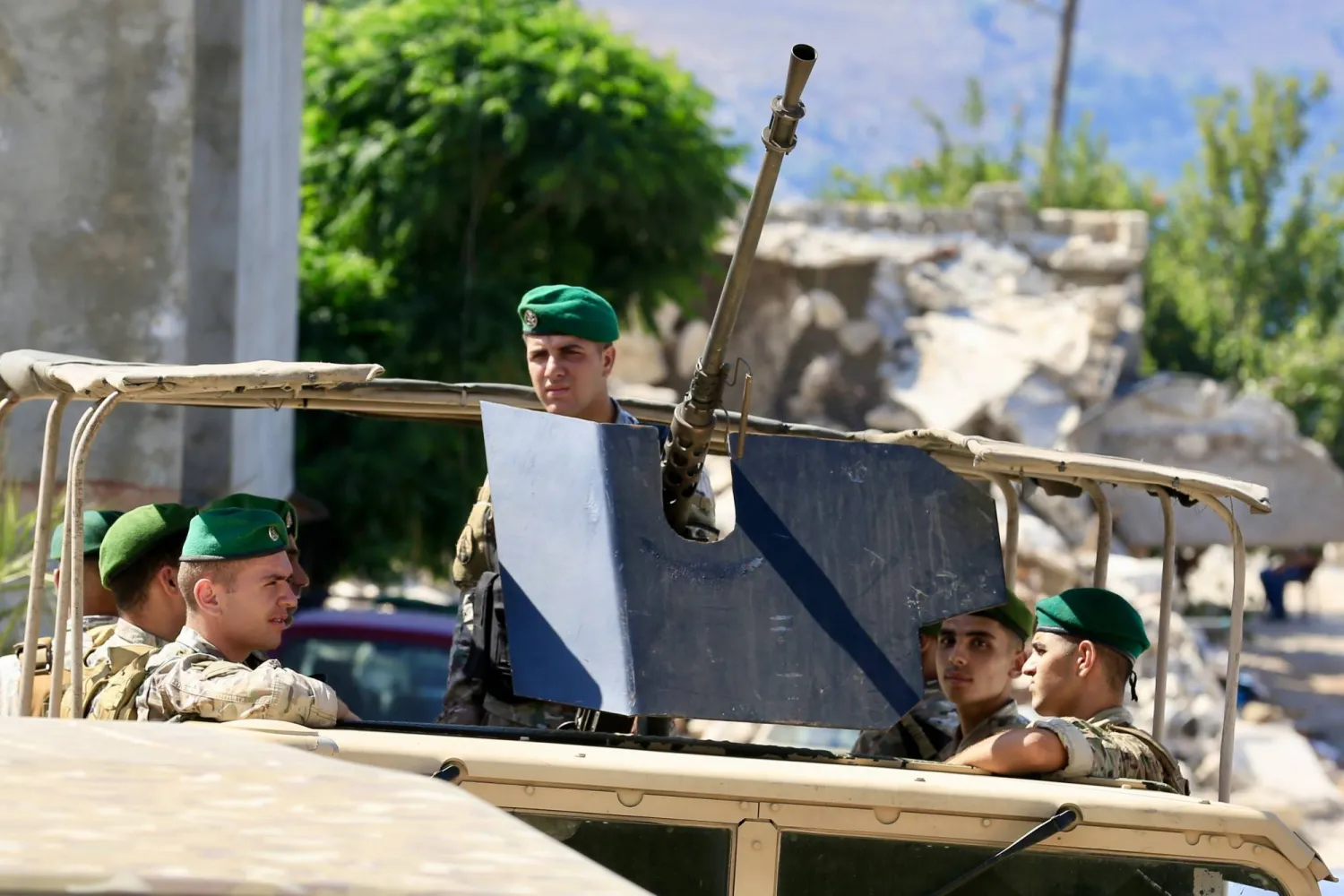
Lebanese soldiers patrol Zawtar al Gharbiya, southern Lebanon, 05 August 2026. Zawtar al-Gharbiya is among the designated pilot zones under the ceasefire agreement between Lebanon and Israel, from which Israeli forces have withdrawn.  EPA/STRINGER
Lebanese soldiers patrol Zawtar al Gharbiya, southern Lebanon, 05 August 2026. Zawtar al-Gharbiya is among the designated pilot zones under the ceasefire agreement between Lebanon and Israel, from which Israeli forces have withdrawn. EPA/STRINGER
TT

Washington Faces Task of Freeing the 'Framework Agreement' From Hezbollah, Netanyahu's Time-Buying

Lebanese soldiers patrol Zawtar al Gharbiya, southern Lebanon, 05 August 2026. Zawtar al-Gharbiya is among the designated pilot zones under the ceasefire agreement between Lebanon and Israel, from which Israeli forces have withdrawn.  EPA/STRINGER
Lebanese soldiers patrol Zawtar al Gharbiya, southern Lebanon, 05 August 2026. Zawtar al-Gharbiya is among the designated pilot zones under the ceasefire agreement between Lebanon and Israel, from which Israeli forces have withdrawn. EPA/STRINGER

Hezbollah has found little response from Lebanon's political forces to Secretary-General Naim Qassem's call for dialogue and now appears increasingly isolated. A Lebanese cabinet source told Asharq Al-Awsat that any party genuinely seeking engagement with its political opponents would not simultaneously escalate political attacks against President Joseph Aoun and Prime Minister Nawaf Salam.

According to the source, Hezbollah has found virtually no support for its campaign against the two leaders, including from its ally, Parliament Speaker Nabih Berri, who has instead been working to improve relations with both. While many members of Berri's parliamentary bloc reportedly view the proposed Framework Agreement as a waste of time and resources, they are instead placing their hopes on the still-suspended Iranian-US Memorandum of Understanding, pending the resumption of negotiations between Tehran and Washington.

The source said Qassem's call for dialogue has effectively been ignored by Hezbollah's opponents as long as the group continues to insist on retaining its weapons and rejects placing all arms exclusively under state control.

Hezbollah, the source added, continues to act as though its unilateral decision to support Gaza and Iran, and to independently determine questions of war and peace, did not trigger a political and security upheaval in Lebanon, while refraining from responding to ongoing Israeli violations and attacks.

The source also noted that Hezbollah did not claim responsibility for the explosion in the southern Lebanese town of Majdal Zoun, which killed two Israeli soldiers and wounded seven others after they entered a booby-trapped house.

The decision may have been made on Berri's advice, the source suggested, unlike Hezbollah's earlier claim of responsibility for launching six rockets in retaliation for Israel's assassination of Iran's Supreme Leader, Ali Khamenei, despite Qassem's earlier pledge that Hezbollah would not intervene on Iran's behalf.

The source questioned whether the group would maintain its current policy of denying Israel a pretext for escalating its military operations.

In the same context, the cabinet source said Hezbollah has refused to comment publicly on the explosion, while a source within the Shiite Duo, the alliance of Hezbollah and the Amal Movement, did not rule out the possibility that Israel itself was behind the incident. The cabinet source expressed hope that Hezbollah would continue to exercise restraint.

The source argued that both Israel and Hezbollah are seeking to buy time, albeit for different reasons. Israel, the source said, is using military pressure on Lebanon to buy time until the October 27 Knesset elections, without offering concessions that would facilitate implementation of the Framework Agreement.

Lebanese officials accuse Israel of obstructing its implementation, although Washington has so far appeared to understand Lebanon's position. That assessment could change, however, if the United States increases pressure on Israel to produce a breakthrough following the seventh round of negotiations, hosted in Rome for the second time. Lebanon is pinning its hopes on direct intervention by President Donald Trump to achieve such a breakthrough.

By contrast, Hezbollah continues to pursue what the source described as a strategy of patience, refraining from responding to Israeli violations despite Qassem's warning that the situation would not be allowed to return to what it was before March 2. The party views the seventh round of negotiations as another exercise in buying time, a position that aligns with some lawmakers affiliated with Berri.

They argue that progress should be measured by a timetable for Israeli withdrawal and the expansion of "pilot areas" under Lebanese Army deployment to include occupied towns and villages, provided that the ceasefire and cessation of hostilities are firmly established to allow displaced residents to return home. Hezbollah, however, is said to be placing all of its political bets on Iran, treating the Iranian-US memorandum as a preferable alternative to the Framework Agreement, which many of its lawmakers have openly called to scrap.

The source questioned whether Hezbollah and Israel would continue buying time for opposing strategic objectives or whether US intervention could break the current deadlock in the Rome II negotiations. Trump, the source noted, had promised President Aoun during their meeting in Washington that the United States would provide full support for implementing the Framework Agreement as the only viable path to separating Lebanon's political track from Iran's and preventing the country from remaining hostage to both sides' delaying tactics.

The source also argued that Qassem's renewed call for dialogue is itself another means of buying time. Otherwise, the source asked, what purpose does the initiative serve while Hezbollah simultaneously attacks Aoun and Salam and has largely cut off communication with its political opponents, including many former allies who distanced themselves after the group's intervention in support of Gaza and Iran?

The source recalled that Hezbollah had previously pledged to turn the page on past disputes to facilitate a new political dialogue, but said such talks appear futile as long as Qassem insists on maintaining his current positions while expecting others to negotiate on that basis, without acknowledging that Lebanon's involvement in regional conflicts fundamentally altered the country's political and security landscape.

According to the source, Qassem's attacks on Aoun and Salam reflected his frustration over the government's decision to withdraw the accreditation papers of Mohammad Reza Sheibani, Iran's ambassador-designate to Lebanon. Hezbollah had reportedly hoped a compromise would allow Sheibani to assume his post before August 25, when the courtesy entry visa granted to him upon arrival at Beirut-Rafic Hariri International Airport expires.

The source added that Hezbollah had already suspended direct dialogue with Aoun, relying instead on occasional contacts through presidential adviser Brigadier General André Rahal, despite assigning MP Hassan Fadlallah responsibility for presidential relations—a role previously handled by Mohammad Raad, head of Hezbollah's parliamentary bloc. No meeting has taken place between Aoun and Fadlallah, the source said, adding that the latter instead launched political attacks against the president, effectively closing the door to reviving dialogue.

As a result, Aoun now holds Hezbollah responsible for the breakdown in communications, arguing that any party seeking dialogue should refrain from making accusations against the head of state. The source said Hezbollah's campaign has only deepened its political isolation by pushing most Lebanese political forces to rally behind Aoun.

The party, the source added, miscalculated in assuming that pressure on the president would persuade him to reverse the government's decision regarding Sheibani's accreditation or ignore the Cabinet's ban on Hezbollah's military and security activities. Lebanon's disputes, the source concluded, cannot be resolved through political pressure but only through dialogue guided by the country's national interest.

The question remains whether Hezbollah and Netanyahu will continue to buy time, or whether US pressure will push the Rome II talks toward implementation measures that restore momentum to the Framework Agreement as the only viable path for leading Lebanon out of its crises.



Israel Puts Military on Alert for Oct 7 Anniversary, Warns Gazans

Residents gather on a hill on October 1, 2026, in Sderot, one of the areas in southern Israel attacked by Hamas three years prior. Oded Balilty, AP
TT

Israel Puts Military on Alert for Oct 7 Anniversary, Warns Gazans

Residents gather on a hill on October 1, 2026, in Sderot, one of the areas in southern Israel attacked by Hamas three years prior. Oded Balilty, AP

Israel's defense minister on Tuesday said he had put the military on high alert before the anniversary of Hamas's October 7, 2023 attack, warning Gazans would pay a "heavy price" if forces were harmed.

The office of Defense Minister Israel Katz said the instruction came "in light of intelligence regarding Hamas's intentions to attempt to carry out attacks and terror operations against our forces in Gaza on that day".

"If, heaven forbid, our forces are harmed, the ones who will pay the heavy price will be Hamas and the population of Gaza -- beyond all proportion," the statement added.

Hamas's October 7, 2023 attack was the deadliest day in Israel's history, resulting in the deaths of 1,221 people, according to an AFP tally based on official Israeli figures.

Militants also dragged 251 hostages into Gaza, 44 of them already dead.

In response, Israel launched a military offensive that has left most of Gaza in ruins and killed more than 74,200 people, according to Gaza's health ministry, which is under Hamas authority and whose figures are considered reliable by the United Nations.

Since a ceasefire was declared last October, Israeli forces have killed more than 1,440 people in Gaza, according to the ministry.

On Monday, during a state ceremony to mark three years since the attack, Israeli Prime Minister Benjamin Netanyahu said there would be "no Hamas rule in Gaza" and vowed to continue targeting anyone who was involved in the attack or who held hostages.


Berri Reins In Hezbollah Campaign against Lebanese Prime Minister

Lebanese Prime Minister Nawaf Salam inspects the Nabatieh Gendarmerie unit last Friday (National News Agency) 
TT

Berri Reins In Hezbollah Campaign against Lebanese Prime Minister

Lebanese Prime Minister Nawaf Salam inspects the Nabatieh Gendarmerie unit last Friday (National News Agency) 

Lebanese Parliament Speaker Nabih Berri has moved to rein in political attacks by his ally Hezbollah against Prime Minister Nawaf Salam, with sources close to Berri telling Asharq Al-Awsat that he pushed for a de-escalation between Salam and a large segment of residents in southern Lebanon.

The shift was reflected in Salam’s visit to Nabatieh on Friday and reinforced in a Sunday interview on NBN, a channel affiliated with Berri’s Amal Movement. Salam reiterated the government’s position on Israel’s withdrawal from southern Lebanon and its commitment to restoring the state’s role and activating its institutions there.

Salam’s meetings Monday offered further signs of a drive to strengthen the state’s presence in the south. He met Berri to discuss political and field developments, pressing social and economic conditions, the outcome of his US visits and his Nabatieh tour and projects launched there, the speaker’s office said.

At the Grand Serail, Salam met Head of Council for the South Hashem Haidar, who briefed him on the council’s work and projects announced during the Nabatieh visit and steps taken to begin them.

Positive signs

Friday’s trip was Salam’s third visit to the south in three months. It was notably coordinated, with Amal MP Hani Qobeissi welcoming him alongside Finance Minister Yassin Jaber, himself from Nabatieh, and Interior Minister Ahmad al-Hajjar. Municipal leaders from Nabatieh-area villages aligned with Hezbollah also joined the reception.

Although Hezbollah’s political representatives were absent, the group issued no statement criticizing the visit or Salam, unlike on previous occasions — a sign of the de-escalation promoted by Berri.

Sources following the visit noted that the tour and meetings “repaired a large part of the relationship between Salam and the people of the region.” They said Hezbollah MP Mohammad Raad, the party’s representative in Nabatieh, was absent because he does not attend social occasions for security reasons. Hezbollah-aligned municipalities took part, while opposition to the visit appeared marginal.

In another sign of de-escalation, Hezbollah MP Hassan Fadlallah said Monday the group supported strengthening the state’s role in the south and having it assume full responsibility, “but that begins with expelling the occupation, stopping the aggression and ending this bulldozing operations and destruction in our villages.”

He urged the state to match words with actions, backed development initiatives in the south and called for the disbursement of a $250 million World Bank loan, part of which is allocated to the region, as well as increased government spending there in the 2027 budget.

Berri consistent with his demands

Unlike Hezbollah, which has attacked Salam in recent months, communication between the prime minister and Berri has continued. Berri has pressed for activating state institutions in the south, securing stability and the ceasefire, enabling residents to return to their villages and providing services to bolster their steadfastness, despite opposing direct negotiations with Israel and having earlier declared the “framework agreement” defunct.

Amal sources told Asharq Al-Awsat that Berri was consistent with his demand for state institutions to be present in the south. Salam’s visit, they said, confirmed the executive authority’s intention to strengthen that presence, making it natural for Amal and its Development and Liberation bloc to “meet it halfway.”

The sources underlined that the visit “soothed the wounds of southerners” and opened the door to a stronger state presence. They also pointed to Salam’s acknowledgment that resources were limited and reconstruction required international support because Lebanon could not undertake it alone.

‘No punishment of any community’

In Sunday’s NBN interview, Salam said: “The state cannot remain in a state of waiting. We must go to the south and to all regions and assume our responsibilities.”

He reiterated the need to stop Israeli attacks, consolidate the ceasefire, secure Israel’s withdrawal from occupied Lebanese territory and work for the release of prisoners.

“When I return for a fourth time to Nabatieh and Tyre, I want to see with my own eyes that water and electricity have been restored, that the contracts we launched are actually being implemented, that schools are being repaired, and that our people are returning and feel safe,” Salam added.

“If I wanted to punish a particular community, I would not personally be following these operations and the response to demands every day.”

Salam stressed that dialogue with all sides remained open, adding that agreed measures now had to be implemented and each side must honor its commitments.

Addressing residents of the south, he said: “You are not alone. The state is with you, beside you and at your service,” citing the presence of security agencies, institutions and services in Nabatieh.


Lebanon, Britain to Hold Joint Military Exercise Starting Tuesday

A Lebanese flag flies as buildings lie in ruins in Mansouri, as seen from Henniye, Lebanon, September 29, 2026. (Reuters)
TT

Lebanon, Britain to Hold Joint Military Exercise Starting Tuesday

A Lebanese flag flies as buildings lie in ruins in Mansouri, as seen from Henniye, Lebanon, September 29, 2026. (Reuters)

Lebanon's army will hold exercises with the British military this month, both sides said on Monday, with the drills also to involve personnel and representatives from countries including the United States and France.

Britain has been a key supporter of the cash-strapped Lebanese army and has provided millions of dollars in assistance over the years, including helping train Lebanese soldiers to secure the country's land borders.

The Lebanese army said that the joint "Pegasus Cedar 2026" exercise would begin on Tuesday and aimed to "bolster the capabilities of military units and raise the level of coordination between the Lebanese army and friendly armies".

It said the exercise would include "training on reconnaissance, raids and combat in built-up areas", among other activities.

A British embassy statement said British soldiers based in Cyprus would "join their Lebanese counterparts in the Air Assault Regiment in a landmark military exercise aimed at strengthening bilateral defense ties and enhancing operational readiness".

"Personnel from the armies of the United States and Italy will also take part, with representatives from the armies of France, Cyprus, Qatar, and Jordan joining as observers," it added.

The exercise, to be held over three weeks, builds on a previous UK-Lebanon military training exercise held in September 2023, the embassy statement added.

Lebanese authorities have called for increased support for the country's under-resourced army, which counts some 80,000 personnel and depends heavily on foreign aid.

The military faces enormous challenges in completing its deployment to south Lebanon under a framework agreement reached in June between Israel and Lebanon that involves the disarmament of the Hezbollah group and the gradual withdrawal of Israeli forces.

Hezbollah drew the country into the Middle East war in March by attacking Israel, which responded with massive airstrikes and a ground invasion.

While violence has dropped since June, Israel still carries out attacks and demolitions, and its troops are occupying a self-declared "security zone" running around 10 kilometers (six miles) inside Lebanon along the border.

The fighting followed another conflict that erupted in 2023 that led to an all-out war the following year.

Last month in Paris, Lebanese President Joseph Aoun met his French counterpart Emmanuel Macron and Jordan's King Abdullah II, and discussed international support for the country's military.