
Netanyahu Faces Plunging Support in North Israel as Voters Demand Tougher Lebanon Stance

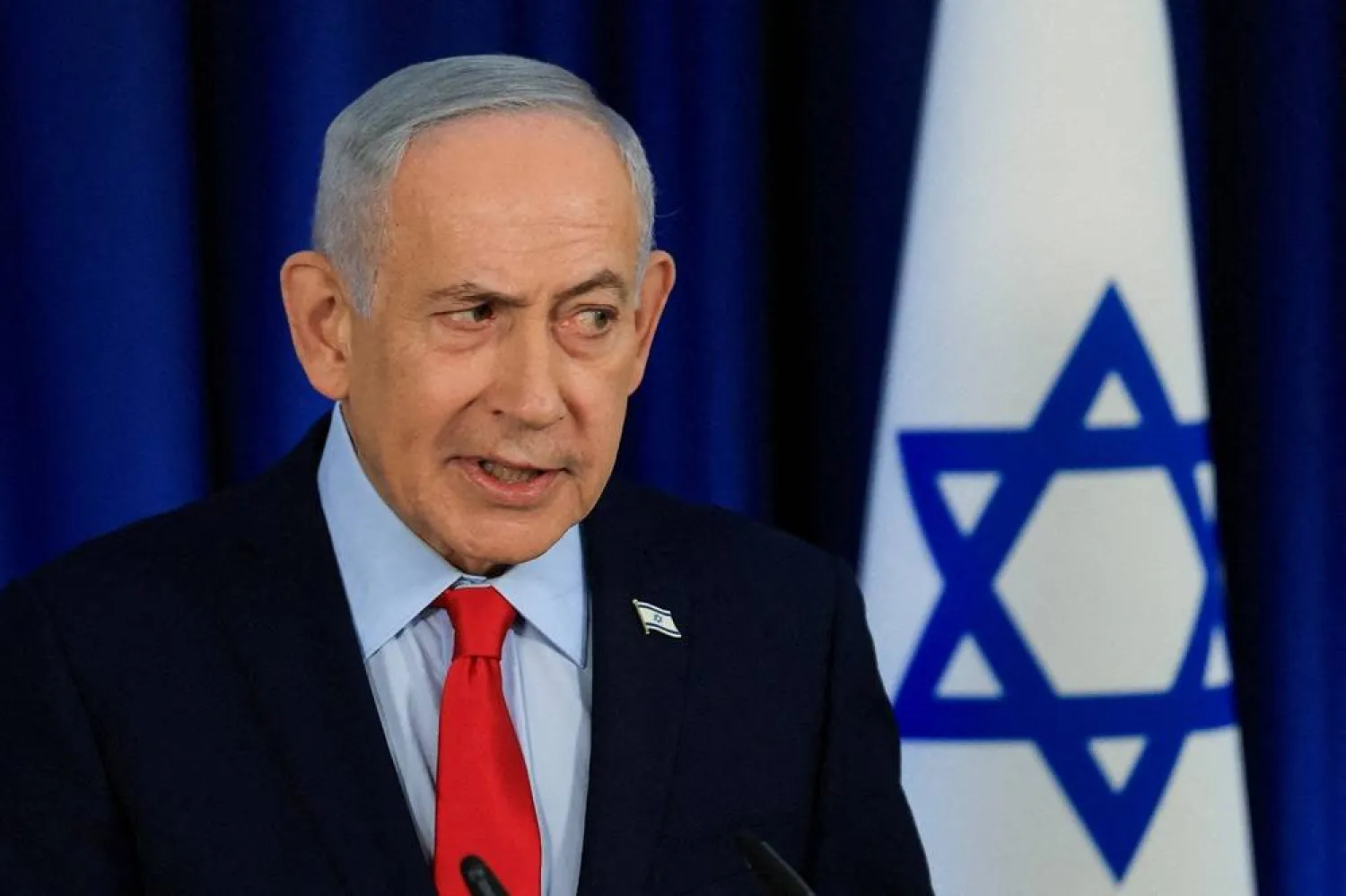
Israeli Prime Minister Benjamin Netanyahu speaks during a press conference, amid the US-Israel conflict with Iran, in Jerusalem, March 19, 2026. (Reuters)
TT

Netanyahu Faces Plunging Support in North Israel as Voters Demand Tougher Lebanon Stance

Israeli Prime Minister Benjamin Netanyahu speaks during a press conference, amid the US-Israel conflict with Iran, in Jerusalem, March 19, 2026. (Reuters)

Israeli Prime Minister Benjamin Netanyahu faces plunging support in the electorally vital north where Hezbollah rocket fire has been heaviest, a new poll has shown, putting pressure on him to take a more hawkish stance as elections loom. Wednesday night's ceasefire agreement between Israel and Lebanon - whether it holds or not - may not be what northern voters have in mind.

The May poll by Agam Labs at Israel's Hebrew University, shared exclusively with Reuters, showed residents in the north abandoning Netanyahu's Likud more quickly than voters elsewhere and faulting him more harshly over the war in Lebanon. With Iran demanding an end to Israel's military campaign as part of any peace deal it agrees with the United States, the poll shows how Netanyahu is increasingly caught between domestic electoral considerations and the diplomatic efforts of his allies in Washington.

NORTHERN VOTERS WANT END TO HEZBOLLAH THREAT

The general election due by October could tip Netanyahu's governing coalition from power, risking his long record as Israel's arch political survivor.

While his government is widely seen as the most right-wing in Israeli history, many northern voters want a tougher military stance, unfettered by US pressure to end the conflicts in the Middle East.

For residents of ‌the northern city ‌of Kiryat Shmona, where some half of voters backed Likud in the last election, ending the threat from ‌Hezbollah and ⁠its near-daily rocket ⁠and drone attacks is the biggest issue.

When sirens start to wail, they have only seconds to seek shelter and voters there told Reuters they want the war against Hezbollah pursued until the group is dismantled.

"All night there are loud explosions," said Kiryat Shmona resident Moshe Yifrah, 45, adding that he does not believe a ceasefire with Hezbollah would protect his family. "Who would we make it with? Murderers who want to kill us?" he said.

Hezbollah began firing into Israel after the Hamas attack of October 7, 2023, and Israel waged an intense armed campaign in Lebanon, killing most of the group's leaders and forcing it to accept a ceasefire.

However, Hezbollah fired again after Israel and the United States launched a war on Iran on February 28, prompting Israel to renew its assault and seize swathes of ⁠south Lebanon.

More than 50 civilians have been killed by Hezbollah fire in north Israel since October 2023, according ‌to Tel Aviv University's Institute for National Security Studies.

In Lebanon, more than 7,500 people have been ‌killed by Israeli military action since October 2023, statements by Lebanese officials that do not distinguish between civilians and combatants show.

Many northern voters, like Yifrah, want Israel to ‌intensify its campaign, which continued despite an April truce, but believe Netanyahu is buckling to pressure from US President Donald Trump to agree a ceasefire.

"I'm ‌not ashamed to say that I voted for this government, but it turns out that the one managing it is President Trump," said Yifrah.

Trump, who wants a deal with Iran, said on Monday that Israel and Hezbollah had agreed to de-escalate hours after Netanyahu ordered new strikes on Beirut's southern suburbs. Netanyahu's electoral rivals almost immediately accused him of compromising on national security - adding to his political difficulties months before the election is due.

"Everywhere Hezbollah is deployed it must be struck and the hands of the Israeli army should not be tied," said former military chief of staff Gadi Eizenkot, a prime ministerial hopeful, in a speech on Monday. Then on Wednesday evening, a new truce agreement was struck requiring Hezbollah to leave south ⁠Lebanon. Netanyahu said soon afterwards that despite ⁠the ceasefire military operations would continue for now.

ELECTION RIVALS TARGET NORTH

The Agam Labs poll showed only 23% of voters in the north saying they would back Likud in the next election, down from the 35% it gained in the last election in 2022. Support for the wider right-wing bloc that makes up Netanyahu's coalition has fallen yet further in the north, the poll showed.

The drop in support for Likud is around three times greater in the north, home to around a fifth of the electorate, than elsewhere in Israel and around 70% of the voters surveyed there said they disapproved of the handling of the war in Lebanon - more than elsewhere in Israel.

"We see a dramatic shift," said Nimrod Nir of Agam Labs.

"It's almost a mirror image of what we saw regarding the past elections, with two thirds intending to vote for the anti-Netanyahu bloc," he added.

The chairperson of Kiryat Shmona's Likud branch did not respond to a request for comment on the party's reduced support in polls or agree to an interview.

Nestled amid lush green mountains, Kiryat Shmona had been a prosperous center of tourism and farming, but residents now describe it as a ghost town with many residents having left.

Shops were shuttered, and a playground was empty during a Reuters visit this week.

Netanyahu's main rivals are trying a hawkish message in the north, with Eizenkot visiting more than 15 times in recent weeks. Netanyahu has stayed away.

"He should come visit," said Yisrael Cohen, 40, who previously backed Likud but will not in the next election. "The government needs to see us."

Israel Resumes Gaza Attacks, Targets Palestinian Factions

A Palestinian child eats from a bowl after receiving food from a charity kitchen at Nuseirat refugee camp in central Gaza on Friday. (AFP)
TT

Israel Resumes Gaza Attacks, Targets Palestinian Factions

A Palestinian child eats from a bowl after receiving food from a charity kitchen at Nuseirat refugee camp in central Gaza on Friday. (AFP)

Israeli forces resumed attacks in the Gaza Strip after a two-day pause requested by mediators and the United States to allow progress in ceasefire talks hosted by Cairo in recent days, where the parties agreed on wording related to the issue of weapons.

Palestinian factions had asked mediators to stop violations and assassinations in Gaza as a condition for advancing the talks, sources told Asharq Al-Awsat at the time.

Mediators then contacted US President Donald Trump’s administration and the Board of Peace to press Israel, before an agreement was reached on halting attacks for several days.

Assassinations and destroyed residential blocks

The airstrikes stopped from dawn Tuesday until Thursday afternoon, then resumed with attacks targeting operatives from Palestinian factions and fresh strikes on residential blocks. Israel used the same approach in the previous round of talks, when it halted airstrikes for two days before resuming them.

The first strike on Thursday targeted member of the al-Nasser Salah al-Deen Brigades, the armed wing of the Popular Resistance Committees, one of the factions that joined the Cairo talks. He was wounded after being hit on the roof of his family home north of Nuseirat camp in central Gaza.

About two hours later, another strike targeted a member of the Qassam Brigades, Hamas’s armed wing, in the Sabra neighborhood south of Gaza City as he stood on the roof of his family home. He was killed immediately.

Asharq Al-Awsat learned he was one of the most prominent members in Qassam’s engineering unit.

Roughly three hours later, an Israeli drone struck two young men west of Nuseirat camp in central Gaza, killing one of them. He was a prominent field operative in the Al-Quds Brigades, the armed wing of Islamic Jihad, based in the Jabalia camp.

At night, Israeli warplanes struck two small rooms and farmland near Al-Aqsa Martyrs Hospital in Deir al-Balah in central Gaza, destroying the site.

They later destroyed two homes and damaged a residential block in Maghazi camp in central Gaza. Later, they destroyed several homes and shops and damaged others after bombing another nearby residential block in the same camp.

The bombing displaced dozens of families who lost their only shelter. Israel has stepped up attacks on intact residential blocks, or those only slightly damaged during the war, especially in the central area, one of the least damaged parts of Gaza and an area where Israeli forces have not carried out major operations.

On Friday, four Palestinians were wounded in shooting incidents and artillery shelling near the yellow line. A young man survived after a drone struck the vehicle he was riding in deep in Deir al-Balah in central Gaza. No injuries were reported.

Israeli forces also expanded the yellow line in the Tuffah neighborhood east of Gaza City, specifically along Salah al-Din Street, in the fourth such operation in about a month and a half.

Hazem Qassem, a Hamas spokesperson, said in a press statement that moving the yellow line, along with the bombardment and displacement that accompanied it, was a flagrant violation of the ceasefire agreement.

He said it reflected Israeli Prime Minister Benjamin Netanyahu’s threats to increase Israel’s control over Gaza, amid the silence of the Board of Peace and the inability of mediating and guarantor states to stop the violations. He said the aim was to blow up the negotiating track and the recent positive atmosphere.

Negative response

The escalation came despite mediators’ success in reaching wording with Hamas and seven other Palestinian factions, in the absence of Fatah, on the clauses of a road map presented by Nickolay Mladenov, the high representative for Gaza at the Board of Peace.

The most sensitive clause concerned weapons, stating that they would be confined and stored rather than handed over, and that this would be done through a Palestinian body, the National Committee for the Administration of Gaza.

In return, the committee would enter Gaza and assume its duties, Israel would withdraw, and the humanitarian protocol from the first phase would be implemented.

Hamas and the Palestinian factions had been waiting for Israel’s response to what had been agreed. By Thursday evening, they had received neither a positive nor a negative reply.

A source from Hamas told Asharq Al-Awsat that the renewed escalation amounted to a clear response from Netanyahu’s government rejecting the wording, adding that the movement would wait for the official response from mediators.

Asharq Al-Awsat learned that parties outside the mediating states, as well as parties within the Board of Peace and the Gaza administration committee, support the wording reached on Gaza’s weapons and see it as an opportunity to build on.


Report: Syrian President Has No Intention of Intervening in Lebanon

 05 April 2026, Syria, Damascus: Syrian President Ahmad al-Sharaa attends a meeting with Ukrainian President Volodymyr Zelensky. (Ukrainian Presidency/dpa)
05 April 2026, Syria, Damascus: Syrian President Ahmad al-Sharaa attends a meeting with Ukrainian President Volodymyr Zelensky. (Ukrainian Presidency/dpa)
TT

Report: Syrian President Has No Intention of Intervening in Lebanon

 05 April 2026, Syria, Damascus: Syrian President Ahmad al-Sharaa attends a meeting with Ukrainian President Volodymyr Zelensky. (Ukrainian Presidency/dpa)
05 April 2026, Syria, Damascus: Syrian President Ahmad al-Sharaa attends a meeting with Ukrainian President Volodymyr Zelensky. (Ukrainian Presidency/dpa)

Syrian President Ahmed al-Sharaa told visitors that Damascus has no intention of intervening in Lebanon, two of them told AFP, days after US President Donald Trump suggested it might be willing to do so.

One of those present, requesting anonymity to speak freely, said that Sharaa told dozens of notables and dignitaries from the Damascus province that "what is being circulated about Syria entering Lebanon is nothing more than rumors".

The Syrian presidency announced on Thursday that Sharaa received the delegation at the presidential palace in a meeting that addressed service and development issues of concern to the province's residents.

The statement made no mention of Sharaa's remarks on Lebanon.

It came with Israel and Iran-backed Hezbollah still trading blows in the country, despite a conditional ceasefire announced by Lebanese and Israeli envoys earlier this month in Washington.

Hezbollah rejected the agreement, which makes no mention of Israel having to cease attacks or withdraw its troops from Lebanon.

Trump told US broadcaster NBC last week that Sharaa was willing to help against Hezbollah, which has been fighting a war with Israel since March 2 as part of the broader Middle East conflict.

"I'd like to see a more surgical attack on Hezbollah. I think it should be more surgical. And we can help them with that, or we can recommend Syria," he said.

"Syria's doing a very good job of cleaning up their act. They have a very good leader. They have a leader that's really done a good job in a short period of time. And he would love to help."

In a televised interview on Thursday, Syrian interior ministry spokesperson Noureddine al-Baba aid that Damascus stands with Lebanese President Joseph Aoun in "preserving Lebanon's security and the sovereignty of the Lebanese state".

"Coordination with our brother Lebanon is the cornerstone of any possible role that Syria can play in resolving Lebanese issues," he added.

Responding to Trump's words, Baba said that "the Syrian and Lebanese sides are best positioned to interpret these statements and agree on a formula that serves both countries within the framework of the common Arab vision".

Syria, which under the Assad family was a close ally of Hezbollah, dominated Lebanon for decades following a military intervention in the latter's 1975-1990 civil war, withdrawing only in 2005, making any new military involvement a fraught proposition.

Hezbollah fought alongside the Syrian government in that country's own civil war, making the new authorities in Damascus, which took over after the fall of Bashar al-Assad in 2024, deeply hostile to it.


Vatican Envoy’s Aid Convoy Stopped by Israeli Forces in South Lebanon

 Smoke billows from southern Lebanon following an Israeli strike, as seen from Marjeyoun, Lebanon, June 12, 2026. (Reuters)
Smoke billows from southern Lebanon following an Israeli strike, as seen from Marjeyoun, Lebanon, June 12, 2026. (Reuters)
TT

Vatican Envoy’s Aid Convoy Stopped by Israeli Forces in South Lebanon

 Smoke billows from southern Lebanon following an Israeli strike, as seen from Marjeyoun, Lebanon, June 12, 2026. (Reuters)
Smoke billows from southern Lebanon following an Israeli strike, as seen from Marjeyoun, Lebanon, June 12, 2026. (Reuters)

An aid convoy organized by the Vatican envoy to Lebanon that was headed for Christian villages in the country's south was stopped by the Israeli military and forced to change course, a convoy member told AFP on Friday.

A number of Christian-majority villages near the border have been caught up in the fighting between Israel and Hezbollah but many residents have refused to leave.

"While approaching the village of Debl on Thursday, we got face-to-face with several Israeli tanks" who stopped the convoy, a member of the convoy told AFP on condition of anonymity.

"There were several tank and machine gun shots towards rear positions that we could not identify... which caused panic," he added.

The person said it was not clear "whether they wanted to intimidate us or they were targeting Hezbollah positions".

Contacted by AFP, the Israeli military and the Vatican did not immediately respond to requests for comment.

The convoy, led by the Apostolic Nuncio Paolo Borgia, included 25 trucks and several cars transporting residents wanting to return home.

The route was coordinated with UN peacekeepers through an international committee created to monitor a ceasefire that sought to end the 2024 Israel-Hezbollah conflict.

After being halted for over an hour, the convoy took another longer route to reach their destination after 12 hours, the member said.

Vincent Gelot, head of Catholic organization Oeuvre d'Orient which regularly takes part in aid convoys, told AFP that the people who chose to remain in their villages "are completely isolated from the rest of the country".

"They are deprived of resources because most of them are farmers. They do not have access to their fields."

The villages are surrounded by areas and localities Israel has warned to evacuate, with Gelot saying they are "threatened to disappear".

On Tuesday, the association of Christian border villages in southern Lebanon urged authorities to "immediately open safe humanitarian and medical corridors to ensure the access of citizens, aid and medical and relief teams to the affected and isolated villages".

On June 2, an Israeli drone strike killed a student alongside her father and brother as she was returning to her border village after sitting for university exams in Beirut.