


Hezbollah Rejects Latest Ceasefire Agreement as Israeli Strikes Kill 4 in Lebanon

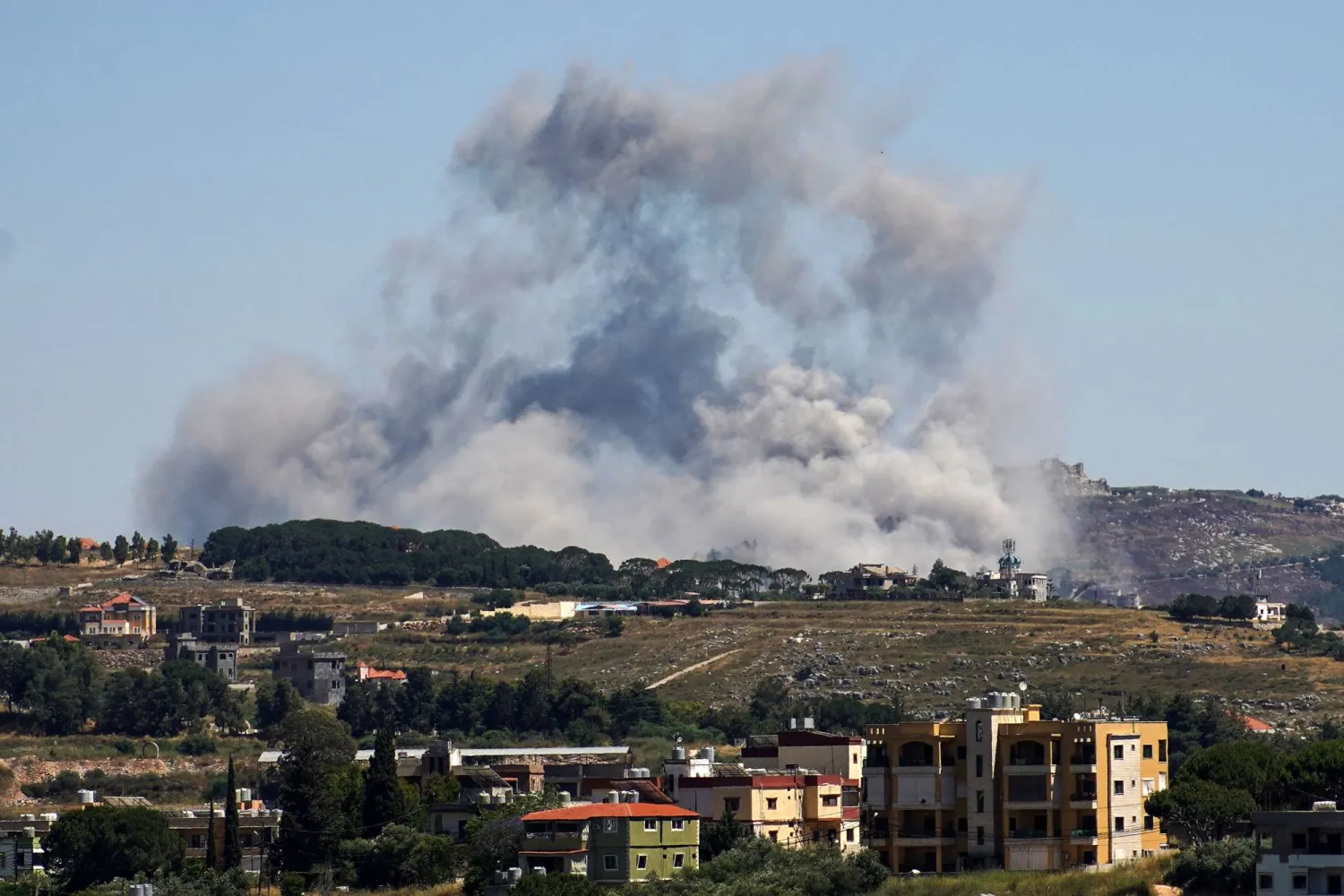
A photograph taken from the southern area of Nabatieh shows smoke rising from the site of an Israeli airstrike in the village of Kfar Tibnit on June 4, 2026. (Photo by Abbas Fakih / AFP)
TT

Hezbollah Rejects Latest Ceasefire Agreement as Israeli Strikes Kill 4 in Lebanon

A photograph taken from the southern area of Nabatieh shows smoke rising from the site of an Israeli airstrike in the village of Kfar Tibnit on June 4, 2026. (Photo by Abbas Fakih / AFP)

Hezbollah on Thursday rejected the latest ceasefire agreement between Israel and the Lebanese government, and the militant group demanded a complete Israeli withdrawal from Lebanon as more fighting there hampered efforts to end the Iran war.

The Hezbollah announcement came as Israeli strikes killed at least four people, according to local authorities, and a UN peacekeeper was killed in the crossfire. An Israeli soldier was also killed in combat in southern Lebanon, The Associated Press said.

Hezbollah leader Naim Kassem, in a written statement read on TV, called the negotiations “absurd, humiliating and insulting.” He said the agreement’s demand that Hezbollah fighters leave southern Lebanon under fire would mean “surrender, defeat and achieving the enemy’s goals.”

“What we are concerned about is an end to the aggression, ceasefire and Israel’s withdrawal,” he said, underscoring that Hezbollah has not made any commitment to stop fighting. “So long as our villages are not safe and are being bombed and destroyed and our people are killed," he said, northern Israel “will not be safe.”

Sirens sound after Netanyahu visit

Following Kassem’s statement, drone alert sirens sounded in several border communities in northern Israel, including Shlomi, a town where Prime Minister Benjamin Netanyahu and several ministers had been meeting with local officials, his office said. Israeli media reported that Netanyahu left a short time before the alerts sounded.

The Israeli military later said the sirens were triggered by attempts to intercept several drones that hit near soldiers in southern Lebanon. No injuries were reported.

Lt. Gen. Eyal Zamir, the Israeli military’s chief of staff, acknowledged Thursday that the ongoing war was straining northern Israeli towns living under the threat of Hezbollah fire. He said Israel’s operations in Iran and Lebanon had “created a new security reality,” by weakening Iran and Hezbollah “to an unprecedented degree.”

Lebanese troops began moving Thursday afternoon into the southern village of Dibbine, in coordination with UN peacekeepers, after Israeli forces left the area, which saw intense clashes in recent days, state-run media reported. It was the first time Israeli troops withdrew from an area in southern Lebanon since the latest Israel-Hezbollah war began about three months ago.

The fighting in Lebanon, where Israeli forces have seized large swaths of the south, threatens efforts to end the Iran war and reopen the Strait of Hormuz, a key transit point for oil and gas. Its closure has jolted the world economy.

Iran has demanded that any lasting truce extend to Lebanon. Israeli Prime Minister Benjamin Netanyahu, who faces elections later this year, wants to press ahead with Israel’s offensive until Hezbollah no longer poses a threat.

US President Donald Trump, who faced a rare rebuke from Congress on Wednesday, has sought to downplay the diplomatic deadlock and the failure of declared ceasefires to end the fighting. He told reporters that in the Middle East, "a ceasefire is when you’re shooting in a more moderate manner.”

Serbian peacekeeper and Israeli soldier killed

A Serbian peacekeeper was killed and two others were wounded when a mortar struck their location near Marjayoun, a Christian-majority town that has seen intense fighting, according to the UN mission in southern Lebanon, known as UNIFIL, and the Serbian Defense Ministry.

Israel blamed Hezbollah for the firing that killed the UN peacekeeper, without offering evidence. Hezbollah and the UN did not immediately comment on who launched the shells.

Also Thursday, the Israeli military announced that a 21-year-old captain in the armored corps was killed in southern Lebanon.

Lebanon’s state-run National News Agency said a drone strike killed a motorcyclist and wounded four people in the village of Maaroub. The Israeli military said soldiers killed an armed militant and later found a Hezbollah cache of guns, grenades, surface-to-air missiles and other combat gear in the area.

The military also said it conducted strikes near the coastal city of Tyre and around Shaqra, another community in southern Lebanon.

The Lebanese news agency reported airstrikes in the south and said a strike on the village of Sohmor in the Bekaa Valley, in eastern Lebanon, killed three people and wounded others.

Israel has warned people not to go into parts of southern Lebanon where it says it is striking Hezbollah facilities.

Fighting has raged despite declared ceasefires

Hezbollah resumed rocket fire days after Israel and the United States launched their surprise Feb. 28 attack on Iran, which backs Hezbollah. Before then, Israel had regularly carried out strikes in Lebanon against what it said were militant targets, often killing civilians, despite an earlier truce reached in 2024.

After Hezbollah's rocket and drone attacks resumed, Israeli troops seized around a fifth of Lebanon, pushing further into the country's south than at any time since the end of Israel’s 1982-2000 occupation.

In the southern city of Sidon, residents reacted to Wednesday's ceasefire announcement with skepticism, saying previous agreements had failed to stop the violence.

“Every few days a ceasefire is announced, but people keep getting killed,” said Mayada Hijazi.

“It’s all talk and no action,” said Salah Nassab. “We keep going back to our homes, and then we get displaced again, back and forth. We’re very tired."

More than 3,500 people have been killed in Lebanon, and over 1.2 million have been displaced. The fighting has killed at least 28 Israeli soldiers and three civilians.

Latest ceasefire came from ongoing Israeli-Lebanese talks

The latest declared ceasefire came about through US-brokered talks between Israel and Lebanon's government, which accuses Hezbollah of dragging the country into war and had made efforts to disarm it before the latest hostilities.

The ceasefire agreement calls for Lebanon's armed forces to take control of security zones in Lebanon from which the militants would be banned.

Lebanese President Joseph Aoun on Thursday called the new agreement "the last chance to enter a final and comprehensive ceasefire.” He said Lebanon was ready to implement the deal once he receives responses from relevant factions in Lebanon, including Hezbollah. The United States — and Trump himself — would determine how and when the deal is implemented, Aoun told journalists.

The agreement terms Hezbollah “an enemy" of Israel, the US and Lebanon and calls for dismantling it. The government has promised to do so in the past but does not have the capabilities to disarm Hezbollah by force.

The latest agreement did not say when Israel would withdraw from southern Lebanon but said the US would support the Lebanese army as it works to assert control in areas where Hezbollah has long wielded power.



Israel Vows War with PA in Case of Oct 7-Style Attack

Israeli soldiers with a military vehicle keep watch near the Palestinian village of Al-Mughayyir, West Bank, 06 September 2026, as local Palestinian students return to school for the new academic year. (EPA)
TT

Israel Vows War with PA in Case of Oct 7-Style Attack

Israeli soldiers with a military vehicle keep watch near the Palestinian village of Al-Mughayyir, West Bank, 06 September 2026, as local Palestinian students return to school for the new academic year. (EPA)

Israel on Monday threatened a "full-scale war" against the Palestinian Authority if it prepared an attack against Israeli forces or settlements similar to the one launched by Hamas from Gaza on October 7, 2023.

The remarks from Defense Minister Israel Katz came after a stabbing attack in the northern occupied West Bank, with the Israeli military saying it had shot and killed the Palestinian assailant.

Violence has surged in the West Bank, occupied by Israel since 1967, after Hamas's October 2023 attack sparked the war in Gaza. Recent months have seen soaring attacks by Israeli settlers against Palestinians, often with little or no legal consequence.

"If... the Palestinian Authority's security mechanisms and related bodies initiate, or we know with certainty that they are about to initiate, a terror attack in the style of October 7 against Israeli forces and Jewish settlements -- Prime Minister Benjamin Netanyahu and I have instructed the army to prepare for the opening of a full-scale war," Katz said in a statement from his office.

Katz said the military campaign would target the "senior leadership and mechanisms" of the Palestinian Authority, which is based in the West Bank city of Ramallah, as well as "all terror infrastructure" in the territory.

He said it would include "targeted killings of senior figures" and the "evacuation of residents from the cities and villages from which terror activity is carried out", with a permanent Israeli military presence in those areas.

Katz said the operation would emulate the so-called "security zones" in which the Israeli military currently operates in Gaza and southern Lebanon.

On Monday, the Israeli military said it shot and killed a Palestinian assailant who had stabbed an Israeli settler in the northern occupied West Bank.

Israel's Magen David Adom emergency services said a man in his 20s had been taken to hospital in a moderate to serious condition with multiple stab wounds.

Praising the soldiers who killed the assailant, Netanyahu vowed: "No terrorist can hide."

"We will continue to eliminate terrorists, hunt down those who dispatch them, and destroy the terrorist infrastructure in Judea and Samaria," he said in a statement, using the Biblical term for the West Bank.

In response to the attack, Palestinian movement Hamas called to "escalate the resistance and engage with the enemy soldiers and settler gangs".

Hamas's attack on Israel resulted in the deaths of 1,221 people, according to an AFP tally based on official Israeli figures. Fighters also took 251 hostages, 44 of them already dead, into Gaza.

Israel responded with a massive offensive in Gaza that has killed at least 73,651 people, according to the Palestinian territory's health ministry, which operates under Hamas authority and whose figures are considered reliable by the United Nations.


Hodeidah Governor to Asharq Al-Awsat: We Are Determined to Fully Liberate Yemen's West Coast

Governor of Yemen’s Hodeidah province Dr. Al-Hassan Taher in this screengrab taken from a video.
TT

Hodeidah Governor to Asharq Al-Awsat: We Are Determined to Fully Liberate Yemen's West Coast

Governor of Yemen’s Hodeidah province Dr. Al-Hassan Taher in this screengrab taken from a video.

Governor of Yemen’s Hodeidah province Dr. Al-Hassan Taher said that government forces were advancing on all military fronts, especially the west coast and Taiz.

In remarks to Asharq Al-Awsat, he stressed that the government was determined to complete the full liberation of Hodeidah and west coast from the Houthis after the militants ceased their advance.

Speaking from the frontlines, Taher said the government forces recaptured several positions from the Houthis and claimed new ones.

The military units are securing the liberated areas and advancing in other regions, he added.

The battle in Taiz has shifted in the government’s favor after stopping the Houthi advance. “We are in the process of defeating them and repelling them to the farthest point possible,” stressed Taher.

The escalation sparked by the Houthis on the western coast and Taiz entered its fourth day Sunday, as government forces shifted from containing the attack to pursuing the group’s operatives in southeastern Hodeidah.

Government forces have detained dozens of Houthis during the battles, the majority of whom are minors, as it continued its advance from northern Hays towards the al-Jarahi district.

Taher said the fight on the west coast was the “mother of all battles,” given its strategic importance.

The fight is not just between the government and Houthis, but between Yemen’s legitimacy and Iran’s proxies, he added.

The armed forces are determined to continue their operations until the full liberation of Hodeidah and the west coast, he declared, warning that the Houthis’ capture of the region “would be a disaster for Yemen, and the whole region and world.”

Government and joint forces announced on Saturday the full liberation of the Hays district in Hodeidah from the Houthis.

Taher warned that the Houthis seizing Bab al-Mandeb would be like Iran controlling the strategic strait. It will alter the equation in the entire region, he said, calling on the legitimate government to confront the danger.

He said Iran was behind the Houthi escalation on the west coast, saying it had ordered the militants to carry it out despite knowing the repercussions.

He explained that after Iran could no longer reap gains from Hormuz, it shifted its attention to Bab al-Mandeb that it has long wanted to capture.

He noted the extent of the funding and modern weapons being provided to the Houthis, saying it reflects Iran’s role in the fighting.

On the humanitarian level, Taher said the Houthi rocket, drone and mortar attacks have killed several people. Over 790 families have been displaced.

Saudi Arabia’s King Salman Humanitarian Aid and Relief Center has been the first to come to their aid and offer relief to the affected people, he stressed.

He added that the Kingdom has long stood with the Yemeni people throughout various crises and they will not forget it.


Asharq Al-Awsat Follows Sweeping Security Campaign Against Former Regime Remnants in Aleppo

 A number of wanted people arrested during the security campaign in Aleppo (security sources) 
 A number of wanted people arrested during the security campaign in Aleppo (security sources) 
TT

Asharq Al-Awsat Follows Sweeping Security Campaign Against Former Regime Remnants in Aleppo

 A number of wanted people arrested during the security campaign in Aleppo (security sources) 
 A number of wanted people arrested during the security campaign in Aleppo (security sources) 

For a third consecutive day, Syrian security forces continued a sweeping campaign in Aleppo in the north, led by Internal Security forces and the Counterterrorism Department, targeting former leaders and members of the ousted regime of Bashar Assad accused of war crimes.

The operation is the second of its kind in Aleppo this year and has led to the arrest of several former regime officers, most notably Brig. Gen. Hamada Ali Murad, a military pilot, in the town of Nubl. It also targeted a network of former regime members and allied militia personnel.

Sources at Aleppo’s Internal Security Directorate told Asharq Al-Awsat that more than 50 people have been detained so far, including former officers, personnel and informants, in operations across the city and surrounding countryside conducted with the Counterterrorism Service.

Murad was arrested in Nubl over accusations that he was responsible for numerous violations against civilians and facilitated alleged illicit activities by members of his family, including looting homes, seizing properties and selling them.

The sources said the operation followed an extensive assessment of those targeted, surveillance of their activities and the gathering of evidence of their alleged involvement in widespread crimes and abuses against civilians. Accusations and individual complaints against them included war crimes, intimidation, extortion, robbery, and the exploitation and sale of property belonging to civilians and displaced people.

They noted that security operations in Aleppo and its countryside would continue until their objectives were achieved, namely arresting wanted former regime personnel and other suspects found to have been involved with terrorist groups or committed acts of violence against civilians.

A Pilot and Allegations Involving His Family

Murad, from Nubl, graduated with the 30th class of the Air Force Academy as a helicopter pilot. He previously served with the 63rd Helicopter Air Brigade at Taftanaz air base in the Idlib countryside, initially as the brigade’s security officer. He was later transferred to the Air Force Academy as an instructor and subsequently served as an officer at the Air Force Institute.

At the beginning of the Syrian uprising against the former regime, Murad was transferred to the Air Force Intelligence branch in Aleppo as a liaison officer. According to the sources, he coordinated between the branch and pilots, relaying and directing information concerning air sorties and identifying areas targeted for bombardment in Aleppo and its countryside.

After fighting in Aleppo subsided, Murad was appointed director of the Air Force Training Institute. Information cited by the sources also points to the alleged involvement of several members of his family in theft and the seizure of homes during the uprising, exploiting Murad’s position.

In a statement on its official channels, the Internal Security Directorate said a pilot — whom it did not name — had been detained in an operation conducted with the Counterterrorism Department targeting people it described as “wanted individuals involved in committing crimes against civilians.”

It said investigations were continuing “to uncover the full circumstances of his activities during the era of the ousted regime.”

Group Leaders and Members Detained

Sources at Aleppo’s Internal Security Directorate said the latest operation did not target “mere names,” but groups that had been affiliated with and fought alongside the former regime, with both group leaders and members detained.

According to the sources, security forces dismantled a group led by Khaled Hazari that had previously operated in Aleppo’s Old City, arresting Hazari, Firas Kako, Zakaria al-Ahmad and others. Another group led by Hamdi Mardali was also dismantled. Mardali was detained in the Bab al-Hadid neighborhood of the Old City, while Nour al-Din Alwan was also arrested.

Director of Public Relations at the Aleppo Media Directorate, Moataz Khattab, wrote on his personal account that several wanted individuals had been detained, including Hassan Raghed al-Ibrahim and his son, Raghed Hussein al-Ibrahim. The two had served with the Fourth Division’s 555th Regiment before moving to the former Republican Guard’s 155th Battalion.

The father is accused of informing on his brother, who later died in Saydnaya prison, as well as three of his cousins, and of seizing their property. He is also accused of illegally selling more than 40 properties belonging to people displaced from Aleppo during the uprising.

Khattab also named Nour Alwan, whom he described as involved in crimes against Syrians; Hossam al-Saad, a former fighter with Liwa al-Quds; and Khaled al-Shahoud, known as Abu Watan, whom he described as accused of working with Air Force Intelligence under the former regime.

Internal Security Responds to Appeal

The father of one detainee, Khaled Mohammed Abed, submitted an appeal to Internal Security authorities requesting his son’s release and a broader review of his security file and the accusations against him.

He maintained that his son had not been in areas controlled by the former regime throughout the years of the uprising and requested an urgent review because his son suffers from a heart condition.

The father asked security authorities to take whatever action they deemed appropriate after examining his son’s case and what he described as malicious accusations against him. He also requested that his son’s reputation be restored legally and in the media following what he described as defamation and abuse on social media.

Aleppo’s Internal Security Directorate confirmed to Asharq Al-Awsat that Khaled al-Abed had been released because of insufficient evidence and the weakness of the accusations against him. It said his health condition had also been taken into account, prompting authorities to expedite the investigation and his release.