


Sadr Hands over Saraya al-Salam to Iraqi Govt as PMF to Be ‘Restructured’

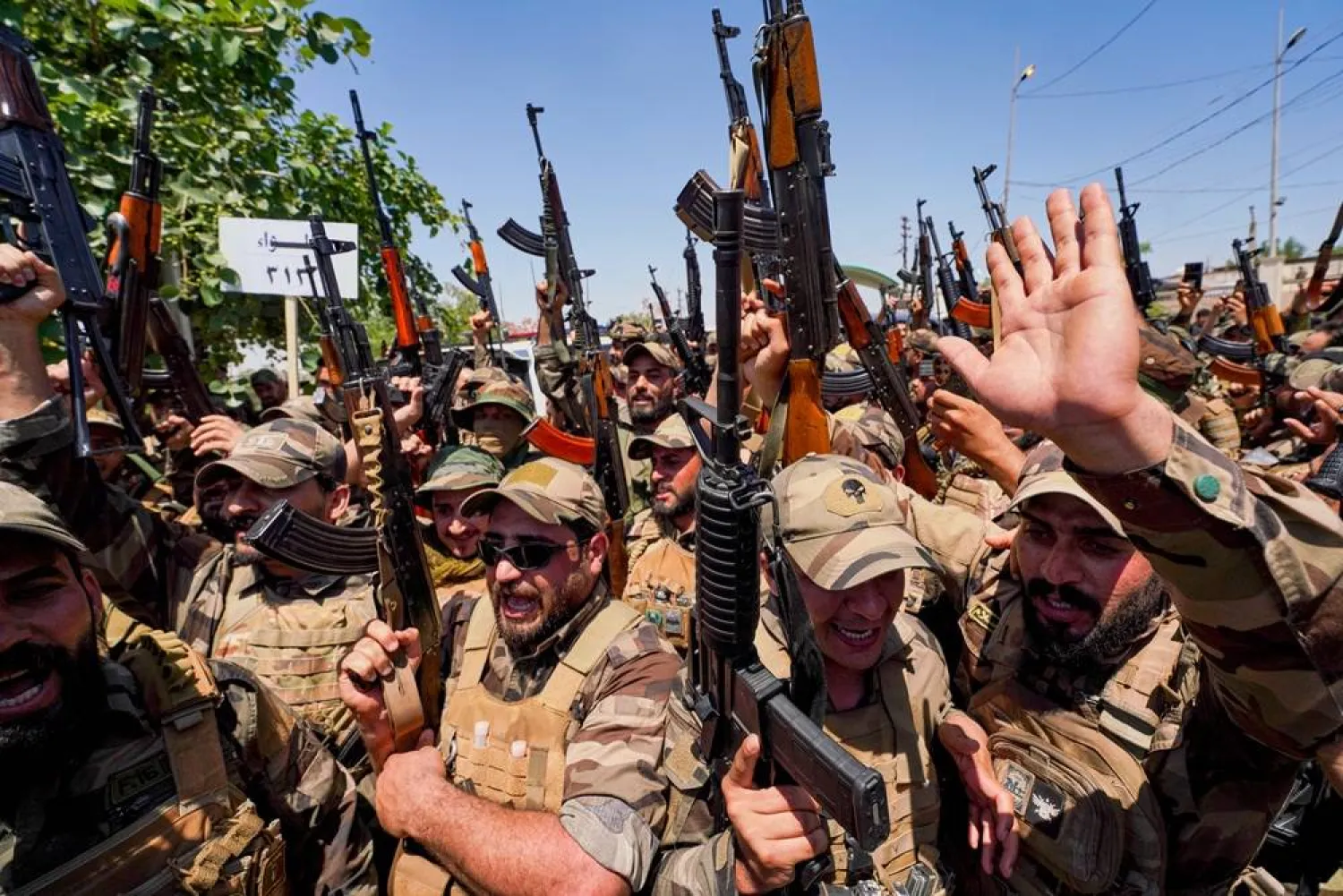
Members of Saraya al-Salam react during a ceremony in the city of Samarra on June 4, 2026, marking their separation from the Sadrist movement and their integration into the Iraqi security forces. (AP)
TT

Sadr Hands over Saraya al-Salam to Iraqi Govt as PMF to Be ‘Restructured’

Members of Saraya al-Salam react during a ceremony in the city of Samarra on June 4, 2026, marking their separation from the Sadrist movement and their integration into the Iraqi security forces. (AP)

The armed wing of influential cleric Moqtada al-Sadr's movement handed over on Thursday its security responsibilities to the Iraqi army in Samarra city.

The Saraya al-Salam are part of the pro-Iran Popular Mobilization Forces and hold security responsibilities in several regions, notably Samarra.

Sadr had announced on May 27 that he was merging the Saraya al-Salam with the state, calling on other PMF factions to follow suit.

Within a week, the Imam Ali Brigades and Asaib Ahl al-Haq factions said they were disengaging with the PMF. Other staunchly pro-Iran factions, the Kataib Hezbollah and Nujaba movement, have refused to disarm and dismantle their armed wings.

Head of Iraq's Security Media Cell Lieutenant General Saad Maan said all Saraya al-Salam fighters are now working under the orders of the prime minister, who is also commander-in-chief of the armed forces.

State media aired footage of the Saraya al-Salam members lowering their faction’s flag at their operations command center at a ceremony attended by a military delegation dispatched by PM Ali al-Zaidi.

Washington has long wanted to curtail Iran's influence in Iraq, but the start of its war with Tehran on February 28 has given it new momentum.

Iran-backed groups in Iraq have launched numerous strikes against US installations in Iraq since the start of the Middle East war at the end of February.

The strikes have been blamed on pro-Iran groups, against whom the US has retaliated, killing dozens of their fighters.
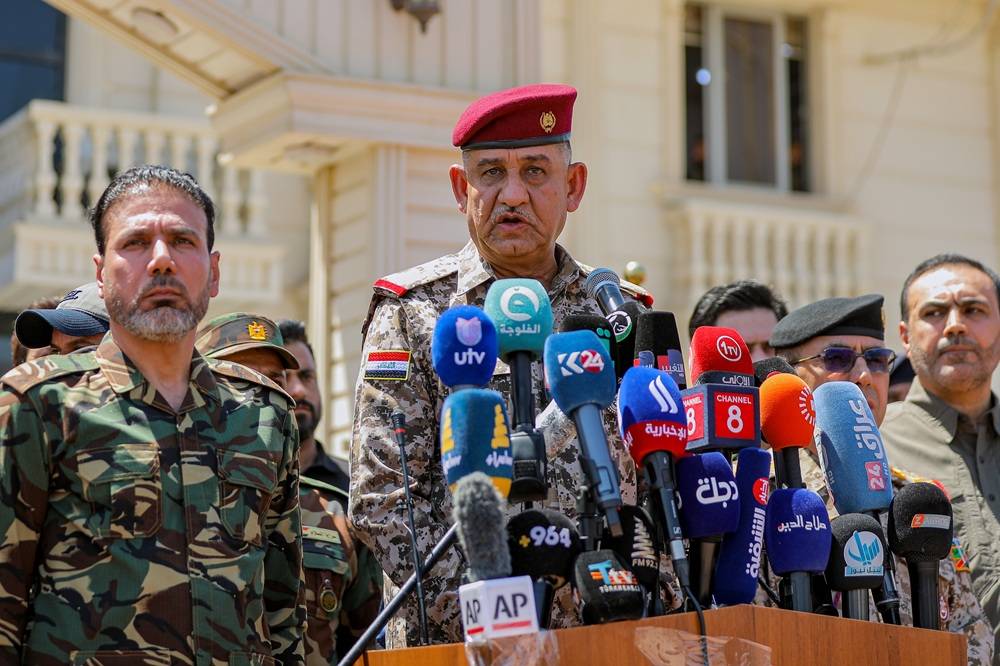
Qais al-Muhammadawi, Deputy Commander of Iraq's Joint Operations Command, speaks during a ceremony marking the start of the process of the Saraya al-Salam handing over its weapons to Iraqi state forces in Samarra, north of Baghdad, Iraq, Thursday, June 4, 2026. (AP)

Washington has in turn put pressure on Baghdad to rein in the groups by suspending security assistance and cash transfers of Iraqi oil revenues.

Qais al-Muhammadawi, Deputy Commander of Iraq's Joint Operations Command, told a press conference that the Saraya al-Salam will now be merged with the armed forces.

The faction has been deployed in Samarra since the 2007 al-Askari shrine bombing. It remains to be seen whether they will quit the city for the first time in 19 years.

A military source told Asharq Al-Awsat that the group handed over all of its headquarters to the army and its fighters are now at the command of the armed forces.

Despite these developments, the details of the dismantling of the groups and their disarmament remain vague, said observers. Questions remain over the size of their arsenal and whether they will really turn them over to the government and completely abandon them.

An Iraqi security official said the mechanism for disarmament remains “unclear”, reported AFP.

Local media said an initiative has been proposed for discussion before the ruling pro-Iran Coordination Framework. It includes securing tens of thousands of government jobs in official security institutions for members of the dismantled armed factions.
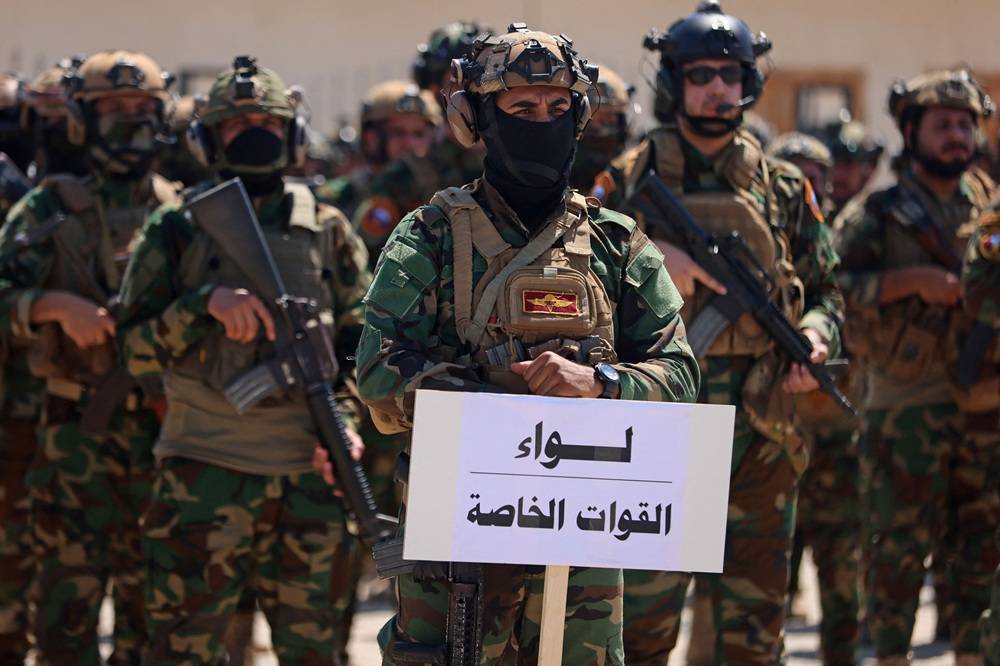
Members of Saraya al-Salam gather during a ceremony in the city of Samarra on June 4, 2026, marking their separation from the Sadrist movement and their integration into the Iraqi security forces. (AFP)

PMF ‘structuring’

Meanwhile, spokesperson for the Commander-in-Chief of the Armed Forces Sabah al-Numan announced that the committee tasked with imposing state monopoly over arms has kicked off its operations.

He said that “faction disengagement from the PMF calls for the restructuring of formations and ensuring the rights of members.”

This was the first time that the issue of structuring of the formations has been brought up since the PMF’s establishment in 2014. The group was initially set up to fight the ISIS extremist group.

Numan explained that “disengagement” entails “administrative frameworks and the restructuring of these formations within the security agencies, guaranteeing the rights of fighters and merging them with military formations.”

The committee will set up mechanisms for merges and the handover of weapons and military equipment to the official security agencies, he added.

The committee is comprised of officials from the defense and interior ministries, Joint Operations Command and PMF.

What’s next?

Qais al-Khazali's Asaib Ahl al-Haq is expected to follow in Sadr’s footsteps and handover its weapons.

The group, which the US designates a terrorist organization, also forms an important parliamentary bloc with 27 seats. Having refocused on politics, it has distanced itself from Iran and has not taken part in the current war.

A source close to the group said “being part of the government is more important that fighting. So we want to offer the US reassurances.”

The Imam Ali Brigades said it will form a committee to follow up on the disarmament and handover of weapons under the PM’s supervision.

The group has effectively put its administrative control in Zaidi’s hands, said a source close to the factions.

Washington's special envoy for Iraq and Syria, Tom Barrack, has called the disarmament efforts a "significant step forward, which represents the nascent foundation for a renewed Iraqi self-governance". He welcomed the "principled decision" of those groups that are choosing to integrate.



Lebanon, Israel and US Sign Trilateral Framework Pact

Secretary of State Marco Rubio and others watch, as seated from left, Israel's Ambassador to the US Yechiel Leiter, counselor Dan Holler, and Lebanon's Ambassador to the US Nada Hamadeh, sign a framework agreement, described as a first step toward peace following months of conflict between Israel and the Lebanese militant group Hezbollah, at the State Department, Friday, June 26, 2026, in Washington. (AP Photo/Kevin Wolf)
TT

Lebanon, Israel and US Sign Trilateral Framework Pact

Secretary of State Marco Rubio and others watch, as seated from left, Israel's Ambassador to the US Yechiel Leiter, counselor Dan Holler, and Lebanon's Ambassador to the US Nada Hamadeh, sign a framework agreement, described as a first step toward peace following months of conflict between Israel and the Lebanese militant group Hezbollah, at the State Department, Friday, June 26, 2026, in Washington. (AP Photo/Kevin Wolf)

Lebanon, Israel and the United States on Friday signed a trilateral framework agreement aimed at paving the way for a peace deal between the two long-time Middle East adversaries.

The agreement -- which includes a pilot effort in which Lebanese soldiers take control of two areas occupied by Israel, as well as a process aimed at disarming Hezbollah -- is the result of five rounds of talks in the US capital, reported AFP.

The deal "begins to put in place a framework for lasting peace and security," US Secretary of State Marco Rubio said at the signing ceremony, noting: "It's the beginning of the beginning. There's a lot of work ahead."

Lebanon's ambassador to Washington, Nada Hamadeh Moawad, said the accord "is a first step on the road to restoring Lebanese sovereignty and territorial integrity, securing a permanent and final cessation of hostilities (and) enabling our people to go back to their land."

And Israel's US envoy, Yechiel Leiter, said that under the deal, "Iran is out, Hezbollah is out, and the road to peace between Israel and Lebanon is in."

Hezbollah drew Lebanon into the broader Middle East war on March 2 with rocket fire aimed at Israel to avenge the killing of Iran's supreme leader Ali Khamenei in US-Israeli strikes.

Israel responded with heavy airstrikes and a ground invasion, and its troops continue to occupy swaths of southern Lebanon, where they have been carrying out extensive demolition of homes and other buildings.

According to the agreement, whose text was released late Friday by the State Department, Israel and Lebanon "declare their intent to conclusively end the conflict, address its underlying causes, and to therewith formally conclude any state of war between them."

It also establishes a process by which the Lebanese Armed Forces (LAF) would restore "sovereign authority over all Lebanese territory," pending the "verified disarmament of non-state armed groups," particularly Hezbollah.

That in turn would allow the Israeli army to "progressively redeploy out of the Lebanese territory," the agreement states.

Despite the deal, Israel and its bitter enemy Hezbollah -- which is part of the Lebanese government but also maintains a powerful armed wing outside state control -- made clear that major differences remain.

- 'Pilot areas' -

Hezbollah chief Naim Qassem said earlier Friday that Israel has "no option but to withdraw completely from every inch of our Lebanese land," and that its forces "must leave unconditionally."

Prime Minister Benjamin Netanyahu however said in a pre-recorded video shared with Israeli media shortly after the framework agreement was announced that Israel has no plans to exit Lebanon until Hezbollah gives up its weapons.

Prior to the release of the text, Netanyahu said his country's military would allow the Lebanese army to take control of territory in "two pilot areas" -- one south of Lebanon's Litani River and another north of it.

According to the text, "the LAF will assume full and effective security responsibility in these zones, internationally supported reconstruction efforts will begin, and Lebanese civilians will be able to safely return to these areas."

Rubio meanwhile said in a statement that the agreement establishes a "clear and structured process" to disarm Hezbollah and its infrastructure, as well as a US-facilitated military working group to help implement the deal.

Washington's top diplomat also said the United States would commit $100 million in humanitarian assistance in coordination with the United Nations, and would reimburse Lebanon's army for $30 million as it seeks to "improve the capability and capacity" of those forces.

The United Nations chief of humanitarian affairs, Tom Fletcher, hailed the agreement and called the signing in Washington "a moment of hope and opportunity."

Under US pressure, Lebanese and Israeli officials began direct talks in April in Washington, and a truce was announced on April 17 that ultimately failed to stop the fighting.

A new but very fragile ceasefire was declared this month as Tehran insisted Lebanon must be included in its deal with Washington to end the broader war.

The conflict has displaced more than one million Lebanese and left more than 4,200 dead, according to Lebanese authorities.


Syria Hails Shift From Captagon Hub to Anti-Drug Partner

Syria’s Anti-Narcotics Directorate seized 25 million professionally packaged Captagon pills. (Syrian Interior Ministry)
TT

Syria Hails Shift From Captagon Hub to Anti-Drug Partner

Syria’s Anti-Narcotics Directorate seized 25 million professionally packaged Captagon pills. (Syrian Interior Ministry)

Syria on Friday marked what it called its shift from a “Captagon hub” to a “partner in combating it,” as the world observed the International Day against Drug Abuse and Illicit Trafficking.

The official Syrian Arab News Agency, SANA, said this year’s event was held under the slogan “The global drug problem: persistent issues, new challenges and innovative responses,” citing rapid changes in global drug markets, the rise of new substances and increasingly complex smuggling routes.

SANA said the occasion came as Syria presses ahead with efforts to dismantle drug production and smuggling networks following changes in the file after the fall of the former government, a reference to the government of former President Bashar al-Assad.

“After years in which Syria, under the former regime, was one of the world’s most prominent hubs for producing and smuggling Captagon, the country entered a new phase after liberation,” SANA said in a report on Friday.

That phase, it said, is focused on dismantling drug factories, pursuing trafficking networks and expanding international cooperation, turning Syria “from a source of threat into an active partner in combating it.”

SANA said that in December 2025, one year after Assad’s government fell, the United Nations Office on Drugs and Crime, UNODC, confirmed the disruption of large-scale Captagon manufacturing in Syria.

It said the Syrian government had dismantled 15 Captagon manufacturing facilities and 13 smaller storage sites since December 2024, the month the former government fell.

The agency said UNODC’s 2026 report also noted that disruption in the Captagon market after Assad’s fall had pushed up pill prices in some areas. The report also warned that some users could turn to other synthetic drugs, such as methamphetamine.

Coinciding with the international anti-drug day, SANA said the Interior and Health ministries had launched a national campaign under the slogan “Syria Without Drugs.”

Brig. Gen. Khaled Eid, head of the Anti-Narcotics Directorate, told Syrian Alikhbariah that reaching a “Syria Without Drugs” was not just a slogan, but a national project built on scientific and carefully studied plans.

He said the campaign rests on a balance between deterrence and treatment. “The user is viewed as a victim who requires care, while the dealer and smuggler are treated as perpetrators of a crime that requires punishment,” he said.

Eid said the Interior Ministry had faced “a complex reality” in recent months, including local manufacturing centers and distribution networks targeting young people. He said this required stronger security controls, tighter oversight of border crossings, better-equipped anti-narcotics units with modern tracking technology, and an integrated database on active networks.

According to SANA, Syria’s Anti-Narcotics Directorate has carried out 1,550 drug seizures and interdiction operations since Assad’s fall. The operations led to the dismantling of 90 international smuggling networks and the closure of 17 Captagon factories.

The seized materials included 697 million Captagon pills, 15 metric tons of hashish, 10 million narcotic pharmaceutical pills, 180 kg of cocaine, 84.5 kg of crystal meth, 7 kg of heroin and 221 metric tons of chemical precursors, according to Eid.

Separately, the UN Security Council unanimously passed a resolution renewing the mandate of the United Nations Disengagement Observer Force in the Golan, known as UNDOF, during a session on Thursday.

Syrian Alikhbariah quoted Syria’s Permanent Representative to the United Nations, Ibrahim Olabi, as saying at the session that Syria was now one of the most stable countries in the region and was “engaged in reconstruction, restoring institutions and attracting investment.”

He also cited Syria’s cooperation with international partners on counterterrorism, chemical weapons-related obligations and regional security.

Olabi also addressed political change in Syria, saying “the change in Syria was represented by the disappearance of a regime that practiced torture and used chemical weapons.”

On Israel, Olabi expressed “Syria’s concern over Israeli statements about not withdrawing from Syria,” saying “Israel’s current actions can be interpreted as an attempt to seize the lands it occupied.”

Olabi said the change in Syria that Israel appeared to fear was the removal of “an authoritarian regime that used chemical weapons against its people.” He asked whether Israel preferred the situation that had existed under Assad.

UNDOF was established after the October 1973 war under the Disengagement of Forces Agreement signed by Syria and Israel in 1974. The force has operated since then in the buffer zone to monitor compliance with the ceasefire in the Syrian Golan Heights, which Israel has occupied since 1967.


Iraq Row Erupts Over ‘Missing’ $140 Bn

 A session of Iraq’s parliament in Baghdad, March 2026. (Iraqi News Agency)
A session of Iraq’s parliament in Baghdad, March 2026. (Iraqi News Agency)
TT

Iraq Row Erupts Over ‘Missing’ $140 Bn

 A session of Iraq’s parliament in Baghdad, March 2026. (Iraqi News Agency)
A session of Iraq’s parliament in Baghdad, March 2026. (Iraqi News Agency)

A senior Iraqi official has ignited a new dispute over the fate of about $140 billion in public revenues, as Iraq presses ahead with corruption investigations involving high-ranking officials at the oil and electricity ministries.

The cases center on allegations that tens of millions of dollars and billions of Iraqi dinars were stolen through contracts suspected of being fake.

The developments come as the Iraqi government faces mounting financial and political pressure ahead of Prime Minister Ali al-Zaidi’s visit to the United States in mid-July.

The government is also grappling with efforts to bring weapons under state control, complete the formation of the government and confront financial strain caused by a drop in Iraqi oil exports after the closure of the Strait of Hormuz.

The pressure has prompted Baghdad to seek alternatives to secure state employees’ salaries for the next three months.

Missing $140 billion

In a televised interview broadcast two days ago, former Finance Ministry undersecretary Masoud Haider said the state treasury had received about 455 trillion dinars over the three years of the previous government, equivalent, by his estimate, to about $345 billion.

Haider said operating spending and public-sector salaries totaled about $205 billion, then questioned the fate of the remaining $140 billion.

Haider, a member of the Kurdistan Democratic Party, said spending on infrastructure projects, including overpasses in Baghdad, could not explain the gap.

He accused the Finance Ministry of blocking his access to data from the accounting and budget departments while he served as undersecretary.

He said the restriction was imposed because of his ethnic and party affiliation and presented an official document that he said barred the two departments from dealing with him without the minister’s approval.

Haider said he informed former Prime Minister Mohammed Shia al-Sudani of what he described as a legal violation, but said Sudani took no action.

Former Finance Minister Taif Sami denied the accusations. In a statement, she said Haider’s remarks were “baseless and not supported by any reports or official documents issued by the relevant oversight authorities.”

Sami said oil revenues are monitored and audited by the Federal Integrity Commission and the Federal Board of Supreme Audit, as well as by international auditing systems that track oil exports and reconcile exported volumes with collected revenues.

She said the disappearance of the cited sums would be “impossible” without their appearing in official records and reports.

She said non-oil revenues had also grown in recent years as a result of reform measures, including the introduction of point-of-sale systems and follow-up with public companies to collect dues and transfer them to the public treasury after audit by the Federal Board of Supreme Audit.

On revenues from the Kurdistan Region, Sami said the file differed from other federal revenues. She said the region’s revenues had not been transferred to the federal treasury in a way that would allow them to be included in the accounts cited.

Sami said maintaining public trust in financial and oversight institutions required accuracy and reliance on facts and official documents, not estimates or accusations unsupported by evidence.

Major budget changes

On Iraq’s severe financial crisis, lawmaker Hussein al-Daraji said in press remarks that the time left this year was not enough to prepare and pass a 2026 budget draft in parliament.

He said the government was instead preparing a draft 2027 budget, which he expected to be sent to parliament in October or November.

Daraji said the government planned major changes to the 2027 budget law, making it different from previous budgets in how it is prepared, how its tables are structured and how spending is set.

He said the decision to bypass the 2026 budget was driven by accounting issues stemming from the advanced stage of the fiscal year. The state, he said, is still spending under a temporary one-twelfth disbursement mechanism, based on the Financial Management Law and the previous three-year budget.

According to the parliamentary finance committee, the government and parliament have agreed to focus technical efforts on preparing the 2027 budget in an economic format with new spending tables.

The draft is expected to be referred to parliament before the end of the year, with the aim of reducing the deficit and passing it before the start of the new fiscal year.