
Two Lebanese Officers, One Soldier Killed in Israeli Strike

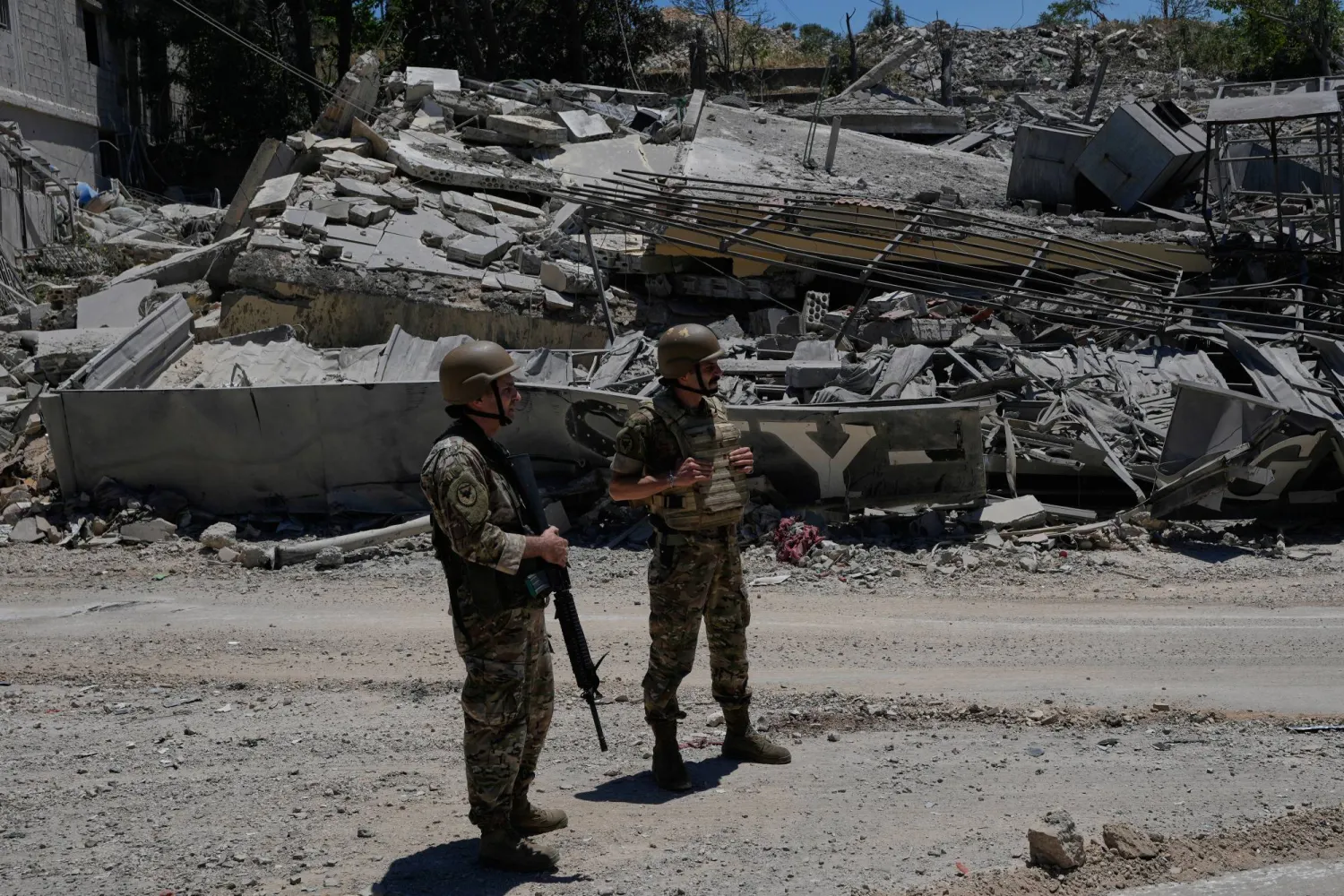
Lebanese army soldiers stand in front of a house that was destroyed in the recent clashes between Hezbollah fighters and Israeli troops in Dibbine village, southeast Lebanon, Friday, June 5, 2026, a day after Israeli forces withdrew. (AP Photo/Hussein Malla)
TT

Two Lebanese Officers, One Soldier Killed in Israeli Strike

Lebanese army soldiers stand in front of a house that was destroyed in the recent clashes between Hezbollah fighters and Israeli troops in Dibbine village, southeast Lebanon, Friday, June 5, 2026, a day after Israeli forces withdrew. (AP Photo/Hussein Malla)

Two Lebanese officers and one ​soldier were killed in an Israeli strike on a vehicle in south Lebanon, the Lebanese military said Saturday, days after the two countries announced a conditional truce following talks in the United States.

Later, ​the ‌Israeli ⁠military ​said it ⁠targeted the vehicle after identifying what it described as a threat to its forces and receiving indications ⁠that Hezbollah was ‌preparing ‌to fire on Israeli ​troops ‌from the area.

It ‌said an initial inquiry showed that two Lebanese army officers and a soldier ‌were inside the vehicle and that ⁠the incident ⁠was under review.

A ceasefire that was supposed to end the fighting in Lebanon between Israel and Hezbollah took effect on April 17, but has not been respected.

Hezbollah and Israel have frequently exchanged accusations of violating the truce, with each side justifying its attacks with alleged violations committed by the other side.

A further conditional truce was announced by Lebanese and Israeli envoys this week in Washington.

It would require Hezbollah to stop firing, withdraw from near the Israeli border and would see Lebanon's army deploy to new "pilot zones" in the area, where it will exercise exclusive control.

But Hezbollah has rejected the agreement, calling for a full Israeli withdrawal from Lebanese territory.

On Saturday, Israel renewed evacuation orders for five villages in Lebanon's south and east, telling residents to move north of the Zahrani River.

"In light of the terrorist Hezbollah's violation of the ceasefire agreement, the IDF is forced to act against it with force," the Israeli military's Arabic-language spokesman Avichay Adraee posted on Telegram.

Lebanese President Joseph Aoun said in an interview with CNN that aired on Friday that Iran must stop interfering in Lebanon.

"It's not your country, it's our country," he said. "It's not your job to interfere into our country."

"They are using Lebanon as a bargaining chip in their negotiation with the United States. It's unacceptable," he added.

"Hezbollah must understand that (there is) no other way but to sit and talk, no other way to solve this problem and to save what's left except through negotiation and diplomacy," Aoun added.


"The majority of the Lebanese people are fed up with war."


Lebanese Army and Israel: Washington Keeps Tensions in Check Through Coordination, Talks

Lebanese soldiers deploy in Zawtar al-Gharbiyeh, the first model town in southern Lebanon (DPA)
TT

Lebanese Army and Israel: Washington Keeps Tensions in Check Through Coordination, Talks

Lebanese soldiers deploy in Zawtar al-Gharbiyeh, the first model town in southern Lebanon (DPA)

Dozens of Israeli attacks have targeted Lebanese army units deployed in the south over the past three years, with friction at times between the two armies.

This has continued despite coordination through the United States and, previously, through the ceasefire monitoring mechanism and the United Nations Interim Force in Lebanon (UNIFIL), pointing to tensions that have stopped short of confrontation.

The attacks and coordination arrangements will be discussed at a US-sponsored military negotiating session between representatives of the Lebanese and Israeli armies at US Central Command headquarters in Florida on Oct. 20.

Ministerial sources following the international talks said the session would address no civilian issues. Negotiators specializing in law or economics would not participate, and discussions would be limited to military representatives.

Ambassador Simon Karam, head of Lebanon’s negotiating delegation with Israel, would chair the session. Lebanon’s ambassador to Washington, Nada Hamadeh Moawad, would also attend.

The sources told Asharq Al-Awsat that the talks “will be limited to operational and military issues, such as the ceasefire, halting bulldozing operations, and the possibility of expanding the model zones or making progress on verification in those zones,” as well as the issue of prisoners.

Lebanon will not boycott negotiations

The eighth negotiating session in Rome has stalled and will be postponed until after the Israeli elections. Those talks usually bring together military and civilian delegations to discuss political, economic and operational issues.

Against that backdrop, “the US side considered it more appropriate to hold a session limited to military representatives to discuss matters on the ground.”

The session demonstrates that “negotiations have neither broken down nor been frozen,” despite fading hopes of progress, particularly on the model zones and prisoners.

The United States will set the agenda. The Lebanese delegation will discuss the core positions outlined by President Joseph Aoun at the Paris conference and Prime Minister Nawaf Salam at the United Nations General Assembly, the sources said.

Dozens of officers and soldiers killed since 2023

The Lebanese army’s role, along with coordination and communication arrangements, is among Lebanon’s priorities.

Since war erupted on Oct. 8, 2023, more than 70 Lebanese army officers and soldiers have been killed in the south during three years of war with Israel. Some died in direct attacks; others were killed by explosive remnants of war.

The toll includes 46 service members killed in 2023 and 2024, according to a tally by Information International.

Lebanese army statements have documented the deaths of 27 officers and service members since the latest war began, following Hezbollah’s launch of six rockets toward Israel on March 2 this year.

The latest incident occurred on Wednesday in Nabatieh al-Fawqa, where a soldier was seriously wounded when a suspicious object left over from the war exploded.

The army command said a soldier and three civilians were wounded in an explosion while troops were accompanying residents inspecting their properties in the area.

“Investigations and an inspection by military engineers established that the incident was caused by the explosion of a suspicious object,” the army said, adding that inquiries were continuing to establish the circumstances.

State institutions barred from the security zone

Repeated bombardment has emptied Nabatieh al-Fawqa of all residents and made it a dangerous area. The army is deployed on its outskirts and at its entrances.

Residents generally ask troops to accompany them into the town for reassurance, reflecting their trust in the army.

Israeli attacks on Lebanese troops have repeatedly occurred in areas the Israeli army has declared off-limits. An attack on a military vehicle killed two officers and a soldier in the Khardali area in June. Friction also occurred between the armies in Deir Mimas last week.

Although Lebanon does not view the incidents as an Israeli message aimed specifically at its army, security sources said Israel “is applying a security zone model that bars all Lebanese, regardless of whether they are civilians, army personnel or members of state institutions.”

The sources told Asharq Al-Awsat that last week’s friction in Deir Mimas, where Lebanese troops had deployed at residents’ request, “illustrates what Israel is trying to impose: isolating the security zone it has created from the rest of Lebanon and from state institutions.”

The Lebanese army recognizes only the international border and considers the Israeli presence on Lebanese territory an occupation.

Condemnation of attacks on the army

After each incident, the Lebanese army steps up contact with the US side through either the ceasefire monitoring mechanism or the Military Coordination Group for Lebanon (MCG4L) to prevent friction.

Lebanon’s political leadership and parliament support the army’s position. Its troops are deployed under a decision by the executive branch.

Lawmaker Mark Daou condemned what he described as crimes against the Lebanese army, which is carrying out government orders to establish stability and maintain security in the south.

He told Asharq Al-Awsat that communication arrangements between the Lebanese army command, UNIFIL and the ceasefire monitoring mechanism allow them to review attacks on service members.

They also coordinate efforts to prevent further violations against troops and maintain security.

He was referring to direct coordination between the Lebanese army command and the leadership of the mechanism, headed by US Lt. Gen. Joseph Clearfield.


Washington Keeps Sights on Dismantling Militias Despite Iraq Withdrawal

Training at Ain al-Asad air base in western Iraq. (File photo/US Army)
TT

Washington Keeps Sights on Dismantling Militias Despite Iraq Withdrawal

Training at Ain al-Asad air base in western Iraq. (File photo/US Army)

Iraq reached a watershed on Wednesday as US forces withdrew from their bases nearly a quarter-century after an invasion that killed hundreds of thousands of Iraqi civilians and thousands of American troops, opened the door to Iranian interference in Iraq and beyond, and upended the regional balance of power.

The withdrawal fulfills a 2024 agreement signed by the administration of former President Joe Biden to end the US military presence in Iraq this year.

President Donald Trump’s administration has made little fanfare about the redeployment. It has yet to announce a comprehensive review of the invasion, which began in March 2003 and inflicted staggering human and financial losses.

As many as 210,000 Iraqi civilians were killed between the invasion and 2023, along with 4,599 US troops, according to Brown University’s Costs of War project. The cost reached about $2.8 trillion.

The departure of US troops and equipment marks a transition from a wartime coalition mission to an Iraqi-led security effort, according to Pentagon spokesman Sean Parnell.

“The primary responsibility for addressing Iraq's remaining security challenges, including ISIS remnants and Iran-aligned militias that undermine Iraqi sovereignty and regional stability, now rests with the Government of Iraq,” he added.

About 1,500 US and international coalition troops fighting ISIS had recently been stationed in Iraq as forces reorganized and withdrew ahead of Wednesday’s Sept. 30, 2026, deadline, a US official said.

The mission will continue in Jordan, where the Pentagon says it can strike militants threatening US personnel and interests.

US forces there will focus on ISIS fighters, the official said.

“If the situation deteriorates beyond Iraq’s and Syria’s ability to control it, and they ask for our help, we will intervene and help them.”

Protecting the embassy and consulate

The military airlifted personnel and equipment out of Erbil, the last US military base in Iraq, in time to meet Wednesday’s deadline, a defense official said.

Some US Marines will stay to guard American diplomatic missions, alongside contractors maintaining Iraq’s fleet of F-16 fighter jets and US-made tanks, current and former US officials said.

“The military has already removed a Patriot air defense battery stationed around Erbil,” other officials said.

The United States will probably concentrate its remaining air defenses on protecting its embassy in Baghdad and consulate in Erbil, they added, despite continuing attacks by Iran and militias.

About 170,000 US troops were in Iraq at the height of its internal conflict in 2007. Former President Barack Obama pledged to end the war after his election in 2008. In 2011, he announced an end to combat operations and a phased withdrawal.

But ISIS and al Qaeda seized large swaths of Iraq and Syria in 2014, prompting the United States to lead a coalition of international and Arab partners in launching Operation Inherent Resolve. The campaign continued into Trump’s first term.

Iraq reclaimed its territory from terrorist groups and began to recover. Yet it remains burdened by the influence Iran gained through allied armed groups, whose involvement in the current US-Iran war poses serious risks.

Iranian militias

US estimates put the number of Tehran-aligned fighters at more than 200,000. They use attack drones and ballistic missiles to strike US forces and neighboring countries.

The US withdrawal was supposed to coincide with the disarmament of militias, according to The Washington Post. But the groups ignored calls to disband, and Iraqi Prime Minister Ali al-Zaidi extended their disarmament deadline to June 2027.

Iran could benefit from the US withdrawal, Mark Cancian, a senior adviser at the Center for Strategic and International Studies in Washington, told the newspaper. But Tehran’s recent actions in the region have also forged unexpected alliances against it.

The invasion plunged Iraq into chaos by toppling President Saddam Hussein, Iran’s adversary on its western border, Cancian said.

Iranian attacks on countries hosting US troops during the latest war have pushed some of those countries closer to Israel, he added.

“We acted against them only in response to attempts to target our troops,” a US official said of Iran-backed militants.

Confronting the groups from now on would be “an Iraqi responsibility.”

As Iraq holds a “sovereignty celebration” this week to mark the withdrawal, the Trump administration is piling pressure on Baghdad to disarm Iran-backed militias. Many defy the state’s efforts to bring them under control.

“They want to vacation in France”

Al-Zaidi’s government faces a daunting task: reining in militias that Iran insists on preserving.

Speaking to The New York Times, the Iraqi prime minister noted that every Iraqi today wants full sovereignty for their country.

He added that Iraqis also want authority to rest exclusively with the state, and pledged to end “the law of the jungle” in Iraq.

During al-Zaidi’s recent White House visit, Trump said: “We don’t think we need the military there anymore.”

“We have a great champion, a new champion. He’s young and handsome,” he added.

But Victoria Taylor, a former US State Department official who worked on Iraq, explained that believing al-Zaidi can disarm the militias within a few months is asking the impossible.

According to Taylor, these armed groups exist because Iran wants them to remain, and Iran continues to find them useful as a tool and a source of leverage against the Iraqi government and the United States in the region.

This situation will continue even after US forces withdraw, she added.

Former Assistant Secretary of State for Near Eastern Affairs David Schenker remains hopeful, citing positive signals from some Iraqi faction officials who seem to want to operate legally.

They want to vacation in France with their families, he said, referring to their desire to give up their weapons.


Signs of a Full-Scale Yemeni Offensive Against the Houthis

Yemeni leadership's move toward general mobilization signals a decisive battle against the Houthis (Military Media)
TT

Signs of a Full-Scale Yemeni Offensive Against the Houthis

Yemeni leadership's move toward general mobilization signals a decisive battle against the Houthis (Military Media)

Clashes between Yemen's government forces and the Iran-backed Houthi group have intensified on the fronts in Taiz and Lahj, alongside an increase in airstrikes, ground operations, and missile attacks. Meanwhile, the general mobilization measures and military readiness announced by Yemen's leadership are pointing toward a new phase that could signal the launch of a full-scale confrontation with the group.

The fronts west of Taiz and in areas bordering Lahj are witnessing ongoing battles, amid Houthi attacks, infiltration attempts, and flanking maneuvers, met by intensive Yemeni military operations involving formations from the Giants Brigades and Nation's Shield Forces, as well as tribal fighters.

The confrontation has also moved to a broader government level following the adoption of executive measures related to general mobilization and a discussion by Yemen's National Defense Council of the readiness of the armed forces, security forces, and military formations across the various fronts. The Yemeni leadership has reiterated that the objective is to restore state institutions and extend their sovereignty over the country's entire territory.

The al-Aghbari front, on the outskirts of al-Mudharaba District and Ras al-Ara in Lahj Governorate, witnessed fierce nighttime battles in the areas of Dhi Ahdah, al-Khazm, and al-Mansoura following a Houthi attack on positions held by government forces and backed by tribal fighters.

Yemeni military sources said government forces and tribal fighters repelled the attack, with clashes continuing through Wednesday and leaving casualties on both sides.

The fighting coincided with airstrikes targeting Houthi positions in the areas of al-Bazalah and al-Dhuhourah, located between al-Wazi'iyah and al-Mudharaba. The Taiz Military Axis Media Center also reported airstrikes on Houthi positions in al-Wazi'iyah District, west of the governorate.

Taiz Under Fire

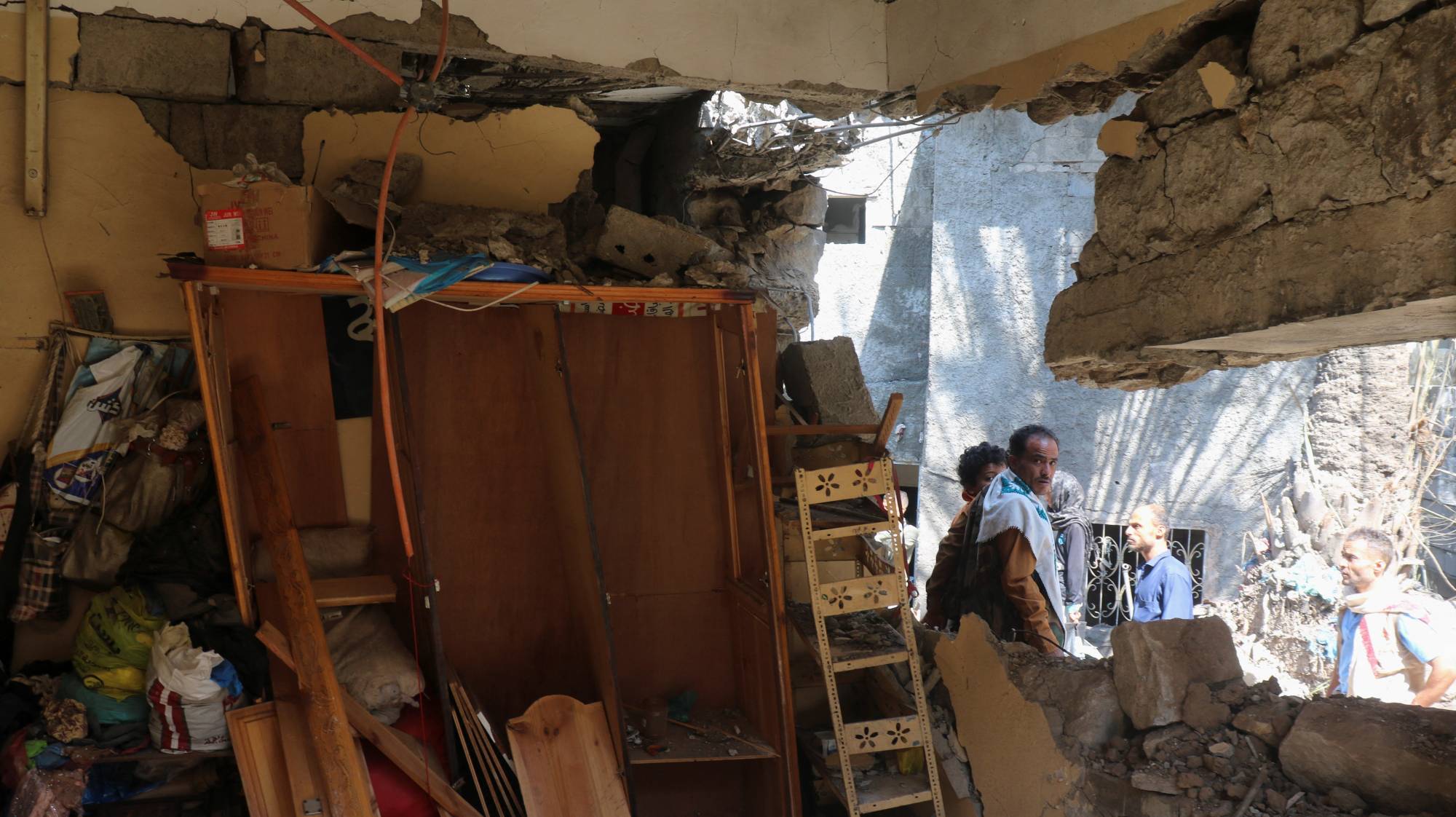
In Taiz, the Houthi group has stepped up its missile and artillery attacks on residential areas and villages in the south and west of the governorate.

Local sources said the group targeted areas in al-Shamayatayn District with four ballistic missiles, while villages in Jurdad Bani Omar were also shelled with rockets and artillery, injuring two civilians and causing fear among residents.

In al-Turbah, south of the governorate, local sources said the group shelled residential neighborhoods with four ballistic missiles, causing material damage to a number of homes and properties.

Other field reports said three ballistic missiles were fired, one of which struck the building of the Mother and Child Hospital, which is still under construction in the city, causing material damage.

The Houthi shelling also reached the villages of Bani Bakari in Jabal Habashi District, while government forces continued their operations along several axes of the governorate.

At the military level, Yemeni Armed Forces spokesman Colonel Staff Officer Majed Abdullah al-Nazili said the forces had carried out 414 precise targeting operations over a 24-hour period against Houthi reinforcements and military capabilities on various fronts.

Al-Nazili said the operations employed a range of modern capabilities and resulted in the neutralization of Houthi militants and military equipment.

This came a day after government forces announced that they had carried out 356 targeting operations over a 24-hour period, saying that, according to their field estimates, the operations had killed or wounded 476 Houthi militants. This brought the total casualties announced by the government forces over four days to nearly 3,000 dead and wounded.

According to the government forces, the targets included command-and-control centers, weapons and artillery depots, and dozens of military vehicles, as the group continued sending reinforcements to the front lines.

General Mobilization Takes Effect

Alongside the developments on the battlefield, the most significant political and military development has been the move by Yemen's state institutions toward organizing a general mobilization.

The National Defense Council held a meeting chaired by Rashad al-Alimi, Chairman of the Presidential Leadership Council, and attended by political, military, and government leaders. The meeting discussed the latest national developments and the readiness of the armed forces, security forces, and military formations on the various fronts, as well as executive measures related to general mobilization.

The council affirmed that the armed forces would continue carrying out their responsibilities to protect civilians and deter sources of threat, with the ultimate goal of restoring state institutions and extending state sovereignty over the entire national territory.

It also stressed the importance of integrating military, security, economic, humanitarian, media, and diplomatic efforts under state leadership, and mobilizing the country's capabilities, resources, and potential in support of this objective.

This follows the Yemeni House of Representatives' approval of a request by the Chairman of the Presidential Leadership Council to declare a general mobilization, a step encompassing human and material resources as well as the capabilities of state institutions.

The National Defense Council approved directives and executive measures related to the general mobilization, stressing the need to move it from a broad framework to a disciplined institutional mechanism in accordance with the constitution and applicable laws.

At the same meeting, the council praised what it described as the cohesion of the armed forces, military formations, and popular resistance, as well as what it said was their ability to regain the initiative on various fronts. It also praised popular and tribal support for the forces and displaced people.

This course of action takes on particular significance as fighting continues in Taiz and Lahj. The institutional measures are coinciding with an increase in the intensity of military operations on the ground, reflecting the state's readiness to deploy its resources and capabilities more broadly in the confrontation.

The National Defense Council has not announced the start of a full-scale offensive. However, its combination of military readiness, general mobilization measures, calls for the integration of national resources, and continued operations on several fronts points to preparations for a broader confrontation.

A Threat Beyond the Front Lines

The National Defense Council linked the military developments to threats it said the Houthi group poses beyond the battlefronts. It warned of the use of mobile Iranian air-defense systems, cruise missiles, and advanced military technologies.

It said these capabilities were expanding the scope of the threat to air-navigation routes in Yemen and the region, putting civilian aircraft and humanitarian and relief flights at risk. The council called for international action to prevent the flow of weapons, technology, and military expertise to the group.

The council also welcomed regional and international positions supporting the government and state institutions, and referred to UN Security Council resolutions concerning Yemen, foremost among them Resolution 2216.

On the humanitarian front, the council affirmed the state's commitment to protecting civilians and civilian facilities and responding to the needs of displaced people and families forced from their homes by the group. It called on international organizations and donors to support the growing humanitarian response.

Alongside the military effort, Yemen's leadership has maintained a parallel political track targeting members of the group. The National Defense Council renewed its assurance that the door to "safe return" remains open to those who abandon the Houthis and stop fighting or working on their behalf.