


New Round of Talks in Cairo Seek to Push Forward Stalled Gaza Ceasefire

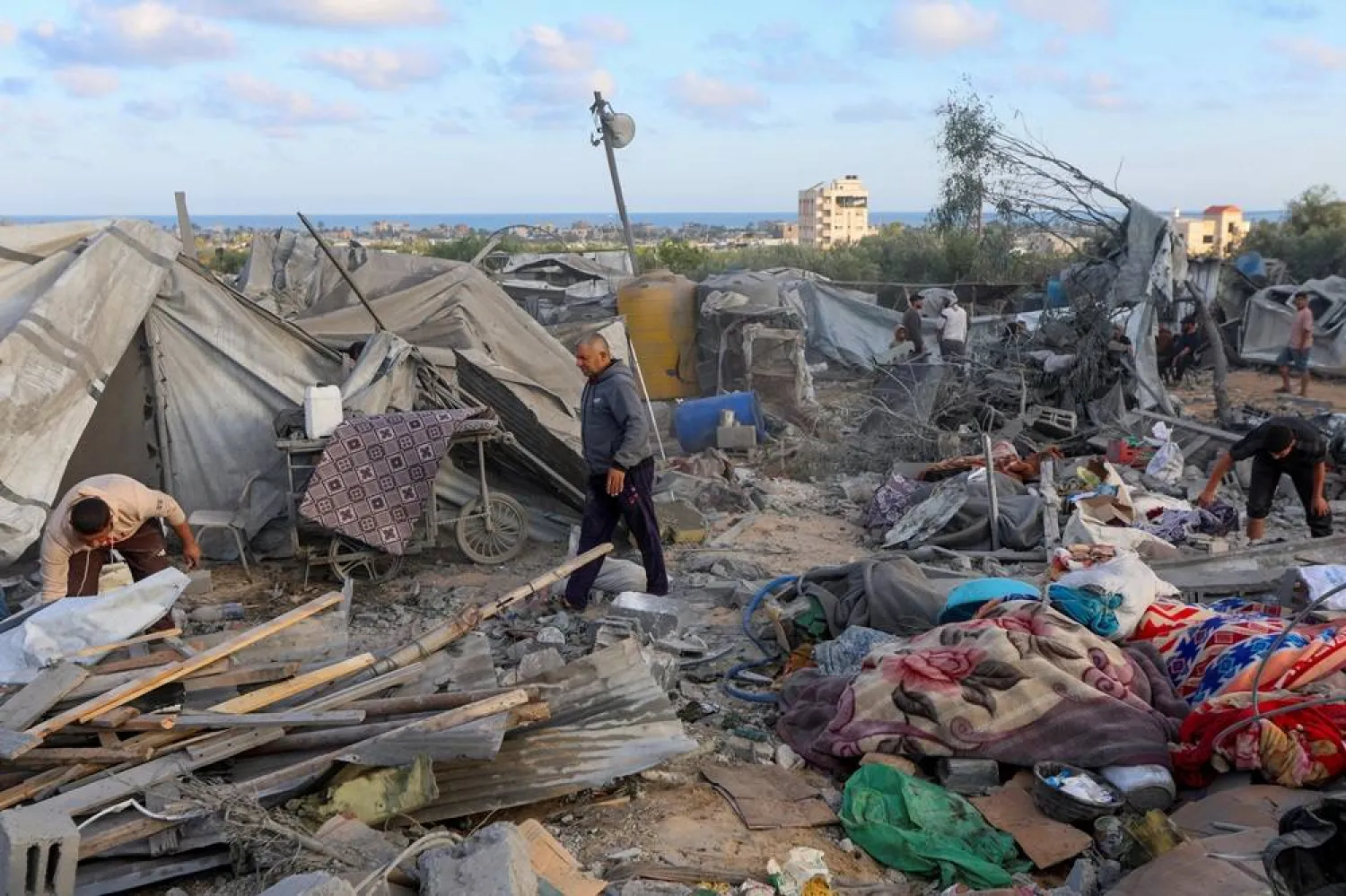
 Palestinians inspect the damage to a tent camp sheltering displaced people in the aftermath of an Israeli strike on a nearby house whose residents were warned to evacuate before the attack, in Khan Younis in the southern Gaza Strip June 7, 2026. (Reuters)
Palestinians inspect the damage to a tent camp sheltering displaced people in the aftermath of an Israeli strike on a nearby house whose residents were warned to evacuate before the attack, in Khan Younis in the southern Gaza Strip June 7, 2026. (Reuters)
TT

New Round of Talks in Cairo Seek to Push Forward Stalled Gaza Ceasefire

 Palestinians inspect the damage to a tent camp sheltering displaced people in the aftermath of an Israeli strike on a nearby house whose residents were warned to evacuate before the attack, in Khan Younis in the southern Gaza Strip June 7, 2026. (Reuters)
Palestinians inspect the damage to a tent camp sheltering displaced people in the aftermath of an Israeli strike on a nearby house whose residents were warned to evacuate before the attack, in Khan Younis in the southern Gaza Strip June 7, 2026. (Reuters)

Cairo is hosting a new round of talks between Hamas and Palestinian factions in an effort to move forward the stalled Gaza ceasefire agreement.

Cairo has hosted at least five rounds of talks in less than two months. Experts told Asharq Al-Awsat that the discussions aim to reach understandings and guarantees that both the Palestinian factions and Israel can commit to.

Efforts to move forward with the phases of the ceasefire agreement have stalled for months and the impasse has grown deeper with the eruption of the US-Israel war on Iran in February.

Talks are focused on the second phase that is focused on Hamas’ disarmament and Israel’s withdrawal from Gaza. Hamas has been demanding that Israel respect its first phase commitments before moving on to the second.

The first phase calls for Israel to increase the entry of aid into the enclave, reopen crossings and cease expanding its control in Gaza. Tel Aviv has been demanding that Hamas disarm, saying it is a priority before moving forward with the ceasefire.

In televised remarks, Hamas spokesman Hazem Qassem said Saturday that the movement was kicking off its meetings in Cairo with Palestinian factions to “reach national agreements”.

The movement is also holding talks with mediators to “truly execute the ceasefire on the ground and complete the first phase,” he added.

“Discussions will be held to reach reasonable and acceptable understandings with all parties on the second phase, including the deployment of international forces and the weapons of armed factions,” he said.

The Hamas delegation, headed by Khalil al-Hayya, arrived in Cairo on Friday for a new round of negotiations that should last several days, said the movement.

Saeed Okasha, an Israeli affairs expert at Cairo's Al-Ahram Center for Political and Strategic Studies, said the latest Cairo talks aim to end the impasse and prevent the continued Israeli escalation in Gaza.

He described the talks as “very important given their timing and agenda. They aim to reach decisive results to throw the ball in the court of the Board of Peace and Israel to prevent any escalation by Israeli Prime Minister Benjamin Netanyahu, who is bracing for elections in months.”

Palestinian analyst Abdulhadi Mutaweh said: “It appears that Hamas will stall over the ceasefire until the negotiations between the US and Iran reach their conclusion.”

The Cairo talks will focus on moving from the first phase to the second, arrangements related to the disarmament of factions and on who will run Gaza in the future, he added.

A Palestinian source told Asharq Al-Awsat on Saturday that six Palestinian factions, including Hamas and the Islamic Jihad, but not Fatah, are present in Cairo.

Talks will focus on “not giving Israel on excuse to launch a new war on Gaza,” he said.


Iraqi Faction Warns against Dismantling of the PMF

Members of the Saraya al-Salam faction attend a ceremony marking the start of the process of handing over their weapons to Iraqi state forces in Samarra, north of Baghdad, Iraq, Thursday, June 4, 2026. (AP)
TT

Iraqi Faction Warns against Dismantling of the PMF

Members of the Saraya al-Salam faction attend a ceremony marking the start of the process of handing over their weapons to Iraqi state forces in Samarra, north of Baghdad, Iraq, Thursday, June 4, 2026. (AP)

The Iraqi government renewed its commitment to imposing state monopoly over weapons, while some factions continue to resist the move, saying it targets the “arms of the resistance.”

In televised remarks, government spokesman Haider al-Aboudi said: “Prime Minister Ali al-Zaidi's government has set as a priority Iraq’s sovereignty and security and imposing state monopoly over arms.”

“Iraq is a sovereign nation and its higher authority is not subject to foreign and internal dictates,” he stressed, in reference to the debate over armed factions, some of which are affiliated with the Popular Mobilization Forces (PMF) that is tied to the state, and others that operate under the banner of so-called “resistance”.

Deputy Commander of Joint Operations Qais al-Mohammedawi, who is also head of the committee tasked with limiting the possession of arms to the state, said the efforts cover factions connected to the PMF.

He denied claims that the efforts will target other groups, saying the authorities are focused on ending possession of weapons that are tied to religious or political affiliations.

The process will take time, he said in statements to the press.

He also revealed that authorities busted attacks against neighboring countries, declaring that Iraq will not act as a platform for assaults on others. He did not offer more details.

Meanwhile, President Nizar Amedi hailed the factions that chose to hand over their weapons and to cooperate with the authorities over this file.

Speaking at an economic forum in Sulaimaniyah city in the Kurdistan region, he added that efforts are ongoing to reach understandings over the disarmament of factions.

These moves bolster security and stability and will help in building and construction, he added.

“Stability is no longer a domestic target, but a main condition for local, regional and international development,” he stated.

He underlined the need for “practical and productive dialogue” to address challenges and limit mounting dangers.

“Iraq must not allow current challenges to hinder its ambitions for development and prosperity,” Amedi urged.

Resistance

The official stances over disarmament have been repeatedly met with defiance from the Kataib Hezbollah and al-Nujaba movement that are staunchly pro-Iran.

The movement said the efforts “target the weapons of the resistance and PMF.”

Head of its executive council Nazem al-Saeedi said from Najaf city that any serious discussions about the weapons “must be comprehensive and subject to unified standards that are applied to all parties without exception.”

He warned that the current demands about the weapons may later extend to the abilities of the security and military institutions, expressing concern over the “politicization of the PMF and involving it in the political power-sharing system,” which may impact its role and standing.

Head of the al-Nujaba movement Akram al-Kaabi had claimed on Wednesday that disarmament efforts are being “directly driven by Israel” and the US Charge d’Affaires in Iraq.

The Kataib Hezbollah, meanwhile, said it will not lay down its weapons and that tackling this issue will be possible after its goals are met.

Kataib security official Abu al-Mujahid al-Assaf warned of attempts to stoke strife over the disarmament efforts.

On the other side of the divide, Sunni clerics welcomed the government’s drive to impose state monopoly over weapons.

During Friday sermons, they hoped the move would achieve stability, security, peace and coexistence in Iraq.

There can be no security so long as several parties carry weapons, while others do not, they added.


Lebanese Officials Slam Iran FM’s Remarks against Aoun, Back Negotiations

Iranian Foreign Minister Abbas Araghchi. (AP)
TT

Lebanese Officials Slam Iran FM’s Remarks against Aoun, Back Negotiations

Iranian Foreign Minister Abbas Araghchi. (AP)

Lebanese officials slammed on Saturday Iranian Foreign Minister Abbas Araghchi for criticizing President Joseph Aoun’s comments against Tehran and its meddling in his country.

Aoun, in an interview broadcast Friday by CNN, called on Iran to stop "interfering" in Lebanon's affairs following the collapse of a new truce announced by Washington between Israel and the Iran-backed Hezbollah movement.

"This is not your country. It is our country, our responsibility, and your role is not to interfere in our affairs," Aoun said. "It is our people who are being killed, and our homes that are being destroyed."

Araghchi on Saturday urged Aoun to save Lebanon from its "real foe," Israel.

"Based on Mr. Aoun's comments, one would think it's Iran that has occupied one-fifth of Lebanon, displaced one-quarter of its population and is bombing the country on a daily basis," Araghchi wrote on X.

"If Lebanon were a bargaining chip for Iran, we would have reached an agreement long ago. Save Lebanon from your real foe, Mr. President," he added.

Aoun has faced fierce opposition from Hezbollah since the launch of direct negotiations between Lebanon and Israel that are the first in decades between the countries that have no diplomatic ties.

Lebanese officials were quick to condemn Araghchi and throw their backing behind Aoun and the negotiations.

Lebanese Forces leader Samir Geagea said: "Aoun’s stances, which reject Iran’s continued use of Lebanon as a bargaining chip in its negotiations with the US so that it can remain an open arena for conflict, underscore the president’s clear will to end this flawed situation that has caused turmoil in Lebanon for decades."

In a statement, he added that Aoun’s stance reflects the position of the majority of the Lebanese people who want the establishment of a capable state.

"His stance is directed primarily at the two parties who are treating Lebanon as an open arena for their own agendas against the will of the Lebanese people: Iran and Hezbollah," he stressed.

"The Lebanese and Iranian people never had any problems between them, but the Iranian regime, since the revolution, has sought to use Lebanon as a card in its regional agenda. So, it armed a military proxy for it on Lebanese soil that operates outside the constitution, laws and national will."

"This has caused grave harm to Lebanon, its people, economy and stability and kept the country an open ground for conflicts and war," Geagea remarked.

On Hezbollah’s criticism against Aoun, he noted that the president’s statements again "highlight that the existence of weapons outside state control is a flagrant violation of the constitution and law."

"His latest stance is decisive in saying that this deadly situation in Lebanon can no longer continue," he said.

"Therefore, Iran must once and for all cease interfering in Lebanon’s affairs and respect its sovereignty and independent decision-making. Hezbollah must also immediately comply with the decision of the state and hand over its weapons, end its armed project and dismantle its military and security wings," he demanded.

"Should Iran refuse to comply, then the Lebanese government must execute its own orders, starting with physically removing the Iranian ambassador for Lebanon," who has continued to defy his expulsion order from months ago. This must culminate in the state imposing monopoly over arms, Geagea stressed.

Head of the Kataeb party MP Sami Gemayel slammed Iranian officials, demanding that they "take their hands off Lebanon. Lebanon is not an Iranian province."

"Our president does not ask for permission to defend our sovereignty," he added in a post on X.

"The period of hegemony is over. Our decisions are made in Beirut, not Tehran," he declared.


Drone Strike on Central Sudan Market Kills 11

FILE - This grab from video shows smoke rising over Khartoum, Sudan, Sept. 26, 2024, after Sudan's military started an operation to take areas of the capital from its rival, the paramilitary Rapid Support Forces. (AP Photo/Rashed Ahmed, File)
TT

Drone Strike on Central Sudan Market Kills 11

FILE - This grab from video shows smoke rising over Khartoum, Sudan, Sept. 26, 2024, after Sudan's military started an operation to take areas of the capital from its rival, the paramilitary Rapid Support Forces. (AP Photo/Rashed Ahmed, File)

A drone strike hit a market in central Sudan on Saturday, killing 11 civilians and wounding dozens more, a rights group said, as escalating aerial attacks deepen the toll of one of the world's worst humanitarian crises.

The attack targeted the main market in Abu Zaeima, a paramilitary-controlled town in North Kordofan state, according to the Emergency Lawyers, a rights group that has documented abuses since fighting erupted in April 2023 between the army and the paramilitary Rapid Support Forces (RSF).

The group said the casualty figures could rise but did not specify who carried out the attack. Neither side has commented.

Emergency Lawyers said similar drone attacks had struck nearby villages and civilian vehicles less than a day earlier.

Two witnesses told AFP that another drone hit a fuel station later on Saturday in El-Obeid, the capital of North Kordofan, which has been partially encircled by RSF forces for months.

A medical source at a hospital there said the facility received four wounded civilians.

The attacks followed a deadly week in the broader Kordofan region.

Nearly 70 people were killed in two separate drone strikes in West and North Kordofan states, according to Emergency Lawyers and a local leader.

Drone warfare has become an increasingly prominent feature of Sudan's conflict. The UN says that between January and April, at least 880 civilians were killed in drone strikes nationwide.

Fighting has intensified in Kordofan and Blue Nile state near the Ethiopian border since the RSF captured El-Fasher last October, the military's last major stronghold in western Darfur.

Since then, more than 300,000 people have fled frontline areas, including El-Fasher and parts of Kordofan and Blue Nile, according to the UN.

Kordofan, rich in oil and arable land, is strategically significant, linking RSF strongholds in the neighboring Darfur region to the country's army-controlled east. The region remains largely contested between the army and the RSF.

Having entered its fourth year, the war has killed tens of thousands of people and forced more than 11 million from their homes, creating what the UN describes as the world's largest displacement and hunger crises.
